Ties
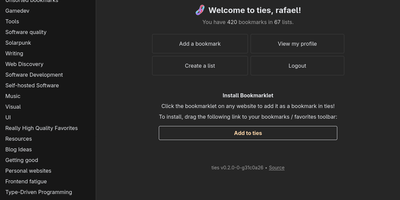
A federated bookmark manager written in Rust: Ties (formerly linkblocks) is your own small corner of the web for saving, organizing, and sharing good pages, connected to the fediverse over ActivityPub. Instead of rigid folders, bookmarks live in arbitrarily nested lists that link together into a knowledge graph. Saved pages are fetched, converted to a readable archived version, and stored in the database, so full-text search covers titles, URLs, and the actual page text - and the content survives if the original disappears. The federation model is deliberately anti-viral: there is no global timeline and no algorithmic feed. You publish public lists for anyone, follow users whose taste you trust, and mark trusted users whose bookmarks become part of your search range - extendable to trusted-users-of-trusted-users for a wider net. Public bookmarks post to Mastodon timelines, and WebFinger lookup makes your handle discoverable across fediverse platforms. Operationally it is about as light as web software gets: a single binary with all assets baked in, integrated TLS so it can run without a reverse proxy, PostgreSQL as the only dependency, OIDC single sign-on, and a bookmarklet for one-click saves. Note the project is alpha: single-user instances only, and all data should be considered public. AGPL-3.0 licensed, built with Rust and htmx.
Mayan EDMS
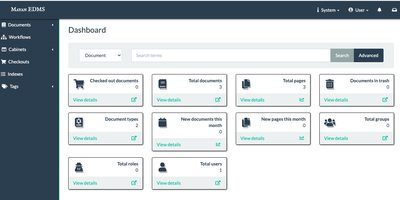
Mayan EDMS stores, classifies, and retrieves millions of documents with automatic OCR, workflow automation, and audit-ready access controls that organizations have relied on for over a decade. Tesseract integration extracts searchable text from scanned PDFs and images in over 100 languages, transforming paper archives into instantly queryable digital collections without manual data entry. The workflow engine routes documents through approval chains using configurable state machines that trigger notifications, enforce retention policies, and maintain complete audit trails for regulatory compliance. Version tracking preserves every revision with full diff capabilities, while GnuPG digital signatures provide cryptographic proof of authenticity and tamper detection for sensitive records. Role-based permissions combined with object-level ACLs and LDAP integration ensure documents remain visible only to authorized users, down to individual file granularity. Full-text search powered by Whoosh or ElasticSearch handles advanced queries across massive document stores with faceted filtering and relevance ranking. The Django REST Framework API enables programmatic upload, metadata extraction, and workflow triggering from external systems. Beyond simple folder hierarchies, metadata schemas, document types, tags, and cabinet structures provide multi-dimensional classification tailored to how your organization actually works. Background processing through Celery handles OCR, conversion, and preview generation asynchronously, keeping the web interface responsive under heavy ingest loads.
BlogFactory
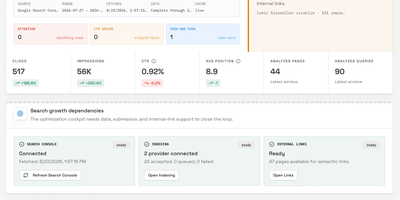
BlogFactory is the first open-source agent control plane purpose-built for multi-site content operations, shipping 16 distinct capabilities across four operational pillars — Operate, Grow, Control, and Deliver — in its v0.1.0 release. The platform keeps source evidence, AI-generated drafts, revisions, SEO metadata, human review, preflight checks, and CMS delivery destinations in one workspace while enforcing a server-side authority ceiling that prevents agents from ever publishing live content, accessing credentials, or performing administrative actions. AI agents connect through a Streamable HTTP MCP endpoint with OAuth authentication and site-scoped tool discovery, compatible with Codex, ChatGPT, and any MCP-capable client. Content creation supports single articles from keywords, titles, URLs, PDFs, text, or YouTube sources, batch campaigns, and programmatic content via reusable templates with structured data rows. The Search Growth module connects Google Search Console complete-day data to ranked optimization opportunities, 30-day growth plans, content classification by signal type (growing, low-CTR, almost-ranking, page-two, zero-click), indexing checks, and semantic internal-link suggestions. Brand Voice separates global voice rules, writer profiles, knowledge context, and brand guidelines from article mechanics. Approved drafts are delivered as CMS drafts to WordPress, Ghost, Wix, or Framer through idempotent, optimistic-locking-protected handoffs with explicit destination selection and preflight validation. The stack runs on React/Vite, a Hono/TypeScript API, PostgreSQL, and MinIO via Docker Compose, with providers including OpenRouter, OpenAI, and Google services under a bring-your-own-AI model. Running on a dedicated VPS on RepoCloud with guaranteed CPU, RAM, and SSD, full root SSH access, and a browser serial console. AGPL-3.0 licensed.
Forgejo
Governed by the non-profit Codeberg e.V. with over 150 contributors and quarterly major releases reaching v16.0 in July 2026, Forgejo delivers a complete code collaboration platform in a single Go binary that runs comfortably on 512 MB of RAM — providing full Git hosting with SSH and HTTPS, pull requests with inline code review, issue tracking with labels and milestones, kanban project boards, wikis, and an integrated package registry supporting Docker, npm, PyPI, Maven, NuGet, and Cargo. Forgejo Actions provides GitHub Actions-compatible CI/CD with reusable workflows, OpenID Connect for secure third-party access, ephemeral runners for autoscaling, and dynamic matrix support for complex build pipelines. The platform implements ActivityPub-based forge federation allowing issues, pull requests, and stars to work across independent instances — enabling a decentralized development ecosystem similar to how Mastodon federates social networks. Organizations and team permissions provide fine-grained access control, while LDAP, OAuth2, and OpenID authentication integrate with existing identity infrastructure. Code search indexes repositories for fast discovery, LFS handles large files efficiently, and mirror synchronization imports repositories from GitHub, GitLab, and other forges. Deploy via a single static binary, Docker container, or official Helm charts with SQLite for small instances or PostgreSQL and MySQL for production workloads. Running on a dedicated VPS on RepoCloud with guaranteed CPU, RAM, and SSD, full root SSH access, and a browser serial console. GPLv3+ licensed.
Grafana OnCall
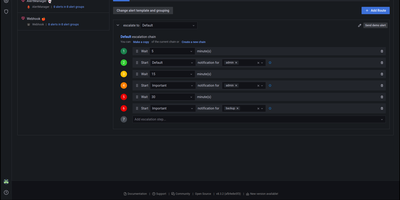
With 3,900 GitHub stars, 140 contributors, and 380 releases since its 2022 launch, Grafana OnCall delivers developer-friendly incident response that routes alerts from any monitoring system to the right engineer at the right time through the right channel. The platform accepts alerts via unique API URLs from Alertmanager, Grafana Alerting, Zabbix, Datadog, Pagerduty-compatible sources, Jira, inbound email, and generic HTTP webhooks, then applies routing templates to direct each alert to the appropriate escalation chain. Escalation chains define notification sequences — notify the primary on-call via Slack, wait 5 minutes, escalate to SMS and phone, wait 10 minutes, page the secondary on-call and notify the engineering manager — continuing until acknowledgment or resolution. On-call schedules support multi-layer rotations with overrides, shift swaps, and timezone-aware handoffs rendered directly inside Grafana dashboards. ChatOps integration publishes alert groups to Slack channels and Telegram groups with interactive buttons for acknowledge, resolve, and silence actions. Template engines based on Jinja2 control alert grouping, appearance rendering, and behavioral automation. The REST API enables programmatic management of integrations, schedules, and escalation policies. Deploy via Docker Compose with PostgreSQL, Redis, and Celery workers alongside your existing Grafana instance. Running on a dedicated VPS on RepoCloud with guaranteed CPU, RAM, and SSD, full root SSH access, and a browser serial console. GNU AGPL v3 licensed.
DumbBudget
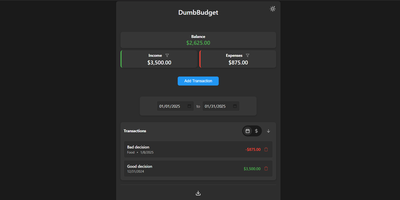
"Stupid simple software" is the entire philosophy at DumbWare.io, and DumbBudget delivers it: no over-engineering, no complexity, no accounts, no bank connections - just a clean, modern ledger for money in and money out. Log income and expenses, assign categories, and watch real-time balance calculations update as you type. Finding transactions is quick: filter by type, narrow by date range, sort by date or amount. When tax season or spreadsheet analysis calls, everything exports to CSV. Access control matches the philosophy - a single PIN (set via one environment variable) gates the app, backed by real security engineering: rate limiting on PIN attempts, temporary lockout after failures, secure session handling, and no sensitive data in browser storage. Multi-currency support covers the ISO codes, and a SITE_TITLE variable names each instance - deliberately useful, because running separate instances per account or family member is the intended pattern for multi-user needs. The responsive UI ships light and dark themes and installs as a PWA on phones, where expense logging actually happens. Configuration is five environment variables; data persists in one folder. If Actual Budget and Firefly III feel like accounting software, this is the notepad that gets used. GPL-licensed.