AliangBoard
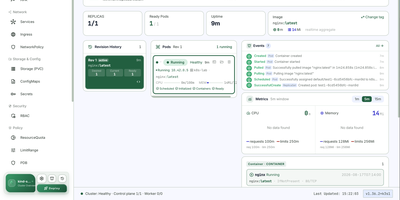
AliangBoard puts every Kubernetes cluster you run behind one web panel, where you manage resources yourself or ask an AI agent to do it with your approval. Connect each cluster with a bearer token or basic auth and the panel persists the connection, so switching clusters, namespaces, and workloads takes one click instead of another kubeconfig. More than thirty resource types stay in sync: create workloads, services, ingress, config, storage, and RBAC through structured forms, edit anything as YAML, apply multi-document manifests at once, and delete optimistically with automatic rollback when the API refuses. Pod work goes deep: a tmux-backed exec terminal survives browser refreshes, port-forwards resolve services to their backend pods, files move up and down with progress, and debug containers inject into running pods without restarting them. Day-two operations are buttons, not flag memorization: scale, rolling restart, rollout undo, manual CronJob triggers, and node cordon or drain. Global search, a layered namespace topology, live event streams, and CPU and memory metrics keep orientation effortless. Then there is the operator: an Agent workbench and MCP server let your LLM read logs, debug containers, and propose changes in natural language, while every write waits for a human click and lands in an audit log that names who did what. Running on a dedicated VPS on RepoCloud with guaranteed CPU, RAM, and SSD, full root SSH access, and a browser serial console. Apache-2.0 licensed.
Chatty
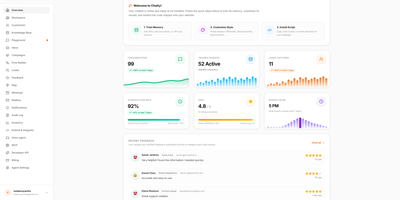
When a customer asks a question on your website, WhatsApp, Telegram, Messenger, Instagram, TikTok, SMS, or email, the Chatty AI agent answers from your own content and hands the chat to a person on request. Its knowledge base ingests PDF, DOCX, CSV, and text files plus crawled sites and sitemaps, and a WooCommerce connection looks up order status, live stock, and cart links. The agent captures leads into a CRM with CSV export and books meetings with Google Meet, Microsoft Teams, or Zoom links. A shared inbox streams conversations live, shows SLA breach warnings, and lets a human take over a thread with one click. A drag-and-drop flow builder adds rule-based paths with time-of-day conditions, webhooks, and an AI copilot that drafts the graph. Proactive campaigns fire on exit intent, time on page, or scroll depth, and a five-pillar scorecard grades conversion, deflection, accuracy, reliability, and satisfaction. An optional voice agent holds real-time spoken conversations with instant interruption and live transcripts, an 81-tool MCP server lets Claude, Cursor, or Codex run the dashboard, and each bot can use your own Gemini, OpenAI, Anthropic, Groq, or OpenRouter key. Running on a dedicated VPS on RepoCloud with guaranteed CPU, RAM, and SSD, full root SSH access, and a browser serial console. MIT licensed.
Ferret
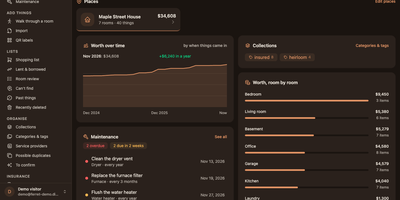
From the tent in the garage to the warranty on the fridge, Ferret keeps one searchable home inventory that your household runs on its own server. Properties, rooms, and boxes hold things with photos, receipts, manuals, serial numbers, and prices, and a quick add accepts a photo, a barcode scan, or a picture of a whole room to sort through. Printed QR labels on boxes and shelves open the list of what is inside. Warranties count down to the last day with a claim shortcut, return windows warn before they close, and maintenance repeats by date or by use, with reminders and how-to videos. Stock levels feed a shopping list, a lending log remembers who borrowed the saw, and a replacement forecast estimates what wears out and when. An insurance report totals value by room and category, exports PDF and spreadsheet files, and can be shared by link. Households have owners, admins, members, and read-only viewers, with invitations and single sign-on. Optional AI reads receipts, suggests details from photos, and answers questions in plain words, while a built-in MCP server lets Claude search, add, and update items with a key that can be read-only. Running on a dedicated VPS on RepoCloud with guaranteed CPU, RAM, and SSD, full root SSH access, and a browser serial console. MIT licensed.
Sara
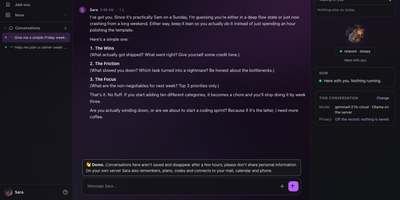
Meet Sara, an AI companion with a personality you design and a coding partner that writes, runs, and tests real software, using any model you choose. Pick a name and pronouns, start from a character or set dials for playfulness and bluntness, and keep memories you can inspect, correct, and forget. Chat from the web app, Windows and Mac apps, Android, iPhone, Telegram, Discord, Signal, or email, and talk through live voice calls you can interrupt or video calls with her moving portrait. A planner turns plain sentences into to-dos, reminders, and notes, with a board, a Today home screen, and routines such as a morning briefing. The library reads PDFs, scans, Word, Excel, PowerPoint, and e-books, then answers with the document and page it came from. For code, each project gets a sandboxed workspace with files, a shell, and git; Sara asks before risky commands, shows test results as cards, and lists every command and its output under each reply. Goals finish only when your own check passes. Use Ollama, vLLM, or llama.cpp locally, connect OpenAI, Anthropic, xAI, or OpenRouter, or reuse the ChatGPT and Claude plans you already pay for. Connect coding agents over MCP, call an OpenAI-compatible API, and add plugins from a signed store. Business workspaces add passkeys, roles, and shared workspaces. Running on a dedicated VPS on RepoCloud with guaranteed CPU, RAM, and SSD, full root SSH access, and a browser serial console. MIT licensed.
OpenPencil
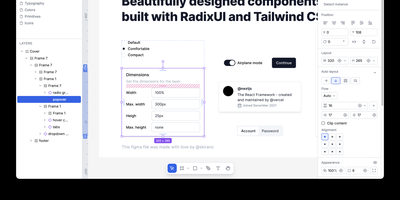
OpenPencil is the open-source design editor that reads and writes native Figma .fig files using the same Kiwi binary format — enabling bidirectional copy-paste between Figma and OpenPencil without data loss. The built-in AI assistant provides 90+ design tools through a chat interface, creating and modifying shapes, fills, strokes, auto-layout, components, variables, and boolean operations from natural language prompts, with BYOK support for Anthropic, OpenAI, Google AI, OpenRouter, Z.ai, MiniMax, and compatible endpoints. A Skia CanvasKit WASM renderer paired with Yoga WASM layout engine delivers Figma-parity rendering with flex and CSS Grid support including gap, padding, and alignment. The headless CLI inspects node trees via XPath queries, lints naming and accessibility, converts between document formats, analyzes color and typography patterns, extracts design tokens, and exports to PNG, SVG, JSX/Tailwind, and HTML. An MCP server exposes all design operations over stdio and HTTP, connecting Claude Code, Cursor, Windsurf, and Gemini CLI for AI-assisted design automation. Real-time P2P collaboration via WebRTC with Yjs CRDT synchronization requires no server and no account. The Vue SDK provides headless components for embedding the editor into custom applications. Ships as a 7 MB Tauri v2 desktop app for macOS, Windows, and Linux, or runs in any browser as a PWA. Running on a dedicated VPS on RepoCloud with guaranteed CPU, RAM, and SSD, full root SSH access, and a browser serial console. MIT licensed.
AsoBeast
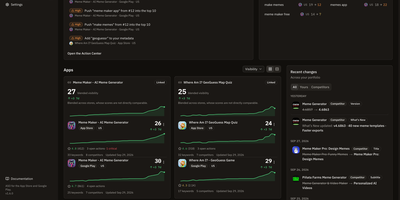
AsoBeast keeps score of your app in the App Store and Google Play, so you always know which keywords you rank for, which ones moved, and what to fix next. Paste a store URL and tracking starts on import: rankings are checked daily in your home storefront and any other market you add, and every keyword is scored for popularity, difficulty, and opportunity so you can tell a winnable term from a vanity one. The dashboard leads with your keywords in the top 10, this week's movement, and an Action Center that turns the data into specific moves, like defending a keyword where two new rivals just entered the top 10, with the reason and the fix spelled out beside each item. Competitor listings are diffed over time, so a rival's new title, subtitle, version, or release notes show up as a before-and-after entry instead of a surprise. Metadata snapshots keep the raw store payload, localization and keyword field analysis shows wasted words, reviews feed the audit score, and the same data is exposed to your AI tools through the built-in MCP server. Registration closes itself once your owner account exists, and store requests run from your own server. Running on a dedicated VPS on RepoCloud with guaranteed CPU, RAM, and SSD, full root SSH access, and a browser serial console. AGPL-3.0 licensed.
Nightingale
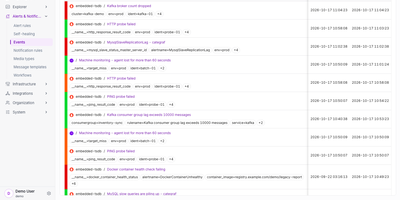
When a query crosses its threshold, Nightingale, a self-hosted alerting engine, decides who hears about it and how, without moving data out of the stores you already run. Rules use PromQL, log queries, or SQL against Prometheus, VictoriaMetrics, Elasticsearch, Loki, ClickHouse, MySQL, or PostgreSQL, graded S1, S2, or S3 with a for-duration that absorbs brief spikes. Existing Prometheus alert rules import from YAML. Business groups give each team its own rules and dashboards, and sign-in works through OIDC, OAuth2, LDAP, or CAS. Once a rule fires, mute rules silence the noise, subscriptions add recipients, and event pipelines rewrite labels or route conditionally. Delivery reaches Slack, PagerDuty, Discord, Telegram, Jira, email, DingTalk, Feishu, WeCom, SMS, and voice calls, plus HTTP webhooks and scripts for anything else. Evaluation records, active and historical events, and notification results show what happened at each step. If an alert misbehaves, the built-in AI agent explains why it fired or never arrived, and it drafts rules, dashboards, and mutes from plain-language requests. Claude Code, Cursor, and other MCP clients can query alerts and manage alerting through /mcp, read-only by default and bound by the caller's own permissions. At remote sites, n9e-edge keeps evaluating and notifying when the link to the center drops. Running on a dedicated VPS on RepoCloud with guaranteed CPU, RAM, and SSD, full root SSH access, and a browser serial console. Apache-2.0 licensed.
Open Connector
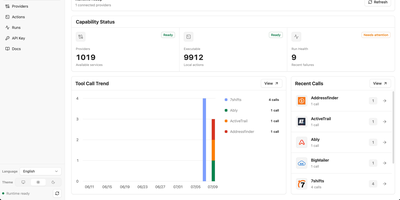
With over 5,000 GitHub stars since its June 2026 launch, OOMOL OpenConnector bridges the gap between AI agents and the real world by handling the authentication nightmare that stops LLMs from calling external APIs safely. The runtime connects to more than 1,000 SaaS providers — GitHub, Gmail, Notion, Slack, Microsoft, HubSpot, Google Workspace, and hundreds more — through 10,000+ prebuilt typed Actions that agents can discover and execute without ever touching raw credentials. OAuth2 flows, API key rotation, custom credentials, and no-auth providers are all managed centrally with AES-encrypted storage, scoped runtime tokens, and configurable action allowlists and blocklists that enforce least-privilege access. Agents interact through five access surfaces: the Model Context Protocol endpoint at /mcp for Claude and other MCP-capable hosts, a full REST API at /v1 for programmatic control, an auto-generated OpenAPI specification for code generation, a TypeScript SDK for application integration, and the oo CLI for local agent relay. The built-in Web Console provides browser-based administration for configuring OAuth apps, managing connections, inspecting action schemas, and reviewing execution logs with redacted inputs. Deploy via Docker Compose with SQLite for single-server setups, run from source on Node.js 22+, or push to Cloudflare Workers with D1 and R2 for edge deployment. Running on a dedicated VPS on RepoCloud with guaranteed CPU, RAM, and SSD, full root SSH access, and a browser serial console. Apache 2.0 licensed.
AKB
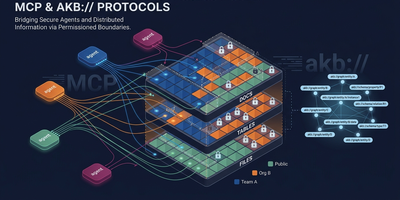
Achieving 98.4% Recall@5 on LongMemEval-S without a reranker, AKB is the agent-native knowledge infrastructure giving Claude Code, Cursor, Windsurf, and any MCP-aware agent persistent organizational memory — a drop-in replacement for Confluence or Notion where AI agents read and write directly rather than scraping human-formatted pages. Documents are stored as Markdown with YAML frontmatter in Git bare repositories (full version history, branching, diff), while PostgreSQL 16 serves as source of truth for chunk text, metadata, and BM25 vocabulary, with dense embeddings handled by a pluggable vector store (pgvector default, Qdrant optional, or managed Seahorse). Agents interact through 20+ MCP tools — akb_put, akb_search, akb_browse, akb_relations, akb_sql, akb_edit, akb_history — performing hybrid dense plus BM25 search fused via Reciprocal Rank Fusion in one call. The URI graph (depends_on, related_to, implements relations) lets agents traverse knowledge connections without external graph databases. Multi-tenant vault isolation is enforced at the PostgreSQL ACL level with per-user roles and SET LOCAL ROLE for SQL sandboxing. Event fanout streams structured events to Redis Streams for external consumers (synthesis bots, digest agents, audit trails), and a hash-chained append-only audit log integrates with enterprise SIEMs. Ships with agent plugins for Claude Code and Codex (session capture, wiki ingest, lifecycle hooks), Kubernetes kustomize manifests, and Open Knowledge Format export. Running on a dedicated VPS on RepoCloud with guaranteed CPU, RAM, and SSD, full root SSH access, and a browser serial console. BSL 1.1 licensed (free under 100 seats, auto-converts to Apache 2.0 after four years).
OpenTakeoff
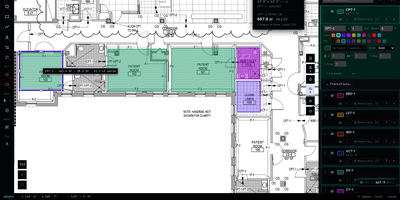
From a PDF plan set to a waste-adjusted material order takes one browser tab: OpenTakeoff measures floors, walls, and fixtures at the drawn scale and never uploads a single drawing. Drag in a PDF, image, or zip plan set, view up to four sheets side by side, and search sheet text, while stitching joins floors split across a match line. Scale comes from the drawn scale note or a known dimension, and a check tool reports percent error before a wrong scale can skew a bid. Area, linear, and count tools carry condition colors, CAD hatches, waste percentages, and wall heights, and a marquee over the architect's finish schedule turns approved rows into conditions. Supporting materials convert coverage rates into rounded-up order quantities, and roll-goods mode lays out lanes, seams, and cuts to scale. Totals in SF, SY, LF, and EA export to CSV, JSON, Excel, print, or a marked-set PDF, while named revisions compare addenda as quantity deltas. Highlighters, revision clouds, callouts, and notes mark up sheets on a layer that is never counted, and dimension lines label measured lengths at the sheet scale. An MCP server with more than 50 tools lets AI agents open plans, set scale, and measure rooms, and each shape they draw stays a dashed proposal until a person accepts it. Running on a dedicated VPS on RepoCloud with guaranteed CPU, RAM, and SSD, full root SSH access, and a browser serial console. AGPL-3.0 licensed.
prest
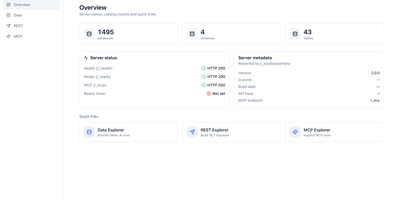
pRESTd points at your PostgreSQL or MySQL database and instantly serves every table as a REST API, so the CRUD backend you were about to spend a week writing already exists. Every table answers at its own address with filtering, ordering, pagination, and column selection in the query string, and batch endpoints group several operations into one call. When a table endpoint is not enough, drop a SQL file into the queries folder and it becomes a named route with bound parameters, or store the scripts in the database and manage them through the admin API. Turn on the auth module and the server issues JWTs from your own users table, checks them on every route, and enforces table-level permissions so public tables stay open while payroll stays shut. The same database also appears as a read-only MCP endpoint, which lets Claude, Cursor, and other AI clients discover your tables and query them with your permissions instead of a copied export. One process can front several databases at once, Postgres and MySQL side by side, each under its own alias for tenants or reporting replicas. An embedded Studio in the same binary browses the catalog and rows, builds GET requests, and invokes MCP tools, so you can inspect everything from the browser before writing a line of client code. Running on a dedicated VPS on RepoCloud with guaranteed CPU, RAM, and SSD, full root SSH access, and a browser serial console. MIT licensed.
repowise
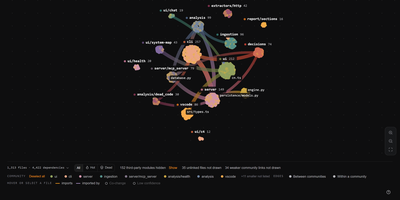
Instead of another round of grepping, a coding agent or developer asks repowise once and gets an answer drawn from a pre-built index of the repository's code, history, tests, and decisions. Indexing needs no API key: the call graph across 29 languages, git co-change and ownership, health scores, and dead code reports all come with zero model calls. A web dashboard opens onto Overview, Docs, Architecture, Knowledge Graph, Code Health, Refactoring, Commits, Decisions, and Usage pages, and a chat view returns cited answers with charts. Ten task-shaped MCP tools let Claude Code, Codex, Cursor, and other hosts ask for callers, risk, tests, owners, and reasons in a single request. Change risk scores any commit or branch against the repository's own history, and impacted-tests lists the tests a diff exercises. Every file earns a 1 to 10 health score from 53 detectors, with refactoring plans such as Extract Method and Break Cycle. Decisions mined from ADRs, comments, and commits stay linked to the code they govern, doc drift flags pages that describe code that no longer exists, and workspaces follow API contracts across repositories. Generated CLAUDE.md and AGENTS.md files keep agents informed, and distill trims noisy test and install output. Running on a dedicated VPS on RepoCloud with guaranteed CPU, RAM, and SSD, full root SSH access, and a browser serial console. AGPL-3.0 licensed.
Busabase
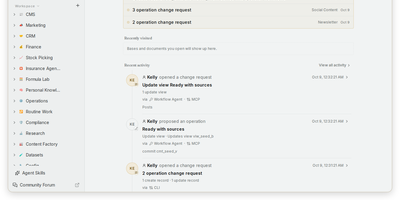
Every AI agent session starts from zero, and Busabase fixes that: it is an open-source workspace where agents and people share records, docs, skills, and apps, and every agent write arrives as a reviewable change. Bases hold typed records with relations, views, and forms, while Docs, Files, Whiteboards, and Workflows live in the same tree, so a project's data and context stay together. Skills are SKILL.md playbooks that any connected agent can look up before it acts. Each write becomes a Change Request carrying a message, a field-level diff, an author, and history; your permissions decide whether it merges at once or waits in the Inbox for approval, and any change can be reversed. Ask an agent to turn a Base into a dashboard, CRM, or content desk and it runs as an AirApp on live workspace data. Claude Code, Codex, Cursor, Gemini CLI, n8n, or your own process can connect through MCP, OpenAPI, the CLI, TypeScript and Python SDKs, or an in-app chat session. Templates install a complete setup, with sample data and an agent manual, in one command. Start it with one command and no accounts, because the open-source edition is a single-user workspace with no sign-in screen. Running on a dedicated VPS on RepoCloud with guaranteed CPU, RAM, and SSD, full root SSH access, and a browser serial console. MIT licensed.
Dory
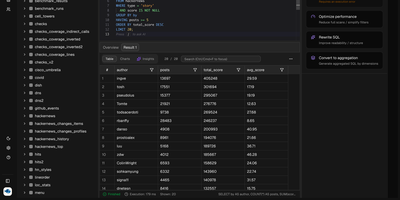
Dory is a SQL workspace where you and your AI agents work on the same queries, results, and charts. Write SQL in a multi-tab editor with schema-aware autocomplete, then let the built-in copilot generate queries from plain English, fix errors, rewrite messy statements, trim full scans, or turn a query into an aggregation. Results land in a grid you can sort, filter, and search, flip into charts, or save as reusable queries. The schema explorer draws a searchable map of tables, primary keys, and foreign keys that you can auto-arrange and export as PNG or SVG, while AI table overviews describe what each column means. Connect PostgreSQL, MySQL, MariaDB, SQL Server, Oracle, SQLite, DuckDB, Snowflake, Supabase, Neon, Cloudflare D1, and ClickHouse, with SSH tunneling for private networks. ClickHouse teams also get a monitoring console for latency, throughput, slow queries, and errors, plus user and role management with cluster-wide privileges. Claude Code, Codex CLI, and other MCP-compatible agents can list connections, explore schemas, and run read-only SQL, and the tabs they open stay editable for you to review, correct, and continue. A team can share one browser address with organizations, invited members, GitHub or Google sign-in, and access tokens for agents. Running on a dedicated VPS on RepoCloud with guaranteed CPU, RAM, and SSD, full root SSH access, and a browser serial console. Apache-2.0 licensed.
BankMCP
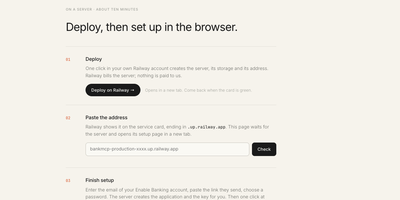
Ask your assistant what you spent on groceries last month, and let it answer from your actual bank accounts instead of a spreadsheet you never update. BankMCP is a small server you run yourself that connects your European banks to Claude, ChatGPT, Cursor, or any MCP client, so questions about balances and spending get real answers. Ask for a balance and it fetches the booked and available figures live; ask where the money went and it searches transactions across every connected account by merchant or invoice number; ask for the month and it totals money in and out while leaving transfers between your own accounts out of the picture. Background watches keep an eye out between conversations: get a webhook when a balance crosses a line, a large debit lands, a named payment arrives, or an expected payment has not shown up by its date. Ready-made prompts cover connecting a bank, building a budget, scanning savings, auditing subscriptions, and spotting unusual transactions. The server is deliberately boring about your data: it keeps consents, account labels, watches, and your login, fetches balances and transactions only when asked, and stores none of them. It is read-only by design, with no payment tools to abuse. Running on a dedicated VPS on RepoCloud with guaranteed CPU, RAM, and SSD, full root SSH access, and a browser serial console. MIT licensed.
GrayMatter
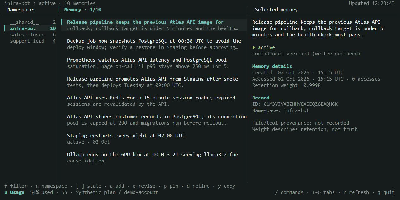
GrayMatter gives AI agents a persistent memory that survives between sessions, so every new run starts from stored facts instead of a blank slate. Agents save facts once and recall them by meaning, receiving the top eight relevant entries instead of a full history replay. A consolidation cycle extracts typed entities (people, organizations, and projects) and links co-mentioned items into a knowledge graph that grows from ordinary use. Every recall can return receipts showing the per-signal ranks, fused score, and provenance behind each fact, so you can audit why the agent remembered something. Deterministic decay gives facts a 30-day half-life and retires stale entries to tombstones, keeping the store current without manual cleanup. Claude Code hooks inject routine recall on every turn, and the context-sync command projects top facts into CLAUDE.md or AGENTS.md inside a set token budget. Agents curate their own memory through the memory_reflect tool, adding, updating, forgetting, and linking facts during a session. The workbench opens six views (Memory, Recall, Activity, Graph, Usage, and Status) for browsing namespaces, inspecting ranking receipts, and tracking subscription limits or API spend. Connect Claude Code, Cursor, Codex, OpenCode, Antigravity, or any MCP-compatible client over stdio, or call the REST API server on port 8080 from your own tooling. Export the graph to Obsidian with one command, turning entities into notes and edges into links. Running on a dedicated VPS on RepoCloud with guaranteed CPU, RAM, and SSD, full root SSH access, and a browser serial console. MIT licensed.
NotifKit
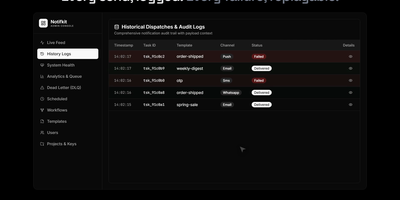
One notify() call is all your product needs to reach users on push, email, SMS, chat, and webhooks, with NotifKit deciding how and when each message travels. List the channels in the order you prefer and NotifKit tries each in turn, so a failed push quietly becomes an SMS or an email instead of a lost message. Per-user preferences, consent, and quiet hours in each user's own timezone hold non-urgent sends until morning, while critical messages such as one-time passwords travel their own lane immediately. Templates, multi-step workflows that wait days or block on events, scheduling, throttling, and deduplication all run behind that single call, defined in TypeScript and kept in your repository. Delivery logs record every attempt, and the admin dashboard shows a live activity feed, queue depth per priority lane, workflow runs step by step, and a replayable dead-letter queue. Several products can share one deployment as separate projects with their own API keys, rate limits, and data, and any service can call the REST API without the TypeScript SDK. Ask an AI assistant why a password reset never arrived by connecting the built-in MCP server to Claude Code, Cursor, or another MCP client. Running on a dedicated VPS on RepoCloud with guaranteed CPU, RAM, and SSD, full root SSH access, and a browser serial console. MIT licensed.
OpenKnowledge
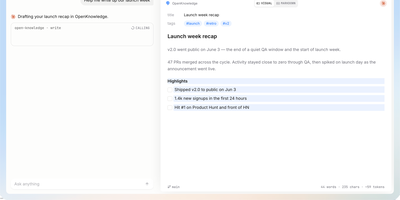
OpenKnowledge turns a folder of markdown files into a workspace where you and an AI agent can write in the same document. The editor feels like a Notion page but saves plain markdown, with a visual mode, a markdown mode, a properties panel for titles and tags, and a file navigator with search and tabs. Ask Claude, Codex, or another harness to draft a recap, and the edit appears beside the chat as you watch. Select any passage and leave a comment, then send all open comments to the agent in one message. A timeline panel lists every change with a before and after diff, so an agent's rewrite is easy to review and undo. Skills Studio covers writing, browsing, and installing agent skills, and it can link one skills folder across Claude, Cursor, Codex, and others. Starter packs set up LLM wikis and second brains, and a graph view shows how wiki links connect pages. Git sync shares a knowledge base with teammates, and rich components like callouts, tabs, and diagrams make specs readable. Running on a dedicated VPS on RepoCloud with guaranteed CPU, RAM, and SSD, full root SSH access, and a browser serial console. GPL-3.0 licensed.