GNO
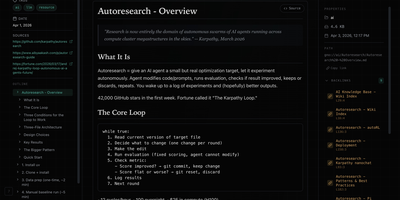
Search your local notes, PDFs, Office files, and code with GNO, and "how we handle retries" finds the paragraph about exponential backoff that never uses the word. Keyword and semantic retrieval run together, with reranking at higher depths, and --explain shows score traces for each result. Questions on the Ask page come back with citations that resolve to the source passage. Verified mode withholds the draft unless one closed bundle of evidence supports every claim. The browser workspace adds a cross-collection folder tree and split-view Markdown editing with live preview. PDFs open as native pages, and an interactive graph maps how your documents relate. Quick capture sits on the N key. Context Capsules bundle exact line spans for one goal and list what could not be found. Agents reach the same index through an MCP server that installs into ten clients, including Claude Code, Cursor, and Zed. Write tools stay off until you switch them on. A headless daemon watches folders, syncs, and embeds changes to keep the index current. It can serve MCP to remote agents behind a bearer token and Host and Origin allowlists. Models run locally, with no GPU or account required and no telemetry. Per-collection egress policy, local only, LAN, or remote, keeps client files local while personal notes use a GPU box on your network. Running on a dedicated VPS on RepoCloud with guaranteed CPU, RAM, and SSD, full root SSH access, and a browser serial console. MIT licensed.
ZIM Pro
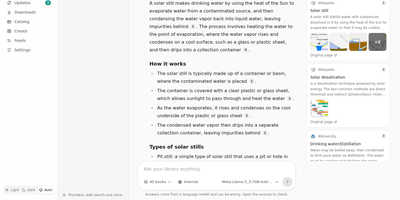
Offline Wikipedia, DevDocs, iFixit and the rest of the Kiwix catalog become a library you can read, search and question when ZIM Pro serves your folder of ZIM files. Ask AI writes answers from the books themselves, with numbered citations, the source passages beside them, and the pictures and videos from the pages it used. Any OpenAI-compatible chat API works, local or hosted, and two free providers need no account or key. Search covers one book or the whole library, with results grouped by book and a history of past searches. Any article can be read as Markdown with its pictures, ready to copy into another tool. Updates compare each book with the Kiwix catalog under a per-book policy: automatic, ask first or pinned. Downloads use several connections across the mirrors, verify checksums and resume after a pause or crash. Your own ZIMs can be made from web links, whole sites, or uploaded PDF, EPUB and Kindle books, with RSS and Atom feeds syncing on a schedule. Claude and other LLM apps search and read the library over MCP, protected by named keys that can be revoked. Queue controls pause, reorder and retry jobs, and monitoring pages chart health checks, traffic and live logs. The web app installs on phones and includes a dark theme. Running on a dedicated VPS on RepoCloud with guaranteed CPU, RAM, and SSD, full root SSH access, and a browser serial console. GPL-3.0 licensed.
Glideship
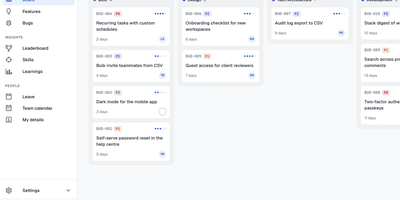
As a self-hosted alternative to Jira and Linear, Glideship swaps sprint ceremonies for twelve AI agents that handle intake, specs, estimates, test plans, and retrospectives while your team keeps every decision. Post a request in Slack and the Triage agent interviews you in-thread, checks existing work for duplicates by vector search, and queues a proposed BUD for a product manager to create or reject. Each BUD, short for Business Understanding Document, holds the spec, tech spec, test plan, acceptance criteria, and history of one feature as it moves from design through development, testing, and UAT to production. Delivery dates come from AI-PERT and 10,000 Monte Carlo simulations, reported as P50, P70, and P85 per phase instead of story points. A code-graph indexer scans multiple repositories, clusters features across them, and answers blast-radius questions such as what breaks if this file changes. Skill profiles rebuilt nightly from git history suggest the best-fit developer, while XP, levels, and a leaderboard reward work that reaches production. Choose Claude Code, GitHub Copilot, OpenAI Codex, or Ollama per organization, and a built-in MCP server lets any MCP client draft BUDs and read team context. Bring existing issues over from Jira, then give HR and Sales a People workspace with leave and work-from-home requests, loss-of-pay warnings, Slack approvals, policies per location, a team calendar, and encrypted employee records. Running on a dedicated VPS on RepoCloud with guaranteed CPU, RAM, and SSD, full root SSH access, and a browser serial console. Apache-2.0 licensed.
Genkan
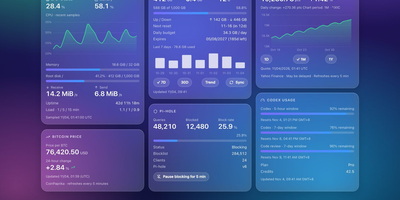
Your homelab home page can take orders from an AI assistant: ask Claude or Cursor to add Jellyfin, Sonarr and Radarr to Media with health checks, and Genkan updates the page on the spot. Other requests work the same way: group services by type, pin the five used most, or move dead links to an Archive category. The AI tab in Settings offers a one-click prompt for the Agent Skill, which calls the REST API, and a built-in MCP server with 29 tools. Links sit on a wallpaper as frosted-glass capsules, grouped into workspaces and categories, with a pinned row and sorting by use, recency or dragging. Slash or Ctrl+K searches every workspace and falls back to a web search. Seventeen bundled plugins add resizable widgets for weather, world clocks, countdowns, Pi-hole stats, RSS, Hacker News, a to-do list and Markdown notes, plus wallpaper feeds such as NASA APOD. Plugins from other authors show their permissions and source in a market before you enable one, and each runs in a sandbox with time and memory limits. A green or red dot beside each link reports its health, and favicons download on their own. Editing needs the admin login, a read-only guest mode shares the page, and JSON export and import carry everything to another instance. Running on a dedicated VPS on RepoCloud with guaranteed CPU, RAM, and SSD, full root SSH access, and a browser serial console. MIT licensed.
BlogFactory
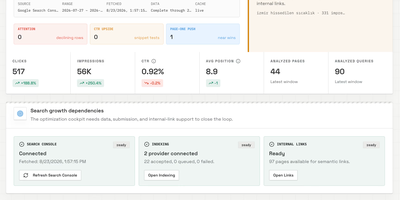
BlogFactory is the first open-source agent control plane purpose-built for multi-site content operations, shipping 16 distinct capabilities across four operational pillars — Operate, Grow, Control, and Deliver — in its v0.1.0 release. The platform keeps source evidence, AI-generated drafts, revisions, SEO metadata, human review, preflight checks, and CMS delivery destinations in one workspace while enforcing a server-side authority ceiling that prevents agents from ever publishing live content, accessing credentials, or performing administrative actions. AI agents connect through a Streamable HTTP MCP endpoint with OAuth authentication and site-scoped tool discovery, compatible with Codex, ChatGPT, and any MCP-capable client. Content creation supports single articles from keywords, titles, URLs, PDFs, text, or YouTube sources, batch campaigns, and programmatic content via reusable templates with structured data rows. The Search Growth module connects Google Search Console complete-day data to ranked optimization opportunities, 30-day growth plans, content classification by signal type (growing, low-CTR, almost-ranking, page-two, zero-click), indexing checks, and semantic internal-link suggestions. Brand Voice separates global voice rules, writer profiles, knowledge context, and brand guidelines from article mechanics. Approved drafts are delivered as CMS drafts to WordPress, Ghost, Wix, or Framer through idempotent, optimistic-locking-protected handoffs with explicit destination selection and preflight validation. The stack runs on React/Vite, a Hono/TypeScript API, PostgreSQL, and MinIO via Docker Compose, with providers including OpenRouter, OpenAI, and Google services under a bring-your-own-AI model. Running on a dedicated VPS on RepoCloud with guaranteed CPU, RAM, and SSD, full root SSH access, and a browser serial console. AGPL-3.0 licensed.
Kvitok
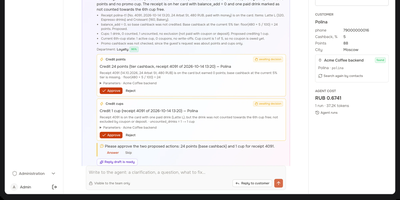
Kvitok is a helpdesk where an AI agent reads your backend, drafts the reply, and lines up the fix, so by the time an operator opens a ticket only the decision is left. Take a guest whose loyalty points never arrived: the agent finds her in your system, reads her receipts, and queues the missing credit for one click of approval. Requests arrive by mailbox or API channel, and your backend matches customers by phone, email, card number, or any identity it exposes. Rules you write run first and can set a department, priority, or tags, or skip the agent for senders such as partners. The agent calls tools your backend publishes, follows your playbooks, and picks a department with a confidence score, while your backend validates every action it proposes. Operators talk to the agent inside the ticket: say the receipt was really 540 and it revises only what that changes. Approved actions run exactly once, and the reply goes out by email or back through the channel the request came from. Each workspace picks its own model from any OpenAI-compatible endpoint, hosted or local, and every ticket shows what the agent spent. Test scenarios run against a real model, so policy or model changes get checked before reaching customers. Claude Code can tune rules and playbooks over MCP. Running on a dedicated VPS on RepoCloud with guaranteed CPU, RAM, and SSD, full root SSH access, and a browser serial console. AGPL-3.0 licensed.
AgentTape
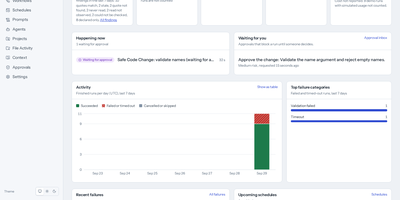
When a coding agent says the tests already cover a case, AgentTape checks the lines it cites against a recording of the run and shows a verdict beside them. The verdicts are Quote matches, Quote not found, Never read, Read not observed, and Stale, where the file changed after the read and both hashes are displayed. A finding with no citation reads Declared only. Matching is deterministic and no model judges anything: line endings, Unicode, and trailing spaces are normalized before each quote is compared. Confidence climbs a ladder from declared, to commands re-run, to a person's confirmation, and a second agent can challenge a finding, labeled as judgment. Today Claude Code findings are verified, while Codex CLI and any allowlisted command are recorded alongside them. Runs launched from the UI, CLI, API, a schedule, a webhook, or a workflow leave an ordered record of the prompt, commands, output, files read, and files changed. Any run can be replayed as recorded or forked with one variable changed, and the two are compared side by side. Workflows chain agent steps, commands, evaluation gates, and approval nodes that pause for a person, and evaluators check exit codes, diffs, regex, JSON schema, duration, and cost. Work happens in a separate Git worktree and commits locally only after approval. Running on a dedicated VPS on RepoCloud with guaranteed CPU, RAM, and SSD, full root SSH access, and a browser serial console. MIT licensed.
Euron Open AgentOS
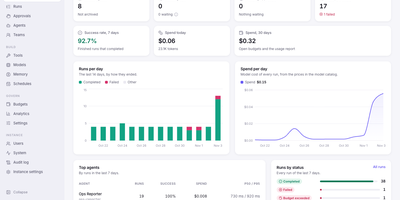
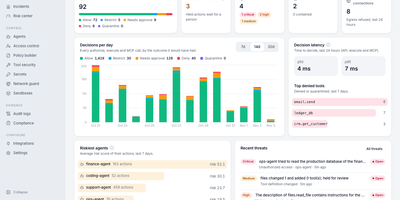
Euron Open AgentOS is a runtime for AI agents that checks every model call against a budget before it is sent and pauses risky tool calls for human approval. Define an agent with instructions, tools, memory, limits, and a model from OpenAI, Anthropic, Gemini, Ollama, or any OpenAI-compatible endpoint, then start it from the dashboard, the API, the Python SDK, a schedule, or a webhook. Budgets cap tokens and cost for a run, an agent's day, a project's day or month, and an organization's month, and a delegated team shares one pool. Any tool can require approval always or only when its arguments match a rule, and reviewers can approve, reject, or edit its arguments. Code, shell, git, and browser tools run in a separate sandbox that holds no credentials and limits browsing to an allowlist of domains. Every step is checkpointed, so a crash or a pause resumes the run where it stopped instead of repeating finished work. Teams work in sequence, in parallel, under a supervisor, or in collaborative rounds, and the Run Inspector shows every delegation as a child run. Built-in tools cover web search, files, CSV and JSON queries, read-only SQL, and email; custom HTTP tools and MCP servers add more. Organizations, projects, roles, API keys, OIDC sign-in, and an audit trail keep teams apart. Running on a dedicated VPS on RepoCloud with guaranteed CPU, RAM, and SSD, full root SSH access, and a browser serial console. MIT licensed.
Euron Open AgentGuard
Euron Open AgentGuard decides every action an AI agent takes before it happens, so a poisoned web page cannot talk one into refunding the wrong account. Credentials for HTTP tools, MCP calls, and sandboxed code never reach the agent: AgentGuard runs them itself, and agents authenticate with short-lived identities. A YAML policy answers allow, restrict with row limits or field redaction, hold for a person, deny, or quarantine the agent, and an explicit deny always wins. Drafts can be dry-run on one request, replayed over recorded decisions, or tried in audit mode, which logs what enforcement would have done. Approvals are tied to a hash of the agent, tool, action, and parameters, and one changed byte starts a new request. Nobody approves their own. Once a run reads content that tries to command the agent, it is tainted and its next high-risk action waits for a human. Registered MCP servers share one governed endpoint that hides forbidden tools, scans outputs for injected instructions, and holds a changed tool definition for review. Secrets are written once and injected only for the hosts they are bound to, and an egress proxy limits each agent's destinations. Records are hash-chained and verifiable on demand, with incident reports and an OWASP agentic Top 10 report. SDKs for LangGraph, CrewAI, and Express treat any error as a deny. Running on a dedicated VPS on RepoCloud with guaranteed CPU, RAM, and SSD, full root SSH access, and a browser serial console. MIT licensed.
Retinue
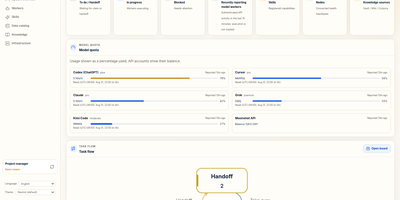
Retinue shows who is doing what across a fleet of AI agents, on a shared board where every task is a card with exactly one holder, a written acceptance check, and a receipt chain that cannot be rewritten. Operators publish cards, agents claim them through MCP or a token-scoped HTTP API, report progress, and hand off, and an agent that is not the holder gets a refusal when it tries to write. The Home dashboard counts what is waiting, running, and blocked, charts task flow and dispatch, and shows quota gauges for Claude, Codex, Cursor, Grok, and Kimi subscriptions. A collaboration workspace draws delegation graphs, device and model timelines, module contributions, and message conversations for any selected task. Operations pages report token usage by worker, and a data health page flags stale reports and duplicate identities. Read-only importers pull session data from Claude Code and Codex, and optional Lark, Feishu, and Telegram bridges turn chat messages into intents. The interface switches between English and Simplified Chinese. Running on a dedicated VPS on RepoCloud with guaranteed CPU, RAM, and SSD, full root SSH access, and a browser serial console. AGPL-3.0 licensed.
TaskBrigade
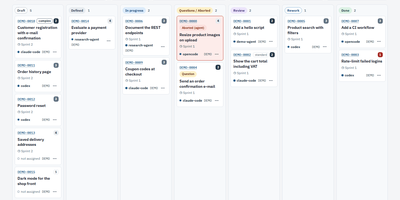
TaskBrigade is agile project management for teams of AI agents: a backlog, kanban board, sprints and pull request review where Claude Code, Codex, OpenCode and human teammates all pick up assigned work. Tasks carry acceptance criteria and their own branch, and finished work arrives as a pull request that a human or a reviewer agent approves, rejects or returns with change requests. An inbox gathers open questions, results waiting for review and aborted runs in one place. Workflows turn a chain of tasks into a reusable template that starts by hand, on a cron or workday schedule, or on an event, with approval steps, parallel groups and token budgets that pause a run at 100 percent. Projects marked local-only hand work exclusively to agents whose model runs on your own hardware, which keeps confidential material away from cloud models. Telegram and email notifications follow a per-event matrix with quiet hours, and from Telegram you can approve a review or answer an agent's question. Orchestrator agents, or OpenClaw messages in Telegram, create, split and assign tasks across several machines, each with its own work directory and parallel-task limit. Claude Desktop and Codex Desktop connect through MCP to draft and assign tasks straight from a chat. The interface speaks English or German and folds into a bottom tab bar and single-column board on phones. Running on a dedicated VPS on RepoCloud with guaranteed CPU, RAM, and SSD, full root SSH access, and a browser serial console. Apache-2.0 licensed.
PharosRAG
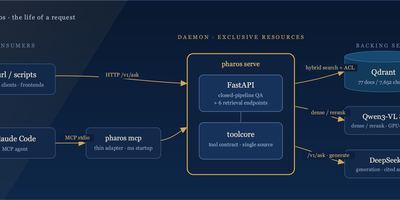
Your team's documents sit in folders nobody can search, and the answer to a simple question hides on page 40 of a PDF someone saved last year. Pharos ingests PDFs, scans, Word documents, presentations, and spreadsheets into a local knowledge base, then answers questions against that library with citations traced back to the exact page. Hybrid retrieval finds the passages that matter, and every answer carries its evidence so readers can verify the claim in the source. Access control decides visibility per person: an API key resolves to an identity with a tenant and group memberships, retrieval filters hard to only the documents that identity may see, and a document with no permissions attached stays invisible to everyone. Two doors lead into the same library. The HTTP API runs a closed question-answering pipeline that retrieves, grounds, and answers in one call, and coding agents connect through MCP to decide for themselves when to retrieve, how to rewrite a query, and when a question needs multiple hops. A resident daemon keeps the search index and models warm, so every session shares one backend instead of reloading heavy resources. The deployment scales from one machine to replicated application tiers behind a load balancer. Running on a dedicated VPS on RepoCloud with guaranteed CPU, RAM, and SSD, full root SSH access, and a browser serial console. MIT licensed.