Outbound OS
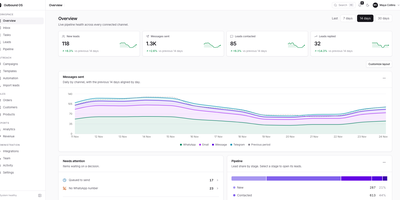
For sales desks that live in WhatsApp, Outbound OS is a CRM where the shared inbox, the follow-up sequences and the pipeline all hang off one lead record. Leads flow in from website forms (plain HTML, Webflow, WordPress, Framer), Facebook Lead Ads, Zapier, Make and n8n webhooks, and CSV or JSON imports, and a configured first contact goes out on an eligible channel. WhatsApp runs through Meta's official Cloud API: the composer checks the 24-hour reply window and offers an approved template once it has closed, while photos, PDFs and voice notes open in the inbox. Email works with any SMTP/IMAP mailbox or Brevo, and Telegram and iMessage (through a Mac running BlueBubbles) join the same thread list. Sequences follow each lead's working hours and stop on a reply, an opt-out or a closed deal, and campaigns target any slice by tag, status, country or score. A pipeline board, tasks, orders, invoices, shipments and revenue reports carry the sale past the first reply, with admin, manager, agent and viewer roles for the team. Dashboard widgets can be rearranged per account, and the phone workspace installs to the Home Screen from the browser. An MCP server lets ChatGPT, Codex, Claude and other remote clients search leads, read replies, preview audiences and prepare campaigns, with sends governed by the client's approval settings. Running on a dedicated VPS on RepoCloud with guaranteed CPU, RAM, and SSD, full root SSH access, and a browser serial console. AGPL-3.0 licensed.
E2A
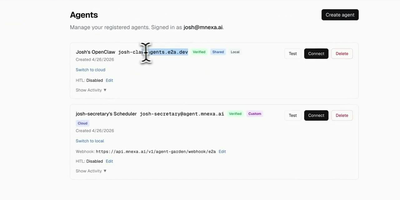
E2A is an open-source email API that lets any application send transactional email and gives AI agents real two-way inboxes of their own, so an assistant can hold a conversation over email without borrowing a person's mailbox. Register an agent and it gets a working address on a shared domain in seconds, or verify your own domain for branded addresses, then connect through the hosted MCP server, a coding-agent plugin with browser OAuth, signed webhooks, a WebSocket stream, REST polling, or the TypeScript and Python SDKs. A local agent behind a firewall needs no public URL at all: it listens over WebSocket and replies in-thread with conversation identifiers keeping multi-turn exchanges coherent across humans and other agents. Every inbound message arrives with structured SPF, DKIM, and DMARC evidence, with the DMARC alignment verdict included, so your agent can judge how far to trust a sender instead of trusting the From header. Flip on the human-in-the-loop gate per agent and outbound messages pause for a person to approve, edit, or reject from the dashboard, the SDK, MCP tools, or magic links in their own inbox, with expiry rules and recipient allowlists narrowing which sends get held. Inbound content screening flags prompt-injection payloads before the agent ever sees them. Support bots triage intake, scheduling agents coordinate meetings, and commerce agents answer order questions from one persistent address. Running on a dedicated VPS on RepoCloud with guaranteed CPU, RAM, and SSD, full root SSH access, and a browser serial console. Apache-2.0 licensed.
DispatchSEO
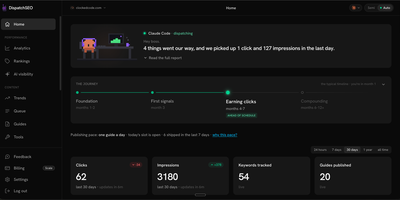
DispatchSEO runs an SEO program through your own AI agent: it researches keywords, queues ideas for your approval, and publishes a guide every morning. Connect Claude Code, Codex, Cursor, or the Claude app over MCP and the agent mines keywords from Search Console data and Google Autocomplete, then drops each idea into a queue showing volume, difficulty, and the reasoning behind it. Approve, reject, or drag to reorder, or switch on auto mode and skip the queue. Each morning the oldest approved idea becomes a real guide, delivered as a GitHub pull request or posted straight to a self-hosted WordPress site, checked against the live search results before it ships. Home greets you with a plain-language daily briefing, a journey tracker, publishing pace, and click and impression counters. Rankings charts daily positions with thirty-day sparklines, Search Traffic plots Search Console history, and an AI visibility page shows how often Claude cites your domain. A backlink playbook lists free and paid submissions with copy ready to paste. One deployment manages many sites, each with its own MCP token. Running on a dedicated VPS on RepoCloud with guaranteed CPU, RAM, and SSD, full root SSH access, and a browser serial console. AGPL-3.0 licensed.
Eidon
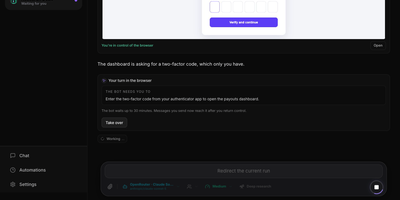
Beyond a plain chat for quick questions, Eidon gives you a team of AI agents, each with its own browser, workspace, and memory, and a Chief of Staff that routes your requests. Ask for anything and it answers, hands the job to a specialist, or creates a new agent for it, and agents message each other and report back. Open an agent's live browser view and watch it work. At a sign-in, a two-factor code, a CAPTCHA, or a payment it stops and waits for you, and you hand control back with a note. Passwords come from an encrypted vault and are typed into the page, never passed to the model. Shell commands and MCP tools run only after you allow them once, always, or never, and emails and Slack messages arrive as drafts to edit. Chat lets you rewind, branch, edit, or regenerate any message, queue follow-ups while a reply streams, and share a read-only link. Deep research drafts an editable plan of up to twelve steps and returns a cited report. Memories wait for your approval. Automations run on an interval, daily, weekly, or once, and alert you through ntfy, Pushover, webhooks, or web push. Connect OpenAI-compatible or Anthropic providers, MCP servers, web search, image generation, and voice dictation, with a private account for each person. Running on a dedicated VPS on RepoCloud with guaranteed CPU, RAM, and SSD, full root SSH access, and a browser serial console. AGPL-3.0 licensed.
Aizen
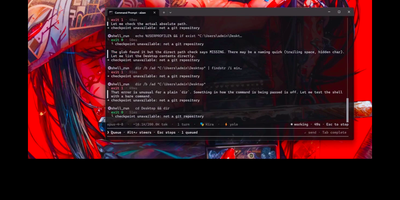
Aizen is a coding agent that actually lives on your server: one small binary you can message from your phone, which fixes code, runs the tests, and reports back before you are anywhere near a keyboard. Leave it running on the box and drive it from Telegram or Discord, approving risky edits with a tap while it works behind NAT with no inbound port to expose. In the terminal it is a single chat and agent loop with a live heads-up display of model, tokens, and context, reading files in parallel, editing symbolically through the language server, and running your shell under an approval layer with a hard floor that refuses catastrophic commands even on auto-approve. It does not get to claim done early: a verify gate runs your typecheck and test suite and sends it back to fix what it broke, git-backed checkpoints let you rewind a bad turn, and seven capability-scoped sub-agents can fan out across finding, planning, building, reviewing, testing, research, and recall when a job wants a team. Point it at any OpenAI-compatible endpoint, from hosted models to your own local server, extend it with MCP servers and slash-command macros, and let the sandbox keep every child process away from your API keys with the network denied by default. Running on a dedicated VPS on RepoCloud with guaranteed CPU, RAM, and SSD, full root SSH access, and a browser serial console. Apache-2.0 licensed.
deco Studio
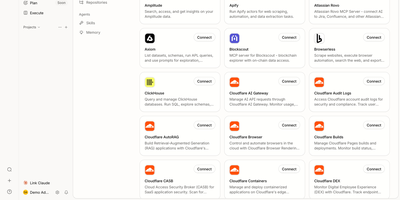
Roll out AI across a whole company without handing a single API key to anyone. deco Studio gives teams a shared chat workspace, and the admin keeps control of which models, tools, and data every agent can touch. Register MCP servers once from a catalog of ready-made connections, including Amplitude, Apify, Atlassian Rovo, ClickHouse, and a long list of Cloudflare services, then grant tool-level access by organization, role, or agent. Tokens stay in an encrypted vault, so teammates share capabilities and never credentials. Agents bundle instructions, skills, files, and approved tools, then publish as their own MCP endpoint that Cursor, Claude Desktop, or custom code can call. A built-in skills library ships with dozens of reusable playbooks, and Memory keeps facts the whole organization should remember. Model choice stays open through OpenRouter, Anthropic, OpenAI, Google Gemini, or any OpenAI-compatible server, and engineers can link a Claude Code or Codex session they already use. Projects group agents and connections around a goal, with Monitor dashboards for orders, visitors, logs, and deploys, and an Execute board for tasks and epics. Running on a dedicated VPS on RepoCloud with guaranteed CPU, RAM, and SSD, full root SSH access, and a browser serial console. MIT licensed.
Cortex Hub
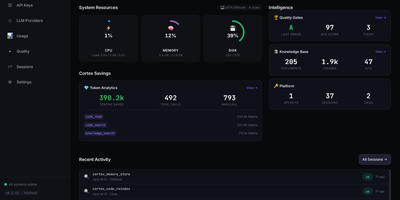
Cortex Hub gives every AI coding agent your team runs a shared brain, so what one agent learns in a repository is still there when the next agent, or the next person, opens it. Starting a session recalls the team knowledge and your own memory for that project, shows who else is editing, and picks up any task waiting for you. Agents search code by meaning and structure rather than text strings, tracing symbols, callers, and the blast radius of a change before touching it. Findings, file risks, and hard-won lessons are stored against the files they belong to, so they resurface exactly where they matter. Ending a session runs build, type, and lint checks, reports the result, and leaves a summary the next session starts from. A conductor can hand tasks to worker agents on other machines and track them centrally, while the dashboard shows sessions, keys, usage, and token savings across the team. Embeddings run locally by default, so your code memory never leaves the building just to be searchable. Running on a dedicated VPS on RepoCloud with guaranteed CPU, RAM, and SSD, full root SSH access, and a browser serial console. MIT licensed.
Hotsauce
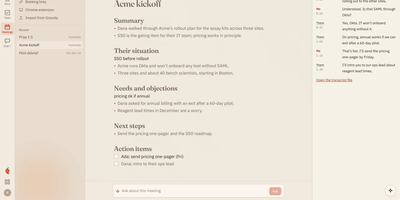
Hotsauce is an office suite for small teams that keeps every doc, meeting note, task, and saved link as a plain Markdown file in git. Meetings record in the browser, with the Chrome extension, or from the Mac app, and no bot ever joins the call. Jotted notes plus the live transcript turn into clean write-ups from customer-call, interview, or stand-up templates. The Ask assistant answers questions across every past meeting and doc, linking the sources it used. A Today page lines up the day's meetings, due and overdue tasks, and an agent brief on tiles you can rearrange. Tasks read quick-add text like "Send the deck fri p1 #Launch", and talking through your day splits it into tasks. Docs are edited together, every save is a git commit, and any doc downloads as Word or PDF or presents as slides. Links is a read-later list that keeps a clean copy and the page as you saw it, with highlights. Dictate types cleaned-up speech into any Mac app, and Clips records screen videos with a camera, transcript, and summary. A built-in MCP server lets Claude, ChatGPT, Cursor, or Codex search and edit the workspace with your permissions, and history shows which tool changed what. Booking links, forms, boards, and PDF signing round out the suite. Running on a dedicated VPS on RepoCloud with guaranteed CPU, RAM, and SSD, full root SSH access, and a browser serial console. AGPL-3.0 licensed.
OpenCorvus
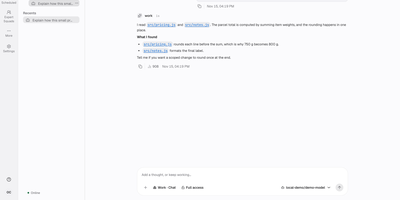
Long agent tasks tend to stall, lose context, or return something nobody can verify, and OpenCorvus is built to prevent all three. OpenCorvus organizes long, complex tasks into Missions worked by Expert Squads, where research, implementation, and independent review each have a named owner and hand off written artifacts. Task state and context are retained, so a stopped run can be recovered rather than restarted, and tool calls, results, and review evidence stay in a record you can inspect. Pick a squad from the bundled catalog of more than a hundred, or let the Dynamic squad compose task-specific experts for you. Connect any of roughly ninety model providers, add MCP servers and skills, schedule recurring work like a weekday brief, and receive tasks from chat channels like Slack, Telegram, Discord, and WhatsApp. A persistent project memory keeps notes the agents reuse across conversations. Start the headless server in a repository, open the workbench in your browser, or create Tasks through the HTTP API and follow their events as they stream. Running on a dedicated VPS on RepoCloud with guaranteed CPU, RAM, and SSD, full root SSH access, and a browser serial console. MIT licensed.
Ogcode
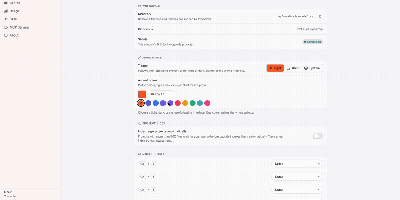
Ogcode puts a full AI coding agent in a browser tab pointed at your own server, where it maps your codebase semantically before reading it, plans changes across files, runs your builds and test suites, and answers with diagrams and documents alongside the shipped code. Before reading files it maps the project with a semantic index, outlines what matters with exact line ranges, and reads only the parts that count, so unfamiliar code becomes navigable in one session. Ask it to implement a feature or chase a failing test and it plans the work, edits across files, runs your builds and test suites, and investigates failures instead of retrying blindly. You stay in control through per-session permission modes: Ask approves each step, Auto gates by risk, and Yolo lets it run, with every decision remembered when you want it to be. Past decisions are recalled instead of replaying whole transcripts, so long sessions stay focused and affordable, and the agent can research as it goes with built-in web search, reusable SKILL.md workflows, and external MCP servers. Answers come back richer than text when the work calls for it, with diagrams, rendered documents, charts, and downloadable artifacts in the same session. Connect Anthropic, OpenAI, OpenRouter, or a local Ollama endpoint and start working. Running on a dedicated VPS on RepoCloud with guaranteed CPU, RAM, and SSD, full root SSH access, and a browser serial console. AGPL-3.0 licensed.
ToolKernel
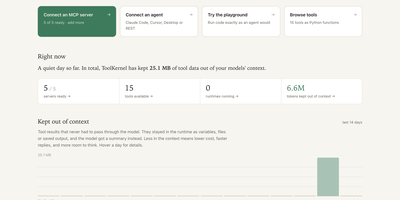
ToolKernel hands an AI agent a Python notebook wired to every MCP server you use, so big tool results stay in variables and the model reads only what it printed. Connect servers with the same mcp.json format as Claude Desktop and each tool becomes a typed function with keyword arguments and a docstring. The agent sees just seven small meta-tools and searches for a signature only when it needs one. Code runs in a persistent runtime per session, so variables stay in memory between calls, like cells in a notebook. An output guard keeps every result within a budget, turns large values into previews with shape and samples, and saves overflow for paging. Policies allow, deny, rate-limit, or hold a call until a person approves it in the web UI, and credentials never enter the runtime. The web UI records every step beside what the model saw and what stayed in the sandbox, with pages for servers, tools, a playground, approvals, and benchmarks. Claude Code and Cursor connect over MCP, stdio-only clients use a shim, and any other model can call a REST API with OpenAI or Anthropic tool formats. In the bundled benchmark, agents answered 20 of 21 data questions correctly, against 8 of 21 with tools wired in directly. Running on a dedicated VPS on RepoCloud with guaranteed CPU, RAM, and SSD, full root SSH access, and a browser serial console. Apache-2.0 licensed.
killBottleneck
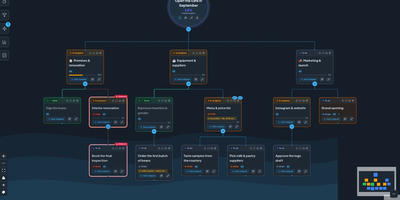
Somewhere in every project one step holds up all the others, and killBottleneck draws your goals as a map that flags that step as a bottleneck. A goal is flagged when it is overdue or stalled while other steps wait on it, and each goal carries an owner, deadline, status, progress, notes, and attachments. The same map switches to a Process style whose recurring steps (every weekday, every Friday, monthly) renew themselves, and an organization map holds positions, functions, and deputies. My day lists what is overdue, due today, or due within a week, beside a team calendar with shared calendars for the company, the meeting room, and time off. Automation rules (WHEN, IF, DO) hand over goals, set deadlines, notify people, offer the assistant, or run an agent, and signed webhooks start n8n workflows or your own agents. An AI assistant in a side panel plans mornings and evenings, sorts notes from a photo, PDF, or voice note, and drafts whole projects, and every change is a card you confirm; it runs on OpenAI, OpenRouter, Groq, Mistral, vLLM, llama.cpp, or a local Ollama model. A REST API and a 20-tool MCP server let Claude Desktop, Claude Code, or the claude.ai connector build maps by conversation. Twelve skins, a simplified phone view, Asana and Trello import, and encrypted backups round it out. Running on a dedicated VPS on RepoCloud with guaranteed CPU, RAM, and SSD, full root SSH access, and a browser serial console. MIT licensed.
Owlmail
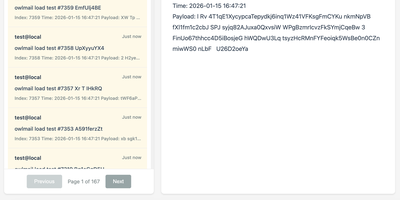
Every email your app sends while you build and test it lands in OwlMail's browser inbox instead of a customer's mailbox. Point any application's SMTP settings at OwlMail and every message is ready to open as rendered HTML, plain text, headers, or raw source. Attachments and inline images sit beside the body, and seven preset preview widths show how the message lays out on phones, tablets, and desktops before anyone real sees it. A Verify panel checks subject, body, and link hosts against expectations, while CI pipelines use the REST API with delivery cursors to wait for exactly the messages their test run produced, assert on them, and clean up afterwards. Coding agents get the same inbox read-only over MCP, so an assistant can confirm a signup email arrived without touching your mail server. When a message proves itself, relay it onwards to a real SMTP server, by hand or automatically under filtering rules, or fire webhooks with HMAC signatures and retry queues into the rest of your automation. Everything stores as plain .eml files on disk, with optional SQLite indexing, S3 attachment storage, and ZIP exports for archiving. Running on a dedicated VPS on RepoCloud with guaranteed CPU, RAM, and SSD, full root SSH access, and a browser serial console. MIT licensed.
Wiki4AI
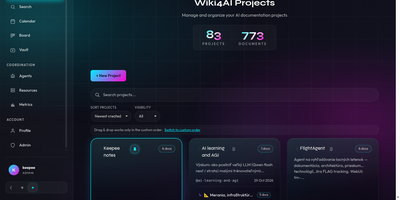
One wiki, two kinds of authors: Wiki4AI lets a team and its AI agents read, write and search one Markdown knowledge base under identical permissions. Projects nest five levels deep, and each project or document is public or private, with private pages answering 404 to anyone but the owner and admins. The editor shows Markdown beside a live preview, autosaves, and rejects a conflicting save with a 409 instead of overwriting it. Mermaid diagrams render in the browser, PlantUML renders through an optional kroki sidecar, and wiki links build backlinks and a relationship graph. Search fuses literal text matching with semantic similarity from a local embedding model; results stay useful even when nobody typed the exact words. Claude Desktop, OpenCode or any MCP client can create pages, search and manage the calendar as a signed-in user through a server with 52 tools over stdio or SSE. Work items move through eight board states; an agent claims one with a lease that expires after 45 minutes by default, and finishing requires a result comment. Agents poll an inbox for what changed and reserve scarce resources, such as a GPU slot, with a time limit. Dedicated pages show agents, resource holds and actor metrics. The calendar offers month and week views with all-day and timed events, custom event types and per-event visibility. Running on a dedicated VPS on RepoCloud with guaranteed CPU, RAM, and SSD, full root SSH access, and a browser serial console. MIT licensed.
FastLLM Proxy
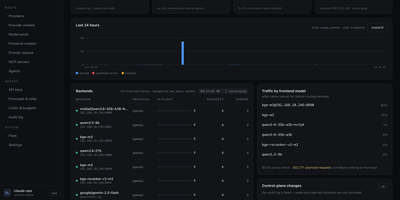
Local vLLM and llama.cpp boxes and hosted providers like OpenRouter, Anthropic, Bedrock, and Gemini all answer to one OpenAI-compatible address once FastLLM Proxy sits in front of them. Clients ask for a frontend model by name, and ordered rules pick the target by caller, prompt size, headers, budget spent, time of day, or how busy a backend is. Prompts that share a prefix return to the node holding their cache, and semantic routing sends coding questions one way and chat another using example prompts you write. API keys carry per-model grants, rate limits, and token or spend budgets, and the management console shows traffic, usage and spend, an append-only audit log, and a fleet topology. Failures fall through to the next target before a byte reaches the caller, and an admission gate turns a flooded engine into a bounded queue. An MCP gateway and an A2A agent endpoint put tool servers and agents behind the same address. Existing LiteLLM configs import unchanged. Running on a dedicated VPS on RepoCloud with guaranteed CPU, RAM, and SSD, full root SSH access, and a browser serial console. Apache-2.0 licensed.
FlowForge
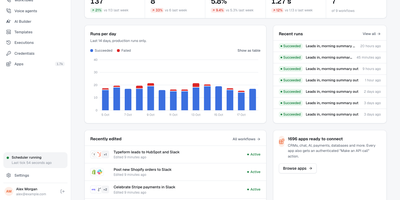
Why pay a per-task bill for workflow automation when FlowForge connects 1,690 apps, builds workflows from a plain-English sentence, and puts AI receptionists on your phone line? Drag triggers, actions, If/Else branches, and filters onto a canvas, then map data between steps by dragging fields. Type "when a Typeform comes in, add the contact to HubSpot and tell #sales" and the AI Builder drafts, links, and saves the workflow. Bring your own OpenAI, Claude, Gemini, DeepSeek, or Qwen key, or point it at Ollama. Services missing from the catalog become custom apps from their documented API or an OpenAPI file, and n8n exports are rebuilt by the AI. Voice agents answer and place calls as clinic receptionists, salon booking lines, or lead qualifiers. Test them free in the browser, then add real numbers through Vapi or ElevenLabs. Every call lands with a recording, transcript, summary, and booking. Failed runs retry from the failing step for up to six hours, and writes that may already have gone through are never repeated. Each step keeps its input, output, and HTTP request for debugging. Claude Code or Cursor can build and run workflows through an MCP endpoint with a personal token. Webhooks, plain-word schedules like every weekday at 9:00, and app polls all run from one cron job each minute. Running on a dedicated VPS on RepoCloud with guaranteed CPU, RAM, and SSD, full root SSH access, and a browser serial console. AGPL-3.0 licensed.
LLMxRay
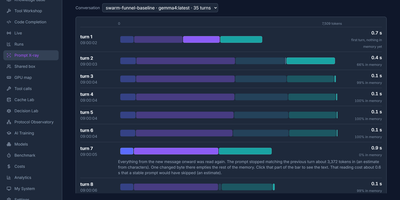
Point VS Code Copilot, Open WebUI, Continue, n8n or your own agent at LLMxRay instead of Ollama, and every turn shows what the cache kept, what was read again and what the daemon silently cut. Prompt X-ray draws each turn to scale, colored by part (system prompt, tool schemas, earlier turns) and dimmed where the model already remembered it. Runs lays one agent's calls out as a waterfall of waiting, loading, prompt reading and answering, with the tool time between them. Shared box names the tool that slowed the others and the setting to change. The GPU map shows what sits in video memory and which pulled models still fit. Tool calls scores a model on thirteen request shapes agents send, and Cache Lab finds the value that breaks the prompt cache and measures the fix. Chat colors each streaming token by the model's own probability, Compare streams up to four slots side by side, and Surgical Benchmark scores models on real token logprobs. A Knowledge Base searches PDF, DOCX, Markdown and CSV files, and Code Completion fills the gap between prefix and suffix. A read-only MCP server lets an agent diagnose its own calls. Turns can flow on to Jaeger, Phoenix, Langfuse or Grafana as OpenTelemetry spans, and nothing leaves the machine unless you send it. Running on a dedicated VPS on RepoCloud with guaranteed CPU, RAM, and SSD, full root SSH access, and a browser serial console. Apache-2.0 licensed.
Agenvo
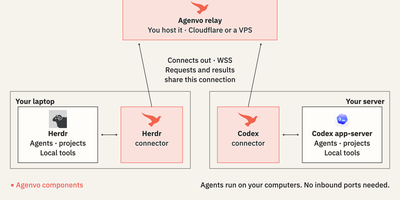
Your coding agents are scattered across a laptop, a server, and whatever machine you left running at home, and Agenvo is the self-hosted relay that lets one AI assistant reach all of them through a single MCP endpoint. Ask ChatGPT on your phone to check on Codex running on your server, or have an agent in Herdr on your laptop fix a failing test, from wherever you are. Connectors for Herdr, Codex app-server, Paseo, and Lody dial out to the relay over WSS, so the computers running agents need no inbound ports, no VPN, and no port forwarding. Your assistant sees the agents running in Herdr without restarting them, resumes Codex threads later, and starts new work where it fits: a Codex thread on the server, or Codex, Claude, or Devin in a Herdr pane. When an agent finishes a turn, waits for input, or exits, the relay pushes a change event back, so a watching assistant or ChatGPT dot reads the output and takes the next step. Closing the chat or losing the network does not stop the agents; connectors reconnect on their own, and your assistant picks up from each agent's current state. Deploy the relay on a single VPS with Docker or on Cloudflare, authorize MCP clients with OAuth over Streamable HTTP, and discover targets and method schemas with search before calling execute. Running on a dedicated VPS on RepoCloud with guaranteed CPU, RAM, and SSD, full root SSH access, and a browser serial console. Apache-2.0 licensed.