n8n
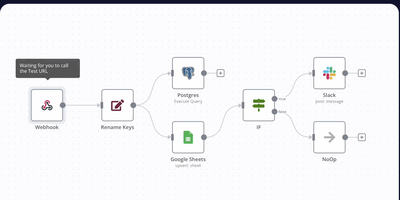
Webhooks, cron schedules, and app events trigger chains of nodes that fetch, transform, and route data: n8n is a workflow automation platform built around a visual, node-based editor. It ships with 400+ built-in integrations covering databases like Postgres, SaaS tools like Slack and HubSpot, and every major AI provider. When a pre-built node does not exist, the HTTP Request node calls any REST API, and the Code node runs JavaScript or Python inline, so you are never blocked by a missing connector. Workflows execute as directed graphs with branching, loops, error handling, and sub-workflows, and every run is logged for inspection and replay during debugging. It also includes LangChain-based nodes for building AI agents with tool calling and memory. Self-hosting on RepoCloud gives you unlimited workflow executions with no per-task pricing, and all data stays on your instance. Runs on Node.js with SQLite by default; add Postgres and Redis queue mode when you need to scale workers horizontally.
Teable
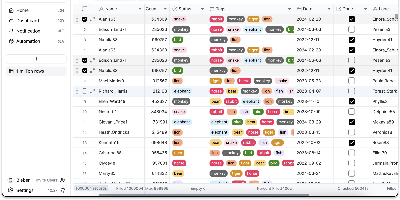
An Airtable-style spreadsheet interface directly on PostgreSQL: Teable is an open-source no-code database where every table is a real Postgres table. Unlike tools that store records in a metadata abstraction layer, every Teable table is a real Postgres table with standard column types, so filtering, sorting, and grouping run at database speed, million-row tables answer complex filters in roughly 200 milliseconds without index tuning, and any PostgreSQL-compatible tool - psql, BI dashboards, ETL pipelines - can query the same data directly. The interface offers Grid, Kanban, Gallery, Calendar, and Form views as non-destructive overlays with their own filters and hidden fields, plus 20+ field types, formulas, comments, attachments, batch editing, undo/redo, and edit history. Collaboration is real-time with live cursors and instant sync across views, backed by Redis, and a REST API is auto-generated per table, largely compatible with Airtable API clients - alongside native SQL access for BI tools, analytics pipelines, and your own applications to JOIN and query directly, with no exports, API rate limits, or sync jobs. Global search spans all records, chart plugins handle quick visualization, and CSV and Excel import/export cover migrations. Where Airtable caps paid plans at 100K-500K rows and charges roughly $20 per user per month, a self-hosted Teable instance has neither limit: the Postgres database itself is the export if you ever leave. Built in TypeScript with NestJS, deployed via Docker with PostgreSQL and Redis, and licensed AGPL-3.0.
Webstudio
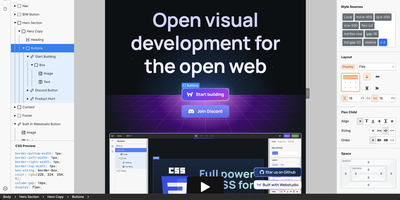
Webstudio delivers a professional-grade visual website builder that outputs semantic HTML and clean CSS without inline style pollution or JavaScript-heavy render paths. The live canvas editor provides direct manipulation of all CSS properties — flexbox, grid, spacing, typography, transforms, and filters — with real-time preview across responsive breakpoints. The component system supports reusable instances with variants and overrides, while design tokens maintain consistent colors, fonts, and spacing across the entire site. Data bindings connect to external content sources through native integrations with Strapi and Supabase, plus a generic CMS interface for any REST API backend. The Scroll Timeline API powers animations at 120 FPS off the main thread, with presets for rotate, scale, translate, opacity, color, and filter effects. Projects build as dynamic Remix applications with server-side rendering or export as static HTML, CSS, and JavaScript files. The Webstudio CLI generates Docker-ready builds that run a Node.js server on port 3000, with Nginx reverse proxy configuration for SSL termination via Let's Encrypt. The builder requires minimum 1 GB RAM and 1 CPU core for Docker builds. MCP integration enables AI agents to create and modify websites programmatically. On RepoCloud, deploy Webstudio projects on a dedicated VPS with root SSH access, persistent storage, and complete control over your hosting, custom domains, and deployment pipeline, all under the AGPL-3.0 license.
Nocobase
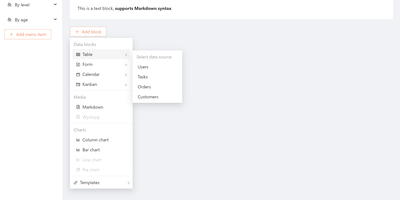
CRMs, project trackers, inventory tools - NocoBase is an open-source no-code/low-code platform for building business systems like these. Its architecture is data-model driven: you define collections and relationships first, then compose any number of interface blocks (tables, forms, kanban, charts) on top of the same model, so data structure is never coupled to a particular view. The core is a microkernel where every feature is a plugin, WordPress-style; you enable official plugins, install marketplace ones, or write your own as npm packages with server and client parts. Data sources include the main PostgreSQL or MySQL database, external databases, and third-party APIs - so you can build admin panels over existing production data instead of migrating it. Built-in infrastructure covers role-based permissions down to collection, record, and field level, workflow automation with approval steps and scheduled triggers, and audit logs; a one-click switch flips between usage and configuration modes. Because custom features live in isolated plugins with a documented lifecycle, core upgrades do not overwrite your customizations, and swapping UIs never requires data migrations since interfaces sit on independent models. Written in TypeScript on Node.js, Koa, and React under the AGPL license, it is light enough for one person to run and extend - and where no-code SaaS platforms charge per seat and per app, a self-hosted instance runs unlimited applications for unlimited users at hosting cost alone.
Flowise
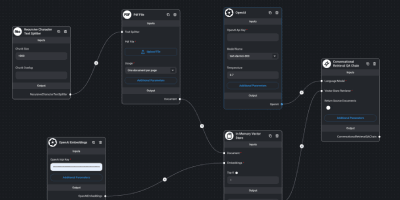
Drag nodes onto a canvas and ship an LLM app: Flowise is an open-source visual builder for AI agents and LLM applications, written in Node.js on LangChain.js and licensed Apache-2.0. You assemble flows by dragging nodes onto a canvas: models, prompts, memory, vector stores, retrievers, and tools, then wire them together and test in the built-in chat panel. Three builder types cover increasing complexity: Assistant for simple RAG chat over uploaded files, Chatflow for single-agent systems with techniques like rerankers and Graph RAG, and Agentflow for multi-agent orchestration with branching, looping, shared flow state, and human-in-the-loop checkpoints. Over 100 integrations connect data sources, vector databases, and both proprietary and open-source models, plus MCP client and server nodes for standard tool interop. Finished flows are exposed as REST APIs, embedded chat widgets, or via JS and Python SDKs - each flow gets an endpoint the moment it is saved, removing the deployment gap between a working prototype and something your application can call. Execution logs, visual step debugging, and external log streaming trace behavior, while input moderation and rate limiting act as guardrails; RBAC, SSO, and workspaces cover team deployments. Self-hosting keeps prompts, encrypted credentials, and conversation data on your own instance, which matters when flows handle internal documents or customer data - and wiring a model, prompt, memory, and vector store on the canvas replaces the boilerplate a hand-coded LangChain project would need.
AutoGen Studio
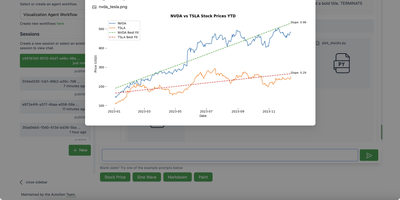
Prototype multi-agent AI systems without writing orchestration code: AutoGen Studio is Microsoft's low-code interface over the AutoGen AgentChat framework. You compose teams of LLM-powered agents in a visual Team Builder, either by drag-and-drop from a component library or by editing the declarative JSON specification directly. Each agent gets a model, a prompt, tools (Python functions), and the team gets termination conditions and an orchestration pattern, sequential or LLM-driven. The Playground runs teams interactively with live message streaming between agents, a visual control-transition graph, tool-call and code-execution tracking, and pause/stop controls, which makes it a practical debugger for agent behavior. Finished teams export as JSON for use in any Python application via the TeamManager class, or serve as an API endpoint. Any OpenAI-compatible model endpoint works, including local servers like Ollama or vLLM. Microsoft labels it a research prototype: use it for prototyping and evaluation, and build production systems on the underlying AutoGen framework.
ToolJet
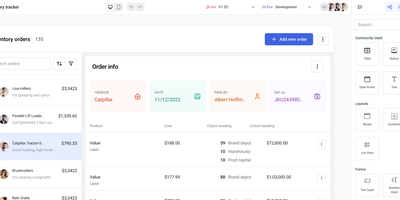
Retool's job, self-hosted: ToolJet is an open-source low-code platform for building internal tools, dashboards, and admin panels. Apps are assembled in a drag-and-drop visual builder with 60+ responsive components, including tables, charts, forms, and lists, and connected to 80+ data sources: PostgreSQL, MySQL, MongoDB, REST and GraphQL APIs, cloud storage, and common SaaS tools. When visual configuration is not enough, you can run JavaScript or Python inline for queries and transformations. A built-in no-code database (ToolJet Database) covers apps that need their own tables without provisioning an external database, Workflows add node-based automation for background jobs with dedicated worker containers and a Redis-backed queue, and multi-page apps with multiplayer editing, inline comments, and mentions support team development. Security is designed for internal data: credentials are AES-256-GCM encrypted, data flows proxy-only through your server so database contents never reach a third-party cloud, and granular per-app access control plus SSO gate each tool. Where Retool-style platforms bill per builder and sometimes per end user, the self-hosted Community Edition serves unlimited builders and users at hosting cost, and full source availability means the platform itself can be forked, audited, and extended. The stack is Node.js and React on PostgreSQL, deployed via Docker.
Budibase
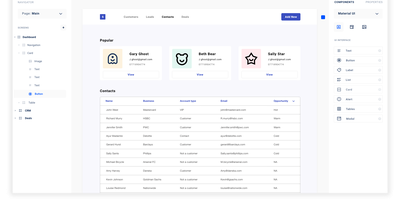
Step right up to the magical world of Budibase, the open-source wizardry that turns the grueling task of building internal tools into a walk in the digital park. Imagine crafting mighty tools and formidable forms in less time than it takes to brew a cup of coffee, all without typing a single line of code! With Budibase, you can charm data from an ancient external database, summon information from a Rest API, conjure up figures from a CSV, or create something entirely new with Budibase's own mystical database. Design your digital dominion with a flick of the drag-and-drop, and automate your kingdom's workflows as if by magic. Join the ranks of the 75,000 teams who've harnessed the power of Budibase to accelerate their business quests. Need to safeguard data like a digital fortress, automate tasks like a sorcerer, or streamline operations like a high-speed chariot? Budibase is your trusty steed in the race to operational victory. And with RepoCloud hosting, you'll save a treasure chest of gold compared to those other cloud-dwelling giants!
Node-RED
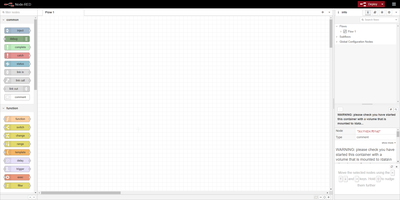
Wire nodes together in a browser, deploy in one click, and real-time data flows from sources through transformations to outputs: Node-RED is the OpenJS Foundation's flow-based programming tool for event-driven applications. Born at IBM as a proof-of-concept for manipulating MQTT topic mappings, it has become the lingua franca of IoT and automation glue - home automation, industrial control, edge data collection - with a community library of over 5,000 contributed nodes and flows covering protocols, devices, and services. Where visual wiring runs out, JavaScript function nodes written in a rich in-editor code editor take over, and every flow serializes to importable, exportable JSON that shares cleanly and version-controls sensibly. Version 5.0 (2026) delivered the largest editor overhaul in the project's history: a rethought layout with Explorer and Information panels in a split sidebar, a native dark theme with theme variants, improved accessibility, and refreshed node appearance. The runtime is lightweight Node.js, exploiting the event-driven non-blocking model so the same flows run on a Raspberry Pi at the network edge or a cloud VM. Apache-2.0 licensed with 240+ contributors, it pairs naturally with dashboard nodes for live charts and controls.
FastGPT
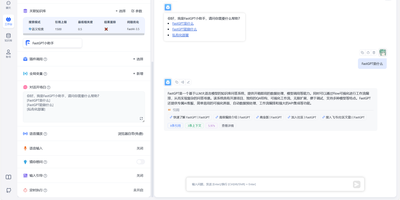
FastGPT lets you build production AI agents and knowledge base chatbots through a visual drag-and-drop workflow editor, connecting any LLM provider to your documents with retrieval-augmented generation that cites sources and reduces hallucination. The workflow canvas chains LLM calls, conditional branching, HTTP requests, code sandbox execution, and plugin nodes into complex conversation flows and agent skill pipelines without writing backend code. The knowledge base engine ingests documents in ten formats (TXT, Markdown, HTML, PDF, DOCX, PPTX, CSV, XLSX, URL scraping, and CSV batch import) then applies automatic chunking, hybrid vector retrieval with semantic reranking, and QA-pair splitting to deliver accurate, citation-backed answers. FastGPT connects to virtually any LLM provider through its AI Proxy aggregation layer: OpenAI GPT-4o, Anthropic Claude, Google Gemini, DeepSeek, Qwen, ERNIE Bot, and models hosted via Ollama all work through a unified OpenAI-compatible API. Bidirectional MCP support enables agents to call external tools and expose their own capabilities to other systems. Completed applications can be shared via login-free links, embedded as iframe widgets, or integrated with WeCom, Lark, DingTalk, and WeChat Official Accounts through the published REST API. Application operation logs, conversation annotation, and per-model usage analytics provide full lifecycle governance for compliance-sensitive deployments. Running on a dedicated VPS on RepoCloud with guaranteed CPU, RAM, and SSD, full root SSH access, and a browser serial console. FastGPT Open Source License (Apache 2.0 based) licensed.
Appsmith
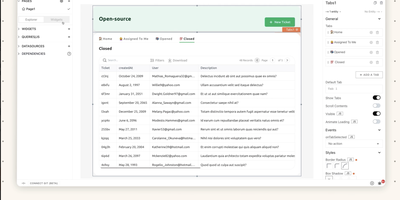
Admin panels, database GUIs, dashboards, approval flows, customer support consoles - Appsmith builds the internal tools your team keeps postponing, on an open-source low-code platform. The UI assembles from 45+ drag-and-drop widgets - tables with server-side pagination and inline editing, charts, forms, lists, buttons - which bind to data through {{ }} JavaScript expressions anywhere in the editor. Datasources cover PostgreSQL, MySQL, MongoDB, MS SQL, Redis, Snowflake, and more, plus any REST or GraphQL API, with SaaS integrations and AI query support for prompt-based steps inside apps. When the widget library falls short, custom widgets are plain JavaScript, HTML, and CSS, and external JS libraries can be imported, which keeps the platform extensible where pure no-code tools hit walls. Git-based version control enables branch-based collaboration, review, and rollback of app definitions. Queries and JS objects hold the business logic layer between datasources and UI. Self-hosted via Docker or Kubernetes, with role-based access control for published apps.
NocoDB
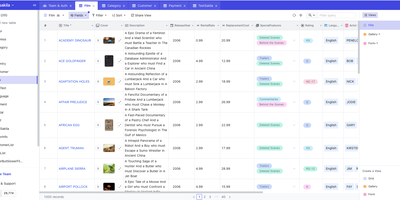
Any existing relational database becomes a collaborative, Airtable-style smart spreadsheet under NocoDB. It connects to PostgreSQL, MySQL, MariaDB, SQL Server, or SQLite, introspects the schema - tables, relationships, indexes - and renders it as interactive Grid, Gallery, Kanban, Calendar, and Form views without migrating a single row. Your business data stays in your database; NocoDB keeps only its own metadata (view configs, permissions, webhooks) in a separate store. Every connected table automatically gets REST APIs with Swagger documentation, effectively turning legacy databases into modern backends. The spreadsheet layer adds 20+ field types including formulas, lookups, rollups, links, attachments, and currency, plus sorting, filtering, grouping, and multi-field editing. Views can be locked or shared publicly with password protection, role-based access control scopes permissions per user, and webhooks plus CSV, Excel, and Airtable import round out integration. An ERD view visualizes the schema. Built with Node.js and Vue, deployed via Docker, handling millions of rows.
Sim Studio
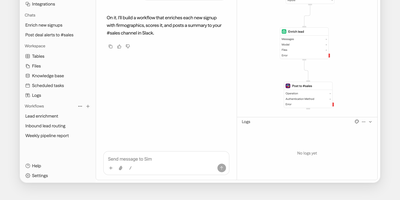
Sim Studio lets teams build, deploy, and monitor AI agent workflows by dragging blocks onto a visual canvas and wiring them into executable pipelines, backed by over 1,000 integrations. The React Flow editor represents each step as a node: LLM calls, tool invocations, conditional branches, and data transformations form directed acyclic graphs that run as complete agent pipelines. Every major LLM provider works natively, including OpenAI, Anthropic, Google Gemini, Groq, and Cerebras, plus local models through Ollama and vLLM. Integrations span Gmail, Slack, Microsoft Teams, Telegram, WhatsApp, Notion, Google Workspace, Airtable, GitHub, Jira, Linear, Perplexity, Firecrawl, PostgreSQL, Supabase, Pinecone, and Qdrant. Built-in tables provide a database layer, a file store offers shared team storage, and knowledge bases powered by PostgreSQL with pgvector enable retrieval-augmented generation. Finished workflows deploy as REST API endpoints, scheduled jobs, or Slack bots, with block-by-block execution traces for full observability. Real-time collaborative editing via Socket.io supports simultaneous multi-user construction. Alternatively, describe agent behavior in natural language and Sim assembles the workflow automatically. Built on Next.js App Router, Bun runtime, Drizzle ORM, and Tailwind CSS. 29,400+ GitHub stars and 100,000+ builders. Apache-2.0 licensed.
Undb
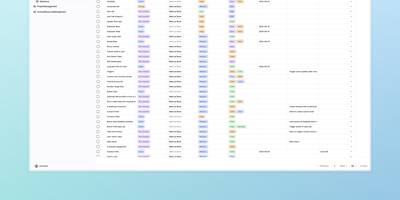
Undb turns a browser tab into a full-featured database with spreadsheet-style editing, auto-generated REST APIs, and five configurable views for every table. The platform organizes data through Spaces, Bases, and Tables, offering grid view for traditional editing, Kanban boards for workflow tracking, calendar for date-based planning, gallery for image-rich records, and pivot tables for analytical summaries, each with independent filtering, sorting, color coding, and field selection. An ANTLR4-powered formula engine provides Airtable-style calculated fields with proper syntax validation, variadic argument handling, and type-checked function signatures that go beyond simple string interpolation. Every table automatically generates a fully documented OpenAPI REST endpoint with Swagger UI, letting developers integrate Undb data into external applications through standard HTTP methods without additional configuration. The Drizzle ORM abstraction layer supports four database backends (SQLite, PostgreSQL, MySQL, and Turso edge-distributed SQLite) with separate migration configurations for each adapter. Authentication uses Lucia with OAuth2 via Arctic for GitHub login and Oslo for TOTP two-factor authentication. The SvelteKit 5 frontend renders through Houdini's compile-time GraphQL client and TanStack Svelte Query, while the Elysia.js backend compiles into a single executable via Bun's --compile flag, embedding all assets into one portable binary. File attachments store in any S3-compatible backend including MinIO. Running on a dedicated VPS on RepoCloud with guaranteed CPU, RAM, and SSD, full root SSH access, and a browser serial console. AGPL-3.0 licensed.
Astron Agent
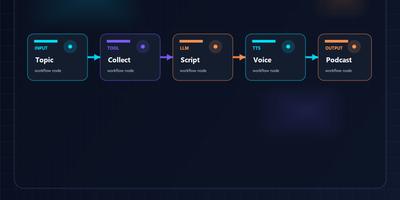
Recognized by the CNCF Landscape in the AI Agent – Workflow Orchestration category alongside Dify and Temporal, Astron Agent is iFLYTEK's fully open-source platform for building, deploying, and managing enterprise multi-agent systems — backed by 8,900+ GitHub stars and the production infrastructure behind one of China's largest AI companies. Unlike pip-install frameworks such as LangGraph, CrewAI, or AutoGen, Astron Agent ships as a complete microservices platform spanning 10+ services across Java, Python, Go, and TypeScript: a ReactFlow-based visual workflow builder for low-code agent orchestration, native integration with the Model Context Protocol (MCP) for tool calling, a built-in model management layer supporting iFLYTEK Spark, OpenAI, Anthropic, and on-premises MaaS deployments, and a multi-tenant Go authentication service powered by Casdoor. The standout differentiator is native RPA integration via the companion astron-rpa project (7,200+ stars), providing 300+ pre-built automation capabilities spanning browser, Office document, and enterprise system interaction — enabling agents to execute physical UI actions rather than only API calls. Infrastructure includes PostgreSQL for multi-tenant data isolation, MySQL for application metadata, Kafka for event streaming, Redis for caching, and MinIO for object storage, all orchestrated through Docker Compose with explicit health checks and dependency chains or production Kubernetes Helm charts. Running on a dedicated VPS on RepoCloud with guaranteed CPU, RAM, and SSD, full root SSH access, and a browser serial console. Apache 2.0 licensed.
APITable
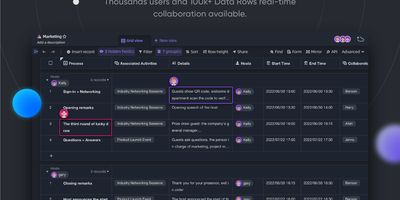
With over 15,000 GitHub stars and positioning itself as the most feature-complete open-source alternative to Airtable, APITable combines a buttery-smooth spreadsheet interface with a full database engine and automatic API generation that turns every datasheet into a queryable REST endpoint without writing a single line of backend code. Real-time collaborative editing powered by Operational Transformation algorithms supports 100,000+ rows with multiple simultaneous users, while seven built-in view types — Grid, Kanban, Gallery, Gantt chart, Calendar, Mindmap, and Form — let teams visualize the same data in whatever format suits their workflow. The one-click API panel exposes every table as a documented REST API with filtering, sorting, and pagination, effectively functioning as a backend-as-a-service for frontend developers and automation builders. Robot automation triggers workflows on record changes with integrations into n8n, Zapier, Appsmith, and Slack, while the extensible widget system provides 20+ open-source widgets for custom charts, dashboards, and data visualizations embedded directly into datasheets. Enterprise features include SAML single sign-on, field-level and row-level permissions via Mirrors, organizational team management, audit logging, database auto-backup, and data export. Bi-directional table linking with infinite cross-links creates relational data models across workspaces, and built-in templates cover CRM, project management, inventory, and content planning. Running on a dedicated VPS on RepoCloud with guaranteed CPU, RAM, and SSD, full root SSH access, and a browser serial console. AGPL-3.0 licensed.
Corteza
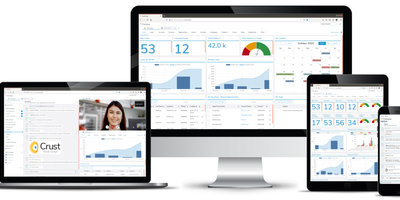
Salesforce's platform model, 100% open-source (Apache 2.0): Corteza is a Go/Vue.js low-code platform developed under a foundation, so there is no open-core bait to grow out of. The heart is Corteza Compose: namespaces contain applications, modules define record structures the way Salesforce objects do, and a drag-and-drop page builder assembles record pages, list pages, dashboards, and charts from configurable blocks. Automation comes from a visual, BPMN-style workflow engine plus JavaScript automation scripts, so cross-application business logic - approval chains, field updates, notifications - is configured rather than programmed. Granular role-based permissions reach down to individual modules, fields, and records, mirroring real organizational hierarchies. Corteza CRM ships as the flagship application built entirely on Compose: leads, accounts, opportunities, campaigns, and cases with a 360-degree customer view, covering most Salesforce standard objects - and because it is just a Compose app, adding or reshaping modules is configuration, not a fork. Everything is reachable over REST APIs, deliberately familiar tooling eases Salesforce admin migration, and a CLI can even generate synthetic records for load-testing what you build.
LLemonStack
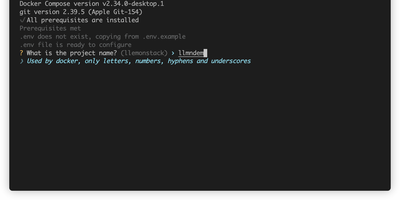
One CLI command deploys a complete AI development environment: n8n, Flowise, Supabase, Ollama, Qdrant, LiteLLM, Langfuse, Open WebUI, LightRAG, Browser-Use, Firecrawl, Crawl4AI, and more, all pre-wired with networking, credentials, and database connections. LLemonStack eliminates the hours of Docker Compose configuration that typically precede any local AI agent project. The llmn CLI initializes isolated project environments with auto-generated secure credentials, starts services in dependency order (databases first, then middleware, then apps), and displays a dashboard showing every service URL and access token. n8n brings 400+ workflow integrations, Flowise provides visual agent building, Ollama runs local LLMs like Llama and Mistral, Qdrant stores vectors at high performance, Open WebUI offers ChatGPT-style model interaction, and LiteLLM proxies requests to any provider with cost tracking. Langfuse automatically logs traces for every LiteLLM query, providing full observability. Each project maintains isolated Postgres schemas preventing data collision across parallel stacks. Firecrawl and Crawl4AI extract web content into LLM-ready formats for RAG pipelines feeding LightRAG or Qdrant. Dozzle streams live container logs for debugging. Import/export tooling migrates workflows between projects with automatic credential reconfiguration. Running on a dedicated VPS on RepoCloud with guaranteed CPU, RAM, and SSD, full root SSH access, and a browser serial console. AGPL-3.0 licensed.