LangWatch
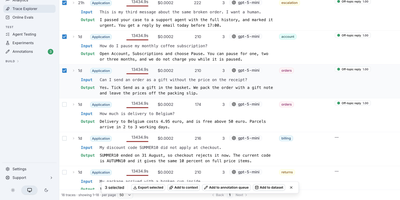
Every call your AI agents make becomes a searchable trace in LangWatch, and the same platform tests and scores those agents before a new prompt or model reaches users. The Trace Explorer filters by origin, user, model, cost, and evaluator, reads each run as a waterfall, flame graph, topology, or sequence diagram, and takes traces from the Python, TypeScript, and Go SDKs or any OpenTelemetry source. Agent Testing sends simulated users, in text or beta voice calls, through your agent while a judge passes or fails every criterion with its reasoning, adds multi-turn red teaming, and compares two agents side by side. The Experiments workbench scores prompts and agents on datasets with LLM judges, exact match, and RAG checks, then compares runs on cost, latency, and pass rate, while online evaluations monitor live traffic and guardrails block unsafe replies. Prompts keep version history and staging or production tags, Workflows wire prompts, Python code, and HTTP calls on a visual canvas, and annotation queues route traces to human reviewers. Alerts fire when a graph crosses a threshold, automations post to Slack, email, or webhooks, and scheduled reports go out by email or Slack. Claude Code, Codex, Copilot, Gemini CLI, and opencode report session cost, pull request cost, and terminal replays, and an MCP server exposes trace search and prompt management to coding assistants. Running on a dedicated VPS on RepoCloud with guaranteed CPU, RAM, and SSD, full root SSH access, and a browser serial console. Apache-2.0 licensed.
MiroFish
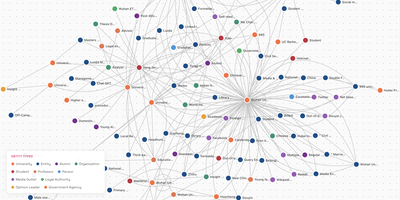
Upload a report, ask a "what if" question in plain language, and MiroFish builds a small simulated society that plays out the answer before you commit to a decision. It reads your seed documents, whether news, policy drafts, financial signals, or a novel, and extracts entities and relationships into a GraphRAG knowledge graph. Entities from the graph become agents with a profession, a biography, and interest tags, and the app estimates simulation rounds from the simulated time span, with a custom mode for shorter runs. Agents post and react on two simulated platforms at once, a feed-style plaza and a topic community, while a live monitor tracks rounds, elapsed simulated time, and actions. A ReportAgent then plans an outline and writes the prediction report section by section with the InsightForge, PanoramaSearch, QuickSearch, and InterviewSubAgent tools. Afterward you can keep questioning the ReportAgent, chat with any individual agent, or send a survey question to a selected group and read their answers. Typical uses include rehearsing public relations responses, testing policy drafts against likely reactions, and exploring alternate endings for a story. The interface switches between English and Chinese, and you bring your own model: any OpenAI SDK compatible LLM endpoint works, Zep Cloud stores agent memory, and the project suggests starting under 40 rounds because runs consume many tokens. Running on a dedicated VPS on RepoCloud with guaranteed CPU, RAM, and SSD, full root SSH access, and a browser serial console. AGPL-3.0 licensed.
MCPProxy
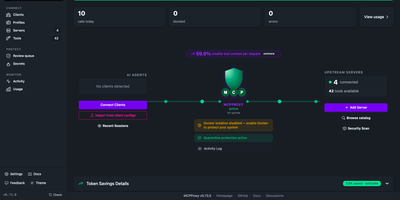
MCPProxy puts one safe endpoint in front of every MCP server your AI agents use, and it holds each new server in quarantine until a person approves it. Add stdio or HTTP servers on the Servers page, then review the captured tool definitions and scanner findings in the Review queue before any agent can call them. The Tools page lists every tool with a Read, Write, or Destructive tier, an approval state, and a usage count, plus switches to hide whatever you do not want exposed. Agents see a short set of discovery and call tools instead of the full catalog, and the Home dashboard estimates how much context that saves per request. The Activity Log records each call with its server, intent, status, and duration, and exports for audits. The Usage page charts calls per tool, response sizes, errors, latency, and activity over time, filtered by profile, client, or token. Profiles and agent tokens scope what each client may reach, a Secrets page keeps credentials out of config files, and a setup wizard connects Claude Code, Claude Desktop, Cursor, Windsurf, and VS Code. Platform teams and solo builders get one place to see and control everything their agents can touch. Running on a dedicated VPS on RepoCloud with guaranteed CPU, RAM, and SSD, full root SSH access, and a browser serial console. MIT licensed.
MaxKB
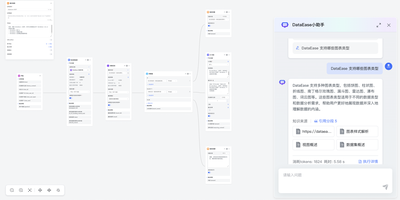
Support teams, IT departments, and researchers can put their own documents behind chatbots and AI agents built with MaxKB, an open-source platform that grounds answers in private knowledge. A support lead starts by uploading Markdown, DOCX, PDF, TXT, HTML, XLSX, XLS, or CSV files, or by syncing a web site, and MaxKB splits, vectorizes, and indexes the content on its own. An IT department can place the finished agent in any third-party site or internal tool with no coding, as a full-screen page, a mobile view, or a floating chat window. Researchers get replies that show, and let them download, the knowledge sources behind each answer. Simple agents pick tools, skills, and MCP connections from the question itself, while advanced agents are drawn as workflows with branching, multi-path recall, loops, and variables. Custom scripts, which AI can help write, plus schedules and event triggers extend what an agent can do. The model manager registers local models such as DeepSeek, Llama, and Qwen beside providers such as OpenAI, Claude, and Gemini, across language, embedding, reranking, vision, speech, and image generation. Conversation logs feed analysis for operations. Dozens of ready-made agent templates, knowledge base templates, tools, and skills in the template center and tool store shorten the first build. Running on a dedicated VPS on RepoCloud with guaranteed CPU, RAM, and SSD, full root SSH access, and a browser serial console. GPL-3.0 licensed.
UltraRAG
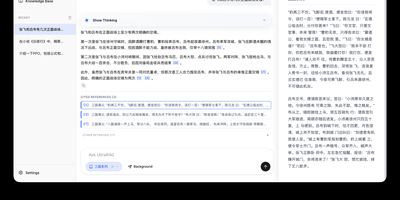
Every step, loop, and branch of a retrieval-augmented generation pipeline appears as a node on UltraRAG's visual canvas, with the YAML behind it kept in sync. Edit nodes on the canvas or in the synchronized YAML editor, press Build, read the console, set model endpoints and credentials on the Parameters page, and manage Jinja prompt templates. Corpus parses and chunks documents, Retriever embeds and indexes them in FAISS or Milvus, Generation calls vLLM, Hugging Face, or OpenAI, and each runs as its own MCP server you can swap or extend. Pipelines run in sequence, loop, or branch on a condition, and bundled examples cover Search-o1, VisRAG, IRCoT, and deep-research workflows. The Knowledge Base page creates Milvus collections and uploads documents, and Chat runs a built pipeline against a chosen collection and shows the sources behind each answer. The AI Assistant inspects your workspace, validates proposed YAML, and waits for you to apply or reject each change. Evaluation scores retrieval with MRR, NDCG, MAP, and Recall and generation with EM, F1, and ROUGE, and a built-in permutation test checks whether one retriever truly beats another. A Case Study viewer steps through each stage's inputs and outputs for every question, so you can see exactly where a pipeline went wrong. Running on a dedicated VPS on RepoCloud with guaranteed CPU, RAM, and SSD, full root SSH access, and a browser serial console. Apache-2.0 licensed.
Faster Chat
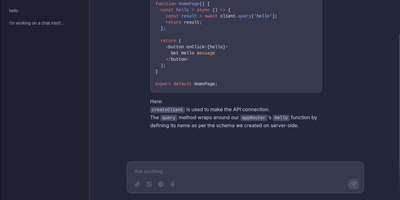
With Faster Chat, your team chats with OpenAI, Anthropic, Google, Groq, DeepSeek, or local Ollama models from one self-hosted window, and every conversation stays on your own server. The first account to register becomes admin, adds providers from a searchable hub that auto-discovers more than fifty services, picks which models people may use, and adds members or read-only users directly or through single-use invite links that expire after seven days. Members chat with streaming replies, Markdown, syntax-highlighted code, and LaTeX, attach files, send images to vision models, generate pictures through OpenAI, Replicate, or OpenRouter, and dictate by voice or have answers read aloud. Users can review or delete everything the memory feature has stored, opt a single chat out of it, and let web search cite its sources as clickable pills. Admins pull Ollama models from the admin panel with live download progress instead of a command line, and anyone can import a ChatGPT export or switch among fifteen-plus color themes, custom fonts, light and dark modes, or a focus mode. White labeling swaps in your organization's app name and sidebar icon, API keys stay encrypted, and one Docker Compose command starts the stack, with optional HTTPS through Caddy. Running on a dedicated VPS on RepoCloud with guaranteed CPU, RAM, and SSD, full root SSH access, and a browser serial console. MIT licensed.
Kotaemon
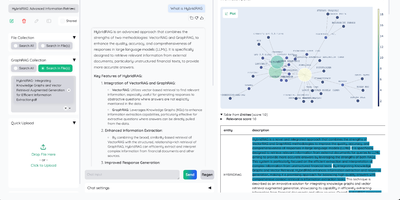
Kotaemon is a document QA platform that combines advanced RAG techniques with a clean Gradio-based web interface for chatting with your documents. Built by Cinnamon, the Python backend supports any LLM provider including OpenAI, Azure OpenAI, Cohere, Groq, and local models via Ollama and llama-cpp-python, with a model management panel for configuring LLM and embedding providers from the UI. The default hybrid RAG pipeline combines full-text keyword retrieval with vector similarity search and applies re-ranking to ensure optimal result quality, while multi-modal document parsing extracts content from tables and figures alongside text. Advanced citations link every answer to specific source passages with relevance scores, viewable directly in the built-in PDF viewer with highlighted text spans. GraphRAG indexing via NanoGraphRAG, LightRAG, or Microsoft GraphRAG builds knowledge graphs from document collections for relationship-aware retrieval. Agent-based reasoning supports question decomposition for multi-hop queries using ReAct and ReWOO strategies. Multi-user authentication organizes documents into private and public collections with sharing and collaboration features. The platform supports Docker deployment in lite, full, and Ollama-bundled variants, runs on port 7860, and stores application data in a persistent volume. MCP tool integration enables external system connections for extended retrieval capabilities. On RepoCloud, deploy Kotaemon on a dedicated VPS with Docker, root SSH access, and complete control over your document AI infrastructure, all under the Apache 2.0 license.
AgentFlux
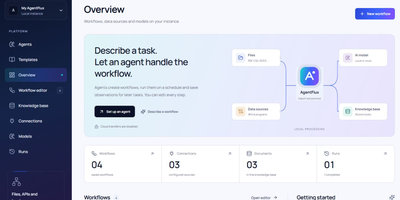
Describe the task in plain words, pick the sources and model it may use, and an agent plans the workflow before running it. That is the core loop: agents build editable visual workflows from a task description, execute them on demand or on a schedule, and keep everything traceable. Prefer building by hand and the canvas offers 17 preconfigured steps, branching, undo and redo, JSON import and export, plus eight starter templates. Feed it real work by importing PDF, DOCX, XLSX, CSV, JSON, and text files, or by connecting folders, HTTP endpoints, and approved local programs. Upload a screen recording and it identifies the actions with timestamps, turning a demonstrated process into an editable workflow you can refine. Model calls go to the endpoint you choose: Ollama, LM Studio, vLLM, or any OpenAI-compatible service, local or cloud with your own credentials. Every run can be inspected step by step, cancelled mid-flight, and exported as JSON, CSV, or Markdown reports. Observations from completed runs land in a knowledge and learnings store, where you review them and promote the useful ones into reusable skills for the next task. The Docker release bundles the application with FFmpeg and local Whisper support, and your documents stay on your own machine. Running on a dedicated VPS on RepoCloud with guaranteed CPU, RAM, and SSD, full root SSH access, and a browser serial console. Apache License 2.0 licensed.
Ollama GUI
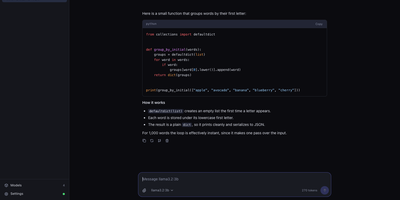
Chat with your own local language models from a clean, fast browser interface. Ollama GUI gives every model on your Ollama server a proper home: streaming replies you can stop, regenerate, or edit, with each edit saved as a version you can flip back to. Reasoning models show their thinking in a collapsible block, and you pick between thinking on, off, or an effort level. Attach images for vision models or drop in text and code files, and answers render with highlighted code, tables, and math. Pull models from a searchable catalog with live progress, check their capabilities and context length, unload them from memory, or delete them in a click. Chats are grouped by date, pinned, archived, renamed, titled automatically, and searched across every message from a command palette. System prompts and generation settings apply globally, per model, or per chat. Light and dark themes, locale-aware dates, and JSON or Markdown export round out the daily routine. Run one shared front end for a whole team or homelab, and every browser keeps its own private history. Running on a dedicated VPS on RepoCloud with guaranteed CPU, RAM, and SSD, full root SSH access, and a browser serial console. MIT licensed.
Whirl
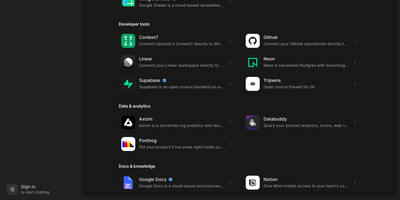
Whirl puts every top AI model in a single conversation and remembers what you were working on last week, so you can switch models mid-thought without losing the thread. Ask for a report, a chart, or a small interactive page and it appears as a living artifact in a side panel, still editable while you keep chatting, and shareable by link when it is ready to leave the conversation. Connect your own tools over MCP, with OAuth sign-in handled for you, or install skills that teach the app new tricks your team relies on. Long-term memory carries your preferences and project context from chat to chat, and live web search with page reading grounds answers in today's pages instead of the model's training data. Sensitive threads can be locked with a password that encrypts them on your device, where the server never sees the key and only zero-retention models may answer. Around those headline pieces sits the everyday kit: incognito mode, a message queue for when you think faster than the model replies, voice input, image generation, file attachments, folders, and sharing controls. An admin console manages the model catalog, integrations, and skills, and the interface itself switches between light and dark with your choice of accent color, installable as a mobile web app. Running on a dedicated VPS on RepoCloud with guaranteed CPU, RAM, and SSD, full root SSH access, and a browser serial console. MIT licensed.
Aegra
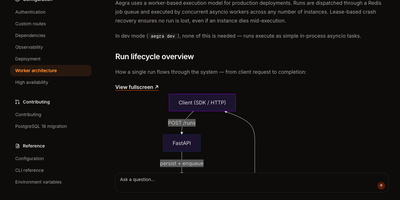
Aegra runs your LangGraph agents on your own infrastructure with the same SDK and APIs you would use on the managed platform, so moving in does not mean rewriting your agents. You deploy an agent once and clients connect through Agent Chat UI, LangGraph Studio, or CopilotKit, while threads, runs, and checkpoints persist between sessions instead of vanishing when a process restarts. Streaming answers arrive token by token over server-sent events, and if a connection drops, the stream reconnects and replays missed events rather than losing the run. Human-in-the-loop gates pause an agent at the step you choose, wait for a person to approve or edit, and then resume from exactly that state. Scheduled cron jobs trigger runs on standard or seconds-level expressions with timezone support, which turns agents into recurring workers for reports, checks, and follow-ups. When traffic grows, Redis-backed workers process runs with lease-based crash recovery, so a dead worker's job is picked up instead of disappearing. Authentication handlers plug in JWT, OAuth, or Firebase, custom endpoints sit beside the agent API, and traces fan out to the observability backend you already run. Running on a dedicated VPS on RepoCloud with guaranteed CPU, RAM, and SSD, full root SSH access, and a browser serial console. Apache-2.0 licensed.
SQL Chat
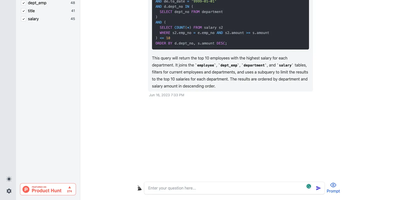
Describe what you want in plain language and get real SQL against your real schema: SQL Chat is an open-source, chat-based SQL client from the Bytebase team. Instead of writing queries in a traditional editor, you connect a database and describe what you want in plain language; the AI reads your schema automatically, generates SQL that references real table and column names, executes it, and returns tabular results in the conversation. Follow-up messages refine the query, so exploration becomes a dialogue - narrow a result set, add a join, change an aggregation - without retyping statements. It supports MySQL, PostgreSQL, SQL Server, TiDB Cloud, and OceanBase from one interface, and covers modification as well as reads: insert, update, and delete operations phrased conversationally. Built with Next.js and TypeScript, it deploys as a single stateless Docker container in single-user mode - connection profiles live in the browser, so there is nothing server-side to maintain. A custom AI endpoint setting routes inference through any OpenAI-compatible API, including self-hosted models, and an optional database-backed mode adds accounts and quotas for offering the tool to a team. MIT-licensed.
AIHelms
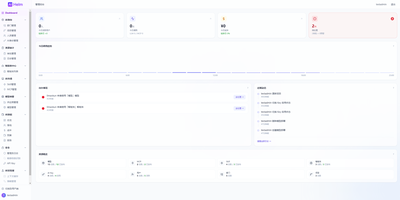
Every employee gets one AI key, and every dollar of model spending gets a name next to it. AIHelms is an admin console and user portal that sits in front of your model providers, so a team can use Claude, DeepSeek, GPT, and local models through one entry point, with IT keeping control. Administrators onboard providers, publish models, and balance traffic across several deployments of the same model, with both OpenAI and Anthropic request formats accepted. Each AI identity carries a model allow-list, quota, rate limits, and an expiry date. Budgets can be set per person, department, project, or model, with soft alerts and hard cut-offs. Internal settlement prices sit beside real provider costs, so departments can be billed with or without a markup. Dashboards show adoption, daily calls, token use, and top users, and weekly or monthly efficiency reports drill down by department. A built-in marketplace registers, approves, and distributes MCP servers and agent Skills, and an AI policy scan flags risky Skills before anyone installs them. Audit logs record every administrator action. Employees see their key, endpoint, models, and monthly spend in the portal. Running on a dedicated VPS on RepoCloud with guaranteed CPU, RAM, and SSD, full root SSH access, and a browser serial console. GPL-3.0 licensed.
GPUWorks
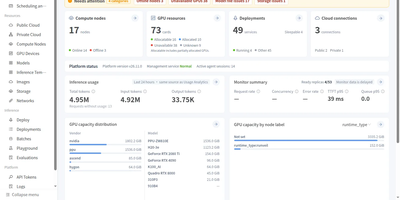
When your GPUs are spread across a rack in the office, rented cloud instances, and a Mac on a desk, GPUWorks pools them into one cluster that serves open models behind a single OpenAI-compatible endpoint. Pick a model from the built-in catalog of launch specs for vLLM and SGLang across NVIDIA, AMD, Huawei Ascend, T-Head PPU, Hygon, and Apple Silicon hardware, and the deploy page estimates the memory needed for weights, KV cache, and engine overhead, shows which GPUs the scheduler chose, and explains why it rejected the others. Several models can share one card through memory quotas or take turns with sleep and wake, while replicas, multi-node parallelism, and prefill and decode disaggregation scale a deployment out. The gateway handles chat, embeddings, rerank, audio, image, and realtime requests with API keys, per-key token usage, and failover routing. A monitor center charts time to first token, throughput, concurrency, and KV cache hit rates, usage analytics break tokens down by key and model, and a built-in benchmark sweeps concurrency to find your latency limit. GPU health checks and an AI assistant help diagnose failing cards, and a Playground lets you try any deployment in the browser. Nodes connect outbound, so they need no open ports, and models can be imported offline for air-gapped sites. Running on a dedicated VPS on RepoCloud with guaranteed CPU, RAM, and SSD, full root SSH access, and a browser serial console. Apache-2.0 licensed.
LoopTroop
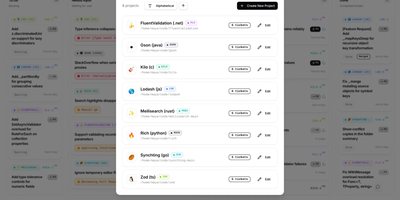
Big coding tickets fall apart inside one endless AI chat, so LoopTroop splits each into stages with fresh, minimal context and ends in a pull request. A council of two to ten models drafts, scores, and votes on each plan, beginning with interview questions that reach you in adaptive batches. The winner refines its draft into a PRD of epics and user stories. That PRD is cut into beads, small tasks with acceptance criteria, target files, and validation steps. Each bead runs in OpenCode inside an isolated Git worktree, so your checked-out branch stays clean. During a bead the agent sees only that task, its target file, and the test file. When a bead fails, the Ralph Loop keeps a compact error trace, resets the worktree, and retries in a fresh session, so tickets can run unattended overnight. You approve specs, blueprints, and the final changes at human gates. Optional Manual QA hands you a checklist for the running app and turns failures into fix beads. A dashboard shows council progress, generated artifacts, live logs, and bead changes. Free-tier models from OpenRouter, NVIDIA NIM, or OpenCode let you start without paid API keys. LoopTroop collects no telemetry, and the project recommends a disposable VM because the agent runs with your permissions. Running on a dedicated VPS on RepoCloud with guaranteed CPU, RAM, and SSD, full root SSH access, and a browser serial console. MIT licensed.
Evidently
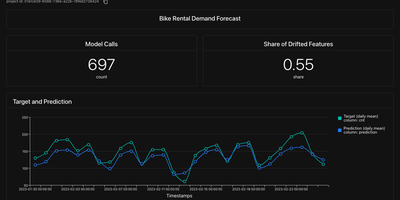
Evidently gives your models and LLM apps a proper check-up and keeps every result on one shared dashboard. Project dashboards chart predictions against targets, data drift, and quality scores over time, with counters for model calls and the share of drifted features. A reports page lists every evaluation snapshot with tags, metadata, timestamps, and view or download buttons, and a search box filters them by metadata. Over 100 built-in metrics cover data quality, classification, regression, ranking, recommendations, text descriptors, and LLM judges. Test suites add pass or fail conditions, so a nightly job can flag a drifting feature before customers notice a bad prediction. Datasets, traces, and prompts have their own tabs, which keeps retrieval and generation experiments beside the scores they produced. Reports export as HTML or JSON for sharing outside the dashboard. Results live in a local folder, a SQL database, or S3-compatible storage, and a remote workspace accepts snapshots sent from jobs running anywhere. Built-in demo projects with bike demand forecasting and e-commerce review classification show how a finished dashboard looks before you wire in your own data. Running on a dedicated VPS on RepoCloud with guaranteed CPU, RAM, and SSD, full root SSH access, and a browser serial console. Apache 2.0 licensed.
Casibase
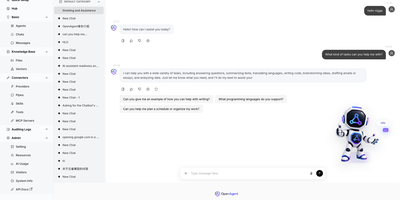
Casibase lets organizations build AI-powered knowledge bases that answer questions from their own documents, connecting to 30+ model providers through a unified admin interface with RAG retrieval and multi-agent orchestration via MCP and A2A protocols. The platform plugs into OpenAI GPT-4o, Anthropic Claude, Meta Llama, Google Gemini, DeepSeek, Ollama local models, HuggingFace, Azure OpenAI, and additional providers, while embedding APIs from OpenAI Ada and Baidu handle vector representation of ingested documents. Document ingestion parses TXT, Markdown, DOCX, PDF, CSV, XLSX, and PPTX files with intelligent chunking strategies for optimal retrieval accuracy. The built-in chat interface provides real-time AI conversations with manual session handover for human agent escalation, and comprehensive chat session logging enables audit trails for compliance. Enterprise identity management integrates Casdoor for Single Sign-On supporting GitHub, Google, WeChat, and OIDC providers with fine-grained access control via the Casbin permission engine. The multi-tenant architecture supports isolated knowledge bases per organization with role-based user management and configurable storage, model, and embedding providers per tenant. The React frontend with Ant Design v5 provides a polished admin dashboard for managing providers, knowledge stores, chat sessions, and user access, while the Go backend with Beego framework handles API logic with MySQL or MariaDB persistence. Running on a dedicated VPS on RepoCloud with guaranteed CPU, RAM, and SSD, full root SSH access, and a browser serial console. Apache 2.0 licensed.
OpenKnowledge
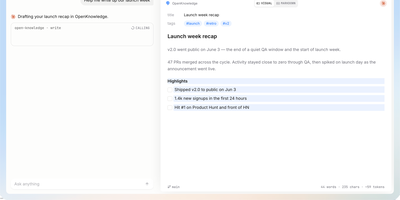
OpenKnowledge turns a folder of markdown files into a workspace where you and an AI agent can write in the same document. The editor feels like a Notion page but saves plain markdown, with a visual mode, a markdown mode, a properties panel for titles and tags, and a file navigator with search and tabs. Ask Claude, Codex, or another harness to draft a recap, and the edit appears beside the chat as you watch. Select any passage and leave a comment, then send all open comments to the agent in one message. A timeline panel lists every change with a before and after diff, so an agent's rewrite is easy to review and undo. Skills Studio covers writing, browsing, and installing agent skills, and it can link one skills folder across Claude, Cursor, Codex, and others. Starter packs set up LLM wikis and second brains, and a graph view shows how wiki links connect pages. Git sync shares a knowledge base with teammates, and rich components like callouts, tabs, and diagrams make specs readable. Running on a dedicated VPS on RepoCloud with guaranteed CPU, RAM, and SSD, full root SSH access, and a browser serial console. GPL-3.0 licensed.