Huly
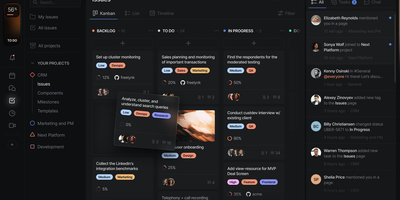
With 27,000 GitHub stars and 349 releases shipping multiple times per week, Huly replaces four separate SaaS subscriptions — Linear for issue tracking, Notion for documents, Slack for team chat, and Motion for time-blocking — with a single self-hosted platform that charges nothing per seat. The issue tracker provides projects, sprints, roadmaps, custom workflows, and Kanban views with bi-directional GitHub and GitLab synchronization that keeps issues and pull requests in lockstep across both systems. Collaborative documents use CRDT-based real-time editing for wikis, meeting notes, and technical specs with nested page hierarchies and rich embedding. Team messaging delivers channels, direct messages, threaded conversations, reactions, and pinned messages in a Slack-equivalent interface that lives alongside your project context. The time-blocking planner schedules tasks into calendar slots with drag-and-drop, integrating directly with your issue backlog so nothing falls through cracks. A virtual office module provides audio and video rooms for standups and pair programming with external guest access. HR features handle team management, office hours, and PTO tracking. The architecture runs 30+ microservices on CockroachDB for ACID-compliant storage, Elasticsearch for full-text search, MinIO for file attachments, and Redpanda for event streaming. Desktop apps ship for macOS, Windows, and Linux alongside mobile apps for iOS and Android. Running on a dedicated VPS on RepoCloud with guaranteed CPU, RAM, and SSD, full root SSH access, and a browser serial console. EPL-2.0 licensed.
Odoo
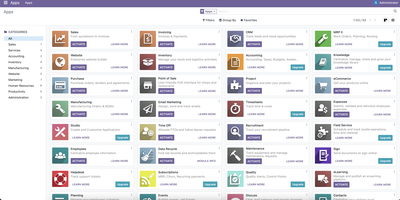
Roughly 40 integrated business apps forming a full ERP: Odoo's open-source suite runs companies end to end. The Community Edition, licensed LGPL-3.0, ships roughly 40 apps covering CRM, sales, invoicing, basic accounting (journals, chart of accounts, taxes, reconciliation), inventory and warehouse management with multi-step routes, manufacturing with BOMs and work orders, purchasing, project management, timesheets, HR, a website builder, and eCommerce. Each app works standalone, but they share one PostgreSQL database and one data model, so a confirmed sale updates stock, triggers procurement, and posts invoices without integration glue. The modular design means you enable only the apps you need and extend with 40,000+ community modules from the Odoo app store covering nearly any vertical requirement. Inventory supports multi-warehouse stock, reordering rules, and lot and serial tracking with barcode-ready operations; manufacturing ties BOMs, work orders, and work-center routing directly to sales demand and stock levels; and the website builder sells straight from your product catalog with payment provider integrations. You can start with just CRM and invoicing on day one and switch on inventory or eCommerce later - new apps integrate with existing data instantly because the schema is shared. The server is Python with an XML/JavaScript view layer, and because data lives in plain PostgreSQL there is no proprietary format: you can query, back up, migrate, and extend business data directly, with unlimited users and no per-seat licensing - where enterprise ERP pricing is per user per month, headcount here costs nothing.
ERPNext
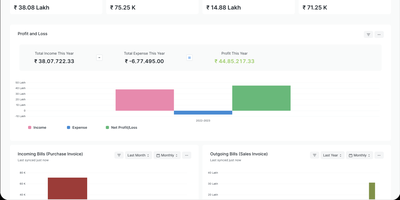
With over 37,800 GitHub stars and active development since its first release in 2008, ERPNext is the most-starred open-source ERP system — delivering accounting, inventory management, manufacturing, CRM, project tracking, asset management, HR, and point-of-sale capabilities through a unified web interface built on the Frappe Framework's metadata-driven architecture. The accounting module handles multi-company consolidation, multi-currency transactions, tax templates for GST and VAT, bank reconciliation, and automated journal entries with real-time profit and loss, balance sheet, and cash flow reporting. Manufacturing covers production planning with multi-level bill of materials, work order scheduling, capacity planning, subcontracting, and quality inspection at each production stage. Inventory tracks stock across multiple warehouses with batch and serial number tracing, automatic reorder levels, landed cost calculations, and perpetual inventory valuation using FIFO or moving average methods. The CRM module manages leads, opportunities, and customer communication with email integration, while project management tracks tasks, timesheets, and Gantt-based scheduling with budget controls. Custom applications extend functionality through the Frappe ecosystem without forking the core codebase, and the REST API enables integration with payment gateways, shipping providers, and third-party services. Deployable via Docker Compose or the bench CLI tool with MariaDB and Redis. Running on a dedicated VPS on RepoCloud with guaranteed CPU, RAM, and SSD, full root SSH access, and a browser serial console. GPL-3.0 licensed.
Ever Gauzy
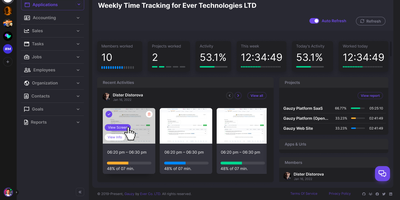
Ever Gauzy consolidates ERP invoicing, CRM sales pipelines, HRM employee records, applicant tracking, and project management into one full-stack TypeScript platform, eliminating the need to stitch together five separate SaaS subscriptions. Over 4,300 GitHub stars and 3,800+ releases back a CQRS architecture that separates command and query responsibilities across modules for invoices, expenses, payments, inventory, contacts, leads, deals, employee onboarding, candidate interviews, hiring workflows, sprints, goals, and KPI tracking. Time tracking captures hours via web timer, Electron desktop timer with activity monitoring and automatic screenshot capture, or browser extension, with timesheet submission and approval workflows supporting billable hour classification across Hubstaff and Upwork integrations. The multi-tenant architecture provides automatic tenant scoping with role-based permissions, while dual ORM support through TypeORM and MikroORM with Knex query builder ensures database flexibility across PostgreSQL, MySQL, and MariaDB. REST APIs documented with OpenAPI and Swagger expose every module for headless operation, complemented by an MCP server offering 323 tools for AI assistant integration. The Angular 19 dashboard provides dark, light, corporate, and material themes with i18n across 10 languages via Crowdin. Supports Docker, Kubernetes, Terraform, and Pulumi deployment with Redis caching and OpenSearch full-text indexing. Running on a dedicated VPS on RepoCloud with guaranteed CPU, RAM, and SSD, full root SSH access, and a browser serial console. AGPL-3.0 licensed.
MintHCM
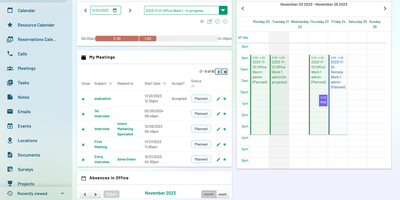
The first AI-enabled open-source Human Capital Management system built for the agentic era — not a legacy HRMS with AI features bolted on, but a platform architected from the ground up with native MCP, A2A, and WebMCP protocols enabling any LLM client to query employee records, create calendar entries, and orchestrate multi-step HR workflows. Built on the battle-tested SuiteCRM/SugarCRM CE foundation and extended with 17 dedicated HR modules — recruitment pipeline with candidate scoring, onboarding checklists, competency matrices, employment history tracking, leave management with accrual policies, time and attendance, resource booking, travel and expense reporting, workplace management, performance evaluations, job description builder, employer branding campaigns, offboarding workflows, and a configurable analytics engine — all controlled through granular role-based permissions. The integrated LangGraph-powered AI agent operates with human-in-the-loop confirmation before mutating data, while the MCP server layer exposes structured HR operations to Claude Desktop, GitHub Copilot, and any MCP-compatible client. Native REST API enables integration with SAP, Workday, and custom applications. Mobile apps for iOS and Android provide field access to employee data and approvals. Runs on Apache2 with PHP 8.2, MySQL 8.0 or MariaDB, and ElasticSearch 7.10+ for full-text search and list indexing. Running on a dedicated VPS on RepoCloud with guaranteed CPU, RAM, and SSD, full root SSH access, and a browser serial console. AGPL v3 licensed.
Atlas
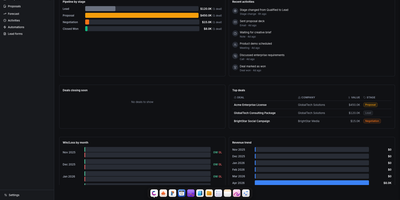
Atlas delivers a complete business operations platform in a single Docker Compose deployment, replacing the need for separate CRM, HRM, project management, invoicing, and file storage subscriptions. The CRM module provides pipeline management with Kanban views, contacts, companies, deals, leads, forecasting, saved views, and web-to-lead forms with Gmail integration for per-user email tracking inside deal timelines. HRM handles employees, departments, org charts, leave management, and attendance tracking. The invoicing system generates professional invoices with recurring billing, customizable templates, and payment tracking. Agreements provides PDF contract generation with legally-binding e-signatures, sequential signing workflows, counterparty linking, audit trails, and automated reminders. Projects integrates time tracking, billing, client management, budgets, and reporting in one view. Drive offers file storage with versioning, sharing, comments, activity logs, and password-protected links with Google Drive import and export. The calendar syncs bidirectionally with Google Calendar across month, week, day, year, and agenda views. Write provides rich text documents with cover images, comments, and templates, while Draw adds an Excalidraw-based whiteboard canvas with PDF export and presentation mode. The platform supports five languages, multi-tenant isolation, role-based permissions, and includes an Odoo importer that ingests res.partner, crm.lead, and CRM activity CSV exports for migration. Built on React, TypeScript, Vite, TanStack Query, and Zustand on the frontend with Express, Drizzle ORM, PostgreSQL, Redis, and BullMQ on the backend. Running on a dedicated VPS on RepoCloud with guaranteed CPU, RAM, and SSD, full root SSH access, and a browser serial console. AGPL-3.0 licensed.
Chief-Onboarding
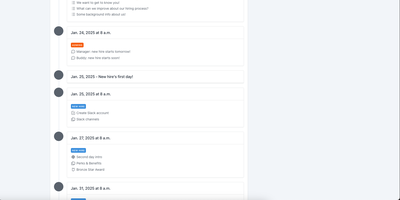
New hires fail from information overload and IT bottlenecks, not lack of goodwill - the observation behind ChiefOnboarding, a free, open-source employee onboarding platform (Django, Celery, PostgreSQL, Redis). Its answer is sequences - drag-and-drop timelines that drip-feed to-do items, resources, courses, forms, and badges to each new hire, triggered by dates or by completing a previous item, so nobody faces everything at once. Onboarding starts before day one: preboarding pages welcome hires early, and colleagues can leave personal messages that appear there. The account provisioning module creates the new hire's Slack, Google, Asana, and other accounts automatically on the scheduled day via a library of integrations plus custom webhooks - the IT ticket queue never gets involved. Everything works through two equivalent interfaces: a full web dashboard and a Slack bot, either usable standalone. Slack can even auto-create new hire accounts when someone joins the workspace and assign default sequences with zero manual action. Colleague tasks with comments and collaboration, a searchable people directory, scheduled introductions, and per-hire timezone awareness (no 3 a.m. notifications) round it out. No trackers, no phoning home - third-party credentials sit in encrypted fields on your server.