OpenBot
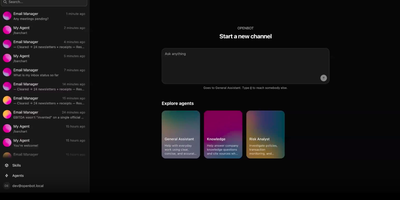
Open source GrokBot, built by the team behind the AG-UI protocol. OpenBot is the open-source enterprise agent platform that gives every AI coworker its own sandboxed computer — a real Chromium browser with its own login sessions, a private filesystem, and only the MCP tools you explicitly grant. The centralized gateway evaluates CEL policy rules against tool name, intent, bot identity, page URL, element attributes, and file paths before any action executes, writing an immutable audit row for every call and outcome. Any agent that speaks AG-UI — LangGraph, Mastra, CrewAI, Pydantic AI, Google ADK, or hand-written endpoints — registers as a Bot and receives its own channel with persistent conversation history. The take-the-wheel system lets humans assume control when an agent encounters login walls or two-factor prompts, recording control transfers as structured audit events. Knowledge documents from Google Drive and OneDrive carry source-based permissions where deny principals always win and ambiguous mappings refuse retrieval entirely. The React and Vite frontend provides live screen viewing of each agent's browser, channel-based chat, admin settings, and component galleries. The Hono API server on port 3001 handles authentication, role-based access, tenant packaging, and credential management backed by PostgreSQL with pgvector. Deploy via Docker Compose with the included supervisor that manages per-bot computer containers. Running on a dedicated VPS on RepoCloud with guaranteed CPU, RAM, and SSD, full root SSH access, and a browser serial console. MIT licensed.
Supabase
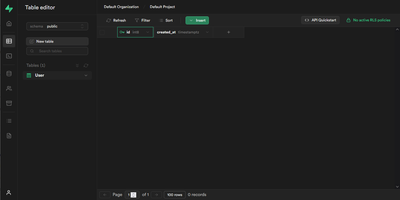
With over 107,000 GitHub stars and adoption by teams at Mozilla, 1Password, Peerlist, and thousands of startups, Supabase has become the most widely deployed open-source Firebase alternative — built entirely on PostgreSQL rather than a proprietary NoSQL store. Every project provisions a dedicated Postgres database with 40+ preinstalled extensions, auto-generating REST APIs via PostgREST, GraphQL via pg_graphql, and real-time change streams via an Elixir-based WebSocket engine that supports database change listeners, user presence tracking, and arbitrary broadcast messaging. Authentication covers email and password, phone OTP, magic links, and 20+ social providers including Google, GitHub, Apple, Azure, and SAML SSO, all enforced through Postgres Row Level Security policies that run inside the database itself. S3-compatible object storage delivers files through a CDN spanning 285+ cities with on-the-fly image transformations powered by imgproxy. Edge Functions run globally distributed TypeScript on the Deno runtime with Node.js compatibility and access to over two million NPM packages. The pgvector extension stores, indexes, and queries vector embeddings for AI-powered semantic search and retrieval-augmented generation workflows. Supabase Studio provides a browser-based dashboard with a table editor, SQL editor, schema visualizer, and log explorer. Official client SDKs ship for JavaScript, Python, Flutter, Swift, Kotlin, C#, Go, and Ruby. The self-hosted Docker Compose stack runs fourteen coordinated services including Kong API gateway, Supavisor connection pooler, and Logflare analytics. Running on a dedicated VPS on RepoCloud with guaranteed CPU, RAM, and SSD, full root SSH access, and a browser serial console. Apache 2.0 licensed.
OpenClaw VPS
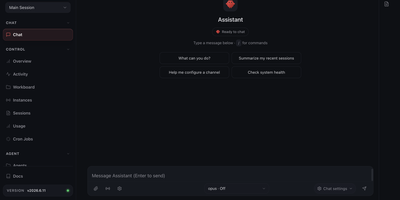
A personal AI assistant that remembers what it learns and reaches you wherever you are — OpenClaw is an open-source agent gateway built by the OpenClaw Foundation with 247,000+ GitHub stars. It connects to 200+ LLM models through providers like Anthropic, OpenRouter, and OpenAI, and meets you on 21+ messaging channels: Telegram, Slack, Discord, WhatsApp, Signal, iMessage, Matrix, and more. Persistent memory with full-text search lets the agent recall context across sessions, and a self-improving skills system means it gets more capable the longer it runs. Voice wake words and talk mode enable hands-free interaction on macOS, iOS, and Android. A live canvas provides an agent-driven visual workspace. Built-in browser automation, cron scheduling for unattended tasks, and subagent spawning for parallel workstreams round out the toolset. The gateway architecture keeps all sessions, credentials, and conversation history on your own server — nothing transits a third-party cloud unless you choose to connect one. The API key you provide for your chosen LLM provider powers the underlying calls; billing goes through your own account. Running on a dedicated VPS with guaranteed CPU, RAM, and SSD, full root SSH access, and a browser serial console. MIT licensed.
Prime Agent
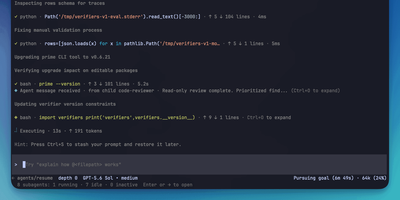
With over 14,000 GitHub stars and 41 releases since its May 2026 launch, Prime Agent delivers a fundamentally different approach to AI coding agents by treating the agent's own operating environment as programmable state that improves through use. The Recursive Language Model architecture provides the model exactly one tool — a persistent IPython kernel — where file operations, shell commands, subagent delegation via rlm() function calls, and context management all happen through code rather than rigid tool-calling schemas. Subagents launch as independent sessions with their own model, kernel, and history, communicating results through agent_message.send() without blocking the parent. The Continual Harness stores supplemental prompts, memories, skill descriptions, and reusable subagent specifications as durable state that the /refine command updates through small, evidence-backed edits with full rollback by ID. Daemon-backed sessions keep running when the terminal disconnects, with automatic context compaction summarizing older messages while preserving recent state. The TUI provides an Agent View for monitoring, switching between, and steering multiple live sessions simultaneously. Autonomous mode operates within configurable turn, token, and time budgets with user-defined quality gates. Persistent goals, heartbeats, and scheduled prompts maintain continuity across terminal sessions. Compatible with Anthropic Claude, OpenAI, Google Gemini, local models via Ollama or vLLM, and Prime Inference endpoints. Install via a single curl command on Linux or macOS. Running on a dedicated VPS on RepoCloud with guaranteed CPU, RAM, and SSD, full root SSH access, and a browser serial console. MIT licensed.
Onyx
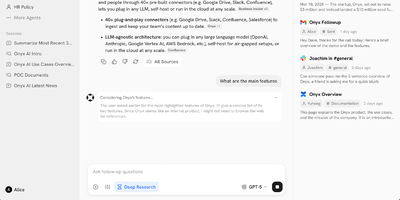
Formerly known as Danswer and now backed by over 31,000 GitHub stars with 253 releases, Onyx delivers a production-ready AI platform that turns any LLM into a context-aware enterprise assistant connected to your organization's actual knowledge. The agentic RAG pipeline combines BM-25 keyword search with prefix-aware embedding models in a hybrid index, then deploys AI agents to retrieve, verify, and synthesize answers with source citations from over 40 connected workplace tools including Google Drive, Confluence, Slack, Notion, Jira, SharePoint, GitHub, and Linear. Custom AI assistants with configurable prompts, backing knowledge sets, and document-level access control enable specialized agents for engineering, sales, support, and research workflows. The platform supports every major LLM provider — Anthropic Claude, OpenAI, Google Gemini, plus self-hosted options via Ollama, LiteLLM, and vLLM for fully air-gapped deployments. Beyond chat, Onyx provides web search with Serper, Google PSE, Brave, and SearXNG integration, an in-house web crawler, code execution, file creation, and multi-step deep research with report generation. Enterprise features include SSO via Google OAuth, OIDC, or SAML with SCIM provisioning, role-based access control, usage analytics by team and agent, query history auditing, PII removal through custom code hooks, and full whitelabeling. Deploy via Docker Compose on any infrastructure. Running on a dedicated VPS on RepoCloud with guaranteed CPU, RAM, and SSD, full root SSH access, and a browser serial console. MIT licensed (Community Edition).
Metabase
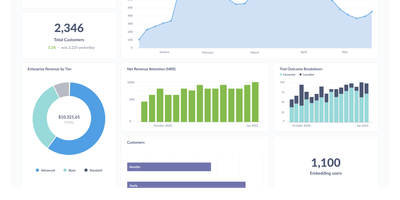
The most widely deployed open-source BI tool, Metabase is a visualization and query layer that sits on top of your existing databases without ingesting or copying data. Non-technical users ask questions through a visual query builder with drill-through menus that answer follow-ups like "broken down by month" without writing a new query, while analysts use the native SQL editor with variables and templates for complex work. Questions assemble into interactive dashboards with filters, auto-refresh, fullscreen mode, and custom click behavior, and dashboard subscriptions email or Slack scheduled reports to stakeholders. It connects to 20+ data sources including PostgreSQL, MySQL, MongoDB, SQL Server, BigQuery, Snowflake, Redshift, and ClickHouse - always querying in place, so there is no second data store to secure, sync, or pay for, and results are always current. Models and metrics let a data team define official, reusable starting points so self-service stays consistent, collections with permissions organize content, and alerts fire when a metric crosses a threshold. The practical effect is cutting the ad-hoc query queue that lands on the data team, since non-technical staff can answer their own questions. Written in Clojure, licensed AGPL, and shipped as a single JAR or Docker image with an embedded application database - a working BI instance runs before most tools finish their installer - the open-source edition has no limits on users, dashboards, or connected databases, where commercial BI platforms price per viewer as well as per creator.
DeerFlow
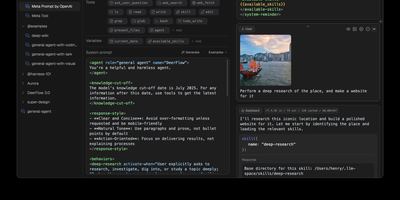
DeerFlow 2.0 is ByteDance's ground-up rewrite that transforms what began as a Deep Research framework into a batteries-included super agent harness handling tasks lasting minutes to hours autonomously. Built on LangGraph and LangChain, the runtime orchestrates a lead agent that plans, decomposes, and delegates to sub-agents executing in isolated Docker or Kubernetes sandboxes with persistent filesystem access, while an extensible skills system lets developers add capabilities as Python functions or MCP servers with OAuth token flows. The harness ships with long-term memory using persistent event loops with per-agent isolation, scheduled task execution via cron, context engineering with manual compaction, and a web UI at localhost:2026 for interactive sessions. Model support spans OpenAI GPT-4o/GPT-5, Anthropic Claude via OAuth, Google Gemini, DeepSeek, Qwen via vLLM, and OpenRouter-compatible gateways with per-model pricing configuration. IM channel integration connects Telegram, Slack, Feishu/Lark, Discord, WeChat, WeCom, DingTalk, and Buzz without requiring a public IP — all using long-polling or WebSocket transports. Production deployment uses Docker Compose with nginx reverse proxy, PostgreSQL or SQLite persistence, Redis stream bridges for multi-worker scaling, and lease-based run ownership with automatic orphan recovery. The terminal workbench TUI enables headless operation. Running on a dedicated VPS on RepoCloud with guaranteed CPU, RAM, and SSD, full root SSH access, and a browser serial console. MIT licensed.
Strapi
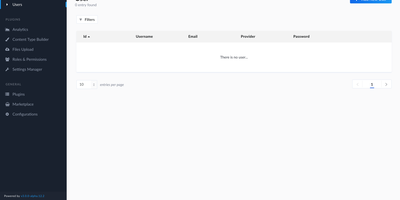
The leading open-source headless CMS with over 72,800 GitHub stars and more than 20 million npm downloads, Strapi has powered content APIs for thousands of organizations since its creation in 2015, providing a complete backend for websites, mobile applications, IoT devices, and any frontend framework through auto-generated REST and GraphQL endpoints. The visual Content-Type Builder lets editors define collections, single types, components, dynamic zones, and relations without code, while Strapi AI introduced in 2026 generates complete content schemas from natural language descriptions, Figma file uploads, or existing JavaScript application code analysis. Version 5 rewrote the platform with a TypeScript-first architecture, replacing the Entity Service with the Document Service API, switching admin panel builds from Webpack to Vite, and integrating internationalization directly into core with unlimited locale support. Database flexibility spans PostgreSQL, MySQL, MariaDB, and SQLite with automatic migration handling. The media library manages uploads to local storage, Amazon S3, or Cloudinary with image optimization and responsive formats. Granular role-based access control defines permissions per content type, field, and locale. The plugin marketplace extends functionality with GraphQL, SEO, email, custom fields, and community contributions, while lifecycle hooks, custom controllers, and middleware enable arbitrary backend logic. Draft and publish workflows, webhooks for external system integration, API token authentication, data import and export, and CRON job scheduling round out a platform that handles content operations from prototype to production. Running on a dedicated VPS on RepoCloud with guaranteed CPU, RAM, and SSD, full root SSH access, and a browser serial console. MIT licensed.
Open Lovable
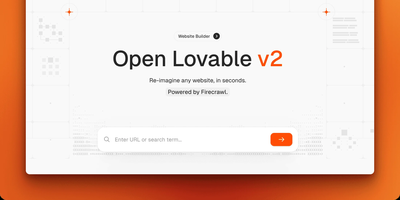
Open Lovable from the Firecrawl team delivers the first truly open-source alternative to Lovable.dev — a chat-driven AI copilot that takes any website URL and regenerates it as a complete, editable React application with TypeScript and Tailwind CSS in seconds. The pipeline combines Firecrawl's intelligent web scraping for JavaScript-rendered pages and single-page applications with your choice of AI provider — Claude, GPT-4, Google Gemini, or Groq — to analyze HTML structure, extract layouts and styling, decompose pages into proper React components, and generate production-ready code following modern best practices. Live preview runs in a secure sandbox environment using Vercel Sandbox with OIDC authentication or E2B Cloud, letting you see results immediately and iterate through natural language chat to request changes like Tailwind migration, componentization, SEO improvements, accessibility fixes, or custom form implementations. The optional Morph LLM fast-apply path accelerates small edits by applying diffs directly without full regeneration. The provider-agnostic architecture means you control costs by routing to different models — use Groq for fast iterations and Claude for complex layouts. Project structure follows Next.js conventions with organized app, components, atoms, styles, utils, and hooks directories. Deploy via pnpm with Node.js 18+ requiring only a Firecrawl API key, one AI provider key, and a sandbox provider configuration. Running on a dedicated VPS on RepoCloud with guaranteed CPU, RAM, and SSD, full root SSH access, and a browser serial console. MIT licensed.
Archestra
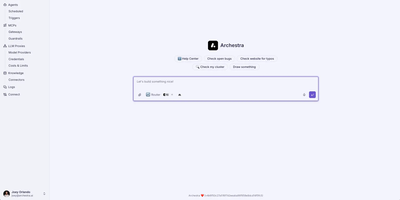
Archestra delivers the enterprise AI infrastructure layer that organizations need when managing multiple LLM providers, MCP servers, and AI agents across teams becomes unmanageable. The LLM gateway routes requests across Anthropic, OpenAI, Azure, Bedrock, and DeepSeek with virtual API keys, per-team cost limits, and dynamic model routing — giving every developer one token for Claude Code, Cursor, or Codex while finance tracks spend per department. The MCP gateway authenticates tool calls with OAuth 2.1 and On-Behalf-Of tokens so each tool executes as the calling user, not a shared service account, eliminating credential sprawl. The private MCP registry lets teams publish custom tool servers with approval flows promoting servers from dev through staging to production, each environment maintaining its own credentials and network egress policies. The Kubernetes operator manages MCP server lifecycle — deploying containers, scaling, health-checking, and routing gateway traffic to local servers automatically. The agent runtime supports scheduled triggers, email and webhook invocations, sub-agent delegation, reusable skills, and sandboxed code execution with a K8s-native filesystem. Deterministic guardrails including Dual-LLM verification and Lethal Trifecta protections prevent dangerous tool calls before execution. Built-in OpenTelemetry traces and Prometheus metrics provide full observability without additional tooling. Docker deployment exposes the Admin UI on port 3000 and API on port 9000 with a single command. Running on a dedicated VPS on RepoCloud with guaranteed CPU, RAM, and SSD, full root SSH access, and a browser serial console. AGPL-3.0 licensed.
LobeHub
With over 82,000 GitHub stars and 700,000+ downloads, LobeHub has evolved from its origins as LobeChat into a comprehensive multi-agent AI collaboration platform where humans and autonomous agent teams co-evolve. The platform's Agent Harness architecture functions as an operating system between AI models and applications, handling prompt presets, tool orchestration, lifecycle hooks, planning, filesystem access, and sub-agent management across 25+ model providers including OpenAI, Anthropic Claude, Google Gemini, DeepSeek, Mistral, Groq, AWS Bedrock, Azure OpenAI, and local models through Ollama. Agent Groups enable sophisticated collaboration with sequential, parallel, iterative, and debate orchestration modes, allowing multiple specialized agents to tackle complex workflows simultaneously. The Agent Builder creates production-ready agents from natural language descriptions with auto-configuration, drawing from a marketplace of 505+ pre-built agents and 10,000+ MCP-compatible skills and plugins. Pages provide collaborative document editing with multi-agent co-authoring, while Schedules automate agent runs around the clock without human supervision. The knowledge base leverages PostgreSQL with pgvector for RAG-powered retrieval, and Personal Memory gives agents transparent, editable context that evolves through continual learning. The full self-hosted stack deploys via Docker Compose with PostgreSQL, Redis, RustFS for S3-compatible storage, and SearXNG for private web search, all configurable through environment variables. Running on a dedicated VPS on RepoCloud with guaranteed CPU, RAM, and SSD, full root SSH access, and a browser serial console. LobeHub Community licensed.
Openship
Point Openship at a GitHub repo, local folder, or prebuilt artifact and it detects your stack, builds a Docker container, provisions databases, configures domains with automatic Let's Encrypt TLS, and routes traffic through an OpenResty edge layer on ports 80 and 443. Already past 10,000 stars since launching in March 2026, it turns any Linux VPS into a managed application host. Language support covers Node.js, Python, Go, Rust, PHP, Ruby, Java, .NET, Docker, and monorepo projects with push-to-deploy CI/CD, pull request preview environments on unique subdomains, staging/production flows, and one-click rollbacks. Integrated backend services include managed Postgres, MySQL, MongoDB, Redis, persistent volumes, WebSocket proxying, object storage, and worker processes, all provisioned from the dashboard without compose files. A built-in SMTP server handles transactional email with automatic DKIM, SPF, and DMARC configuration, eliminating external email services. The edge layer serves HTTP/3 with Brotli compression, configurable cache rules, and instant purging. Real-time monitoring streams build logs, container metrics, visitor geography, and per-status-code analytics at 1.4 microsecond overhead with zero database writes. Scheduled backups cover databases and volumes with one-click restore and export. Three interfaces (web dashboard, desktop app for macOS/Windows/Linux, and the openship CLI) drive the same API, plus a Model Context Protocol endpoint for AI integration. Running on a dedicated VPS on RepoCloud with guaranteed CPU, RAM, and SSD, full root SSH access, and a browser serial console. Apache 2.0 licensed.
Hermes Studio
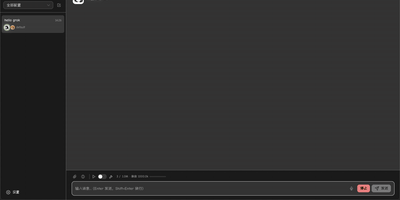
The most comprehensive open-source control plane for Hermes Agent — a full workspace combining AI chat, visual workflows, multi-agent orchestration, coding agent management, and platform channel integration in one self-hosted dashboard. Real-time chat streaming over Socket.IO connects to any OpenAI-compatible backend including Ollama, OpenAI, Anthropic, and custom endpoints with multi-session management, tool call expansion, inline file previews for HTML, PDF, DOCX, images, and source code, plus profile-scoped uploads and workspace attachments. The visual workflow builder provides a Vue Flow canvas for constructing DAG-structured pipelines with directed edges, conditional routes, approval gates, loops, and live execution with per-node status updates. Platform channel integration configures Telegram, Discord, Slack, WhatsApp, Matrix, Feishu, DingTalk, QQBot, WeChat, and WeCom bots from one page with credential management and per-platform behavior settings. Multi-agent group chat rooms enable real-time messaging with @mention routing, automatic context compression, and SQLite message persistence. The coding agent panel installs, launches, and monitors Claude Code and Codex with built-in terminal, session history, and file diffs. Usage analytics track token consumption, estimated costs, cache hit rates, and 30-day daily trends with model distribution charts. Kanban boards plan and track agent work alongside cron job scheduling for recurring tasks. Deploy via Docker, npm CLI, or desktop installer for Windows, macOS, and Linux. Running on a dedicated VPS on RepoCloud with guaranteed CPU, RAM, and SSD, full root SSH access, and a browser serial console. MIT licensed.
Coolify VPS
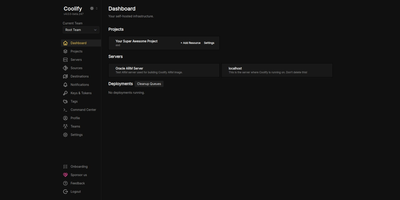
The open-source PaaS with 55,000+ GitHub stars and the largest one-click service catalog in its class — Coolify gives you the Vercel push-to-deploy workflow on a dedicated server you control. Connect a GitHub, GitLab, Bitbucket, or Gitea repository and every push builds and deploys automatically via Nixpacks, a Dockerfile, or Docker Compose, with Traefik or Caddy reverse proxying, automatic Let's Encrypt certificates, and per-branch preview deployments with their own URLs. Databases — PostgreSQL, MySQL, MariaDB, MongoDB, Redis — provision in a few clicks, and a catalog of 280+ one-click service templates covers WordPress, n8n, Grafana, MinIO, Plausible, Ollama, and more. One dashboard manages the entire server, with Docker Swarm available for clustering multiple nodes. Backups go to any S3-compatible storage with one-click restore, and a full API supports CI/CD integration. All configuration lives on your own server, so resources keep running even if you stop using Coolify — no vendor lock-in by design. Running on a dedicated VPS with guaranteed CPU, RAM, and SSD, full root access via SSH and browser console. Apache 2.0 licensed.
Bolt.diy
Prompt, run, edit, and deploy full-stack Node.js applications from a browser tab: Bolt.diy is the official open-source version of Bolt.new's AI coding agent. Its foundation is StackBlitz's WebContainer technology - a sandboxed in-browser Node.js environment where the AI controls the whole stack: filesystem, npm, dev servers, terminal, and browser console. That means the agent does not just generate code; it installs dependencies, runs Vite or Next.js, reads errors, and fixes them. The defining difference from Bolt.new is model choice per prompt: 19+ providers including OpenAI, Anthropic, Gemini, DeepSeek, Groq, Mistral, Amazon Bedrock, and local models via Ollama or LMStudio, extensible through the Vercel AI SDK. Development ergonomics include live preview, a diff view of AI changes, codebase search, file locking to prevent generation conflicts, 15+ starter templates (React, Vue, Next.js, Astro, Svelte, Expo), and MCP support for external tools. Projects integrate with Git and Supabase, and deploy in one click to Vercel, Netlify, or GitHub Pages.
LibreChat
Every major model provider behind one ChatGPT-style interface: LibreChat spans OpenAI, Anthropic, Google, Azure, AWS Bedrock, Vertex AI, Groq, Mistral, OpenRouter, DeepSeek, and any OpenAI-compatible endpoint including local Ollama. You can switch models mid-conversation and compare providers without changing tools. Its Agents framework builds no-code custom assistants with tool access via Model Context Protocol servers, file search over uploaded documents through an optional pgvector-backed RAG service, and a sandboxed Code Interpreter that executes Python, JavaScript, Go, C++, Java, PHP, and Rust. Artifacts render React components, HTML, and Mermaid diagrams directly in chat, and image generation works through DALL-E and other configured providers. Multi-user support is enterprise-grade, with OAuth, SAML, LDAP, and two-factor authentication, per-user conversation history in MongoDB, and Meilisearch-powered search across all messages and files, plus reusable presets, forkable threads, and persistent memory across conversations. The economics favor teams: instead of a ChatGPT Plus seat per person, everyone shares one instance billed per API token, with access to every provider rather than one - and providers see individual API calls, not your accumulated organizational knowledge. Deployment is Docker Compose; API keys and endpoints are configured through .env and librechat.yaml.
Teable
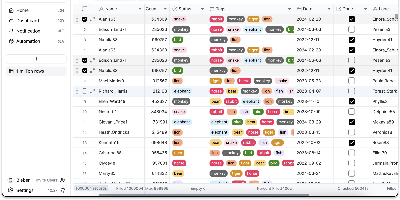
An Airtable-style spreadsheet interface directly on PostgreSQL: Teable is an open-source no-code database where every table is a real Postgres table. Unlike tools that store records in a metadata abstraction layer, every Teable table is a real Postgres table with standard column types, so filtering, sorting, and grouping run at database speed, million-row tables answer complex filters in roughly 200 milliseconds without index tuning, and any PostgreSQL-compatible tool - psql, BI dashboards, ETL pipelines - can query the same data directly. The interface offers Grid, Kanban, Gallery, Calendar, and Form views as non-destructive overlays with their own filters and hidden fields, plus 20+ field types, formulas, comments, attachments, batch editing, undo/redo, and edit history. Collaboration is real-time with live cursors and instant sync across views, backed by Redis, and a REST API is auto-generated per table, largely compatible with Airtable API clients - alongside native SQL access for BI tools, analytics pipelines, and your own applications to JOIN and query directly, with no exports, API rate limits, or sync jobs. Global search spans all records, chart plugins handle quick visualization, and CSV and Excel import/export cover migrations. Where Airtable caps paid plans at 100K-500K rows and charges roughly $20 per user per month, a self-hosted Teable instance has neither limit: the Postgres database itself is the export if you ever leave. Built in TypeScript with NestJS, deployed via Docker with PostgreSQL and Redis, and licensed AGPL-3.0.
Nocobase
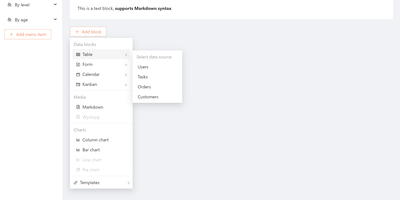
CRMs, project trackers, inventory tools - NocoBase is an open-source no-code/low-code platform for building business systems like these. Its architecture is data-model driven: you define collections and relationships first, then compose any number of interface blocks (tables, forms, kanban, charts) on top of the same model, so data structure is never coupled to a particular view. The core is a microkernel where every feature is a plugin, WordPress-style; you enable official plugins, install marketplace ones, or write your own as npm packages with server and client parts. Data sources include the main PostgreSQL or MySQL database, external databases, and third-party APIs - so you can build admin panels over existing production data instead of migrating it. Built-in infrastructure covers role-based permissions down to collection, record, and field level, workflow automation with approval steps and scheduled triggers, and audit logs; a one-click switch flips between usage and configuration modes. Because custom features live in isolated plugins with a documented lifecycle, core upgrades do not overwrite your customizations, and swapping UIs never requires data migrations since interfaces sit on independent models. Written in TypeScript on Node.js, Koa, and React under the AGPL license, it is light enough for one person to run and extend - and where no-code SaaS platforms charge per seat and per app, a self-hosted instance runs unlimited applications for unlimited users at hosting cost alone.