Buzz
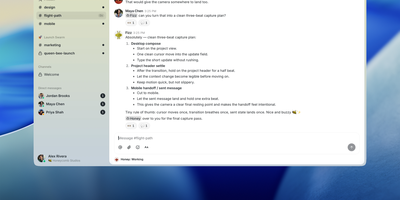
Buzz delivers the first production workspace where humans and AI agents operate as cryptographically equal team members on a self-hosted Nostr relay. The Rust-based backend stores every message, code patch, CI result, review comment, and workflow step as a signed Nostr event in a unified PostgreSQL-backed event log with Redis pub/sub for real-time presence and S3/MinIO for media storage. The integrated Git forge implements NIP-34, turning feature branches into dedicated channels where patches, reviews, and merge decisions live alongside the discussion that produced them — eliminating the split between chat tools and code hosts. Through the open Agent Client Protocol, Buzz natively supports Goose, Anthropic Claude Code, and OpenAI Codex as first-class channel members with scoped permissions, their own audit trails, and the ability to create patches, run workflows, and orchestrate multi-step automations via YAML-defined triggers including message events, reactions, schedules, and webhooks. The Tauri-based desktop client runs on macOS, Windows, and Linux, while buzz-cli provides agent-first JSON I/O for headless automation. Deploy via Docker Compose with the production bundle in deploy/compose/, Railway one-click, or build from source requiring Rust 1.88+, Node 24+, and pnpm. Multi-community mode scopes tenant data by domain with NIP-42 Schnorr authentication, rate limiting, and hash-chain audit logging. Running on a dedicated VPS on RepoCloud with guaranteed CPU, RAM, and SSD, full root SSH access, and a browser serial console. Apache 2.0 licensed.
QM
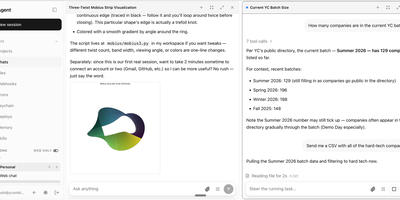
QM is Y Combinator's internal multiplayer agent infrastructure that shifts AI agents from personal assistants to shared company operating layer. The headless TypeScript core runs on Node.js with Fastify handling HTTP, Slack integration via Bolt, and a web UI built with Vite and Lit. PostgreSQL stores sessions, memory, queue state, and audit logs. Every person and every Slack channel gets an isolated sandbox with its own durable file system, installed tools that persist across runs, private memory, keychain view, permissions, and background crons. The harness-agnostic architecture routes agent tasks through Pi, OpenCode, Codex, or Claude Code without vendor lock-in, with production implementations swapping via a single wiring file. Three org-level security postures gate execution: Strict requires human approval for every tool call, Auto applies automated content screening, and Dangerous removes all pauses. Skills are scope-owned and shareable by grant, with admin-gated promotion to the entire organization and skill packs importable from Git repositories. The web apps feature lets agents spin up custom internal applications published to specific users. The qm CLI bootstraps operator-owned deployment directories with digest-pinned release images, infrastructure rendering, secret management, and live verification checks for Docker, Fly.io, or AWS ECS Fargate targets. On RepoCloud, deploy QM on a dedicated VPS with PostgreSQL persistence, Docker socket access, root SSH access, and complete control over your multiplayer agent infrastructure, all under the MIT license.
Listmonk
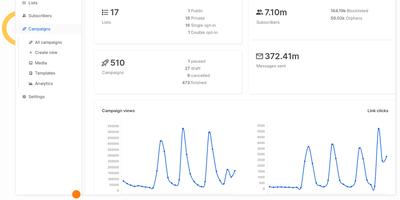
Seven million emails from a single binary peaking at 57 MB of RAM: listmonk is a high-performance newsletter and mailing list manager in Go with PostgreSQL as its only dependency - no Redis, no worker processes, no message broker. The project's own production benchmark sent 7+ million emails with the binary peaking around 57 MB of RAM, and throughput exceeds 100K emails per hour on modest hardware. Campaigns run through a multi-threaded, multi-SMTP queue with round-robin delivery, per-server concurrency, retries, and sliding-window rate limiting across providers like Amazon SES, SendGrid, Mailgun, or your own Postfix relay. Subscribers carry custom JSON attributes and are segmented with raw SQL queries, so any audience Postgres can express, listmonk can target. Templates use Go template syntax with 100+ functions for dynamic per-subscriber content, and the Vue dashboard reports opens, clicks, bounces, and unsubscribes with automated bounce processing. A REST API handles transactional email and programmatic control, a built-in media library hosts campaign assets, and CSV or API import migrates lists from hosted platforms. The economics are the headline: where Mailchimp pricing scales with list size, listmonk plus Amazon SES sends the same volume for hosting cost plus roughly $0.10 per thousand emails - commonly a 95% reduction - and your email list, a core business asset, stays on your own infrastructure. AGPLv3-licensed; bring your own SMTP provider for delivery.
Notifuse
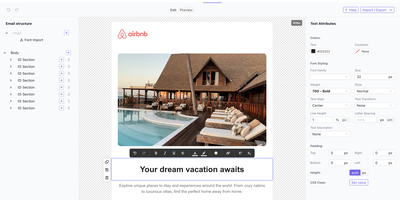
Marketing campaigns and transactional mail from one open-source platform: Notifuse is a modern, self-hosted alternative to Mailchimp, Brevo, and Klaviyo without per-email or per-contact pricing. Built with Go and React on PostgreSQL, it separates concerns cleanly: a drag-and-drop visual builder composes responsive templates from MJML components with Liquid variables like {{ contact.first_name }} and per-template version history; campaigns add A/B testing across subject lines, content, and send times; and a REST transactional API serves application-triggered mail. Delivery routes through your choice of provider - Amazon SES, Mailgun, Postmark, SendGrid, SparkPost, Mailjet, or plain SMTP - with multi-provider failover. Contacts carry custom fields and a full activity timeline (messages, profile changes, webhook events), and real-time segmentation builds dynamic rules over properties, activity, and subscriptions. Event-driven automations create behavioral sequences, a notification center gives recipients self-service preference management, and an S3-compatible file manager handles images with CDN delivery. Multi-tenant workspaces with isolated databases and custom domains suit agencies. Open and click tracking report engagement in real time.
Mattermost
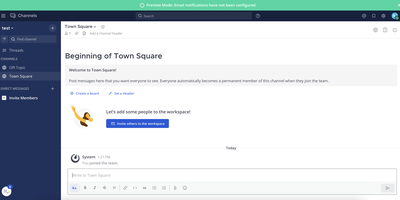
Teams that cannot send messages through someone else's cloud run Mattermost - the open-core, self-hosted alternative to Slack. It provides public and private channels, threaded discussions, unlimited search history, file sharing with previews, one-to-one audio calls, and screen sharing, with desktop clients for Windows, macOS, and Linux plus iOS and Android apps. Messages support full Markdown, which suits engineering conversations with code blocks and logs. Playbooks turn repeatable processes such as incident response and release management into checklist-driven workflows with automated triggers and retrospectives. Integration is a core strength: prebuilt connectors for GitHub, GitLab, Jira, ServiceNow, and PagerDuty, plus webhooks, slash commands, bots, a REST API, and a plugin marketplace with 700+ entries - together making it a working surface for ChatOps rather than just a chat room. Playbooks add keyword and event triggers, task assignment, status broadcasting, and post-incident retrospectives, so operational knowledge is not trapped in individuals' heads. The server is a single Go binary backed by PostgreSQL, with React clients, released monthly under MIT license and deployable fully air-gapped - which is why governments and defense organizations run it inside closed networks, and why the same control applies to any team with confidentiality requirements. The compiled Team Edition is free for unlimited users with no message history cutoff, so costs stay flat as the team grows.
Screego
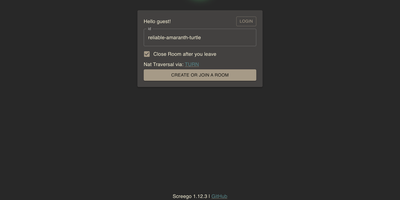
With over 10,000 GitHub stars and a reputation forged in the frustration of laggy corporate screen sharing, Screego delivers what Microsoft Teams and Zoom screen share consistently fail to provide: instant, high-resolution screen streaming that lets remote colleagues actually read your code. Built on WebRTC peer-to-peer connections, Screego transmits screen data directly between browsers without routing through centralized servers, achieving sub-second latency and native-resolution quality that makes pair programming and code reviews genuinely productive. The server component, written in Go with a TypeScript frontend, deploys as a single binary or Docker container with minimal configuration — set your external URL, generate a secret key, and you're live. An integrated TURN server handles NAT traversal automatically, eliminating the need for separate STUN/TURN infrastructure, with configurable UDP port ranges and support for external TURN servers when scaling beyond a single instance. Authentication supports three modes — requiring login for all actions, only for TURN connections, or none — with user management via simple credential files. Rooms are created instantly and support multiple simultaneous viewers, with system and tab audio sharing available for demonstrations that need sound. The architecture supports reverse proxy deployment behind Nginx, Caddy, or Apache with automatic TLS termination, and recent releases added riscv64 architecture support alongside existing amd64 and arm64 builds. Running on a dedicated VPS on RepoCloud with guaranteed CPU, RAM, and SSD, full root SSH access, and a browser serial console. GPL-3.0 licensed.
Jitsi Meet
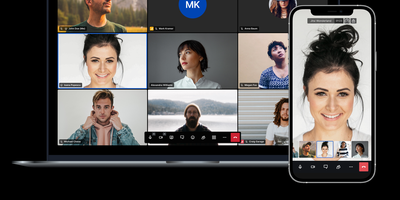
Backed by nearly 30,000 GitHub stars and powering millions of meetings through meet.jit.si, Jitsi Meet is the open-source video conferencing platform that runs entirely in the browser with no plugins or downloads required. The WebRTC-based architecture delivers HD audio and video through the Jitsi Videobridge selective forwarding unit, while Prosody handles XMPP signaling and Jicofo manages conference focus and orechestration. End-to-end encryption uses AES-GCM 128-bit keys exchanged via the Olm protocol, protecting audio, video, and screen sharing through the Insertable Streams API in Chromium-based browsers. Moderators can split participants into breakout rooms with individual password protection, enable lobby waiting rooms for admission control, set meeting passwords, and track speaker statistics with per-participant talk time metrics. Virtual backgrounds leverage TensorFlow.js body segmentation with WebGPU and WebGL acceleration, automatically adapting quality through device tier detection. Server-side recording and YouTube live streaming run through Jibri, while Jigasi provides a SIP gateway for PSTN dial-in and speech-to-text transcription. The platform includes in-meeting chat with private conversations, polls, raise-hand functionality, emoji reactions, and tile and speaker view layouts. Mobile applications for iOS and Android complement the web client, and both web and native SDKs enable embedding video conferences into custom applications. Running on a dedicated VPS on RepoCloud with guaranteed CPU, RAM, and SSD, full root SSH access, and a browser serial console. Apache-2.0 licensed.
The Lounge
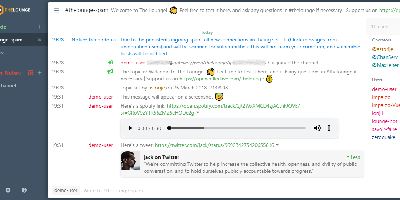
"Forget about bouncers" became a real sentence because of The Lounge: a Node.js web IRC client that holds persistent connections to your networks 24/7, logging everything while you sleep, so closing the browser tab never means missing a message or losing your place in a channel. Open it again from any device - desktop, phone, tablet - and you resume exactly where you left off, with full history synchronized. Because it combines bouncer and client in one process, the experience feels like a modern chat app rather than 1990s infrastructure: push notifications for highlights and private messages (with self-generated VAPID keys, so even Web Push needs no third-party service), automatic link previews, inline file and image uploads, and full IRCv3 protocol support. It installs as a progressive web app from any modern browser, so phones get a native-feel client without an app store. Multi-user support means one instance serves your whole team or community, each user with their own networks and history, and LDAP integration ties into existing authentication. A public mode alternatively serves as an open, registration-free web chat for events or support channels. MIT-licensed, born as a fork of Shout, and a fixture of self-hosting stacks since.
Stoat
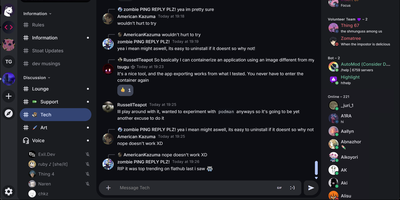
Stoat delivers a complete Discord-like community chat experience that organizations can self-host on their own infrastructure with full data ownership. The platform provides text channels organized in categories, real-time voice calls powered by LiveKit, file sharing with automatic media proxying, custom emoji support, bot framework, GIF search, server invites, and granular role-based permissions — all wrapped in a polished web UI that feels immediately familiar to Discord users. The architecture separates concerns across dedicated Rust binaries handling the REST API, WebSocket real-time events, file storage with S3-compatible backends, push notifications, and media proxying, backed by MongoDB for persistence and Redis for caching. Web, desktop, and mobile clients connect through the same API, ensuring consistent experience across platforms. Unlike federated alternatives such as Matrix, Stoat provides a single-server deployment model focused on the Discord-style community experience: server invites, channel categories, member management, and an invite-first onboarding flow that communities expect. The Docker Compose deployment stack handles all microservices with Caddy providing automatic TLS via Let's Encrypt. Running on a dedicated VPS on RepoCloud with guaranteed CPU, RAM, and SSD, full root SSH access, and a browser serial console. AGPL-3.0 licensed.
Huly
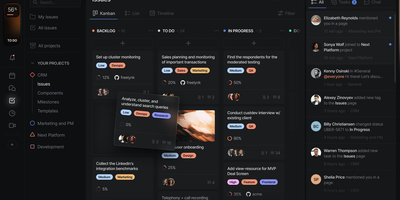
With 27,000 GitHub stars and 349 releases shipping multiple times per week, Huly replaces four separate SaaS subscriptions — Linear for issue tracking, Notion for documents, Slack for team chat, and Motion for time-blocking — with a single self-hosted platform that charges nothing per seat. The issue tracker provides projects, sprints, roadmaps, custom workflows, and Kanban views with bi-directional GitHub and GitLab synchronization that keeps issues and pull requests in lockstep across both systems. Collaborative documents use CRDT-based real-time editing for wikis, meeting notes, and technical specs with nested page hierarchies and rich embedding. Team messaging delivers channels, direct messages, threaded conversations, reactions, and pinned messages in a Slack-equivalent interface that lives alongside your project context. The time-blocking planner schedules tasks into calendar slots with drag-and-drop, integrating directly with your issue backlog so nothing falls through cracks. A virtual office module provides audio and video rooms for standups and pair programming with external guest access. HR features handle team management, office hours, and PTO tracking. The architecture runs 30+ microservices on CockroachDB for ACID-compliant storage, Elasticsearch for full-text search, MinIO for file attachments, and Redpanda for event streaming. Desktop apps ship for macOS, Windows, and Linux alongside mobile apps for iOS and Android. Running on a dedicated VPS on RepoCloud with guaranteed CPU, RAM, and SSD, full root SSH access, and a browser serial console. EPL-2.0 licensed.
Evolution API
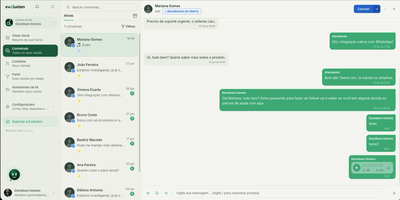
Evolution API gives your applications a production-ready REST interface to WhatsApp, supporting both free Baileys-based Web connections and Meta's official Business Cloud API from the same server. With 9,200+ stars and 7,100+ forks, it is the most widely deployed WhatsApp integration layer available. Each installation handles unlimited isolated instances (one per phone number) with independent auth, webhooks, and database separation via Prisma ORM against PostgreSQL or MySQL, cached through Redis. Message types include text, images, audio, video, documents, contacts, locations, interactive buttons, list messages, carousel cards, and PIX payment links through unified endpoints. Native integrations connect to Typebot for chatbot flows, Chatwoot for multi-agent support, Dify and OpenAI for AI conversations, N8N and Flowise for workflow automation, and RabbitMQ, Kafka, or SQS for enterprise event streaming. Socket.io delivers real-time message and connection events. Amazon S3 or MinIO handles media offloading. The Evolution Manager v2 dashboard provides visual instance creation, QR code scanning, connection monitoring, and integration configuration without touching the API directly. Docker Compose bundles the server, PostgreSQL, and Redis with environment-variable-driven setup. Running on a dedicated VPS on RepoCloud with guaranteed CPU, RAM, and SSD, full root SSH access, and a browser serial console. Apache 2.0 licensed.
NodeBB
Forum software rebuilt on the modern web stack: NodeBB runs the classic bulletin-board format - categories, threads, local accounts - in real time, on Node.js over MongoDB, Redis, or PostgreSQL. WebSockets stream new posts into open topics as they're written and deliver instant notifications for follows, likes, and subscriptions; built-in chat supports side-by-side private conversations. The headline of recent versions is core ActivityPub federation: your forum can follow, share, and converse with other NodeBB instances, Mastodon, Lemmy, and anything else that speaks the protocol, turning an isolated community into a fediverse node. Everything beyond the common core is a plugin - more than 500 plugins and themes install in one click from the admin panel, covering SSO providers, search backends like Elasticsearch and Solr, galleries, calendars, and more. The theming engine extends base templates with SCSS/CSS on Bootstrap 5, plus a drag-and-drop widget system and custom HTML/CSS/JS injection. Operators get a real-time analytics dashboard, human-readable SEO-friendly URLs with semantic markup, multilingual UI, and full read and write REST APIs for integration. Mobile-first rendering means the same install works everywhere. For communities that outgrew phpBB but don't want Discourse's weight, NodeBB is the natural middle.
Stalwart
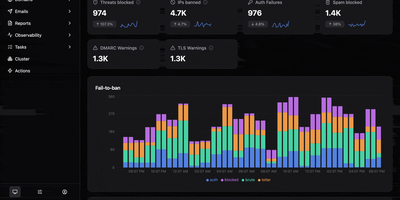
With 14,000 GitHub stars and 81 releases since March 2023, Stalwart is the most protocol-complete open-source mail server available — delivering JMAP, IMAP4rev2, IMAP4rev1, POP3, SMTP, CalDAV, CardDAV, and WebDAV from a single Rust binary that compiles to a memory-safe, zero-garbage-collection executable with predictable latency under load. The SMTP server implements DMARC, DKIMv2, DKIMv1, SPF, and ARC for complete message authentication with automatic DKIM key rotation, while transport security enforces DANE, MTA-STS, and SMTP TLS reporting to prevent downgrade attacks. Built-in spam filtering with statistical classifiers, DNS blocklists, and collaborative reputation databases eliminates the need for external Rspamd or SpamAssassin deployments. Encryption at rest protects stored messages with S/MIME or OpenPGP, and automatic TLS certificate provisioning via ACME supports TLS-ALPN-01, DNS-01, and HTTP-01 challenges without manual certificate management. The ManageSieve server enables server-side email filtering rules, while full-text search indexes message bodies and attachments for instant retrieval. Pluggable storage backends support RocksDB for embedded deployments, PostgreSQL, MySQL, and S3-compatible object storage for distributed architectures. LDAP and SQL-based authentication integrate with existing directory services, and the web administration panel manages domains, accounts, quotas, and DKIM keys. Security audited with memory safety guaranteed by Rust's ownership model. Running on a dedicated VPS on RepoCloud with guaranteed CPU, RAM, and SSD, full root SSH access, and a browser serial console. AGPL-3.0 licensed.
Novu
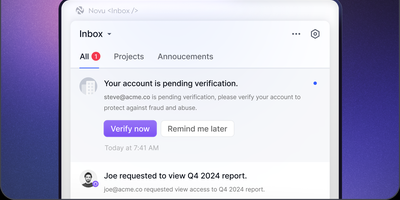
Powering notification delivery for thousands of organizations with over 39,000 GitHub stars, Novu is the open-source communication infrastructure that eliminates the need to build separate integrations for every messaging channel. The TypeScript-based platform provides a single API endpoint that routes notifications across In-App Inbox, Email via SendGrid, Mailgun, AWS SES, and Postmark, SMS through Twilio, Vonage, and Plivo, Push via Firebase Cloud Messaging, Expo, and APNS, and Chat through Slack, Discord, Microsoft Teams, and WhatsApp. The embeddable React Inbox component delivers real-time WebSocket-powered notifications with read/unread states, action buttons, and user-controlled preferences directly inside your application. The workflow engine orchestrates complex multi-channel delivery with conditional branching, time delays, digest batching to reduce notification fatigue, throttle controls, and per-step channel fallbacks. Novu Connect introduces Agent Communication Infrastructure enabling AI agents built with LangChain, Claude, or custom frameworks to hold threaded two-way conversations with humans across any supported channel through a single conversation model with identity resolution and credential management. The backend runs on Node.js with NestJS, MongoDB for notification storage, Redis with BullMQ for job queuing, and Socket.io for real-time delivery. Self-hosting deploys via Docker Compose with the dashboard accessible at port 4200. Running on a dedicated VPS on RepoCloud with guaranteed CPU, RAM, and SSD, full root SSH access, and a browser serial console. MIT licensed.
Haven
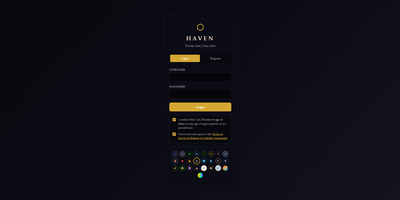
Haven gives your community a private chat server with voice calls, screen sharing, and end-to-end encrypted direct messages where friends join via invite link in their browser without installing apps or creating third-party accounts. Real-time messaging supports image uploads via paste and drag-drop, emoji reactions, replies, threads, typing indicators, @mentions with autocomplete, and inline GIF search through Tenor or GIPHY. Peer-to-peer WebRTC voice chat includes per-user volume sliders, mute and deafen controls, talking indicators, and screen sharing with picture-in-picture mode. Direct messages use ECDH P-256 key exchange with AES-256-GCM symmetric encryption where private keys never leave the browser, ensuring not even the server operator can read them. Twenty-plus visual themes with stackable effects including CRT scanlines, Matrix Rain, Cyberpunk Text Scramble, Snowfall, and Campfire Embers let users personalize the experience with configurable intensity sliders. Rich Presence integration shows what members are playing or listening to via Last.fm, Steam, and Spotify. A built-in bot API supports webhooks and custom slash commands, while Discord history import preserves channels, threads, forums, reactions, pins, and avatars. The Node.js server deploys via Docker Compose or a single batch file that auto-handles dependencies, SSL certificates, and configuration. Running on a dedicated VPS on RepoCloud with guaranteed CPU, RAM, and SSD, full root SSH access, and a browser serial console. AGPL-3.0 licensed.

Vexa
Vexa is the only Apache 2.0 meeting bot API that self-hosts the complete transcription pipeline, from bot dispatch to Whisper speech-to-text to knowledge agents, with zero audio leaving your infrastructure. A single POST /bots request sends a transcription bot into any Google Meet, Microsoft Teams, or Zoom call, where it captures audio, runs speaker-attributed transcription through faster-whisper or any OpenAI-compatible endpoint, and streams results to your application via real-time WebSocket with sub-second latency. The built-in agent framework watches live transcripts and your accumulated workspace context, answering mid-call questions grounded in your own meeting history and wiki. An MCP server connects Vexa to Claude, Cursor, and other compatible AI tools, turning every captured meeting into queryable context for external agents. The Terminal, a bundled Next.js web workbench, lets you send bots, watch live transcripts, manage users and API tokens, and chat with your meeting archive from a browser. Docker Compose brings the full stack up on one Linux host in five minutes; the Helm chart scales to thousands of users on Kubernetes with a Pod-per-bot architecture and built-in RBAC. Recordings persist in MinIO or any S3-compatible store, transcripts in Postgres, with Redis handling queues and scheduling. Deploy on RepoCloud for a dedicated VPS with full root SSH access and browser console. Apache 2.0 licensed.
AgentDesk
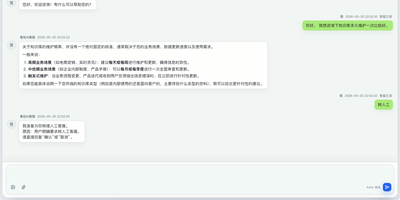
Most AI chat integrations bolt an LLM onto a text box and call it customer support; AgentDesk builds the entire helpdesk around AI agents that handle first responses, escalate to humans when they cannot answer, and track follow-up work through integrated ticket workflows. Each AI agent binds to a specific LLM configuration, one or more knowledge bases, a set of callable Skills, and MCP tool integrations, creating specialized support personas for different product lines or departments. When a customer message arrives, the agent retrieves relevant FAQ entries and document chunks through RAG-powered vector search (Qdrant), then passes retrieved context through an Answerability Gate that determines whether the knowledge base can support a reliable answer; if not, it triggers a fallback response and recommends human handoff instead of hallucinating. Human agents pick up escalated conversations in a dedicated workspace that preserves the full AI conversation history, customer profile, conversation tags, and linked tickets, so they never start from scratch. The ticket system converts conversations into tracked work items with category assignment, status flows, progress notes, and team routing. An admin dashboard provides user management, role-based access control, team scheduling, and automatic conversation assignment rules. Model configuration supports any OpenAI-compatible provider, letting you wire in LLMs, embedding models, and reranking models with per-model context limits, timeout settings, and rate controls. Running on a dedicated VPS on RepoCloud with guaranteed CPU, RAM, and SSD, full root SSH access, and a browser serial console. Apache 2.0 licensed.
Friendica
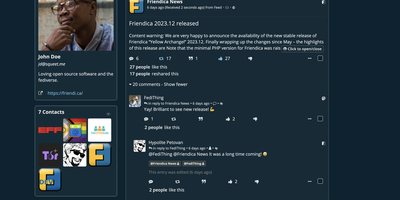
Friendica connects to more federation protocols than any other single platform: ActivityPub reaches Mastodon, Pleroma, Misskey, Lemmy, Pixelfed, and PeerTube; the Diaspora protocol bridges that network; and OStatus provides legacy compatibility. But protocol reach is just the foundation. Where most fediverse platforms stop at microblogging, Friendica offers long-form posts, photo albums, event calendars with RSVP, group discussions, and rich multimedia content. BlueSky and Tumblr connectors extend your reach into non-federated networks, while RSS import pulls content from any blog or news source into your timeline. Privacy controls let you scope each post to specific contacts, groups, or public visibility with per-post granularity rather than account-wide settings. Multiple themes customize the interface from Facebook-like layouts to minimal designs, and Fedilab provides native mobile access. Under the hood, the PHP application with MariaDB runs as either an Apache or FPM Docker image with Redis caching and background cron workers handling federation delivery, media processing, and notification dispatch. One of the oldest fediverse projects (1,650+ stars, 160+ contributors since 2010), Friendica has weathered every protocol evolution and platform migration the decentralized web has thrown at it, making it one of the most battle-tested social networking platforms available.