Observal
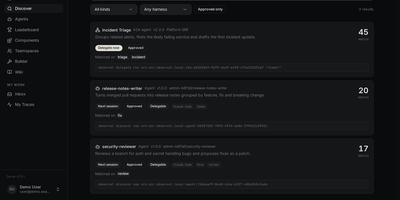
To pull a team's skills, MCP servers, hooks, prompts, and agent files out of scattered Git repositories, Observal keeps them in one reviewed registry and traces real sessions to show which ones help. Build an agent visually, with a live config preview for every harness. Submissions wait in an admin review queue, where reviewers inspect side-by-side version diffs before approving a release. Teamspaces give each team its own namespace, and approved releases can be forked into independent drafts. One pull command then writes the right config for Claude Code, Cursor, Kiro, Codex, Copilot, Pi, OpenCode, Antigravity, or Goose. Every approved resource is discoverable through the open Agentic Resource Discovery standard, and a running agent can hand part of its task to another approved agent or a remote Agent2Agent service. Hooks record each session as a trace of prompts, tool calls, MCP round trips, tokens, and errors, with turn-by-turn replay for debugging and audits. Insight reports, generated through providers such as Anthropic, OpenAI, or Ollama, list what is working, what is hindering, and quick wins. A dashboard follows adoption, cost, and department usage, a leaderboard ranks agents by downloads, and audit logs, SAML single sign-on, and SCIM provisioning are included. Running on a dedicated VPS on RepoCloud with guaranteed CPU, RAM, and SSD, full root SSH access, and a browser serial console. Apache-2.0 licensed.
Pi Web
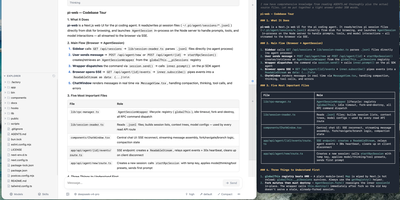
Pi Web is a browser interface for the Pi coding agent ecosystem, providing a visual workspace that reads the same local configuration and session files as the CLI. The session workspace groups conversations by project with running state indicators, context usage percentages, cost tracking, and compaction details, while two branching modes let users create independent session files from earlier messages or fork branches within existing sessions to explore alternative coding directions. Real-time streaming via Server-Sent Events delivers agent responses with structured Markdown rendering, thinking steps, tool call visualization, and image drag-and-drop input. The project file explorer browses working directories with syntax-highlighted source preview, Git diff inspection, and rendering for Markdown, images, audio, PDFs, and DOCX files with automatic refresh. Git worktree support switches checkouts from the sidebar while keeping sessions from the same repository grouped together. The Models panel manages provider authentication via OAuth and API keys, model selection, model smoke tests, and models.json configuration shared bidirectionally with the CLI agent. The Skills panel lists, searches, installs, and toggles agent skills without terminal access. The interface ships with English and Simplified Chinese translations, light and dark themes, a chat minimap, keyboard shortcuts, and completion sounds. Basic Auth protects remote access when binding to non-loopback addresses. Running on a dedicated VPS on RepoCloud with guaranteed CPU, RAM, and SSD, full root SSH access, and a browser serial console. MIT licensed.
Plandex
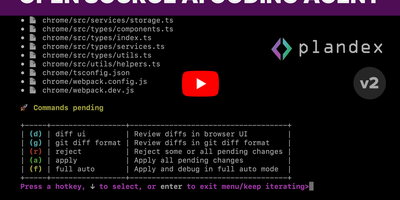
With 15,500 GitHub stars and over 1,100 forks, Plandex delivers a terminal-based AI coding agent purpose-built for the complex, multi-file tasks that overwhelm single-file AI assistants. The Go-powered server maintains a cumulative diff review sandbox that quarantines all AI-generated changes from your project files until you explicitly approve them — enabling 20-file refactors where you cherry-pick good changes and reject bad ones without touching git. A 2M token effective context window loads only what each step requires, while tree-sitter project maps index repositories exceeding 20M tokens across 30+ programming languages, providing structural awareness of class hierarchies, function signatures, and import graphs without burning tokens on full file content. The configurable model pack system assigns different models to different roles — Claude for planning, GPT for coding, Gemini for summarization — supporting Anthropic, OpenAI, Google, OpenRouter, Azure OpenAI, AWS Bedrock, DeepSeek, Perplexity, and Ollama for local models. Full auto mode handles end-to-end autonomous workflows including high-level planning, context loading, implementation, terminal command execution, and automated debugging of both terminal and browser applications. The interactive REPL provides fuzzy auto-complete, version-controlled sandbox branching, rewind to any previous point, and Git integration for commit message generation. The Plandex Server exposes 60+ REST API endpoints for programmatic orchestration across organizations, projects, plans, and branches. Deploy via Docker Compose for self-hosted operation with your own API keys. Running on a dedicated VPS on RepoCloud with guaranteed CPU, RAM, and SSD, full root SSH access, and a browser serial console. MIT licensed.