Depl0y
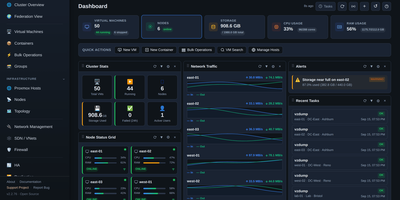
Three Proxmox sites, a lab host in the corner, and a rack of Dell and HPE servers can all share one screen when Depl0y runs the show. The dashboard totals virtual machines, containers, CPU, RAM, storage, and network traffic across every registered endpoint, with draggable widgets, alerts, and recent task feeds. Virtual machine pages cover start, stop, restart, snapshots, cloning, migration, templates, and a browser console, and node pages add metric charts, storage, networking, and update status. A guided failover wizard checks quorum, storage, and disks, then protects a guest so it restarts on another node if its host fails. A topology view maps hosts, guests, bridges, storage, and BMCs, with PNG, SVG, and draw.io export. Hardware pages poll iDRAC and iLO for health, temperature, power draw, DIMMs, drives, and firmware, and power controls reach machines that are fully off. Deployment tools build VMs from cloud images, import OVA, VMDK, and QCOW2 files, and launch self-hosted LLM guests. Admin, Operator, and Viewer roles, TOTP, host pinning, and a searchable audit log keep access tidy. MSPs managing client clusters, homelabs with several nodes, and data center teams that want hypervisor and hardware status together are the target audience. Running on a dedicated VPS on RepoCloud with guaranteed CPU, RAM, and SSD, full root SSH access, and a browser serial console. MIT licensed.
CockroachDB
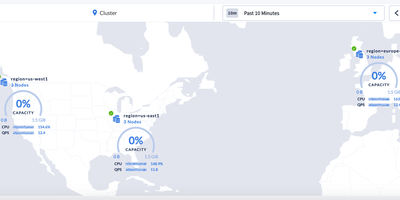
With over 32,000 GitHub stars and adoption by DoorDash, Netflix, and Bose, CockroachDB is the distributed SQL database designed to survive disk failures, machine outages, rack losses, and entire datacenter failures while maintaining strongly-consistent ACID transactions with serializable isolation by default. The architecture layers SQL on a transactional key-value store using the Raft consensus protocol for synchronous replication, automatically splitting data into ranges that distribute and rebalance without manual sharding. PostgreSQL wire protocol compatibility means existing drivers, ORMs, and tools including psycopg2, pgx, ActiveRecord, Django ORM, GORM, Hibernate, and Prisma work without modification. Multi-region capabilities include configurable survival goals at region or zone level, table-level locality settings for pinning data to specific geographies for GDPR compliance, and follower reads for low-latency global queries. The built-in DB Console provides cluster overview dashboards, node maps showing geographical distribution, SQL activity pages tracking statement fingerprints, transaction latency percentiles, session details, and real-time metrics for queries per second, storage capacity, and replication status. Change data capture streams row-level changes to Apache Kafka, Google Cloud Pub/Sub, or webhook endpoints for event-driven architectures. Online schema changes execute ALTER TABLE without locking or downtime, and distributed backup supports full and incremental snapshots to S3, GCS, Azure Blob, and NFS. Running on a dedicated VPS on RepoCloud with guaranteed CPU, RAM, and SSD, full root SSH access, and a browser serial console. CockroachDB Software License (source-available).
Roxy-WI
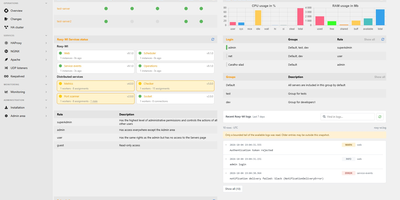
Proxies and load balancers spread across a fleet of servers finally share one calm web console in Roxy-WI. Connect existing hosts over SSH and manage HAProxy, NGINX, Apache, and Keepalived from a single place, with service actions, logs, statistics, and a Runtime API panel for HAProxy. The configuration workspace splits files into expandable sections, searches across them, and switches between a form editor and plain source, and saved versions make comparing and restoring earlier files straightforward. An overview page shows service health for every server at a glance, including worker status and recent application logs. High availability gets its own tools: choose Keepalived or Corosync/Pacemaker, review quorum, fencing, and witness setups, run a readiness audit with per-node evidence, and plan node maintenance with a drain review. Request diagnostics trace a domain through DNS, the virtual IP, TCP, TLS and SNI, and candidate backends to explain why traffic fails. Certificates come from Let's Encrypt or from a CertWarden connector. Groups, roles, and OIDC or LDAP sign-in decide who may touch which servers. Running on a dedicated VPS on RepoCloud with guaranteed CPU, RAM, and SSD, full root SSH access, and a browser serial console. Apache-2.0 licensed.
Timeful
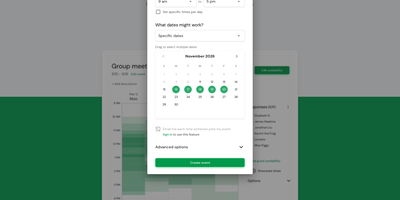
Picking a meeting time for six people usually takes forty messages, and Timeful replaces them with one link. Create an event, choose a date range or days of the week, and share the URL; guests do not need an account. Each person drags across a time grid to mark what works, and the combined heatmap reveals the overlap at a glance. Times can be marked as available or only if needed, and a best-times toggle highlights the slots that suit the most people. Calendar autofill pulls busy blocks from Google, Apple, Outlook, or an ICS feed so nobody retypes their week. Time zones convert automatically for distributed teams. Event owners can hide responses from other guests, duplicate polls for recurring meetings, export availability as a CSV, and schedule the final slot straight into a Google Calendar event. Availability groups keep a team's live calendar overlap on a single page, and reminder emails go out to attendees on the day of the event. A plugin API lets browser extensions read and write availability. The interface is a calm green grid with no clutter. Running on a dedicated VPS on RepoCloud with guaranteed CPU, RAM, and SSD, full root SSH access, and a browser serial console. AGPL-3.0 licensed.
HAProxy Manager
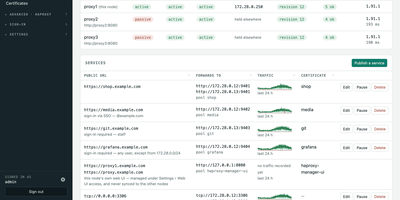
HAProxy Cluster Manager puts a web console on top of HAProxy, so you publish services, issue certificates, and cluster nodes from forms instead of hand-editing haproxy.cfg. Publishing a service takes two inputs, the public URL and the backend address, and the wizard builds the frontend, backend pool, host condition, routing rule, HTTPS listener, certificate, and HTTP redirect, with a preview of the exact configuration before anything applies. Every change is rendered and checked with haproxy -c before it is written, and a failed reload rolls back to the previous file automatically. Certificates come from Let's Encrypt through acme.sh, using HTTP-01 or DNS-01 with about 190 DNS providers, and renewals reload HAProxy and push the new certificate to every node on their own. Any number of nodes share one virtual IP through Keepalived: configuration and certificates sync between them, only the node holding the address is editable, and the dashboard flags split brain, an unclaimed virtual IP, or a node running stale configuration. You can gate services behind basic sign-in or OIDC single sign-on enforced by HAProxy itself, watch traffic statistics and logs, take transition alerts by email, Pushover, or webhook, and expose Prometheus metrics and Home Assistant entities. Running on a dedicated VPS on RepoCloud with guaranteed CPU, RAM, and SSD, full root SSH access, and a browser serial console. GPL-3.0 licensed.