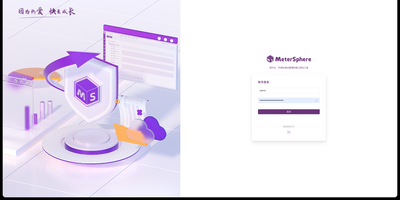
MeterSphere
MeterSphere is the open-source continuous testing platform that brings test management, API testing, and AI-powered automation into a single self-hosted environment. The Spring Boot Java backend handles test execution with the JMeter engine while the Vue.js frontend delivers a responsive interface for managing test cases, plans, defects, and reports across projects. The built-in AI assistant leverages large language models to auto-generate functional test cases and API interface definitions, reducing manual test creation effort. Test management covers the complete lifecycle from writing and reviewing cases in list or mind-map views, through test plan creation with single plans and plan groups, to defect tracking with customizable templates and workflow rules. API testing combines Postman-like ease of use with JMeter-level flexibility, supporting interface debugging with server-side and local execution, API definition with visual request and response editors, interface mocking with configurable headers and body parameters, scenario automation with visual orchestration, and detailed test reports with automatic generation. The system-organization-project hierarchy supports up to 30 users in the community edition with role-based access control, file management, and configurable notification channels. MySQL stores application data, Kafka handles message queuing, MinIO provides S3-compatible object storage, and Redis manages caching. The plugin marketplace extends testing capabilities and enables DevOps pipeline integration. On RepoCloud, deploy MeterSphere on a dedicated VPS with Docker, root SSH access, and complete control over your testing infrastructure, all under the GPLv3 license.
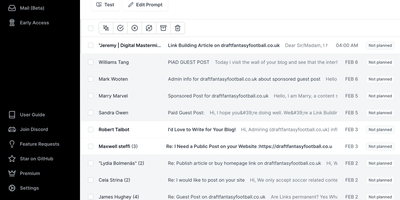
Inbox Zero
Your Gmail, Google Workspace, or Outlook inbox, worked by an AI assistant: Inbox Zero sits on top of the account you already have. Its core idea is rules written in plain English - tell the assistant "label invoices and file the PDF to Drive" or "archive cold outreach unless they mention my company" - and it executes against every incoming message. Emails that need a response arrive with a pre-drafted reply written in your tone, learned from your email history and calendar context. Reply Zero tracks what you owe responses to and what you're waiting on; the Bulk Unsubscriber surfaces newsletters you never read (with read-rate analytics) for one-click unsubscribe-and-archive; the Cold Email Blocker auto-archives unsolicited pitches based on your own definition of "cold." Smart Filing routes attachments - receipts, contracts, PDFs - into the right Google Drive or OneDrive folder, and Slack/Telegram integration lets you read, draft, and triage without opening a mail client. Email analytics show top senders and volume trends. It is not a new email client: everything happens in your real mailbox using native filters. Self-hosting means your mail content and the LLM calls that process it run on infrastructure you control.
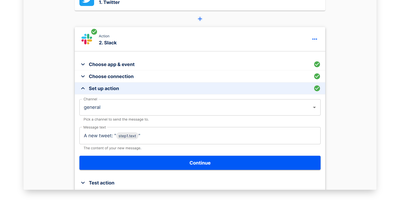
Automatisch
Automatisch runs your Zapier workflows on your own hardware - an open-source, self-hosted automation platform built as a direct alternative. Flows are chains of steps: one trigger (a polling or webhook event such as a new GitHub issue, a Stripe payment, or a form submission) followed by action steps that pass data downstream (post to Slack, append a Google Sheets row, update Notion). The visual builder deliberately mirrors Zapier's trigger-action model, so migrating existing Zaps requires no retraining and no programming knowledge. Roughly 60 integrations cover common business services - Slack, GitHub, Google Sheets, Notion, Stripe, Discord - and connections store credentials per service, with multiple accounts per app supported. Every execution runs on your own server: execution history, logs, and payload data never touch a third-party processor, which matters for GDPR, healthcare, and finance workloads. Error handling with retry logic, a REST API for programmatic flow management, and Docker Compose deployment round out the platform. The AGPL-3.0 Community Edition has no feature limits or per-task billing; an Enterprise Edition adds SSO, roles, and audit logs.
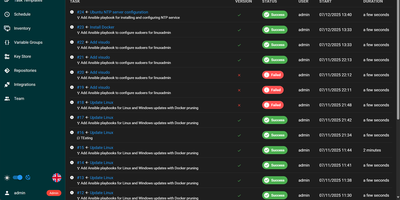
Semaphore
With nearly 14,000 GitHub stars and over 200 releases, Semaphore UI has established itself as the lightweight yet powerful alternative to enterprise automation platforms like Ansible AWX and Jenkins. Unlike AWX's heavyweight Kubernetes-dependent architecture, Semaphore ships as a single Go binary with zero external runtime dependencies — install it, run setup, and you have a production-ready automation server in minutes. The platform natively orchestrates Ansible playbooks, Terraform and OpenTofu infrastructure code, Terragrunt configurations, PowerShell scripts, Bash commands, and Python automation, all from a clean Vue.js web interface that displays task history, execution logs, and scheduling status at a glance. Semaphore supports concurrent task execution across multiple servers using distributed project runners, enabling horizontal scaling of automation workloads without complex clustering. The built-in inventory management system handles both static and dynamic inventory sources, while four-level RBAC (Owner, Manager, Task Runner, Guest) provides granular access control for team environments. Notifications flow to Slack, Microsoft Teams, Telegram, email, Rocket.Chat, and Gotify, keeping operators informed of failed tasks and deployment status. Integration with HashiCorp Vault secures sensitive credentials, and the comprehensive REST API with built-in Swagger documentation enables programmatic automation. Deploy via Docker Compose, Helm chart for Kubernetes, or native packages for Debian, Ubuntu, and RHEL-based distributions. Running on a dedicated VPS on RepoCloud with guaranteed CPU, RAM, and SSD, full root SSH access, and a browser serial console. MIT licensed.
Radarr
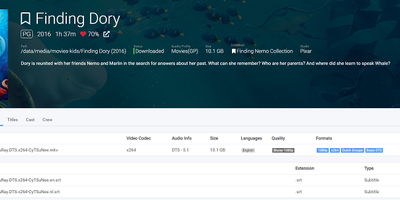
The movie half of the *arr stack: Radarr is a .NET collection manager that automates acquiring films for Usenet and BitTorrent users the way Sonarr does for TV. Add a movie once and Radarr handles the rest: it monitors indexers and RSS feeds, grabs a matching release the moment one appears, sends it to SABnzbd, NZBGet, qBittorrent, Deluge, Transmission, rTorrent, or another connected download client, then imports, sorts, and renames the file into your library structure. Quality profiles are the control surface - define allowed resolutions and a cutoff, and Radarr keeps upgrading files automatically, replacing a DVD rip when a Blu-ray release lands. Custom formats go further, scoring releases by codec, HDR metadata, release group, streaming source, or arbitrary regex so the copy you want always wins the pick. Failed downloads retry with another release automatically; a manual search shows every candidate and explains why one was skipped. Release parsing recognizes director's cuts, special editions, AKA titles, and hardcoded subs. Plex and Kodi integration handles notifications, library refreshes, and metadata like posters, trailers, and subtitles, and a calendar view tracks upcoming releases. It pairs naturally with Jellyseerr for request management and shares its API conventions with the whole *arr ecosystem.
Jellyseerr
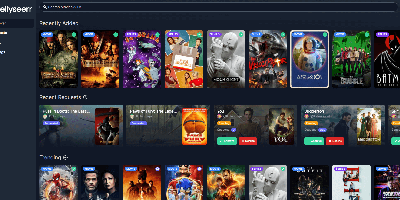
Browse trending titles, search anything, request it in two clicks: Jellyseerr gives Jellyfin, Emby, and Plex users a beautiful storefront for the media library. Born as the Overseerr fork that added Jellyfin and Emby support (the projects have since unified as Seerr), it handles the full request lifecycle - users authenticate with their existing media-server accounts, pick individual seasons or movies in a clean interface, and admins approve or decline from a simple queue, including on mobile. Approved requests flow straight to Sonarr and Radarr, which handle acquisition automatically, with support for separate 4K server instances. Regular library scans keep availability accurate, so users see instantly what already exists instead of requesting duplicates. A granular permission system controls who can request what - auto-approval for trusted users, quotas and limits elsewhere - and override rules adjust request routing by user, tag, or other conditions. Watchlist and blocklist functions curate discovery, notifications reach email, Discord, Telegram, Slack, Pushover, and Pushbullet, and both PostgreSQL and SQLite are supported. Localized into many languages, it turns "can you add this movie?" texts into a self-service system that runs itself.
Dagger
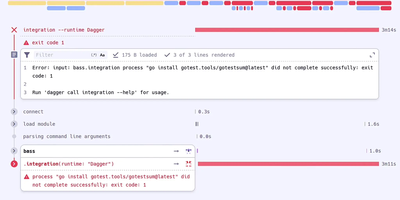
With 16,100 GitHub stars and created by Solomon Hykes (co-founder of Docker), Dagger eliminates proprietary YAML DSLs from CI/CD by letting developers write pipelines as real programs in their preferred language — then executing them identically on a laptop, in GitHub Actions, in GitLab CI, or on any machine with a container runtime. The BuildKit-based Dagger Engine runs every pipeline operation inside OCI containers, constructing a directed acyclic graph where each node is cached by default, parallelized automatically, and produces bit-for-bit reproducible outputs regardless of execution environment. Native SDKs generated from the GraphQL API schema provide Go, Python, TypeScript, PHP, Java, .NET, Elixir, and Rust developers with full type safety, IDE autocomplete, and the ability to unit-test CI pipelines using the same testing frameworks as application code. The module ecosystem enables cross-language composition where a Python team can invoke a Go team's build functions without learning Go, while filesystems, secrets, git repositories, and network tunnels are passed between functions as strongly-typed objects. Pipeline operations cache at container-layer granularity with content-addressed deduplication, and the interactive REPL enables step-by-step pipeline debugging with live container inspection. Host dependencies are explicit and strictly typed, eliminating implicit environment coupling that causes "works on my machine" failures. Running on a dedicated VPS on RepoCloud with guaranteed CPU, RAM, and SSD, full root SSH access, and a browser serial console. Apache 2.0 licensed.
OliveTin
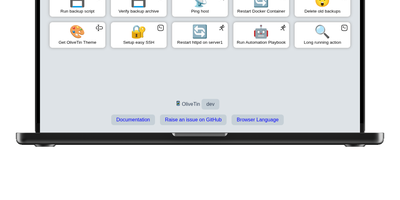
With over 3,600 GitHub stars and a philosophy of deliberate simplicity, OliveTin eliminates the need for SSH sessions, admin panels, and complex automation platforms by letting you define shell commands in a YAML config file and access them as clickable buttons through a clean browser interface. The Go binary consumes only a few megabytes of RAM, running on everything from tiny ARM and RISC-V devices through Linux VMs, containers, macOS, and Windows. Each button executes a predefined shell command with optional typed arguments that render as dropdowns, text fields, and validated inputs, preventing free-form command entry while giving users controlled access to server operations. Access control lists define exactly who can view or run each action — guests, family members, or junior administrators see only the buttons they are permitted to use. Entity templates generate actions dynamically from lists of hosts, containers, or other resources, creating one template that produces many buttons without manual duplication. Flexible triggers extend beyond browser clicks: cron schedules, webhooks, calendar file events, and filesystem watchers run actions automatically when conditions are met. Authentication supports OAuth2, JWT, and header-based methods for integration with reverse proxies and identity providers. Dashboards organize actions into folders and fieldsets for clear navigation across dozens of commands. No plugin system, no extension marketplace, no premium tiers — every feature ships in the single open-source release. Running on a dedicated VPS on RepoCloud with guaranteed CPU, RAM, and SSD, full root SSH access, and a browser serial console. AGPL-3.0 licensed.
Skyvern
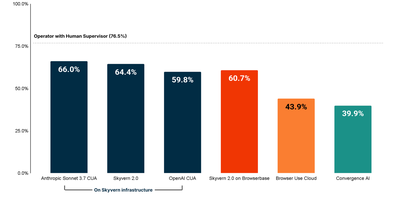
Scoring 64.4 on the WebBench benchmark — state-of-the-art among browser automation platforms — Skyvern replaces brittle XPath-based scripts with Vision LLM reasoning that adapts when websites change their layouts. The platform extends Playwright with AI-powered page methods including page.act(), page.extract(), and page.validate() that accept natural language prompts while still supporting traditional CSS selectors as fallback. The drag-and-drop Workflow Studio offers 17+ block types including navigation, extraction, login, loops, conditionals, code blocks, file download, and file upload — enabling non-technical users to build complex multi-step automations without writing code. Self-hosted deployments support bring-your-own-LLM with OpenAI, Anthropic, Gemini, and Ollama, while the multi-engine architecture allows swapping between Skyvern 2.0, OpenAI CUA, Anthropic CUA, or UI-TARS per task with a single parameter. Built-in infrastructure handles persistent browser sessions preserving cookies and localStorage across runs, automatic CAPTCHA solving for reCAPTCHA and hCaptcha, anti-bot bypass for Cloudflare and DataDome, residential proxy rotation across 20+ countries, and a credential vault integrating with Bitwarden and 1Password for secure 2FA management. Real-time session livestreaming via WebRTC enables visual debugging, while step-by-step action logs with screenshots and full LLM diagnostic traces provide production observability. The MCP server integration exposes Skyvern as a tool for Claude, Cursor, Windsurf, and any MCP-compatible AI agent. Connect to 6,000+ apps through Zapier, Make.com, or self-hosted N8N workflows. Deploy via Docker Compose or pip install with a two-command setup. Running on a dedicated VPS on RepoCloud with guaranteed CPU, RAM, and SSD, full root SSH access, and a browser serial console. AGPL-3.0 licensed.
Paperclip
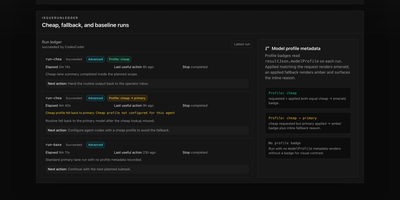
With over 77,000 GitHub stars accumulated in under five months since its March 2026 launch, Paperclip has become the default control plane for teams running multiple AI agents in production. Rather than juggling dozens of terminal tabs with Claude Code sessions, Codex instances, and Gemini CLI workers, Paperclip organizes all agents into a company structure with org charts, reporting lines, role-based permissions, and per-agent monthly budgets that trigger hard-stops when exceeded. The platform supports any runtime through its adapter system — Process adapters manage local CLI agents like Claude Code, Codex, Cursor, Pi, and OpenCode as child processes, while HTTP adapters trigger remote agents via webhooks to OpenClaw, serverless platforms, or custom endpoints. Heartbeat-based execution wakes agents on configurable schedules, injecting goal context, budget state, and workspace paths directly into the invocation payload. The Work and Task System provides atomic checkout with execution locks, first-class blocker dependencies, and structured work products to eliminate duplicate effort. Governance features include approval workflows, decision tracking, emergency stops, and full audit trails tracing every mutation to an actor. Deployment runs as a single Node.js process with embedded PostgreSQL locally or scales to external Postgres for production, installable in one command via npx paperclipai onboard. Running on a dedicated VPS on RepoCloud with guaranteed CPU, RAM, and SSD, full root SSH access, and a browser serial console. MIT licensed.
Budibase
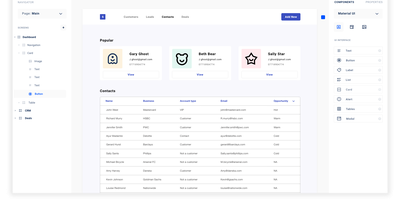
Step right up to the magical world of Budibase, the open-source wizardry that turns the grueling task of building internal tools into a walk in the digital park. Imagine crafting mighty tools and formidable forms in less time than it takes to brew a cup of coffee, all without typing a single line of code! With Budibase, you can charm data from an ancient external database, summon information from a Rest API, conjure up figures from a CSV, or create something entirely new with Budibase's own mystical database. Design your digital dominion with a flick of the drag-and-drop, and automate your kingdom's workflows as if by magic. Join the ranks of the 75,000 teams who've harnessed the power of Budibase to accelerate their business quests. Need to safeguard data like a digital fortress, automate tasks like a sorcerer, or streamline operations like a high-speed chariot? Budibase is your trusty steed in the race to operational victory. And with RepoCloud hosting, you'll save a treasure chest of gold compared to those other cloud-dwelling giants!
OpenSign
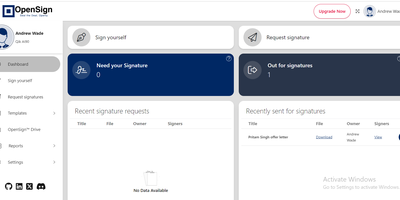
With 6,700 GitHub stars, 79 releases, and 40 contributors since its October 2023 launch, OpenSign delivers a fully free electronic signature platform that removes the per-envelope pricing and seat limits of commercial e-signing services. The React-based frontend provides a drag-and-drop interface for placing signature fields, initials, date stamps, text inputs, and checkboxes onto PDF documents, while the Parse Server backend built on Node.js handles document routing through configurable multi-signer workflows with sequential or parallel signing order. Guest signers authenticate via one-time-password email verification without requiring account creation, while registered users manage documents through OpenSign Drive — a centralized vault with folder organization and status tracking across draft, in-progress, completed, and declined states. Every signing action generates tamper-proof audit trails logging timestamps, IP addresses, email addresses, and phone numbers, culminating in a detailed completion certificate attached to the finished document. The REST API v1.2 exposes endpoints for document creation, template dispatch, self-signing, and real-time webhook notifications on document lifecycle events, with regional deployments available in US and EU. PDF templates with pre-placed widgets enable repeated dispatch to different signers in a single API call. Custom branding controls email invitation templates, signing page appearance, and completion certificate styling. Deploy via Docker Compose with MongoDB, Caddy reverse proxy, and automatic HTTPS provisioning. Running on a dedicated VPS on RepoCloud with guaranteed CPU, RAM, and SSD, full root SSH access, and a browser serial console. AGPL-3 licensed.
Ever Works
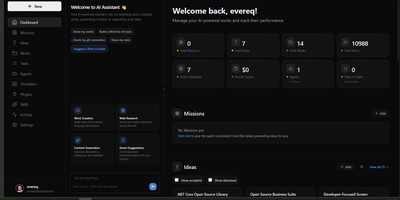
Ever Works transforms a single text prompt into a fully researched, written, coded, and deployed website through autonomous AI agents that operate on a configurable 15-step generation pipeline. Unlike one-shot builders, it continuously improves generated content on a schedule, keeping sites fresh without manual intervention. The platform integrates with six AI providers (OpenAI, Anthropic, Google, Groq, Mistral, Ollama) via gateways like OpenRouter and Vercel AI Gateway, while its plugin system connects ten search providers including Tavily, Brave, Exa, SerpAPI, and Perplexity for deep autonomous research. Every generation is Git-native — code and content live in your own GitHub repositories as commits, providing full version control, portability, and zero vendor lock-in. The monorepo ships a NestJS 11 REST API with JWT authentication, a Next.js 16 web dashboard for managing works, a CLI for terminal operations, an MCP server for AI agent integration, and admin tooling. Content management supports items, categories, tags, and collections, while deployment targets include Vercel and Kubernetes. Background processing runs on Trigger.dev with BullMQ scheduling, and monitoring leverages Sentry plus PostHog for error tracking and product analytics. The platform supports OAuth via GitHub and Google, subscription billing, email notifications, and AI chat conversations for natural-language interaction with your generated works. Running on a dedicated VPS on RepoCloud with guaranteed CPU, RAM, and SSD, full root SSH access, and a browser serial console. AGPL-3.0 licensed.
Tugtainer
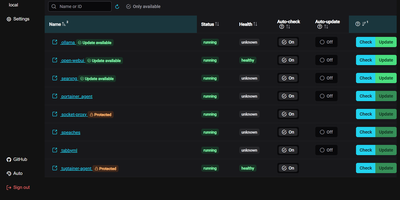
Tugtainer delivers a visual command center for Docker environments that automates container image updates, monitors registry releases, and manages application lifecycles across multiple servers without command-line intervention. System administrators can inspect running containers across all connected hosts, trigger immediate image pulls, and configure automated cron schedules for recurring health and registry checks. Flexible update policies allow teams to flag production databases as notification-only while automatically updating stateless web applications whenever new image tags publish. When updating linked services, the platform analyzes Docker Compose project definitions and custom dependency labels to stop and restart containers in strict dependency order, preventing broken network links and orphaned volume mounts. Administrators can authenticate private container registries, browse image layers and tags, and view real-time container log streams directly within the browser console. Automated pruning jobs continuously reclaim server disk space by deleting obsolete, untagged images and dangling build layers after successful deployments. Multi-channel alerting integrates with over fifty notification providers, delivering real-time update summaries and error warnings directly to Discord, Telegram, Slack, and email webhooks. Running on a dedicated VPS on RepoCloud with guaranteed CPU, RAM, and SSD, full root SSH access, and a browser serial console. MIT licensed.

Octop
Modern engineering teams and busy households deploy Octop to run private, autonomous AI agents equipped with persistent memory workspaces, scheduled cron jobs, and direct browser automation. Users can orchestrate specialist agents tailored for software development, IT operations, content generation, and system diagnostics through an interactive React dashboard. The platform connects directly to Discord, Feishu, DingTalk, and WeCom, allowing team members to delegate complex tasks without leaving their everyday messaging apps. An integrated remote desktop and browser control engine lets agents navigate websites, capture screenshots, fill forms, and operate graphical software autonomously. Administrators can assign distinct MBTI personality profiles to agents, establish granular role-based permissions, configure scheduled cron workflows, and integrate custom Model Context Protocol servers for external tool access. Long-term memory persists across conversations through dedicated workspace files, ensuring contextual continuity whenever switching between underlying language models or team collaborators. Running on a dedicated VPS on RepoCloud with guaranteed CPU, RAM, and SSD, full root SSH access, and a browser serial console. MIT licensed.
Cloudflare OS
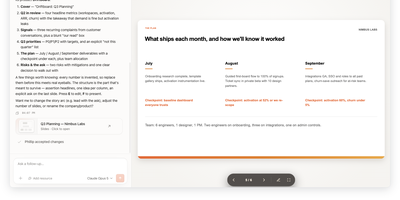
With over 7,700 GitHub stars and thousands of Cloudflare employees using it daily across every function, Cloudflare OS delivers an open-source AI workspace where every employee gets a personal agent grounded in company context, systems, and skills — not a generic chatbot but a programmable workspace that builds real applications, automates workflows, and connects to internal tools through governed access. The Code Mode agent writes and immediately executes code snippets to perform arbitrary tasks, build full-stack Gadgets with client code, server code, APIs, and durable SQLite state, debug errors, and test results within isolated sandboxes. Gadgets are private application instances running in separate sandboxes — each document, spreadsheet, or tool is its own secure runtime that cannot leak data even to attackers with access to other Gadgets. Blueprints enable sharing application code as templates that others instantiate with independent state, credentials, and resources. Gatekeepers provide security governance giving system owners precise control over what agents can see, change, and when human approval is required before actions execute. Built on Cloudflare Workers using Durable Objects for workspace persistence, Dynamic Workers for Gadget execution, and Facets for access management. Zero Trust security via Cloudflare Access verifies every user and request before granting access. Real-time collaboration lets colleagues use shared Gadgets. Deploy to your own Cloudflare account or self-host on workerd, the open-source Workers runtime, on your own servers. Running on a dedicated VPS on RepoCloud with guaranteed CPU, RAM, and SSD, full root SSH access, and a browser serial console. Apache-2.0 licensed.
OpenCode Manager
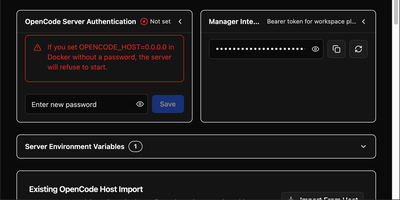
OpenCode Manager is a mobile-first command center for AI coding agents. Install the PWA on your phone or tablet and you get real-time streaming chat, multi-repository Git operations, and scheduled automation right in your pocket. Git integration handles SSH-authenticated repo cloning, worktree management, unified diffs, and branch operations across all your projects in one dashboard. Chat with coding agents through Server-Sent Events streaming that supports slash commands, @-mentions for files, Plan and Build modes, and Mermaid diagram rendering for architecture discussions. Schedule reusable prompts to run against any repository on intervals or cron expressions, with each run tracking history and linking to sessions so you can pick up exactly where automation left off. MCP server configuration adds local and remote HTTP servers with OAuth support, plugging into the broader Model Context Protocol ecosystem. A dedicated assistant workspace provides an isolated AI environment with auto-provisioned skills for managing schedules, notifications, and settings. Multiple AI providers are supported including Anthropic, GitHub Copilot, and OpenAI-compatible services, each configurable with custom system prompts and granular tool permissions. Push notifications alert you to session events, agent questions, errors, and task completions across all managed repositories.
Change Detection
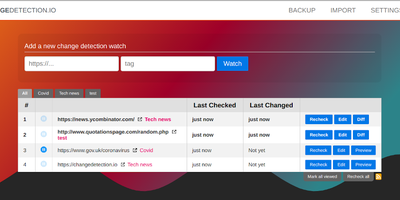
Price drops, restocks, job postings, government announcements, competitor edits - changedetection.io watches web pages and alerts you the moment anything changes, down to PDF text and checksums. Point it at a URL, set a check interval, and precise filters decide what counts as a change: a Visual Selector targets page elements by pointing and clicking, CSS selectors and XPath narrow scope, trigger-text and ignore-text rules (with regex support) cut noise, and JSONPath or jq handles API responses. A dedicated re-stock and price detection mode extracts product metadata and fires on thresholds - alert only when the price drops below your target or the percentage change exceeds a limit. JavaScript-heavy sites render through a real Chrome browser via Playwright, with the ability to execute JS steps first (log in, click, scroll) before extracting text. Notifications reach 85+ services through Apprise - Discord, Slack, Telegram, email, webhooks - optionally with a screenshot of the changed page, and AI-powered summaries (any OpenAI-compatible endpoint, including local Ollama) describe what changed. Per-watch proxies, custom headers, and POST/GET control cover hostile targets. Apache-2.0 licensed with local file-based storage: the URLs you monitor and why stay entirely your business.