CyberScraper 2077
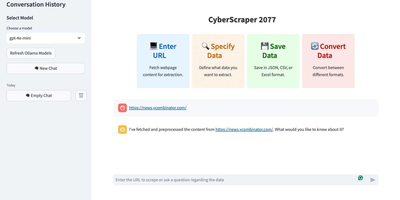
With 3,100+ GitHub stars, CyberScraper 2077 replaces brittle CSS selectors and XPath queries with natural language data extraction powered by Large Language Models. Users paste a URL, describe the data they want in plain English, and the AI extracts structured results from any website — no HTML parsing knowledge required. The tool supports three LLM backends: OpenAI GPT models for maximum accuracy, Google Gemini for cost-effective extraction, and local Ollama instances for fully private scraping where URLs and data never leave your server. Built on Python asyncio with Playwright browser automation, it handles concurrent page fetching with content-based and query-based LRU caching to minimize redundant API calls. The Streamlit web interface runs on port 8501 and provides one-click export to JSON, CSV, HTML, SQL, Excel, and direct Google Sheets upload. Tor network integration routes requests through onion routing for anonymous scraping of both clearnet and .onion hidden service sites with automatic circuit management and stream isolation. Stealth mode randomizes user agents, manages cookies, and controls JavaScript execution timing to bypass bot detection systems. Multi-page scraping navigates through paginated results with automatic URL pattern detection. Docker deployment packages all dependencies including Playwright browsers into a single container. Running on a dedicated VPS on RepoCloud with guaranteed CPU, RAM, and SSD, full root SSH access, and a browser serial console. MIT licensed.
Row-Bot
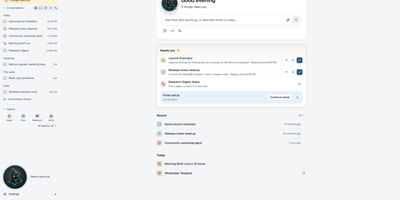
Conversations, goals, memory, and scheduled workflows live together in one private AI assistant that runs on your own server and opens in any browser, on a laptop or a phone. Chat with local models through Ollama, provider API keys, ChatGPT, Claude, or Grok subscriptions, or any OpenAI-compatible endpoint, and every tool call shows up in the transcript. Risky actions pause for Approve or Deny in the chat, on the Home screen, or on a connected channel. Memory grows into a personal knowledge graph with recall, review, and an Obsidian-compatible wiki vault. Ask for a deck, a mockup, or an app and a design or code panel opens beside the chat, with Present, export to PDF, HTML, PNG, or PPTX, a changes view, Git, pull requests, checks, and an interactive terminal. Goals keep going until done, delegated agents get their own conversations, and workflows run on a schedule, a webhook, or a chain, with run history and delivery to channels. Telegram, WhatsApp, Discord, Slack, and SMS channels, voice dictation, and an app catalog for GitHub, Notion, Linear, and Stripe extend it, and health checks propose one fix per problem. Pairing a phone takes a QR code and a one-time invitation, and the server serves a single owner across many devices. Running on a dedicated VPS on RepoCloud with guaranteed CPU, RAM, and SSD, full root SSH access, and a browser serial console. Apache-2.0 licensed.
pi-dispatch
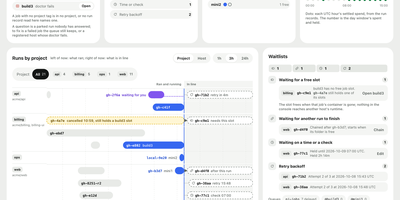
pi-dispatch turns one AI coding agent into a swarm that works in the background and reports to a single web page. Jobs start from a nightly schedule, a labeled issue, or a comment, then wait in one shared queue until a machine has room. Each job runs in a sealed box that is thrown away afterwards, reaches only the internet addresses you allow, and stops at the dollar limits you set per day, week, and month. When an agent hits a decision, it parks a question with options and a recommendation, and no model spend accrues until you answer. The overview shows what needs you, what is queued, what is running, and what today has cost. A Zero touch page tracks how often runs needed a person, per project, so you can see how far to step back. On GitHub, GitLab, Forgejo, and Azure DevOps the work ends as a proposed change that a human merges. Fleet, Spend, Triggers, and Models pages cover several machines, budgets per project, and fallback models. Running on a dedicated VPS on RepoCloud with guaranteed CPU, RAM, and SSD, full root SSH access, and a browser serial console. MIT licensed.
FLUJO
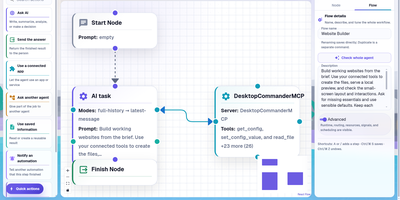
Building an AI agent in FLUJO means saving a model connection once, adding plain-language steps or dragging nodes onto a visual graph, and attaching tools from any MCP server, all inside one open-source workspace you host yourself. Connections cover OpenAI, Azure OpenAI, Anthropic, Google Gemini, xAI, OpenRouter, and local Ollama models, with ordered fallback connections for rate limits and outages plus a built-in connection test. The Connected Apps screen imports MCP servers from curated apps, the MCP Registry, a remote URL, a GitHub repository, or a local command, then lets you call their tools and read their resources before an agent touches them. Easy mode assembles an agent one recipe step at a time, Expert mode exposes Start, AI, connected-app, Static, and Subflow nodes with branching handoffs and loops, and both open the same saved agent. Talk runs agents in a live chat with a context-window meter, optional tool approvals, file and audio attachments, message editing, and a visual debugger that sets breakpoints and steps through nodes. Triggers start flows from schedules, webhooks, file changes, polled MCP tools, changed websites, or another flow finishing. Experimental Personas keep memories and goals between sessions, and Meetings seat several agents in one conversation. Any saved flow answers as a model on an OpenAI-compatible /v1 endpoint, so Cline, Cursor, or SDK clients can call it. Running on a dedicated VPS on RepoCloud with guaranteed CPU, RAM, and SSD, full root SSH access, and a browser serial console. MIT licensed.
Tale
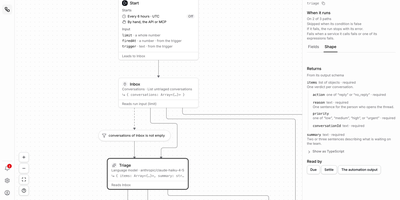
One workspace for the whole job: Tale puts your team and your AI agents on the same project board, so a question becomes an assigned task, a reviewed report, and files you can open. Describe the work with a brief, source files, and completion criteria, then assign it to a teammate or an agent. Agents get their own runtime (Claude Code, Codex, Cursor, Gemini CLI, Hermes, OpenClaw, OpenCode, Pi, or Qwen Code), model, skills, and tools, and work in a persistent sandbox; a manager agent can delegate ready tasks. Steer with @mentions in task comments, then accept the result or send it back. Chat shows the sources behind an answer and compares two models side by side in Arena. Knowledge holds documents, short entries, crawled websites, products, and contacts for retrieval within each team's access. Automations are versioned workflows with schedule, webhook, and event triggers, tests before deployment, playback of finished runs, and approval before protected writes; ready-made templates triage Gmail, Outlook, and IMAP inboxes, review pull requests, and send daily task digests. Coding agents connect over MCP with an access level you choose and can revoke. Roles, teams, budgets, guardrails, and a hash-chained audit log keep the work governed. Running on a dedicated VPS on RepoCloud with guaranteed CPU, RAM, and SSD, full root SSH access, and a browser serial console. MIT licensed.
Plandex
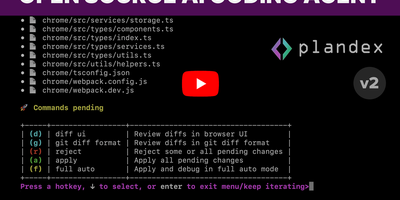
With 15,500 GitHub stars and over 1,100 forks, Plandex delivers a terminal-based AI coding agent purpose-built for the complex, multi-file tasks that overwhelm single-file AI assistants. The Go-powered server maintains a cumulative diff review sandbox that quarantines all AI-generated changes from your project files until you explicitly approve them — enabling 20-file refactors where you cherry-pick good changes and reject bad ones without touching git. A 2M token effective context window loads only what each step requires, while tree-sitter project maps index repositories exceeding 20M tokens across 30+ programming languages, providing structural awareness of class hierarchies, function signatures, and import graphs without burning tokens on full file content. The configurable model pack system assigns different models to different roles — Claude for planning, GPT for coding, Gemini for summarization — supporting Anthropic, OpenAI, Google, OpenRouter, Azure OpenAI, AWS Bedrock, DeepSeek, Perplexity, and Ollama for local models. Full auto mode handles end-to-end autonomous workflows including high-level planning, context loading, implementation, terminal command execution, and automated debugging of both terminal and browser applications. The interactive REPL provides fuzzy auto-complete, version-controlled sandbox branching, rewind to any previous point, and Git integration for commit message generation. The Plandex Server exposes 60+ REST API endpoints for programmatic orchestration across organizations, projects, plans, and branches. Deploy via Docker Compose for self-hosted operation with your own API keys. Running on a dedicated VPS on RepoCloud with guaranteed CPU, RAM, and SSD, full root SSH access, and a browser serial console. MIT licensed.
WPPConnect Server
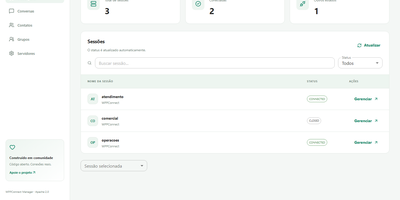
WhatsApp becomes an HTTP service your own systems can call. WPPConnect Server wraps WhatsApp Web sessions in a REST API for integrators who need to send and receive messages, manage contacts and groups, and react to events without building browser automation themselves. Each session pairs by QR code and gets its own token, and multiple sessions run side by side for different numbers, teams, or customers. Endpoints cover text and media messaging, contact and group operations, product catalog actions, and session lifecycle, all documented in a built-in Swagger UI and a Postman collection. Webhooks push incoming messages and status changes to your backend, with destination allowlists keeping callbacks pointed only where you configured. Chatwoot connects through a dedicated authenticated webhook, so support conversations can flow between the help desk and WhatsApp in both directions. The Docker image bundles WPPConnect Manager, a web workspace for session administration, QR pairing, and reading and answering chats, protected by the server secret key at the top level and per-session tokens below it. Credentials, browser data, media, and logs persist in named volumes, surviving container restarts without re-pairing. Support desks automate ticket updates, shops send order notifications, and clinics confirm appointments through numbers they already publish. Running on a dedicated VPS on RepoCloud with guaranteed CPU, RAM, and SSD, full root SSH access, and a browser serial console. Apache-2.0 licensed.
Uyuni
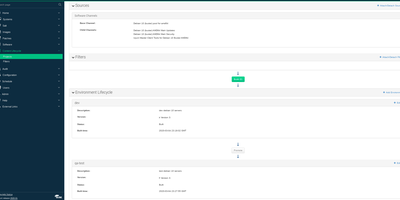
Four hundred servers need a security patch, they run five different Linux distributions, and a spreadsheet says which ones were done. Uyuni replaces that spreadsheet: one server inventories your fleet, mirrors the software channels each machine subscribes to, and shows exactly which patches and errata apply where. Administrators register clients manually, by bootstrap script, or automatically through activation keys, then group them into systems sets so an action aimed at a group lands on staging first and production on schedule. Patch management creates and applies errata with CVE context, and CVE audits check systems against vulnerability data so you can prove a fix landed instead of believing it did. Configuration channels push files, directories, and symbolic links rendered with Jinja templates through the built-in Salt master, which also runs remote commands and orchestration across tens of thousands of clients. The Content Lifecycle Manager promotes package sets from development through testing to production channels, so every environment consumes tested content in order. Provisioning reinstalls or network-boots machines through PXE with AutoYaST, Kickstart, or cloud-init profiles, proxies cache content for branch offices, and built-in Prometheus and Grafana monitoring watches the management server itself. Running on a dedicated VPS on RepoCloud with guaranteed CPU, RAM, and SSD, full root SSH access, and a browser serial console. GPL-2.0 licensed.
AgentDock
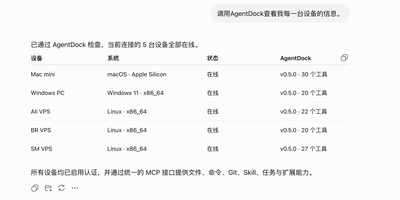
AgentDock turns the computers and servers you already run into machines an AI assistant can operate for you through one secure MCP endpoint. Connect ChatGPT, Claude, Codex, or any other MCP client and the agent works in the real environment: reading and writing files, searching code, running shell commands, and driving Git where the project actually lives. Long jobs survive interruptions because task state and checkpoints persist on the node, ready to resume where they stopped. Browser work is covered as well, with web pages driven through a native Chrome DevTools connection that reuses your logged-in sessions, captures screenshots, and can even operate macOS desktop applications. Capabilities grow through installable Skills and dynamic MCP servers, so a node picks up new tools without a rebuild. Run a single node on a laptop, or spread nodes across VPS hosts and containers and pair them with the optional NexusDock console for one fleet view, shared Recall memory, reusable workflow templates, and a single MCP address for every machine. Access stays locked down with Bearer tokens or OAuth sign-in, loopback-only defaults, and optional Cloudflare Tunnel or HTTPS exposure when a remote client needs a way in. Running on a dedicated VPS on RepoCloud with guaranteed CPU, RAM, and SSD, full root SSH access, and a browser serial console. Apache-2.0 licensed.
Mularr
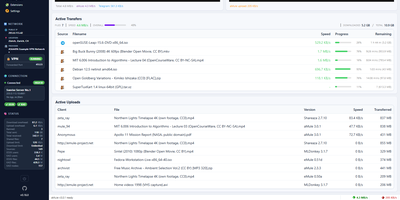
Classic eD2k and Kad downloading gets a browser interface with the look of Windows XP, Windows Classic, a clean modern dashboard, or green-on-black Hacker mode. Mularr wraps an aMule daemon and shows live download and upload graphs, active transfers with progress and remaining time, and the uploads other clients are pulling. Transfers can be started, paused, stopped, categorized, and bulk imported from ED2K links. Servers, search, shared files, categories, and extensions each get their own page. For automation it presents itself as a qBittorrent download client and a Torznab indexer, so Sonarr and Radarr can use it with their standard settings. Extensions for Sonarr and Radarr read the Wanted list and publish matches into a feed the apps can poll. Telegram can act as an extra download provider and notification channel, and Hispashare releases appear in search results next to aMule's. A VPN panel reports Gluetun health and the forwarded port, and the settings page covers ports, bandwidth limits, IP filters, a blacklist, and shared folders. One container image and a single data volume are enough to get started. Running on a dedicated VPS on RepoCloud with guaranteed CPU, RAM, and SSD, full root SSH access, and a browser serial console. MIT licensed.
Ever Works
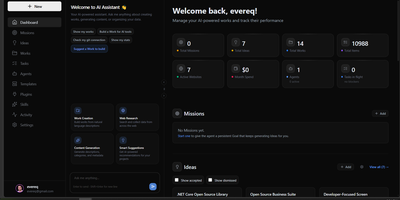
Ever Works transforms a single text prompt into a fully researched, written, coded, and deployed website through autonomous AI agents that operate on a configurable 15-step generation pipeline. Unlike one-shot builders, it continuously improves generated content on a schedule, keeping sites fresh without manual intervention. The platform integrates with six AI providers (OpenAI, Anthropic, Google, Groq, Mistral, Ollama) via gateways like OpenRouter and Vercel AI Gateway, while its plugin system connects ten search providers including Tavily, Brave, Exa, SerpAPI, and Perplexity for deep autonomous research. Every generation is Git-native — code and content live in your own GitHub repositories as commits, providing full version control, portability, and zero vendor lock-in. The monorepo ships a NestJS 11 REST API with JWT authentication, a Next.js 16 web dashboard for managing works, a CLI for terminal operations, an MCP server for AI agent integration, and admin tooling. Content management supports items, categories, tags, and collections, while deployment targets include Vercel and Kubernetes. Background processing runs on Trigger.dev with BullMQ scheduling, and monitoring leverages Sentry plus PostHog for error tracking and product analytics. The platform supports OAuth via GitHub and Google, subscription billing, email notifications, and AI chat conversations for natural-language interaction with your generated works. Running on a dedicated VPS on RepoCloud with guaranteed CPU, RAM, and SSD, full root SSH access, and a browser serial console. AGPL-3.0 licensed.
Pipewright
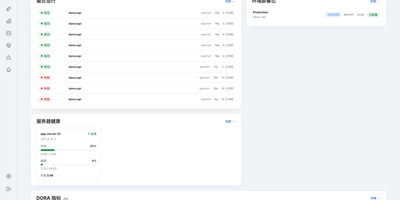
Draw a pipeline, push code, and watch it build, deploy, and roll back on its own: Pipewright is a self-hosted CI/CD platform delivered as one static binary. Pipelines are drawn on a two-level canvas of stages and jobs, then run with matrix builds, sidecar databases for tests, manual approval gates, and typed parameters validated at trigger time. The pipeline can also live in the repository as a per-branch .pipewright.yml file, and triggers cover webhooks, schedules, branch to environment mapping, and chained pipelines. Builds run isolated inside containers with cached dependencies and a content-addressed artifact store, and JUnit and Cobertura reports feed quality gates that stop bad code before deployment. Deployment is agentless over SSH: health checks gate a zero-downtime cutover, failures roll back on their own, and environments track their active version with one-click rollback and promotion toward production. Deployed services receive HTTPS domains through a managed Caddy proxy with automatic certificates, path routing, and load balancing, and each pull request gets a throwaway preview address with its own certificate. The operations side watches host CPU, memory, and disk, manages containers and networks across servers, and opens terminals in the browser. Notifications route by event to Slack, email, WeCom, DingTalk, Lark, or a webhook, approvals arrive as signed links, and the four DORA metrics are computed out of the box. Running on a dedicated VPS on RepoCloud with guaranteed CPU, RAM, and SSD, full root SSH access, and a browser serial console. MIT licensed.
Breeze
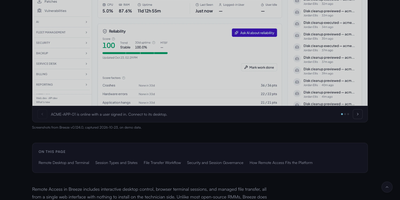
Breeze is an open-source RMM and PSA platform for MSPs that watches every managed device, and its built-in AI operator investigates alerts and drafts fixes for your approval. See live CPU, memory, disk, and network health for the whole fleet, with hardware and software inventory on every Windows, macOS, and Linux endpoint. Approve and deploy operating system and application patches in rings and maintenance windows, or push scripts and software to hundreds of devices at once. Open a remote terminal, browse files, or take over the desktop with multi-display support when a user needs hands-on help. Network discovery scans each site for unmanaged devices, while configuration policies and drift checks keep machines aligned with your baseline. Tickets, time entries, quotes, and invoices live beside the device work, so a resolved issue becomes a billable record without a second system. Clients get their own portal to raise requests and follow progress, and the multi-tenant structure keeps every customer separate from day one. When the AI operator acts, tiered approvals and a full audit log show exactly what it did and who allowed it. Running on a dedicated VPS on RepoCloud with guaranteed CPU, RAM, and SSD, full root SSH access, and a browser serial console. AGPL-3.0 licensed.
Atlantis
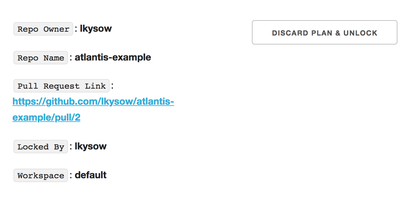
Every Terraform change becomes a pull request with Atlantis, which runs the plan on your server, posts the output for review, and applies only the exact change reviewers approved. Open a pull request that touches Terraform code and Atlantis automatically runs terraform plan, posting the full output as a comment and a commit status your reviewers can inspect line by line. When the change looks right, a teammate comments atlantis apply and Atlantis executes the exact plan that was reviewed, then reports the result back on the same pull request. Each directory and workspace is locked while a pull request is open, preventing two changes from applying out of order, and locks can be inspected or discarded from the web interface. Apply requirements let you demand an approved review or a mergeable branch before anything runs, and optional policy checks evaluate plans against your rules before they can proceed. Repositories describe their projects, workspaces, and custom workflows in an atlantis.yaml file, including pinned Terraform versions, execution order groups, and parallel planning or applying across projects. Because Atlantis runs inside your infrastructure, cloud credentials never leave your network, and every plan, approval, and apply is preserved on the pull request as an audit trail. Running on a dedicated VPS on RepoCloud with guaranteed CPU, RAM, and SSD, full root SSH access, and a browser serial console. Apache-2.0 licensed.
Magnetissimo
Magnetissimo is a self-hosted torrent indexer that searches eight public sources at once and remembers everything they return, so the release you hunted for across half a dozen sites last week is already waiting in your own index when you look for it again. A search answers from the local database immediately and asks YTS, Nyaa, Sukebei, TorrentDownloads, AudioBookBay, The Pirate Bay, EZTV, and OxTorrent in parallel; every answer is filed into the index as it lands and streams into the results page with size, seeders, leechers, and age attached. The query language goes further than any single source: exact quoted text, exclusions, alternatives, wildcards, and filters for file size, seeder count, and age, with matching that copes with dotted scene release names and titles without spaces. An optional DHT crawler walks the peer-to-peer network in the background at a rate you choose, discovering torrents and their file lists around the clock and showing arrivals live on its own page. Media automation connects natively: the Torznab endpoint feeds Sonarr, Radarr, Lidarr, Prowlarr, and book managers with standard categories, and a JSON API serves the latest and best-matching torrents to scripts. Everything lives in one SQLite database inside a single container, search and paging work without JavaScript, and upgrades are a pull and a restart. Running on a dedicated VPS on RepoCloud with guaranteed CPU, RAM, and SSD, full root SSH access, and a browser serial console. MIT licensed.
octo-agent
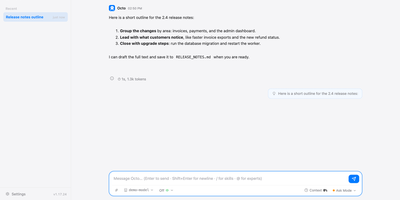
One download gives you a coding agent and personal assistant that is ready to work after a single message. The agent runs shell commands, reads and edits files, searches the web, calls MCP servers over stdio or HTTP with OAuth, and splits work across parallel sub-agents. Chat from the terminal, the web dashboard, a desktop app, VS Code, Obsidian, an Android app, or IM bridges for Telegram, Discord, Feishu, DingTalk, WeCom, and WeChat. Bring DeepSeek, Kimi, Qwen, Anthropic, OpenAI, or any compatible endpoint, with prompt caching tuned for each provider to keep token bills predictable. Skills use the Claude Code SKILL.md format, so an existing skills folder works unchanged. Cross-session memory, scheduled tasks, reusable multi-agent workflows, and Chrome automation that records, replays, and repairs browser steps cover the repetitive jobs. Light Apps are small agent-built tools that run in the browser with no further tokens. Safety is built in: catastrophic commands are hard-denied, deleted or overwritten files go to a recycle bin first, and an OS sandbox can confine the terminal. There is zero telemetry, and the web dashboard loads no outside fonts or scripts. Expose the server on a VPS behind its auto-generated access key and reach the same sessions from any device. Running on a dedicated VPS on RepoCloud with guaranteed CPU, RAM, and SSD, full root SSH access, and a browser serial console. MIT licensed.
Murmur
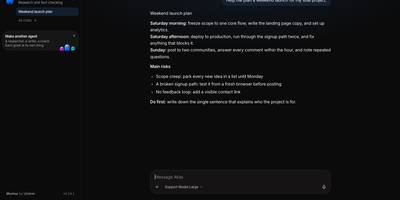
Every AI agent gets a face, a colour, and a job in Murmur, a chat app that makes running Hermes Agent as friendly as texting a colleague. Start from a template (Researcher, Writer, Planner, Coder, Coach, or Chef) or describe a new agent from scratch, then talk to one at a time or drop several into a group room and call on a single one with an at-mention. Replies stream in live, long jobs show a plan that ticks itself off, and every step appears in plain words. Connect a model with a ChatGPT plan, a local model server, or an API key from OpenRouter, OpenAI, Anthropic, and others, with the model and thinking effort chosen per agent or chat. Agents can reach Notion, Linear, Todoist, Figma, and dozens of other apps, and they ask for an Allow or Don't allow before changing anything important. Morning briefings run as routines, a memory view shows what each agent knows with controls to edit or forget it, and WhatsApp or Telegram can be linked by scanning a code. A voice call mode lets an agent answer out loud, and slash commands set long-running goals or ask quick side questions. Chats sync across browser, desktop, and phone. Solo builders, homelab fans, and small teams get a calm front door to their own agents. Running on a dedicated VPS on RepoCloud with guaranteed CPU, RAM, and SSD, full root SSH access, and a browser serial console. MIT licensed.
Markus
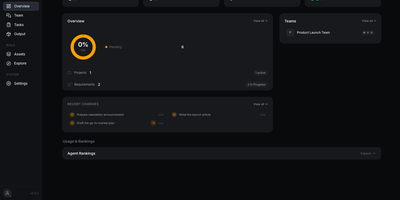
Markus is an AI workforce you run yourself: describe a goal in plain language and a team of specialist agents plans it, splits it into tasks, does the work, and reports back. A built-in Secretary agent hires agents from role templates, groups them into teams, and turns requirements into dependency-linked tasks. Work runs in parallel, each task in its own workspace, and a peer reviewer approves or sends back every delivery before it counts as done. Follow progress on a backlog table, a kanban board, or a dependency graph that shows which task unblocks which. Agents keep persistent memory, patrol their own task board around the clock, and can join team group chats or take direct messages. Connect Slack, Telegram, Discord, WhatsApp, or Feishu so people can reach agents where they already talk, and give agents browser and desktop automation through an optional Chrome extension. Pick any model provider, including Anthropic, OpenAI, Google, DeepSeek, OpenRouter, or a local Ollama server, and import skills from MCP servers or community hubs. A REST and WebSocket API, usage rankings, and an audit trail round out the control room. Running on a dedicated VPS on RepoCloud with guaranteed CPU, RAM, and SSD, full root SSH access, and a browser serial console. Apache-2.0 licensed.