Connapse
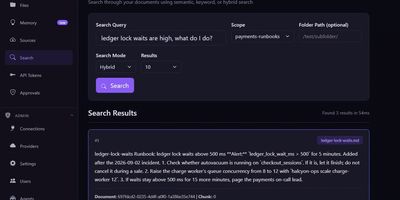
Give your AI agents a library to search and a memory that survives the session: Connapse serves both over MCP and a REST API. Upload files or whole folders, or index them where they live: SFTP servers (including folders on your own computer), Amazon S3, Azure Blob Storage, GitHub, Confluence, Jira, or a custom source server. Queries run vector and keyword search together and fuse the rankings, an optional cross-encoder reranker re-scores the top results, and each passage comes back labeled with its source file. Agents save dated facts with their sources into personal or team memory spaces, recall them later, correct them without losing history, and forget them on request, while a Memory page shows each space's timeline. Results from GitHub, Confluence, Jira and custom sources are checked against each reader's own access, and a passage is left out whenever that check cannot be made. Optional link search follows a GitHub issue to its closing pull request or a Jira issue to its epic, and code tools find definitions, callers, and what a change could affect. More than twenty named tools suit Claude Code, Cursor, and VS Code; each key gets only the tools its scopes allow, and deletes can wait for approval. Embeddings run locally by default, with OpenAI or Azure OpenAI one setting away. Running on a dedicated VPS on RepoCloud with guaranteed CPU, RAM, and SSD, full root SSH access, and a browser serial console. MIT licensed.
OpenClaw Dashboard
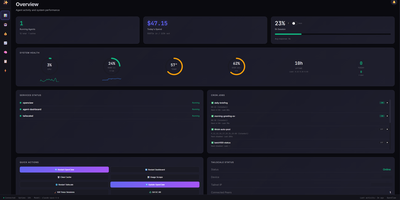
OpenClaw Dashboard is a secure real-time monitoring dashboard for OpenClaw AI agents that tracks live sessions, API costs, rate limits, and host health from one browser page. The overview refreshes every five seconds with live session activity, token totals, and lifetime spending, so you can see what every agent is doing right now. Cost views break spending down by model, session, and time period, and rate limit panels track Claude and Gemini usage against rolling windows with browser alerts before quotas run out. A live feed streams agent messages across all sessions, and a session browser adds search, status filters, timelines, and a 30 day activity heatmap. You can read agent memory files (MEMORY.md, HEARTBEAT.md, daily notes) and edit workspace files, skills, and configuration with JSON validation and automatic backups. Host panels report CPU, memory, disk, and temperature with 24 hour sparklines, plus Docker containers, cron jobs, real-time logs, and one-click service restarts. A security page shows firewall rules, open ports, fail2ban status, and SSH login history, and sign-in uses PBKDF2 hashed passwords with optional TOTP two-factor codes. Running on a dedicated VPS on RepoCloud with guaranteed CPU, RAM, and SSD, full root SSH access, and a browser serial console. MIT licensed.
Engraphis
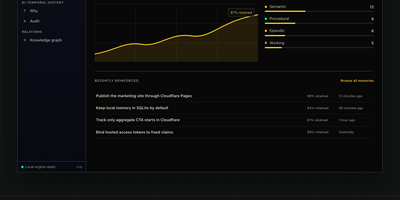
Engraphis is a durable memory layer for coding agents that answers questions like what did we decide about the auth layer three weeks ago, and why, with inspectable project memory that survives across sessions and repositories instead of evaporating when a chat ends. Store a decision once and recall it later in a new session, scoped by workspace, repository, and session so one project's facts never leak into another's context. Recall blends vector, lexical, graph, and code-aware retrieval, then packs the strongest evidence into a hard context budget your agent can actually use. Every returned fact keeps its provenance attached, and the engine cites its support or abstains when the evidence is too weak to trust. Facts are never silently overwritten: bi-temporal history preserves earlier versions, and a timeline view surfaces superseded knowledge when you need to know what used to be true. Index a repository into a code-symbol graph and ask what calls a function before you change it. Conflicting or quarantined memories wait in a review queue for a human decision. Running on a dedicated VPS on RepoCloud with guaranteed CPU, RAM, and SSD, full root SSH access, and a browser serial console. Apache 2.0 licensed.
Evonic
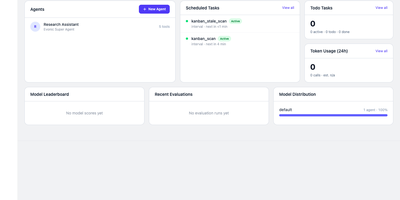
AI agents that delegate to each other, remember past conversations, and stay inside your safety rules all live in one self-hosted platform called Evonic. Every agent in Evonic has its own identity, model, tools, knowledge base, channels, and skills, and a guided first-run wizard creates the first one in minutes against OpenRouter, Together AI, Ollama, DeepSeek, llama.cpp, or any custom OpenAI-compatible endpoint. Agents message and delegate to each other, run commands in a Docker, Podman, or bubblewrap sandbox, and execute on a local folder, an SSH server, or a tunnel device that needs no public IP. A built-in Kanban board hands tasks to agents, a scheduler fires cron jobs and reminders, and Telegram, WhatsApp, and Discord channels put agents where users already chat. Markdown knowledge bases with wiki-links form an interactive graph, a memory engine recalls facts across sessions, and an organizer sub-agent extracts entities and merges duplicates. Safety layers inspect actions for mass deletion or remote code execution and escalate to a human, and an injection guard blocks prompt manipulation. Evaluation dashboards score models across domains, a token monitor tracks usage per agent and model, and bundled skills, 12 plugins, backup and restore, and themed light and dark modes round it out. Running on a dedicated VPS on RepoCloud with guaranteed CPU, RAM, and SSD, full root SSH access, and a browser serial console. AGPL-3.0 licensed.
Tingly Box
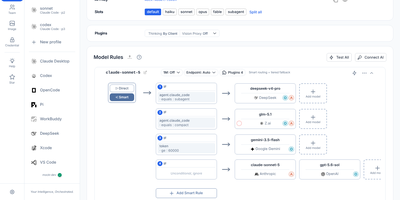
Give every agent your team runs the same front door, and the model chaos behind it becomes manageable. Tingly Box is a self-hosted gateway with a web console where providers, keys, routing rules, and team usage live in one place. Claude Code, OpenCode, Codex, Xcode, and other clients simply call the endpoint. A request arrives. The gateway reads your rules, weighs cost against speed against the policy you wrote, picks a model and a token, translates the protocol if the two ends disagree, and streams the answer back. Existing subscription quotas are spendable here, connected by OAuth beside ordinary API keys, and per-scenario profiles let quick edits and deep refactors land on different models by default. Team mode shares that endpoint properly. Model rules are managed centrally, each member receives a dedicated key, data stays isolated per user, and the usage dashboard shows exactly who consumed what. The gateway also speaks images, generating and editing through the same address with a playground for testing prompts before clients depend on them. Agents remain reachable after you leave the desk, driven through Telegram, DingTalk, Feishu, Lark, Weixin, or WeCom, with guardrails and an MCP gateway available as power-ups. Virtual models give new rules a safe target for testing and benchmarking before real traffic moves over. Running on a dedicated VPS on RepoCloud with guaranteed CPU, RAM, and SSD, full root SSH access, and a browser serial console. MPL-2.0 licensed.
E2A
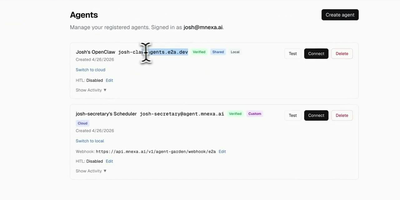
E2A is an open-source email API that lets any application send transactional email and gives AI agents real two-way inboxes of their own, so an assistant can hold a conversation over email without borrowing a person's mailbox. Register an agent and it gets a working address on a shared domain in seconds, or verify your own domain for branded addresses, then connect through the hosted MCP server, a coding-agent plugin with browser OAuth, signed webhooks, a WebSocket stream, REST polling, or the TypeScript and Python SDKs. A local agent behind a firewall needs no public URL at all: it listens over WebSocket and replies in-thread with conversation identifiers keeping multi-turn exchanges coherent across humans and other agents. Every inbound message arrives with structured SPF, DKIM, and DMARC evidence, with the DMARC alignment verdict included, so your agent can judge how far to trust a sender instead of trusting the From header. Flip on the human-in-the-loop gate per agent and outbound messages pause for a person to approve, edit, or reject from the dashboard, the SDK, MCP tools, or magic links in their own inbox, with expiry rules and recipient allowlists narrowing which sends get held. Inbound content screening flags prompt-injection payloads before the agent ever sees them. Support bots triage intake, scheduling agents coordinate meetings, and commerce agents answer order questions from one persistent address. Running on a dedicated VPS on RepoCloud with guaranteed CPU, RAM, and SSD, full root SSH access, and a browser serial console. Apache-2.0 licensed.
Shep
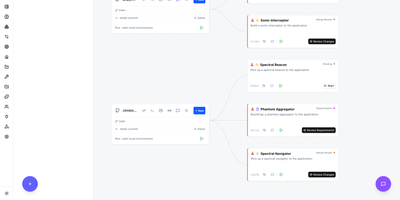
Type one sentence about a feature, and Shep spins up an AI coding agent on its own branch and worktree, then carries the work through commit, push, CI, and a draft pull request. Run three features, five, or ten at once, with Claude Code, Codex, Copilot, Cursor, Gemini, Kimi Code, Cline, or local models picked per feature. A control center draws every repository and feature as a live graph with a fleet bar that counts what is cruising, queued, waiting on you, or failed. When an agent is unsure it asks a blocking question with a recommended answer and a deadline, and you reply from the web, the CLI, chat, or the terminal console. Optional spec-driven mode writes requirements, research, and a plan as YAML for you to approve before any code exists. CI watch reads failing logs and pushes fixes, a checkpoint follows every agent step so you can diff or restore it, and nothing merges without your approval. Tool pages, skills, plugins, webhooks, project memory, and per-feature chat round out the workspace, and an app starter plans a brand new project from a prompt. State stays in a local SQLite database, and usage metrics can be switched off. Running on a dedicated VPS on RepoCloud with guaranteed CPU, RAM, and SSD, full root SSH access, and a browser serial console. MIT licensed.
Hivekeep
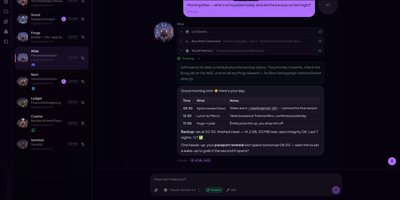
Most AI chats forget you by tomorrow; Hivekeep keeps a team of agents on your own server that remember everything, work together, and answer wherever you already talk. Each agent has a name, a role, and one continuous conversation that never resets, backed by long-term memory it can search. Agents hand tasks to one another, spawn helpers, and run scheduled jobs. Queenie, the built-in setup agent, connects providers and creates your first teammates through plain chat. They reach you on Telegram, Slack, Discord, WhatsApp, Signal, Matrix, or the installable web app, and a channel can move from one agent to another mid-conversation. Agents write custom tools, build mini-apps that open beside the chat, edit files in a workspace with a code editor, and add plugins from a marketplace. Credentials go straight into an AES-256-GCM vault that the model never reads. A context viewer and a token-usage dashboard show what each prompt contains and what each agent, model, and day costs. Running on a dedicated VPS on RepoCloud with guaranteed CPU, RAM, and SSD, full root SSH access, and a browser serial console. MIT licensed.
Eidon
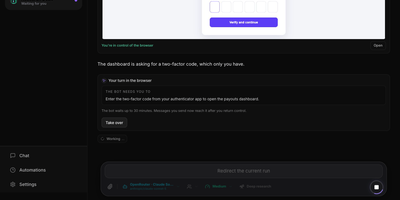
Beyond a plain chat for quick questions, Eidon gives you a team of AI agents, each with its own browser, workspace, and memory, and a Chief of Staff that routes your requests. Ask for anything and it answers, hands the job to a specialist, or creates a new agent for it, and agents message each other and report back. Open an agent's live browser view and watch it work. At a sign-in, a two-factor code, a CAPTCHA, or a payment it stops and waits for you, and you hand control back with a note. Passwords come from an encrypted vault and are typed into the page, never passed to the model. Shell commands and MCP tools run only after you allow them once, always, or never, and emails and Slack messages arrive as drafts to edit. Chat lets you rewind, branch, edit, or regenerate any message, queue follow-ups while a reply streams, and share a read-only link. Deep research drafts an editable plan of up to twelve steps and returns a cited report. Memories wait for your approval. Automations run on an interval, daily, weekly, or once, and alert you through ntfy, Pushover, webhooks, or web push. Connect OpenAI-compatible or Anthropic providers, MCP servers, web search, image generation, and voice dictation, with a private account for each person. Running on a dedicated VPS on RepoCloud with guaranteed CPU, RAM, and SSD, full root SSH access, and a browser serial console. AGPL-3.0 licensed.
Solo Agent
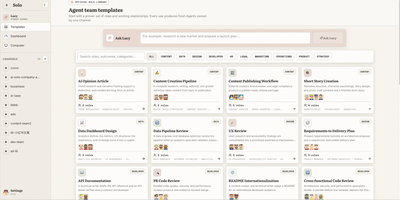
Give an outcome to Lucy, the built-in steward, and she assembles a fresh team of role-based agents inside a channel, with separate sessions and memory for each one. An official template library covers content, data, design, developer, legal, marketing, operations, product, and strategy workflows, from API documentation teams to pull request reviewers. Messages turn into Kanban tasks that agents claim, split into subtasks, submit for review, and close, and each task keeps its thread attached. A channel team graph shows who assigns work to whom, and Thinking mode branches a discussion into focused lines of reasoning that return conclusions to the parent. Agent Live tracks working, idle, and timed-out agents with a transcript viewer for every session, and an Insight dashboard charts messages, runs, tasks, and token usage over time. Finished work becomes artifacts you can review, regenerate, and publish. Pair a laptop or server as a Computer with a one-time command, and an inbox gathers mentions and replies. Running on a dedicated VPS on RepoCloud with guaranteed CPU, RAM, and SSD, full root SSH access, and a browser serial console. MIT licensed.
OpenCorvus
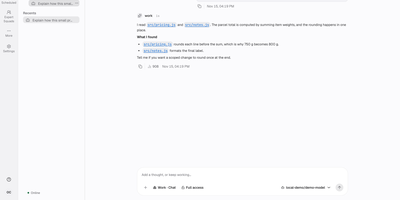
Long agent tasks tend to stall, lose context, or return something nobody can verify, and OpenCorvus is built to prevent all three. OpenCorvus organizes long, complex tasks into Missions worked by Expert Squads, where research, implementation, and independent review each have a named owner and hand off written artifacts. Task state and context are retained, so a stopped run can be recovered rather than restarted, and tool calls, results, and review evidence stay in a record you can inspect. Pick a squad from the bundled catalog of more than a hundred, or let the Dynamic squad compose task-specific experts for you. Connect any of roughly ninety model providers, add MCP servers and skills, schedule recurring work like a weekday brief, and receive tasks from chat channels like Slack, Telegram, Discord, and WhatsApp. A persistent project memory keeps notes the agents reuse across conversations. Start the headless server in a repository, open the workbench in your browser, or create Tasks through the HTTP API and follow their events as they stream. Running on a dedicated VPS on RepoCloud with guaranteed CPU, RAM, and SSD, full root SSH access, and a browser serial console. MIT licensed.
Containarium
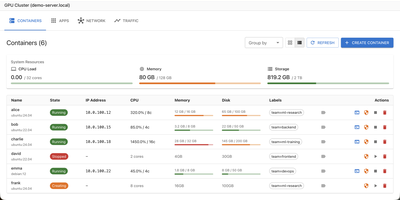
Containarium gives every AI agent a persistent Linux box of its own, reachable over SSH and driven through structured tools instead of a fragile terminal session. One command creates a named sandbox, syncs the SSH configuration, and wires the box into Claude Code, Codex, Gemini or Cursor through an MCP server that runs inside the container. From there the agent can execute shell commands, read and write files, install services, and expose a port on a public hostname with TLS terminated by a Caddy sentinel. Detached code runs keep working after a laptop sleeps or a connection drops, and the operator reattaches to the same byte-exact log later, checks status, or stops the run without losing output. An optional per-tenant eBPF egress policy limits outbound traffic per box, logs denied attempts for audit, and keeps provider API keys inside a model gateway rather than inside the agent environment. Boxes run on LXC or Kubernetes, keep state between agent sessions, support GPU passthrough for local model work, and stay separate from the host operating system and the cluster control plane. The dashboard presents containers, traffic, security events, audit records, GPU state and monitoring in one place. Running on a dedicated VPS on RepoCloud with guaranteed CPU, RAM, and SSD, full root SSH access, and a browser serial console. Apache-2.0 licensed.
killBottleneck
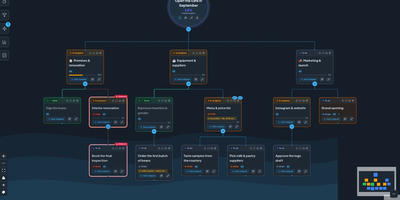
Somewhere in every project one step holds up all the others, and killBottleneck draws your goals as a map that flags that step as a bottleneck. A goal is flagged when it is overdue or stalled while other steps wait on it, and each goal carries an owner, deadline, status, progress, notes, and attachments. The same map switches to a Process style whose recurring steps (every weekday, every Friday, monthly) renew themselves, and an organization map holds positions, functions, and deputies. My day lists what is overdue, due today, or due within a week, beside a team calendar with shared calendars for the company, the meeting room, and time off. Automation rules (WHEN, IF, DO) hand over goals, set deadlines, notify people, offer the assistant, or run an agent, and signed webhooks start n8n workflows or your own agents. An AI assistant in a side panel plans mornings and evenings, sorts notes from a photo, PDF, or voice note, and drafts whole projects, and every change is a card you confirm; it runs on OpenAI, OpenRouter, Groq, Mistral, vLLM, llama.cpp, or a local Ollama model. A REST API and a 20-tool MCP server let Claude Desktop, Claude Code, or the claude.ai connector build maps by conversation. Twelve skins, a simplified phone view, Asana and Trello import, and encrypted backups round it out. Running on a dedicated VPS on RepoCloud with guaranteed CPU, RAM, and SSD, full root SSH access, and a browser serial console. MIT licensed.
Searcharvester
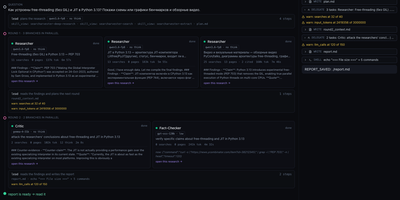
Searcharvester gives your AI agents a private search and research backend that runs entirely on your server, with a web UI where you watch every research job unfold. The search endpoint speaks the Tavily schema, so existing agent code points at your host and queries more than a hundred SearXNG engines without API keys or quotas. Send a URL to the extract endpoint and it returns clean markdown with navigation, footers, and ads stripped, sized in presets from five thousand characters to fully paginated long documents. Three extractors compete on each page and a quality gate keeps the best result, so hard pages still yield readable text. For bigger questions, the research endpoint runs a team of agents: a lead plans sub-questions, researchers gather in parallel, a critic tries to disprove the findings, and a fact-checker re-verifies numbers and dates before the final report arrives with clickable citations. You assign a different model and reasoning level to each role, follow agent branches, the reading graph, sources, and media live, then read the finished report in the same UI. Search settings let you toggle engines per category, test proxies, and apply changes with a targeted restart. A loop guard enforces budgets for calls, tokens, searches, and page reads across the whole job. Running on a dedicated VPS on RepoCloud with guaranteed CPU, RAM, and SSD, full root SSH access, and a browser serial console. AGPL-3.0 licensed.
Glideship
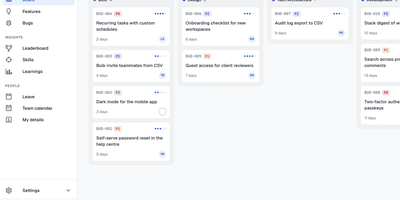
As a self-hosted alternative to Jira and Linear, Glideship swaps sprint ceremonies for twelve AI agents that handle intake, specs, estimates, test plans, and retrospectives while your team keeps every decision. Post a request in Slack and the Triage agent interviews you in-thread, checks existing work for duplicates by vector search, and queues a proposed BUD for a product manager to create or reject. Each BUD, short for Business Understanding Document, holds the spec, tech spec, test plan, acceptance criteria, and history of one feature as it moves from design through development, testing, and UAT to production. Delivery dates come from AI-PERT and 10,000 Monte Carlo simulations, reported as P50, P70, and P85 per phase instead of story points. A code-graph indexer scans multiple repositories, clusters features across them, and answers blast-radius questions such as what breaks if this file changes. Skill profiles rebuilt nightly from git history suggest the best-fit developer, while XP, levels, and a leaderboard reward work that reaches production. Choose Claude Code, GitHub Copilot, OpenAI Codex, or Ollama per organization, and a built-in MCP server lets any MCP client draft BUDs and read team context. Bring existing issues over from Jira, then give HR and Sales a People workspace with leave and work-from-home requests, loss-of-pay warnings, Slack approvals, policies per location, a team calendar, and encrypted employee records. Running on a dedicated VPS on RepoCloud with guaranteed CPU, RAM, and SSD, full root SSH access, and a browser serial console. Apache-2.0 licensed.
AGenUI Studio
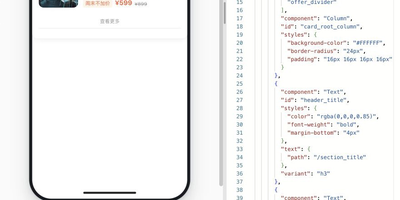
AGenUI Studio turns a written description into a working interface card: an AI agent generates the UI, binds it to your APIs and data, and packages it so it runs anywhere, no Studio required. Bring your own model by entering any OpenAI-compatible or Anthropic Messages endpoint and key in the console settings, and generation proceeds contract-first, steered by design rules you publish as versioned Markdown revisions. You preview each card live as it is generated, then refine it over multiple turns while every component, binding, and action you did not target stays protected from accidental edits. The console also manages the supporting cast: a local knowledge base, API definitions, and reusable operators, all starting from bundled demo data you can swap for real services whenever you are ready. When a card is finished, download it as a self-contained Runtime Package carrying its data sources, bindings, actions, and operators, and execute it with the bundled Card Runtime inside your own application, or register a delivery target and publish straight from the workbench over a callback or a message queue. Applications subscribe to native run events over HTTP and SSE, and production deployments can replace the local defaults piece by piece, MySQL for storage, Redis for hot state, MCP services for knowledge and data, while the packages keep the same contracts. Running on a dedicated VPS on RepoCloud with guaranteed CPU, RAM, and SSD, full root SSH access, and a browser serial console. Apache-2.0 licensed.
Magec
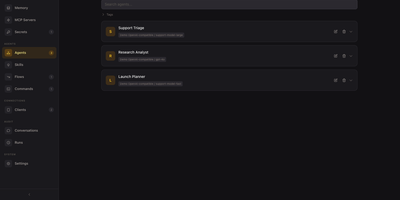
One self-hosted admin console runs a team of AI agents you can reach by voice, chat, webhook, or schedule. Each agent gets its own model backend, system prompt, memory, tools, and voice, with OpenAI, Anthropic, Gemini, Ollama, or any OpenAI-compatible API behind it. A visual flow editor chains agents with routers, joins, loops, parallel fan-out, templates, and small code blocks, so a question can be sorted and answered by the right specialist. Every run is recorded as a step-by-step timeline you can open and read, and conversations are browsable per client. Connect tools through the Model Context Protocol, keep long-term memory in PostgreSQL, and store API keys as secrets that models only ever see as placeholders. Voice runs on the server with wake word detection and speech models, and clients cover a voice web app, Telegram, Discord, Slack, webhooks, and cron jobs. One password-protected console manages every agent, flow, and client. Running on a dedicated VPS on RepoCloud with guaranteed CPU, RAM, and SSD, full root SSH access, and a browser serial console. Apache-2.0 licensed.
PharosRAG
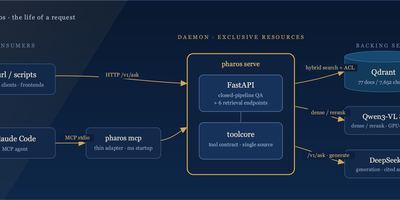
Your team's documents sit in folders nobody can search, and the answer to a simple question hides on page 40 of a PDF someone saved last year. Pharos ingests PDFs, scans, Word documents, presentations, and spreadsheets into a local knowledge base, then answers questions against that library with citations traced back to the exact page. Hybrid retrieval finds the passages that matter, and every answer carries its evidence so readers can verify the claim in the source. Access control decides visibility per person: an API key resolves to an identity with a tenant and group memberships, retrieval filters hard to only the documents that identity may see, and a document with no permissions attached stays invisible to everyone. Two doors lead into the same library. The HTTP API runs a closed question-answering pipeline that retrieves, grounds, and answers in one call, and coding agents connect through MCP to decide for themselves when to retrieve, how to rewrite a query, and when a question needs multiple hops. A resident daemon keeps the search index and models warm, so every session shares one backend instead of reloading heavy resources. The deployment scales from one machine to replicated application tiers behind a load balancer. Running on a dedicated VPS on RepoCloud with guaranteed CPU, RAM, and SSD, full root SSH access, and a browser serial console. MIT licensed.