Novu
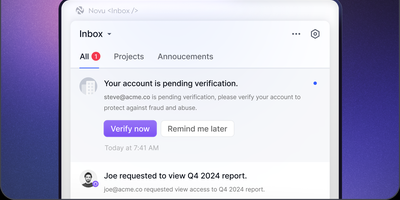
Powering notification delivery for thousands of organizations with over 39,000 GitHub stars, Novu is the open-source communication infrastructure that eliminates the need to build separate integrations for every messaging channel. The TypeScript-based platform provides a single API endpoint that routes notifications across In-App Inbox, Email via SendGrid, Mailgun, AWS SES, and Postmark, SMS through Twilio, Vonage, and Plivo, Push via Firebase Cloud Messaging, Expo, and APNS, and Chat through Slack, Discord, Microsoft Teams, and WhatsApp. The embeddable React Inbox component delivers real-time WebSocket-powered notifications with read/unread states, action buttons, and user-controlled preferences directly inside your application. The workflow engine orchestrates complex multi-channel delivery with conditional branching, time delays, digest batching to reduce notification fatigue, throttle controls, and per-step channel fallbacks. Novu Connect introduces Agent Communication Infrastructure enabling AI agents built with LangChain, Claude, or custom frameworks to hold threaded two-way conversations with humans across any supported channel through a single conversation model with identity resolution and credential management. The backend runs on Node.js with NestJS, MongoDB for notification storage, Redis with BullMQ for job queuing, and Socket.io for real-time delivery. Self-hosting deploys via Docker Compose with the dashboard accessible at port 4200. Running on a dedicated VPS on RepoCloud with guaranteed CPU, RAM, and SSD, full root SSH access, and a browser serial console. MIT licensed.
LiteLLM
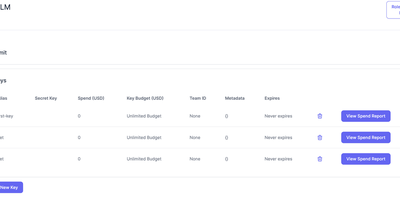
Backed by 56,000+ GitHub stars and over 240 million Docker pulls, LiteLLM delivers the open-source AI gateway trusted by Netflix, Lemonade, Rocket Money, and thousands of engineering teams to route every LLM request through one unified API. The Rust-core gateway adds sub-millisecond overhead per request with 8ms P95 latency at 1,000 RPS, 15x throughput improvement and 11x lower memory footprint compared to Python-only proxies. A single OpenAI-compatible endpoint connects to 100+ providers and 1,800+ models spanning OpenAI, Anthropic, Google Gemini, AWS Bedrock, Azure OpenAI, Vertex AI, Hugging Face, vLLM, Nvidia NIM, Ollama, and Mistral with day-zero support for new model releases. The Auto Router V2 classifies request complexity across four tiers using rule-based scoring, semantic keyword matching, and adaptive Thompson sampling to route each request to the most cost-effective model without API calls or training data. Virtual API keys enable multi-tenant governance with per-team, per-user, and per-project cost tracking, budget caps with automatic fallback rerouting, and role-based access control. Built-in guardrails provide PII masking, prompt injection detection, and model-graded evaluation before requests reach providers. The Agent Gateway extends routing from model calls to agent workflows with MCP server integration. Observability integrates with Langfuse, Arize Phoenix, OpenTelemetry, and MLflow for complete request tracing. Running on a dedicated VPS on RepoCloud with guaranteed CPU, RAM, and SSD, full root SSH access, and a browser serial console. MIT licensed.
Spree
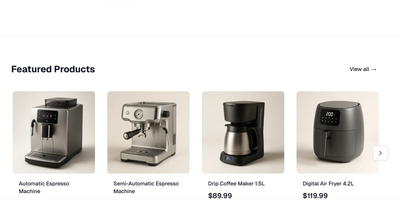
Spree Commerce provides a complete headless ecommerce backend where products, orders, payments, and promotions are managed through typed REST APIs with OpenAPI 3.0 specs and TypeScript SDKs providing autocomplete and type safety. Fifteen years of production history and 15,600+ GitHub stars back a mature ecosystem that ships a production-ready Next.js 16 storefront built with React 19 and Tailwind CSS 4, including multi-region URL routing and Stripe payments supporting Apple Pay, Google Pay, Klarna, and Affirm. Sales Channels model distinct contexts from a single instance: DTC storefronts, wholesale portals, mobile apps, and point-of-sale terminals, each with its own catalog, pricing, and checkout flow. The rules-based promotion engine supports coupon codes, multi-condition discounts, gift cards, and digital product fulfillment. Multi-warehouse inventory tracks stock across locations in real time with reservations and advanced order routing that splits shipments across fulfillment centers. B2B capabilities include customer-specific price lists, storefront access gating, wholesale portals with approval workflows, and quick order forms. The admin dashboard built with Tailwind CSS provides role-based permissions, product management, order processing with refunds, and scaffold generators for custom pages. BSD 3-Clause licensed with zero platform or transaction fees. Running on a dedicated VPS on RepoCloud with guaranteed CPU, RAM, and SSD, full root SSH access, and a browser serial console.
Hasura
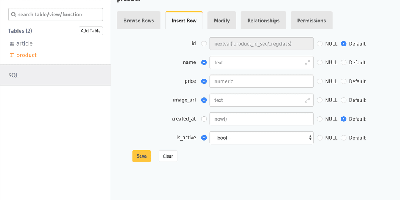
A PostgreSQL database becomes a production-grade GraphQL API the moment Hasura GraphQL Engine points at it: track tables and relationships - existing schemas included - and full query, mutation, and subscription types appear with where, order_by, limit, offset, and on_conflict arguments, no resolvers or boilerplate written. Its Haskell core compiles GraphQL to efficient SQL, and any query becomes a real-time live query with a single keyword, powering dashboards and collaborative UIs over standard GraphQL subscriptions. Authorization is where Hasura earns its enterprise reputation: role-based access control with row- and column-level permission policies driven by session variables from JWTs, auth webhooks, or headers - each role effectively sees its own GraphQL schema containing only what it may touch, integrating cleanly with Auth0, Firebase, or homegrown auth. Event triggers fire webhooks on inserts, updates, and deletes for asynchronous business logic; Actions extend the schema with custom REST handlers; remote schema stitching merges external GraphQL services into one endpoint; and auto-generated REST endpoints serve clients that skip GraphQL. A browser console handles data modeling and API exploration, the CLI manages migrations and metadata as code, and deployment is a single stateless Docker container beside Postgres.
Firecrawl
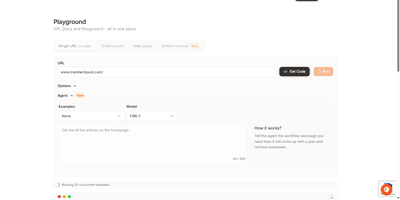
With over 164,000 GitHub stars and one of the fastest-growing open-source projects in the AI tooling ecosystem, Firecrawl is the web context API that turns any website into clean markdown, structured JSON, or screenshots optimized for large language models. The Scrape endpoint converts a single URL into LLM-ready output with approximately 67% fewer tokens than raw HTML, handling JavaScript rendering, rotating proxies, anti-bot bypasses, and dynamic content extraction with zero configuration. The Crawl endpoint recursively scrapes entire websites from a single request with configurable depth, URL filters, and concurrent page limits. The Map endpoint discovers all URLs on a domain instantly for sitemap generation. The Search endpoint performs web searches and returns full page content from results. The Interact endpoint scrapes a page then continues working with it — clicking buttons, filling forms, and extracting dynamic content using AI prompts or code. The Agent endpoint provides autonomous web data gathering where users describe what they need in plain English. SDKs are available for Python, Node.js, Go, Rust, Ruby, PHP, Java, C#/.NET, and Elixir, with an MCP server for connecting to any AI agent or MCP client. Self-hosting deploys via Docker Compose and requires Redis and a Playwright-based browser service for JavaScript rendering. Running on a dedicated VPS on RepoCloud with guaranteed CPU, RAM, and SSD, full root SSH access, and a browser serial console. AGPL-3.0 licensed.
Parse Server
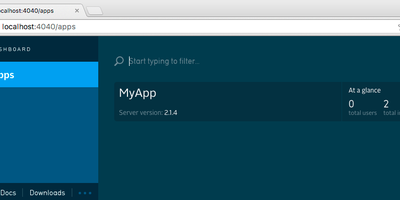
With 21,400 GitHub stars, 500+ contributors, and battle-tested since its 2016 open-source release after powering Facebook's mobile backend infrastructure, Parse Server delivers production-grade Backend-as-a-Service that eliminates months of custom API development. The platform generates REST and GraphQL endpoints automatically from your data schema with class-level permissions and object-level ACLs providing granular access control. Cloud Code enables server-side JavaScript execution for triggers (beforeSave, afterSave, beforeDelete, afterDelete), custom functions, and scheduled jobs — all deployable without restarting the server. Live Queries push realtime data changes to subscribed clients via WebSockets, powering chat applications, collaborative editors, and live dashboards. Push notification support spans APNs for iOS, FCM for Android, and web push for browsers with audience segmentation, scheduling, and delivery analytics. The Parse Dashboard provides a comprehensive admin interface with a data browser featuring configurable info panels, graph visualization, custom canvas builder with draggable elements, AI agent integration via OpenAI, data import/export, and multi-factor authentication. Database flexibility supports MongoDB 6-8 and PostgreSQL 13-18 with PostGIS for geospatial queries. Native SDKs cover JavaScript, iOS (Swift/Objective-C), Android, Flutter/Dart, .NET/Xamarin, Unity, PHP, and Arduino for IoT devices. Deploy via npm, Docker, or the official Express template with automatic schema migration. Running on a dedicated VPS on RepoCloud with guaranteed CPU, RAM, and SSD, full root SSH access, and a browser serial console. Apache 2.0 licensed.
Shlink
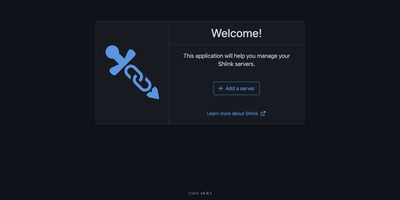
With over 5,100 GitHub stars and eight years of active development since 2016, Shlink has become the definitive self-hosted URL shortener for teams that need unlimited links, full visitor analytics, and complete data ownership without per-link pricing or monthly caps. The PHP backend built on the Mezzio framework with Doctrine ORM serves redirects through any number of custom domains on a single instance, generating unique short codes or accepting custom slugs including multi-segment paths and emoji characters. Every click is tracked with anonymized visitor data including geolocation by country, city, and coordinates, browser and operating system identification, referrer source, and device type classification, all stored in your choice of MySQL, MariaDB, PostgreSQL, Microsoft SQL Server, or SQLite. Dynamic redirect rules route visitors to different destinations based on geolocation, device type, or browser language, enabling targeted campaigns from a single short URL. The REST API exposes every operation with OpenAPI documentation and an interactive sandbox at api-spec.shlink.io, while the CLI provides equivalent functionality for scripting and automation. The official progressive web app at app.shlink.io manages multiple Shlink instances from a single interface with URL creation, tag management, and detailed visit charts. Real-time event integration supports both Mercure and RabbitMQ for webhook-style notifications on new visits. Third-party imports migrate existing short URLs from Bitly and YOURLS with visit history preserved. Running on a dedicated VPS on RepoCloud with guaranteed CPU, RAM, and SSD, full root SSH access, and a browser serial console. MIT licensed.
Lago
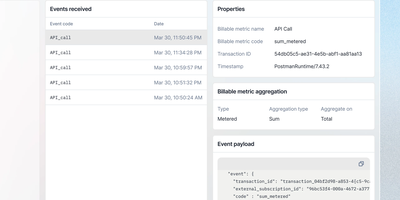
Trusted by Mistral AI, PayPal, Groq, and Synthesia with over 10,300 GitHub stars and Y Combinator backing, Lago is the open-source billing engine that handles usage-based, subscription-based, and hybrid pricing models through a single API-first platform — replacing the need to build custom billing logic or depend on opaque SaaS pricing infrastructure. Real-time event ingestion via ClickHouse processes billable events with deduplication and multiple aggregation methods including count, sum, unique count, max, and weighted sum, while graduated pricing tiers, package-based billing, and percentage-based fees model any pricing strategy from simple subscriptions to complex marketplace commission structures. Automated invoice generation calculates charges according to configurable billing cycles with grace periods, proration for mid-cycle changes, and credit note issuance for refunds and adjustments. Prepaid credits enable pay-in-advance models where customers purchase credit blocks and draw down as usage accumulates, while entitlements tie feature access directly to billing plans for automated provisioning and de-provisioning. Payment orchestration integrates natively with Stripe, Adyen, and GoCardless with automatic retry logic, dunning workflows for failed payments, and multi-gateway routing. Revenue analytics provide cross-stream visibility into MRR, usage trends, churn, and revenue drivers through dedicated API endpoints. The customer portal embeds into your application for self-service invoice access and usage monitoring. Running on a dedicated VPS on RepoCloud with guaranteed CPU, RAM, and SSD, full root SSH access, and a browser serial console. AGPL-3.0 licensed.
Frappe
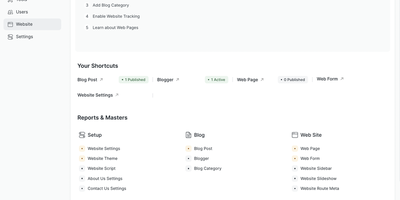
Define a DocType in Frappe and the framework automatically generates database tables, Python ORM classes, REST API endpoints, form views, list views, and role-based permission rules from that single schema definition. The meta-driven architecture stores schemas as database records, letting administrators add fields, reorder layouts, and modify validation rules through the browser-based Form Builder without redeployment. Server-side Python controllers handle business logic through hook-based lifecycle events while client-side JavaScript manages interactive form behavior, with WebSocket connections providing real-time updates across sessions. The built-in workflow engine defines document state machines with role-gated transitions, email notifications, and conditional action visibility. Pre-configured Desk views include list, form, report, tree, kanban, calendar, and dashboard layouts with drag-and-drop workspace customization. The report builder generates grid reports with configurable columns, filters, grouping, and chart visualizations from DocType data or custom SQL and Python scripts. Background job processing uses Redis queues for email delivery, data imports, and periodic tasks. Virtual DocTypes connect external databases to the framework's UI without data migration. Docker deployment via frappe_docker provides production-ready Compose configurations with MariaDB, Redis, Nginx, and worker containers. The foundation powering ERPNext, HRMS, CRM, and Helpdesk in production. Over 10,500 GitHub stars. MIT licensed.

Vexa
Vexa is the only Apache 2.0 meeting bot API that self-hosts the complete transcription pipeline, from bot dispatch to Whisper speech-to-text to knowledge agents, with zero audio leaving your infrastructure. A single POST /bots request sends a transcription bot into any Google Meet, Microsoft Teams, or Zoom call, where it captures audio, runs speaker-attributed transcription through faster-whisper or any OpenAI-compatible endpoint, and streams results to your application via real-time WebSocket with sub-second latency. The built-in agent framework watches live transcripts and your accumulated workspace context, answering mid-call questions grounded in your own meeting history and wiki. An MCP server connects Vexa to Claude, Cursor, and other compatible AI tools, turning every captured meeting into queryable context for external agents. The Terminal, a bundled Next.js web workbench, lets you send bots, watch live transcripts, manage users and API tokens, and chat with your meeting archive from a browser. Docker Compose brings the full stack up on one Linux host in five minutes; the Helm chart scales to thousands of users on Kubernetes with a Pod-per-bot architecture and built-in RBAC. Recordings persist in MinIO or any S3-compatible store, transcripts in Postgres, with Redis handling queues and scheduling. Deploy on RepoCloud for a dedicated VPS with full root SSH access and browser console. Apache 2.0 licensed.
Gorse
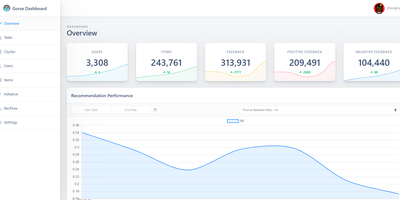
Gorse generates personalized recommendations from your application's user interaction data through automatically trained models, requiring no machine learning expertise to deploy or operate. Over 10,000 GitHub stars and production deployments processing millions of interactions validate a multi-source architecture that merges candidates from latest-item, user-to-user, item-to-item, and collaborative filtering recommenders, then ranks them using factorization machines or LLM-based rerankers with configurable query and document templates. Multimodal content support processes text, images, and video metadata via embedding vectors stored in BF16 format, with optional Qdrant, Weaviate, or Milvus integration for distributed similarity search. The visual RecFlow editor provides a drag-and-drop interface for designing recommendation pipelines, connecting data sources to recommenders and rankers without writing configuration files. A distributed cluster separates concerns across master nodes for model training and dashboard hosting, worker nodes for offline recommendation generation, and server nodes for real-time API endpoints, all scaling horizontally behind load balancers. Online evaluation analyzes recommendation quality from recent user feedback with configurable cache sizes and expiration intervals. RESTful APIs expose CRUD endpoints for users, items, and feedback alongside recommendation retrieval with category filters and API key authentication. Stores data in MySQL, PostgreSQL, MongoDB, or ClickHouse with Redis caching. Running on a dedicated VPS on RepoCloud with guaranteed CPU, RAM, and SSD, full root SSH access, and a browser serial console. Apache 2.0 licensed.
LibreTranslate
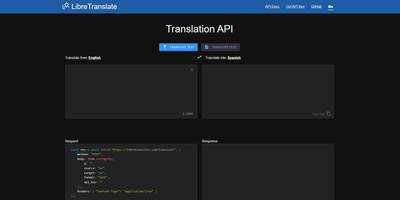
Machine translation with no Google, no Azure, no per-character billing, and no text leaving your infrastructure: LibreTranslate is a free, open-source translation API that runs entirely on your own server. The engine underneath is Argos Translate, which runs OpenNMT neural models with SentencePiece tokenization and Stanza sentence-boundary detection, all offline. Models install as portable .argosmodel packages covering dozens of languages - English, Spanish, French, German, Chinese, Japanese, Russian, Arabic, Hindi, Portuguese, and many more - and Argos handles automatic pivoting: with es-to-en and en-to-fr installed, it chains them to translate es-to-fr without a direct model. The API is a straightforward HTTP POST to /translate with source and target language codes, returning JSON - simple enough that the ecosystem has clients in every major language and integrations across tools like Weblate and Mastodon. Beyond plain text it translates HTML while preserving markup and handles whole file uploads (documents in, translated documents out), plus automatic language detection when the source is unknown. A clean bundled web UI serves interactive translation for end users, and optional API keys with rate limits control access. AGPL-licensed and trainable with custom models, it is the standard answer when translation must be private, unmetered, and self-contained - GDPR-sensitive text never touches a third party.
GrowChief
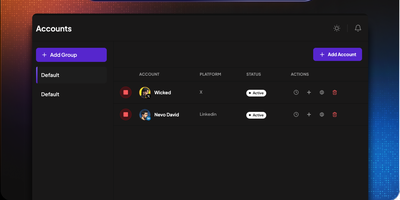
GrowChief delivers a self-hostable social media automation engine that replaces expensive SaaS tools like PhantomBuster, Expandi, and Zopto with a Docker-deployable alternative you fully control. The React and NestJS monorepo architecture runs headful Chrome via xvfb with Playwright and Patchright for maximum stealth — natural mouse movements and randomized interaction patterns make automation indistinguishable from manual browsing. Temporal orchestration manages workflow execution with built-in concurrency control that throttles actions to one every ten minutes per account even when ten workflows trigger simultaneously, preventing rate-limiting and account flags. The enrichment waterfall resolves profile URLs from partial data — provide an email address or organization name and GrowChief queries multiple providers to locate the correct social profile automatically. Working hours scheduling ensures outreach runs only during configurable business hours regardless of when leads enter the pipeline via the public REST API. Proxy support accepts custom SOCKS5 and HTTP proxies per account for geographic distribution and IP isolation. The public API enables full workflow management and lead injection from n8n, Make, Zapier, or any HTTP client, with a dedicated n8n custom node shipping ready to install. The multi-step workflow builder lets you chain connection requests, profile visits, message sends, and conditional delays into repeatable sequences. Running on a dedicated VPS on RepoCloud with guaranteed CPU, RAM, and SSD, full root SSH access, and a browser serial console. AGPL-3.0 licensed.
Apprise-API
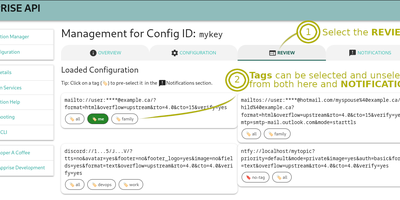
One REST call, 130+ notification services: Apprise API wraps the well-known Apprise library in a lightweight Django/Gunicorn microservice, so "send an alert" works the same whether it goes to Slack, Discord, Telegram, Teams, email, SMS, Pushover, or PagerDuty - each addressed by a simple URL scheme. It solves the credential-sprawl problem cleanly: instead of embedding provider tokens in every app, cron job, and CI pipeline, you centralize them here and everything else just POSTs a body and title. Two modes cover every workflow. Stateless calls to /notify carry target URLs in the payload (or fall back to a default set via APPRISE_STATELESS_URLS); stateful mode stores named configurations server-side under keys, so /notify/{KEY} fans out to everything registered - with tag-based routing (comma for OR, space for AND) selecting which endpoints fire per message. Messages take info, success, warning, or failure types in text, Markdown, or HTML, with attachments up to a configurable size. A built-in web UI manages and tests configurations, APPRISE_CONFIG_LOCK makes the store read-only, service allow/deny lists restrict which schemes work, webhook remapping adapts third-party payloads, and a Prometheus /metrics endpoint watches the gateway itself.
Open Connector
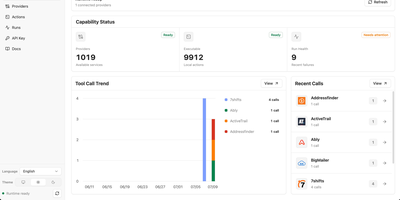
With over 5,000 GitHub stars since its June 2026 launch, OOMOL OpenConnector bridges the gap between AI agents and the real world by handling the authentication nightmare that stops LLMs from calling external APIs safely. The runtime connects to more than 1,000 SaaS providers — GitHub, Gmail, Notion, Slack, Microsoft, HubSpot, Google Workspace, and hundreds more — through 10,000+ prebuilt typed Actions that agents can discover and execute without ever touching raw credentials. OAuth2 flows, API key rotation, custom credentials, and no-auth providers are all managed centrally with AES-encrypted storage, scoped runtime tokens, and configurable action allowlists and blocklists that enforce least-privilege access. Agents interact through five access surfaces: the Model Context Protocol endpoint at /mcp for Claude and other MCP-capable hosts, a full REST API at /v1 for programmatic control, an auto-generated OpenAPI specification for code generation, a TypeScript SDK for application integration, and the oo CLI for local agent relay. The built-in Web Console provides browser-based administration for configuring OAuth apps, managing connections, inspecting action schemas, and reviewing execution logs with redacted inputs. Deploy via Docker Compose with SQLite for single-server setups, run from source on Node.js 22+, or push to Cloudflare Workers with D1 and R2 for edge deployment. Running on a dedicated VPS on RepoCloud with guaranteed CPU, RAM, and SSD, full root SSH access, and a browser serial console. Apache 2.0 licensed.
Medusa
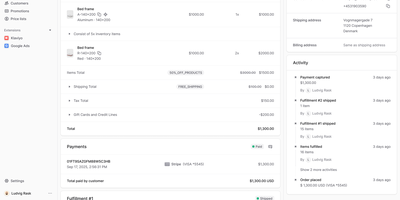
With over 35,000 GitHub stars and 460 contributors, Medusa is the headless commerce framework that gives development teams full ownership of their e-commerce backend without license fees, per-transaction charges, or revenue sharing. The modular architecture ships over 18 domain modules covering products, collections, categories, inventory, pricing, carts, orders, payments, fulfillment, promotions, customers, users, API keys, and stock locations, each independently usable and replaceable. REST and GraphQL APIs expose every commerce operation to any frontend framework — official starters exist for Next.js with community options for Nuxt, Remix, and Gatsby. The React-based admin dashboard provides out-of-the-box order management, product maintenance, promotions configuration, B2B accounts, and multi-warehouse inventory, extensible via the Admin SDK for custom views and workflows. The workflow engine orchestrates long-running commerce processes like checkout, fulfillment, and returns with compensating transactions for reliability. Over 200 official and community plugins integrate Stripe, PayPal, Klarna, Algolia, Meilisearch, SendGrid, Mailchimp, Contentful, Sanity, and Klaviyo. Native multi-region and multi-currency support handles tax-inclusive pricing, region-specific payment and fulfillment providers, and localized storefronts from a single backend. Enterprises including Viessmann, Makro PRO, and INSPIRED Pet Nutrition run Medusa in production. Self-hosting deploys via Docker or directly on Node.js with PostgreSQL and Redis. Running on a dedicated VPS on RepoCloud with guaranteed CPU, RAM, and SSD, full root SSH access, and a browser serial console. MIT licensed.
Kokoro FastAPI
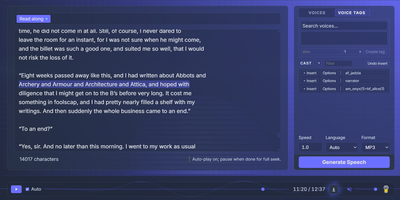
Kokoro-FastAPI turns text into natural-sounding speech across eight languages by serving the 82-million-parameter Kokoro-82M model through an OpenAI-compatible REST API, so any existing OpenAI SDK client can generate audio by just changing the base URL. With over 5,300 GitHub stars since December 2024, the fully Dockerized FastAPI server covers American English, British English, Spanish, French, Hindi, Italian, Japanese, Brazilian Portuguese, and Mandarin Chinese with language-specific phoneme processing. Inline voice mixing blends multiple profiles using weighted ratios like af_bella(2)+af_heart(1), automatically normalizing weights and caching combined voicepacks as PyTorch tensor files for reuse. Audio streams in real time over HTTP with configurable chunk sizes, or generates complete files in MP3, WAV, OPUS, FLAC, AAC, or PCM formats with speed control from 0.25x to 4.0x. Per-word timestamped captions with speaker-tagged voice labels enable subtitle generation for podcasts, audiobooks, and accessibility workflows. Pre-built Docker images support NVIDIA GPU acceleration via CUDA, experimental AMD GPU inference via ROCm, and CPU-only deployment on linux/amd64 and linux/arm64 architectures, with Apple Silicon MPS support available through direct UV execution. The integrated web interface at port 8880 provides browser-based speech generation, while the Swagger UI at /docs exposes the full API reference. Debug endpoints report system statistics for monitoring inference load. Running on a dedicated VPS on RepoCloud with guaranteed CPU, RAM, and SSD, full root SSH access, and a browser serial console. Apache 2.0 licensed.
KrakenD
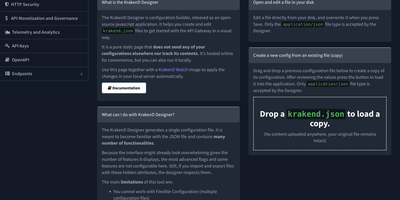
KrakenD processes over 18,000 requests per second on a single instance while consuming under 50MB of RAM at 1,000 concurrent connections, operating as a stateless API gateway that requires no database whatsoever. The Community Edition has earned over 2,600 GitHub stars by outperforming database-dependent alternatives like Kong and Tyk in independent benchmarks. Written entirely in Go, it uses declarative JSON or YAML configuration files that integrate directly into GitOps workflows for version-controlled infrastructure management. The gateway aggregates responses from multiple backend services into a single API call, transforms request and response payloads with field filtering, grouping, and mapping, and applies zero-trust security policies including JWT validation, OAuth 2.0, CORS, HSTS, clickjacking protection, and XSS prevention. Traffic management features include multi-layer rate limiting at both the router and proxy levels, circuit breakers for backend fault isolation, spike arrest policies, and concurrent call support that requests the same data from multiple backends in parallel for improved response times. Telemetry integrates with OpenTelemetry, Prometheus, Grafana dashboards, Datadog, Zipkin, and Jaeger for distributed tracing and metrics collection. The gateway extends through Go plugins, Lua scripting, Martian modifiers, and Google CEL expressions for custom request processing logic. AI workload routing supports OpenAI, Anthropic, Gemini, and other model endpoints with built-in fallback, retries, and load balancing. Deploy via Docker with the devopsfaith/krakend image as a single binary. Running on a dedicated VPS on RepoCloud with guaranteed CPU, RAM, and SSD, full root SSH access, and a browser serial console. Apache 2.0 licensed.