Nyro
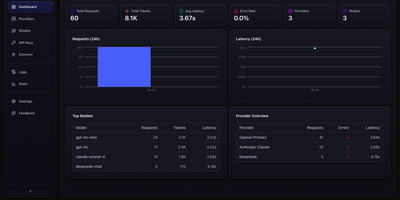
Point Claude Code, Codex CLI, Gemini CLI, or any OpenAI, Anthropic, or Gemini SDK at one address and Nyro routes every request to whichever model provider you choose. The gateway translates protocols on the fly, including streaming, reasoning blocks, and tool calls, so a tool built for one API can run on a model from another. Define virtual model names, bind each to one or more providers, and pick weighted load balancing or priority failover; unhealthy targets are skipped and recover automatically. Issue API keys with limits on requests and tokens per minute and per day, and bind each key only to the models it may call. Exact and semantic caching return repeated answers instantly. A request log records provider, model, token counts, latency, and streaming speed, and usage charts break traffic down by model and provider. The Connect page generates ready-to-paste samples in Python, TypeScript, and cURL, plus one-click configuration for popular coding CLIs. Choose an embedded database for a single host or an external PostgreSQL or MySQL server for production, and run the gateway, the admin UI, or both as separate processes. Running on a dedicated VPS on RepoCloud with guaranteed CPU, RAM, and SSD, full root SSH access, and a browser serial console. Apache-2.0 licensed.
Calnode
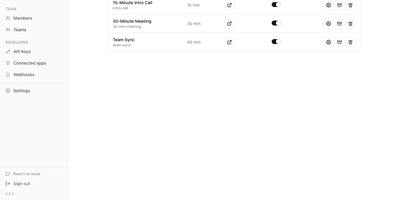
One binary replaces your booking link and your meeting room: Calnode is a complete scheduler you run yourself, small enough to audit and cheap enough to forget. Create event types with durations, custom questions, and locations, set DST-correct availability with date overrides, and share a booking page where guests pick a slot, reschedule, or cancel without an account. Two-way sync with Google Calendar, Microsoft 365, and CalDAV checks real free and busy time across every connected calendar, then mints Meet or Teams links automatically. Teams route bookings round-robin, collectively, or by priority, while paid event types collect through Stripe before the slot confirms. Choose Calnode Rooms and the meeting itself happens in the browser on your LiveKit server, with host controls, consent-aware recording into your own storage, and an AI notetaker that files a transcript and summary on the booking. Agents get first-class access through the REST API, HMAC-signed webhooks, and a native MCP server, and visitors can even book by describing a time in plain language. Everything runs from one static binary and one SQLite file with streaming Litestream backups. Running on a dedicated VPS on RepoCloud with guaranteed CPU, RAM, and SSD, full root SSH access, and a browser serial console. Apache-2.0 licensed.
Sage Wiki
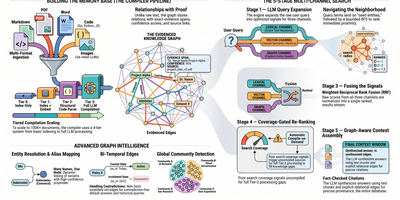
Sage Wiki turns a pile of unstructured documents into a fully interlinked, searchable wiki by running them through a five-pass LLM compiler pipeline. Inspired by Andrej Karpathy's vision of LLM-compiled knowledge bases, the pipeline processes source files through diff detection, summarization, concept extraction, image captioning, and cross-reference discovery, with parallel LLM calls and checkpoint/resume for vaults scaling to 100,000+ documents. The typed ontology graph stores entities and relations with BFS traversal, configurable relation types, multilingual synonyms, and a promotion/demotion lifecycle backed by grounding verification and consensus scoring. Multi-format ingestion handles Markdown, PDF, Word, Excel, PowerPoint, EPUB, email, CSV, images, and code files without manual tagging. LLM provider support spans Anthropic, OpenAI, Gemini, Ollama, and any OpenAI-compatible API, with per-pass model routing enabling cost optimization by assigning cheaper models to simpler tasks. The built-in MCP server exposes 17 tools over SSE transport for integration with Claude, Cursor, and any MCP-compatible agent, while native Obsidian vault overlay ensures existing note workflows remain undisrupted. Team deployment supports Git-synced shared wikis, centralized server access, and hub federation across multiple projects. Ships as a single Go binary with Docker Compose multi-arch images serving the web UI on port 3333. Running on a dedicated VPS on RepoCloud with guaranteed CPU, RAM, and SSD, full root SSH access, and a browser serial console. MIT licensed.
Lumen Learning Platform
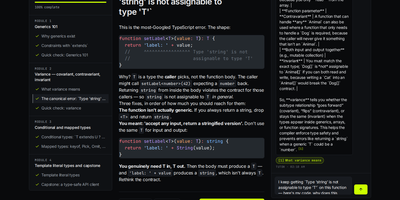
Tell Lumen what you want to learn in one sentence and it interviews you, drafts a brief, and builds a private course with modules, lessons, and quizzes, showing progress as it goes. Every learner owns the whole loop: define a goal, build the course, study it, and share it only when you choose to. An AI tutor sits beside each lesson, streams answers grounded in that course, and attaches citations that jump to the lesson it drew from. A trace view shows every planner step, tool call, and retrieval score behind an answer, and a replay view steps through how a course was authored. Quizzes feed a spaced-repetition review queue, a mastery view tracks progress, and finishing a course issues a verifiable Open Badges credential. Browse a public catalog with subject, level, and tag filters, clone any listed course into your own draft, and press Ctrl+K to search courses or switch themes. Add your own OpenAI, Anthropic, Groq, or Mistral key, or run without a key and keep the rest of the app working. An admin area moderates shared courses, and an MCP server lets coding agents list courses and ask the tutor. Running on a dedicated VPS on RepoCloud with guaranteed CPU, RAM, and SSD, full root SSH access, and a browser serial console. MIT licensed.
Draw Agent Studio
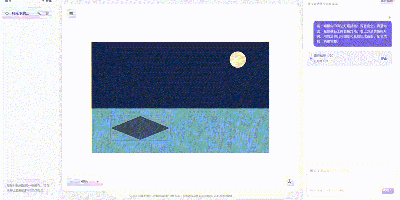
Type a sentence like 'draw a seaside lighthouse under moonlight, with a small sailboat and stars' and Draw Agent Studio sketches it on a live canvas you can then keep editing by chat. Follow-up messages move objects, change colors, delete elements, and undo or redo steps, so refining a diagram becomes a conversation instead of a wrestling match with shape handles. The same canvas accepts direct manual work: select and drag shapes, draw freehand with the pen, or drop text onto the page to finish details the model missed. Researchers and writers use it to build flowcharts from a paragraph of method notes, grouping stages, adding quality checks and feedback loops, and restructuring sections on request. Canvases save automatically as you work, and finished pieces export as PNG, JPG, WebP, or SVG images, or as editable Excalidraw files for further hand editing elsewhere. You bring your own model connection, choosing OpenAI, Claude, Gemini, Azure OpenAI, Ark, DeepSeek, Kimi, Groq, OpenRouter, Bedrock, Vertex AI, or a local Ollama or OpenAI-compatible endpoint. A built-in connection test sends a real image and verifies recognition and tool calling before you save, and your API keys stay encrypted on the server rather than in the browser. Running on a dedicated VPS on RepoCloud with guaranteed CPU, RAM, and SSD, full root SSH access, and a browser serial console. MIT licensed.
37Studio
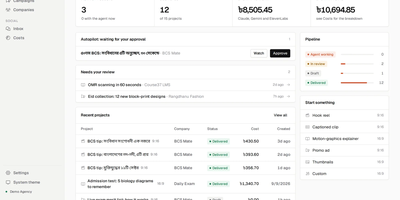
37Studio is a self-hosted AI video studio and social media desk that turns a short brief into on-brand videos, posts them to nine social platforms, and drafts replies to the messages that come back. Paste a company website and it builds a brand library of logos, photos, fonts, and colours, plus a knowledge base every later video and reply draws on. An editor agent builds each video as an animated composition, checks its own rendered frames, and takes revision requests in plain words. The same workflow yields hook reels, captioned clips, explainers, podcast clips, promo ads, and thumbnails, and any finished video can become a template. A two-hour recording becomes a shelf of short clips: transcription runs locally in about 100 languages at no cost, and YouTube or Drive links import directly. Publishing reaches Facebook Pages, Instagram, YouTube, TikTok, LinkedIn, X, Pinterest, Bluesky, and Mastodon in one action, now or scheduled, each with its own caption. Autopilot goes further: state a content plan in one sentence and a fresh video is made before every slot, waiting for one-click approval. Messenger, Instagram, and WhatsApp messages and social comments land in one inbox, with replies drafted in the customer's language under rules each brand sets. Exact AI spend shows on every project, and an MCP server lets your own AI tools run the studio. Running on a dedicated VPS on RepoCloud with guaranteed CPU, RAM, and SSD, full root SSH access, and a browser serial console. MIT licensed.
AMC WebUI
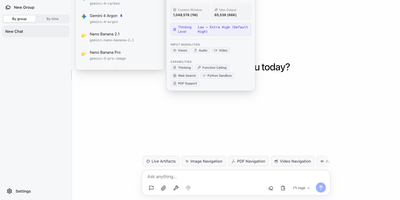
AMC WebUI is one chat window for every Gemini trick, with your conversations kept in your own browser instead of someone else's database. Pick a model from a picker that shows context window, output limit, and capabilities, then watch its reasoning stream with adjustable thinking levels. Voice chat and screen sharing run in realtime, and code blocks can turn into interactive HTML, SVG, Mermaid, or Graphviz previews. A Python sandbox executes snippets with numpy, pandas, and matplotlib inside the page. MCP settings list built-in tool servers beside any stdio, SSE, or HTTP server you add, and tool calls wait for your approval. Upload images, PDFs, audio, video, or whole ZIP folders, search past chats, and read per-request token and pricing logs. Deep search cites sources, text to speech offers thirty voices, and image generation takes aspect ratio and size options. Switch to any OpenAI-compatible endpoint with its own keys and models, choose among four themes and seven interface languages, and install it as a PWA. Running on a dedicated VPS on RepoCloud with guaranteed CPU, RAM, and SSD, full root SSH access, and a browser serial console. MIT licensed.
ReadyLLM
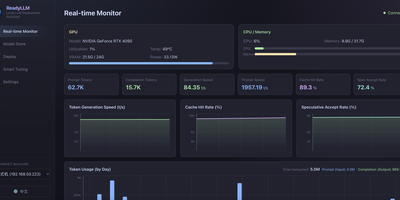
Your inference server should not sit mostly idle while a model crawls along at ten tokens per second, so ReadyLLM gives you a visual way to deploy, watch, and tune LLMs until the hardware is actually earning its keep. Add the machine under your desk or a remote box over SSH, let hardware detection read its GPU, VRAM, CPU, and memory, and get model recommendations that fit what you own instead of wishful downloads. A model store catalogs text, image, and video models with parameter counts, precision, resolutions, and real weight filenames, background downloads from multiple sources, and integrity checks when they land. One click starts or stops llama.cpp, vLLM, or SGLang services, installs a missing engine matched to your GPU backend, and leaves runtime parameters open for manual tweaks. Live curves track GPU utilization, memory, throughput, and latency as requests flow. When speed disappoints, two-phase auto tuning searches the knobs that matter, checks VRAM feasibility before it wastes your time, and benchmarks honestly against latency, throughput, or prefill goals; an AI tuning mode can reason through the same loop across several rounds. Beyond chat models, ComfyUI generation covers text-to-image and text-to-video, storyboards, shot-by-shot long video, and upscaling, with prompts optionally expanded first. Running on a dedicated VPS on RepoCloud with guaranteed CPU, RAM, and SSD, full root SSH access, and a browser serial console. MIT licensed.
Supercheck
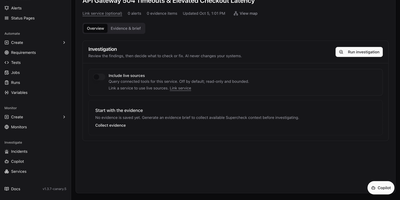
Browser tests, load tests, uptime checks, public status pages, and an AI incident investigator all live in one self-hosted dashboard called Supercheck. Write browser, API, database, custom, and k6 performance tests in a built-in code editor, or record a flow with the Chrome and Edge Recorder extension and save it as a Playwright script. Group tests into scheduled jobs, trigger them from CI with trigger keys, and review run logs, screenshots, traces, and reports. Five monitor types cover HTTP endpoints, website SSL expiry, ping, TCP and UDP ports, and scheduled synthetic browser journeys, with administrator-defined check locations and alerts to email, Slack, Discord, Telegram, Microsoft Teams, or webhooks. Status pages publish component health with 90-day uptime, incidents, scheduled maintenance, badges, and subscriber notifications under a subdomain or custom domain. When something breaks, the incident workspace collects evidence, drafts an evidence brief, and runs a read-only AI investigation across connectors such as GitHub, Prometheus, Grafana, and Kubernetes, while Copilot answers questions about that evidence. Requirements link expectations to tests and show coverage, and AI can extract them from a PRD. Organizations, projects, six roles, API keys, and audit trails keep teams in their lanes, and the CLI pulls, diffs, and deploys resources as code. Running on a dedicated VPS on RepoCloud with guaranteed CPU, RAM, and SSD, full root SSH access, and a browser serial console. AGPL-3.0 licensed.
Tela
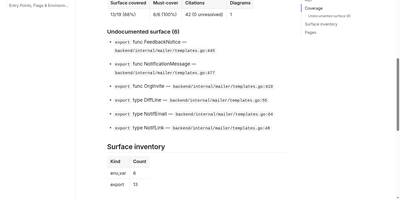
Tela keeps a team's documentation as canonical markdown in a self-hosted wiki that AI agents read, search, and write alongside humans through a built-in MCP server. People edit together with live multi-cursor collaboration, threaded comments, backlinks, and full revision history, so every page shows who changed what and why. PostgreSQL full-text search works immediately, and adding an embedder unlocks semantic retrieval and grounded ask-your-docs answers that cite their sources. Connect Claude, Cursor, or another MCP client with a personal access token and the agent can search the wiki, draft and patch pages, answer comment threads, build spreadsheets with real formulas, and assemble presentation decks exportable to PDF and PPTX. Atlas, the built-in documentation engine, points at a git repository or Jira project and drafts cited wiki pages, then keeps them fresh as the sources change. Teams organize work into spaces, invite members by email, and flip any space public to publish a login-free blog with per-author home pages. Content syncs over WebDAV and exports to zip or PDF, and optional AI features run against your own endpoint or a bundled local Ollama profile, so nothing leaves your server unless you wire it up. Running on a dedicated VPS on RepoCloud with guaranteed CPU, RAM, and SSD, full root SSH access, and a browser serial console. AGPL-3.0 licensed.
QMReader
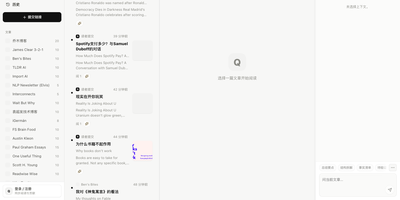
QMReader is a self-hosted reading workbench that treats RSS as raw material for knowledge you keep, not a pile of unread badges waiting to be cleared. Subscribe to RSSHub routes, direct feeds, sitemaps, Hacker News, Product Hunt, GitHub Trending, and Hugging Face Papers, and new items land in the article list immediately while translation and rewriting finish in the background. English headlines gain Chinese translations automatically, and full articles can be read as the original, a Chinese translation, or a plain-language rewrite, all kept side by side on the same page. Highlight passages, attach your own commentary, and open an AI conversation scoped to the article in front of you instead of starting from a blank chat box. Work you produce becomes a public reading asset with a stable link: translations, rewrites, comments, and dialogues collect on contributor pages and flow out through asset catalogs and RSS feeds for the next reader. Split background workers keep fast feed fetching separate from slower AI processing, and search, unread, popular, favorites, and history views keep a heavy reading habit navigable. Running on a dedicated VPS on RepoCloud with guaranteed CPU, RAM, and SSD, full root SSH access, and a browser serial console. MIT licensed.
Potato Annotation Tool
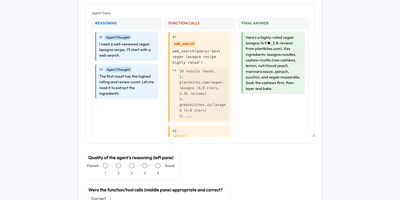
Collect trustworthy human labels and judgments for your datasets, models, and AI agents from one self-hosted annotation server, whether the item is a sentence, a bird call, a microscope image, or a long agent trace. A study is one YAML file plus your data, written by hand, designed in the browser, or generated by a coding agent through the Potato skill or an MCP server. For agent and LLM evaluation, Potato reads traces from OpenAI, Claude, LangChain, LangFuse, SWE-bench, OpenTelemetry, CrewAI, AutoGen, and LangGraph, then lets reviewers rate whole trajectories, single steps, text spans, or two agents side by side. Web-agent runs replay with click and scroll overlays, LLM judges are calibrated against human labels, and pytest evaluations fail CI when scores regress. Models from OpenAI, Anthropic, Gemini, Ollama, vLLM, and OpenRouter pre-label items for people to correct, active learning puts the most uncertain items first, models train on your annotations from the admin page, and a labeling engine certifies machine labels against a blind human sample. Solo Mode lets one person hand labeling to an LLM as agreement grows. Attention checks, gold items, adjudication, Krippendorff's alpha, and annotator timing keep quality visible. Recruit through Prolific, CloudResearch Connect, SONA, or invite links, or code interview transcripts with a living codebook, in-vivo codes, and memos. Running on a dedicated VPS on RepoCloud with guaranteed CPU, RAM, and SSD, full root SSH access, and a browser serial console. GPL-3.0-or-later licensed.
Watchtower
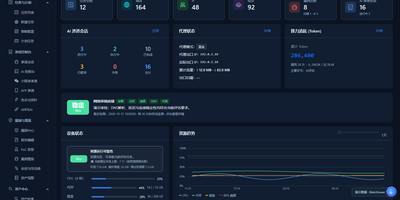
Watchtower puts AI-driven security assessments into one web console, where sessions probe your attack surface while every request, finding, and piece of evidence is captured as it happens. The AI session console follows the attack surface, session progress, tool calls, and findings as an assessment runs, so you can watch an engagement unfold instead of reading a log afterwards. A built-in proxy workflow records HTTP and HTTPS traffic history with highlighted patterns, and any captured request can be sent to the Repeater for editing, replay, and response comparison. Mobile work is covered too: connect phones over USB or wireless, capture app traffic separately from accessibility control, and import WeChat mini-program packages to configure an assessment session. A public vulnerability intelligence library can be searched by component, severity, and source and kept synchronized locally, giving assessments current context without sending your targets anywhere. Findings are managed by source, severity, and status, each linked back to its supporting evidence, and the report editor assembles them with a live preview, impact notes, and remediation guidance. The dashboard tracks assets, tasks, AI sessions, token usage, and runtime resources, and task admission is budgeted against physical memory so heavy scans do not starve the host. Running on a dedicated VPS on RepoCloud with guaranteed CPU, RAM, and SSD, full root SSH access, and a browser serial console. GPL-3.0 licensed.
Unla
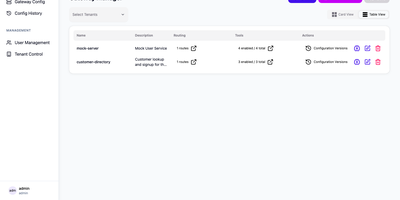
Unla puts a friendly front door on every API you already run, so AI clients can call it as an MCP server without anyone writing a line of glue code. Describe an endpoint in YAML or the form editor, name its arguments, choose where each one goes in the request, and the gateway exposes it as a tool over SSE or streamable HTTP. Import an OpenAPI file to generate a whole server at once, or proxy a third-party MCP server and route it under a prefix of your choice. The Gateway Manager shows every server as a card or table row with its routes, enabled tools, and tool counts. Every save creates a numbered config version with its author and timestamp, so changes are easy to audit and roll back. Tenants keep teams separate, user accounts carry roles, and CORS settings sit next to each route. Configuration hot reloads, syncs across replicas, and persists to disk, SQLite, PostgreSQL, or MySQL. Running on a dedicated VPS on RepoCloud with guaranteed CPU, RAM, and SSD, full root SSH access, and a browser serial console. MIT licensed.
PullMD
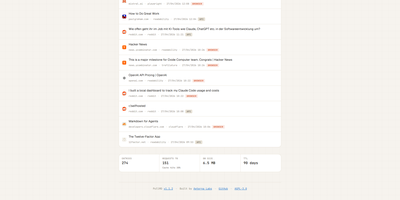
PullMD turns any URL or file you point it at into clean Markdown your AI agent can actually afford to read. Paste a web page and get back tidy body text with metadata tucked into frontmatter instead of navigation soup and cookie banners. Send it a Reddit or Hacker News thread and it returns the full comment tree with depth and count under your control. Hand it a PDF, Word file, PowerPoint, spreadsheet, or EPUB and it hands back Markdown, with an optional OCR tier for stubborn table-heavy documents. YouTube links come back as title, description, and a transcript with clickable timecodes, no API key required. The query-scoped mode answers a question about a long page by returning only the relevant sections, typically cutting 70 to 95 percent of the tokens. Every conversion gets a short share link that re-fetches the source when it goes stale and serves the last good snapshot if the original dies. Agents connect through the built-in MCP server with OAuth 2.1, a plain REST API, or a downloadable Claude Code skill, while you keep history, an archive, and cache statistics in the web app. Running on a dedicated VPS on RepoCloud with guaranteed CPU, RAM, and SSD, full root SSH access, and a browser serial console. AGPL-3.0 licensed.
ShowAI
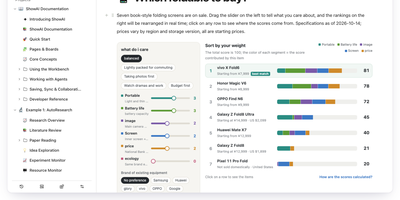
Your coding agent answers a question, and instead of a wall of Markdown you get a page you can actually use. ShowAI turns replies into interactive pages built from text, tables, charts, flow diagrams, sliders, and boards, so you can drag a weight, compare options, or step through an idea and watch the result change. Every page is saved as versioned files in a local project, with undo, retained drafts, and conflict protection, and the agent reads your edits before it continues. Select any text, cell, or board object to ask the agent to expand, reorganize, or visualize it, and run several conversations on one project in parallel. When a needed component is missing, the agent builds it, and pages that work can be distilled into templates. Export a page as standalone HTML, an inline fragment, or a static site. Connect a self-hosted ShowAI Server for projects shared by administrators, editors, and viewers, with account login and device management. Running on a dedicated VPS on RepoCloud with guaranteed CPU, RAM, and SSD, full root SSH access, and a browser serial console. MIT licensed.
Garcon
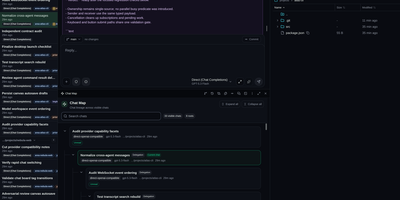
Garcon gives developers one browser workspace for running several coding agents at once, steering their work live, and turning reviewed changes into commits. Tile up to four resizable windows, move chats between them, and place live sessions on durable canvases that show delegated children, handoffs and parentage. Turn that activity into a tag-driven delivery board, or create tickets first and open chats from them with the project, priority, assignee and discussion already attached. Queue instructions, reorder them, answer agent questions, approve tool calls, pause work, interrupt a run or stop it without losing the transcript. Exchange labelled messages between chats, delegate bounded tasks to child agents, and bring final results back into the parent conversation. Browse and edit files, open terminals, inspect reasoning and tool calls, then stage individual lines, hunks, files or folders before committing and pushing. Search transcripts, save filters, pin or archive chats, export Markdown or XML, schedule prompts for later, and review token use and estimated API cost by day, agent and model. Connect trusted remote executors when work belongs on another machine, and open the same workspace from a phone when an agent needs a decision away from your desk. Running on a dedicated VPS on RepoCloud with guaranteed CPU, RAM, and SSD, full root SSH access, and a browser serial console. GPL-3.0 licensed.
Xiryn
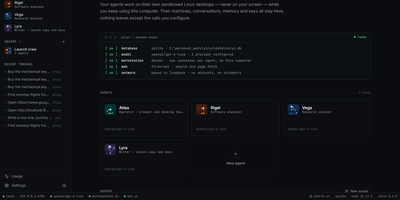
Picture a small staff of AI agents clocking in on your own server, each with a name, a specialty, its own model, and a private Linux desktop it can click around in. Every agent works inside a disposable Docker workstation with a shell, persistent files, and a Chromium browser, so it can research the web, write and run code, and finish multi-step tasks without touching your own files. You watch an agent click and type in real time, and when a login, payment, or one-time code needs a human, you take over the desktop, then hand it back with a note and let it continue. Pair a Telegram bot by scanning a QR code and you can assign work, answer questions, and receive results from your phone, with no public URL or port forwarding. Routines turn recurring requests into schedules, so a morning briefing, a price watch, or a weekly report runs by itself and reports back when it is done. Each agent can use a different model, from OpenAI, Anthropic, Google, xAI, Groq, Mistral, or DeepSeek to a local Ollama endpoint, and every reply shows its cost while a monthly budget pauses paid models automatically. Agents remember what matters about you across every thread, and logins or cards you save sit in an encrypted vault the agents themselves never see. Running on a dedicated VPS on RepoCloud with guaranteed CPU, RAM, and SSD, full root SSH access, and a browser serial console. MIT licensed.