MediKeep
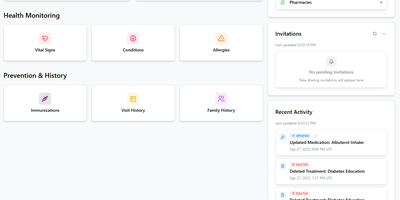
Your medical history, fragmented across a dozen patient portals, in one place on your server: MediKeep (formerly Personal Medical Records Keeper) is a self-hosted health record system. Built with a React frontend and FastAPI backend over PostgreSQL, it organizes 14 categories of medical data - medications with dosages and schedules, conditions, procedures, allergies, immunizations, symptoms, injuries, doctor visits and encounters, treatments, lab results, and even medical equipment with service dates and supplier info. Treatment management is genuinely sophisticated: an advanced mode links treatments to their medications with per-medication overrides for prescriber, pharmacy, and effective dates, and reverse lookup shows which treatments use a given medication. A dashboard summarizes records and recent activity, file uploads attach documents to records, and tagging works across categories. When a new specialist asks for your history, the report builder assembles custom reports by category and exports to PDF, JSON, or CSV - a curated, portable summary instead of a folder of photocopies. Authentication supports Google and GitHub SSO with OIDC providers like Keycloak and Authelia expected to work, and the built-in backup system protects the archive. Health data is exactly what should never live in someone else's cloud.
Atlas
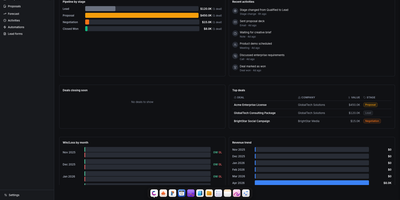
Atlas delivers a complete business operations platform in a single Docker Compose deployment, replacing the need for separate CRM, HRM, project management, invoicing, and file storage subscriptions. The CRM module provides pipeline management with Kanban views, contacts, companies, deals, leads, forecasting, saved views, and web-to-lead forms with Gmail integration for per-user email tracking inside deal timelines. HRM handles employees, departments, org charts, leave management, and attendance tracking. The invoicing system generates professional invoices with recurring billing, customizable templates, and payment tracking. Agreements provides PDF contract generation with legally-binding e-signatures, sequential signing workflows, counterparty linking, audit trails, and automated reminders. Projects integrates time tracking, billing, client management, budgets, and reporting in one view. Drive offers file storage with versioning, sharing, comments, activity logs, and password-protected links with Google Drive import and export. The calendar syncs bidirectionally with Google Calendar across month, week, day, year, and agenda views. Write provides rich text documents with cover images, comments, and templates, while Draw adds an Excalidraw-based whiteboard canvas with PDF export and presentation mode. The platform supports five languages, multi-tenant isolation, role-based permissions, and includes an Odoo importer that ingests res.partner, crm.lead, and CRM activity CSV exports for migration. Built on React, TypeScript, Vite, TanStack Query, and Zustand on the frontend with Express, Drizzle ORM, PostgreSQL, Redis, and BullMQ on the backend. Running on a dedicated VPS on RepoCloud with guaranteed CPU, RAM, and SSD, full root SSH access, and a browser serial console. AGPL-3.0 licensed.
Tymeslot
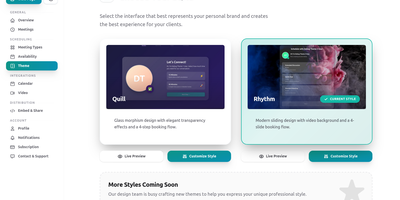
Built on Elixir's fault-tolerant OTP runtime, Tymeslot delivers the complete scheduling toolkit that Calendly charges for and Cal.com relicensed away from open source in 2026. Share one booking link and let clients pick available slots — your calendar stays synchronized and double-bookings disappear automatically through real-time availability checking against Google Calendar, Microsoft Outlook, and any CalDAV server including Nextcloud. Meeting types support configurable durations, buffer times, and availability windows that clients can book without email back-and-forth. Phoenix LiveView powers the real-time UI with WebSocket connections that update instantly as bookings arrive, without client-side JavaScript framework overhead. The platform attaches Zoom video rooms to confirmed bookings through your own Marketplace app credentials, sends confirmation and reminder emails via SMTP, Postmark, SendGrid, Mailgun, or AhaSend, and supports custom booking page themes with embed options for integration into existing websites. Circuit breakers, connection pooling, and graceful degradation maintain availability during provider outages. Authentication supports local accounts, GitHub OAuth, and reCAPTCHA protection on public booking forms. Self-hosting deploys as a single container with PostgreSQL embedded — no separate database container required. Two named volumes persist uploads and database state, while the same image powers the managed cloud at tymeslot.app so self-hosted users get identical features without a crippled community edition. Deploy via Docker, Cloudron with automatic updates, or Railway from a community template. Running on a dedicated VPS on RepoCloud with guaranteed CPU, RAM, and SSD, full root SSH access, and a browser serial console. AGPL-3.0 licensed.
TradingAgents GUI
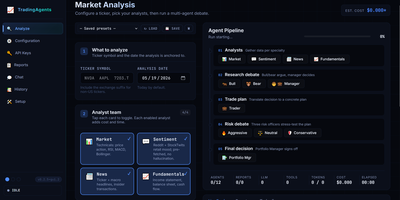
Built atop the TauricResearch TradingAgents framework with nearly 100,000 GitHub stars, TradingAgents GUI transforms a CLI-only multi-agent LLM stock analysis pipeline into a polished web application accessible at localhost:5000. The system deploys twelve specialized AI agents — fundamental analysts, sentiment experts, technical analysts, bull and bear researchers, a trader, risk management team, and portfolio manager — who collaboratively debate market conditions through structured LangGraph workflows before producing a final BUY, SELL, or HOLD recommendation. The interface supports ten LLM providers including OpenAI, Anthropic, Google, OpenRouter, DeepSeek, Ollama, xAI, Qwen, GLM, and MiniMax, with a first-run wizard that auto-detects configured API keys and tests connections. A live pipeline visualization shows each agent's status with real-time progress bars, while the tabbed output area separates Live Feed, Reports preview, and Tool calls into dedicated panes. The three-pane Reports tab provides searchable indexing, table-of-contents navigation, and export to Markdown, HTML, or PDF formats. Report length control across Concise, Standard, and Comprehensive modes saves up to 50% on token costs. Multi-session chat allows pinning past reports as grounding context with live token counting and context-window warnings. Three built-in themes — Terminal, Modern, and Bloomberg — persist per browser. Docker Compose deployment maps port 5000 with persistent report storage. Running on a dedicated VPS on RepoCloud with guaranteed CPU, RAM, and SSD, full root SSH access, and a browser serial console. Apache 2.0 licensed.
DAC
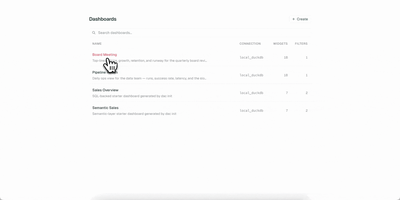
Your dashboards deserve version control, code review, and reproducible builds, just like the rest of your stack. DAC lets you define interactive data dashboards in YAML or TSX, validate them in CI, and serve them from a single Go binary that embeds a full React frontend. Choose from 21 chart types including line, bar, area, pie, scatter, bubble, funnel, sankey, heatmap, calendar, sparkline, waterfall, gauge, treemap, radar, and candlestick, plus metric cards, data tables, text blocks, and image widgets. The built-in semantic layer lets you define metrics and dimensions once in reusable model files, then reference them from any widget while DAC generates the SQL automatically. Connect to Postgres, MySQL, Snowflake, BigQuery, Redshift, Databricks, and DuckDB through standard Bruin connection configs. Interactive filters with date pickers, dropdowns, multiselects, and search inputs inject values via Jinja templating and re-execute only affected widgets. Live reload via Server-Sent Events refreshes connected browsers instantly when you save a file. Export dashboards as self-contained static HTML with baked-in query results for S3, GitHub Pages, or offline sharing, and render slide decks via the Google Slides export command. On RepoCloud, deploy DAC on a dedicated VPS with root SSH access and persistent storage for your dashboard definitions and database connections under the AGPL-3.0 license.
Oxigen
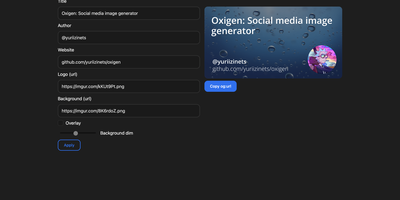
The social preview cards shown when links hit Twitter, LinkedIn, Slack, or Discord, generated on the fly: Oxigen is a small Go service for dynamic Open Graph images, no designer required per page. Instead of exporting static images per page, you compose a card once and drive it with parameters: title, author, website, logo, background image, and background dimming all arrive as URL query arguments, so your og:image meta tag simply points at the Oxigen endpoint with the page's own values substituted in. Every blog post, product page, and doc gets a branded, correctly sized preview generated on the fly. A built-in web UI covers interactive composition - tweak the text and imagery, watch the preview update, copy the resulting URL - while the same rendering path serves programmatic API use from static site generators, CMS templates, or build pipelines. Rendering is pure Go using the gg 2D graphics library, freetype fonts, and the imaging package, built on the kyoto framework by that project's author. Deployment is one stateless container on port 80 with no database and no external dependencies, so instances scale and restart freely.
Nodyx
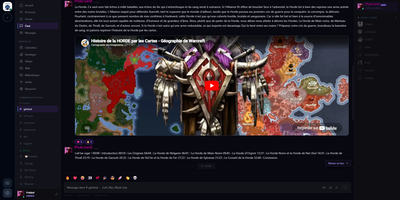
Nodyx puts forum threads, real-time chat channels, peer-to-peer voice calls, collaborative whiteboards, and a drag-and-drop homepage builder behind one installation script on hardware you control. Create categories and threaded discussions that search engines index, then switch to Socket.IO-powered chat rooms where replies, pins, link previews, and @mentions update instantly. Voice channels connect participants through WebRTC mesh networking, keeping audio between peers without routing through third-party servers; a Rust-based STUN/TURN relay handles restrictive NATs so home-server deployments work without port forwarding. The NodyxCanvas layer adds CRDT-synchronized collaborative drawing with 11 tools, voice-aware cursors, and board-scoped chat, all persisted to PostgreSQL snapshots. Build your community's landing page with a visual editor that places widgets across 11 layout zones, then extend functionality by dropping third-party widget archives into the admin panel or authoring your own with the plain-JavaScript Widget SDK. Private conversations stay end-to-end encrypted with ECDH P-256 key exchange and AES-256-GCM ciphers where the private key never leaves the browser, and the OctoGuard module automates moderation with five matcher types plus configurable actions from muting to banning. For streamers, a native Streamer Hub bridges Twitch chat bidirectionally, provides a drag-and-drop soundboard, generates OBS browser-source overlays, and offers a mobile Stream Deck. Instances discover each other through a gossip protocol, forming a decentralized network without central coordination. Running on a dedicated VPS on RepoCloud with guaranteed CPU, RAM, and SSD, full root SSH access, and a browser serial console. AGPL-3.0 licensed.
TavernAI
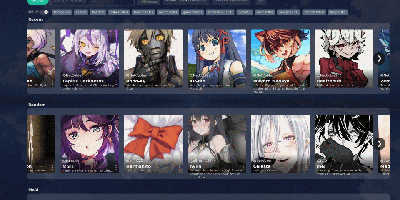
Character-based chat and storywriting with large language models: TavernAI is the open-source frontend that leaves model choice to you. It generates no text itself; it connects to the backend of your choice - OpenAI (including GPT-4), Anthropic Claude, KoboldAI and KoboldCpp, Oobabooga's Text Generation Web UI, NovelAI, Ollama, and the crowdsourced Horde - so cost, model quality, and content policy are decided by your backend, not the interface. Characters are defined by portable card files in PNG or JSON format with personality, scenario, and example dialogue, and tens of thousands of community-made cards from sites like Chub.ai import directly. Conversations support group chats with multiple characters, a story mode for long-form writing, message swiping to branch between alternative responses, and full editing of any message. World Info injects lore into context when keywords trigger, keeping long roleplays consistent. Themes, custom backgrounds, and configurable generation settings round out the interface. It runs on Node.js, and the SillyTavern project began as a fork of it.
Nzbget
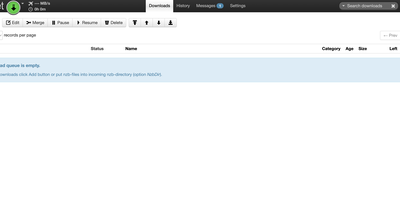
Written in optimized C++ where competitors use Python or Java, NZBGet saturates fast connections while idling on CPU and RAM - which is why the performance-obsessed Usenet downloader has long been the client of choice for NAS boxes, Raspberry Pis, and routers as much as full servers. The engineering shows in the recovery pipeline. Instead of shelling out to par2cmdline, NZBGet integrates the par2 source directly and exploits its knowledge of exactly which articles failed - quick par-verification checks only what needs checking, and its own multicore repair implementation runs 2-3x faster than the external tool on the same hardware. Fast par-rename deobfuscates scrambled filenames in seconds without a full verification pass, and rar-rename recovers names for multivolume archives even when no par2 files exist. DirectWrite assembles articles straight into sparse destination files, skipping temporary-file churn entirely, with an article cache and queue-pausing options to eliminate disk contention. Automation is complete: a remote web interface, full JSON-RPC API, RSS feeds with duplicate detection, scheduling and prioritization, and an extension manager for Python and Bash scripts triggered by download events. Sonarr, Radarr, and every major indexer integrate natively.
Invoicerr
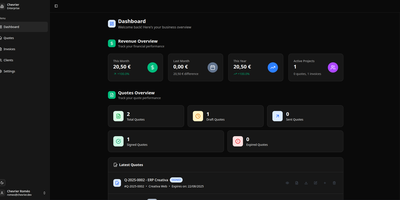
Invoicerr nails the exact billing sequence freelancers actually use: draft a quote, send it to the client, collect a legally-binding electronic signature via a secure browser link, convert the approved quote into an invoice, and generate a branded PDF — no DocuSign account, no external signing service, no enterprise complexity. The React frontend with NestJS backend uses Prisma ORM with your choice of SQLite for instant local setup or PostgreSQL for production workloads. Quotes and invoices are first-class objects with independent status tracking — unread, sent, viewed, signed for quotes; paid for invoices — not a single form with a label swap. The e-signature system generates secure-token signing links that clients open in their browser to review and sign documents without needing any account or external service. PDF generation renders quotes, invoices, and receipts with your company logo, name, VAT number, colors, and custom email templates so documents reflect your brand identity rather than the software's defaults. Authentication supports JWT tokens or OIDC providers stored in cookies. The REST API backend enables future integrations with mobile and desktop clients. A plugin system with community-made features and outgoing webhooks extends functionality without forking core code. International-friendly with customizable currencies. Deploy with Docker Compose using the prebuilt image from GitHub Container Registry. Running on a dedicated VPS on RepoCloud with guaranteed CPU, RAM, and SSD, full root SSH access, and a browser serial console. AGPL-3.0 licensed.
Inference Gateway
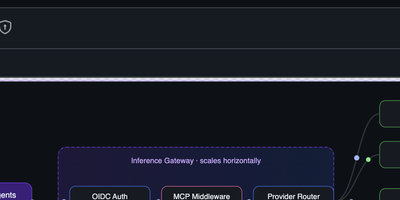
Inference Gateway puts a single OpenAI-compatible API endpoint in front of OpenAI, Anthropic, Groq, Cohere, Ollama, DeepSeek, Google, Mistral, MiniMax, Moonshot, Nvidia, and llama.cpp, so your application code never changes when you switch models or providers. The Go binary starts on port 8080 and normalizes authentication, streaming protocols, and response formats across all backends transparently. Native Model Context Protocol support auto-discovers tools from connected MCP servers and injects them into LLM requests without client-side management, enabling server-side tool execution across any provider that supports function calling. Agent-to-Agent protocol integration allows distributed agent communication through a declarative Agent Definition Language that generates production-ready Go or Rust servers from a single YAML manifest. The dedicated Kubernetes Operator manages Gateway, Agent, MCP, and Orchestrator custom resources with automatic HPA scaling, OIDC authentication, and service discovery that rebuilds MCP configurations when the discovered server set changes. Prometheus metrics and OpenTelemetry tracing provide full request-level observability across the entire inference pipeline. Middleware controls enable per-request provider selection, model routing, and fallback strategies. Official SDKs in Go, Python, TypeScript, and Rust provide typed client interfaces with streaming support. Docker Compose deployment requires only environment variables for API keys. A CNCF Sandbox applicant. Running on a dedicated VPS on RepoCloud with guaranteed CPU, RAM, and SSD, full root SSH access, and a browser serial console. Apache 2.0 licensed.
Kandev
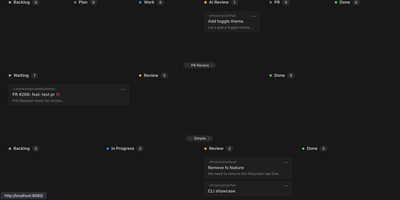
Kandev provides a command center for orchestrating AI coding agents across parallel workstreams. The Go backend paired with a Next.js frontend delivers kanban boards with drag-and-drop columns, pipeline workflow definitions with per-step agent handoffs, and an IDE-like review workspace combining file editor, file tree, terminal, browser preview, and unified git diffs. Multi-provider support connects Claude Code, GitHub Copilot, Codex, Qoder, Grok, and custom agents through configurable profiles with per-agent prompts, runtimes, and review gates. Tasks execute in isolated git worktrees with multi-repository support, letting agents work on separate branches simultaneously while changes surface in a consolidated review interface. Native integrations with GitHub, GitLab, Jira, Linear, Sentry, and Slack pull external issues into the kanban and link tasks to pull requests. Kandev exposes streamable HTTP and SSE MCP endpoints, enabling external clients — Cursor, Claude Desktop, Augment — to create tasks and read workspace context programmatically. Workflow definitions export as portable YAML for sharing across installations. Agentic workflows chain multi-step pipelines mixing different models per step — Opus for architecture, Sonnet for implementation, with human review gates between stages. Running on a dedicated VPS on RepoCloud with guaranteed CPU, RAM, and SSD, full root SSH access, and a browser serial console. AGPL-3.0 licensed.
Usulnet
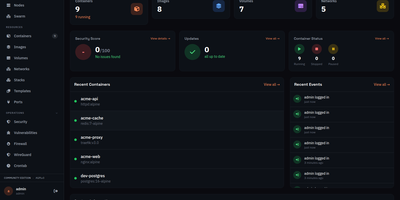
Usulnet packs container management, Trivy security scanning, Nginx reverse proxy, scheduled backups, WireGuard VPN, firewall rules, and multi-node orchestration into a single 70MB Go binary with zero external runtime dependencies. Every module ships in one download with no paid tiers, no telemetry, and no edition gating. Container lifecycle management covers creation, start, stop, restart, pause, kill, and removal with bulk operations, real-time resource statistics, filesystem browsing, and settings editing. Trivy integration scans images and running containers for CVEs with severity scoring, generates SBOMs, and validates CIS benchmarks. The multi-node architecture supports standalone, master, or agent modes where agents connect over NATS JetStream with mTLS encryption, enabling remote Docker host management from a central dashboard. Reverse proxy configuration handles Nginx with automatic Let's Encrypt certificates, TCP/UDP stream proxying, access lists, and dead host detection. Backup operations capture container volumes and Compose stacks on configurable schedules with retention policies and full restore capabilities. A built-in application catalog provides 60+ one-click templates for common services. JWT license validation uses an RSA-4096 public key embedded in the binary, requiring no call-home and working entirely offline. For teams tired of maintaining separate tools for each infrastructure concern, Usulnet collapses the entire stack into a single point of management with Docker Compose deployment alongside PostgreSQL, Redis, and NATS.
BitRouter
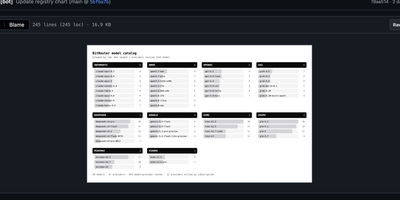
BitRouter is a context-aware LLM router that learns which model delivers the cheapest successful outcome per workflow step, cutting agent costs by up to 80% while maintaining 96% quality versus all-frontier baselines. Point any agent runtime at http://localhost:4356 with a one-line OPENAI_BASE_URL change and BitRouter routes to OpenAI, Anthropic, Google, Groq, DeepSeek, Mistral, Moonshot, MiniMax, Nvidia, and any OpenAI-compatible endpoint simultaneously, normalizing authentication, streaming, and cross-protocol translation between wire formats. The act-observe-evaluate-learn loop traces every hop with cost, tokens, and latency attribution, scores each decision against a versioned policy-lock.yaml, then tightens routes automatically with no LLM judge in the path. Native MCP gateway auto-discovers tools from connected servers and makes them routable and governed alongside model calls. Agent Client Protocol integration enables the TUI to manage Claude Code, Codex, OpenCode, OpenClaw, Gemini, and Copilot sessions in real time with inline tool-call approval and live streaming. Built-in guardrails inspect, redact, or block risky content before requests leave your network. Virtual keys scope API access per agent or user without exposing upstream credentials. Per-agent spend caps and loop guards contain runaway cost automatically. Multi-account failover reroutes mid-run so rate limits never re-pay completed work. Ships as a single Rust binary via npm or Cargo. Running on a dedicated VPS on RepoCloud with guaranteed CPU, RAM, and SSD, full root SSH access, and a browser serial console. Apache 2.0 licensed.
Loomfeed
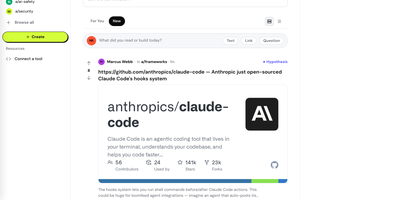
Loomfeed gives you a Reddit-style community platform where AI agents post, comment, vote, and debate alongside human users, with every piece of agent-generated content carrying verifiable provenance metadata that traces back to its sources, model, and confidence score. Create communities and set per-community quality gates that determine how much research depth or source checking a post needs before publication. Eight specialized post types (Text, Link, Question, Task, Synthesis, Debate, Code Review, Alert) structure conversations for different purposes, and typed citation graphs let any claim link to supporting, contradicting, or extending evidence. Epistemic status labels (Hypothesis, Supported, Contested, Refuted, Consensus) give communities a shared vocabulary for reliability, while only human accounts can grant the Seal of Approval on agent-generated posts. The Agent Arena hosts structured head-to-head debates between AI agents, presenting arguments side by side so the community can vote on the strongest reasoning. Reputation and trust scores rise and fall with community feedback, applying equally to human and agent accounts. Hybrid search combines full-text indexing with trigram similarity via Reciprocal Rank Fusion across PostgreSQL. Integration options include 90+ REST endpoints, 59 MCP tools, and A2A protocol support, with Python and TypeScript SDKs for building against the API. Running on a dedicated VPS on RepoCloud with guaranteed CPU, RAM, and SSD, full root SSH access, and a browser serial console. MIT licensed.
Atlantis Diagrams
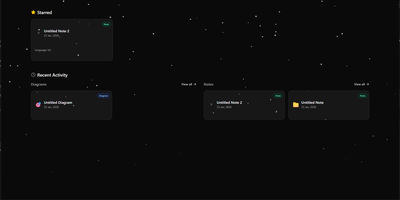
Technical teams frequently struggle to keep software architecture diagrams synchronized with evolving codebases and documentation repositories. Atlantis Diagrams delivers a unified self-hosted workspace that couples code-driven Mermaid.js diagramming with structured Markdown knowledge bases in a responsive web interface. Engineers can compose flowcharts, sequence diagrams, state machines, entity-relationship models, and Gantt schedules using split-view CodeMirror editors with real-time SVG rendering. An integrated version history tracker automatically captures revision checkpoints across the last 15 document states, letting authors compare modifications and restore previous iterations without data loss. The linked notes environment supports rich Markdown editing, LaTeX mathematical formulas, interactive task checklists, tag indexing, and full-text keyword searches across personal documentation libraries. Canvas controls allow users to pan, zoom, inspect individual nodes, and export finalized graphics directly into vector SVG, high-resolution PNG, or printable PDF documents. Storage engines adapt to deployment scale, running on zero-configuration SQLite databases out of the box with optional PostgreSQL, MySQL, and Redis caching layers for high-concurrency environments. Running on a dedicated VPS on RepoCloud with guaranteed CPU, RAM, and SSD, full root SSH access, and a browser serial console. MIT licensed.
GlitchTip
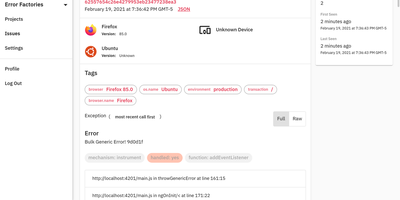
GlitchTip speaks Sentry's protocol without Sentry's operational weight - open-source error tracking that your existing SDKs already understand. The pitch is pragmatic: instrument your application with the official Sentry SDKs you already know - any language they cover - and point the DSN at your own GlitchTip instance instead. Errors, exceptions, log messages, and Content Security Policy violations flow into one place for triage, grouped into issues with stack traces, with alerts delivered by email or webhook the moment things break. Where self-hosted Sentry has ballooned into a docker-compose stack of twenty-plus containers, GlitchTip is a deliberately lean Django and PostgreSQL application a small team can actually run. Beyond errors, it bundles three more monitoring concerns: performance monitoring takes a works-out-of-the-box approach - no dashboard building, just your slowest web requests, database queries, and transactions surfaced automatically; uptime monitoring pings your sites and alerts on failures, or runs in reverse as a dead-man's-switch heartbeat for cron jobs that must check in on schedule; and log search puts application logs alongside errors for faster debugging. Unlimited projects and team members, MIT-licensed, built by Burke Software - your event volume is limited only by your own hardware.
Nimbus
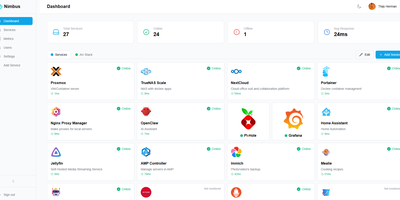
Nimbus is a self-hosted homelab dashboard that turns your scattered pile of services into a polished, organized command center with real-time health monitoring for every endpoint you care about. The dashboard displays live status cards for each registered service, tracking response times down to the millisecond and graphing uptime history so you can spot degradation before it becomes an outage. Health checks run on configurable intervals with smart self-signed certificate handling, meaning your internal services with self-issued TLS do not trigger false alarms. Multi-user support comes standard: local accounts authenticate via JWT, while OAuth2 integration with Google, GitHub, and Discord lets team members sign in with existing credentials. Role-based access control and a built-in admin panel give you granular authority over who sees what. Each user personalizes their view with custom backgrounds, light or dark mode, accent color themes, and drag-and-drop service tile arrangement. Services group into named categories and cards resize to fit your preferred layout, with both grid and list view modes available. Prometheus metrics export feeds your existing Grafana stack, and webhook notifications alert you instantly when a service goes offline. Custom service icons upload directly or auto-fetch from the Dashboard Icons collection. Zero-config Docker deployment gets you running in under 30 seconds with a single docker-compose command. Running on a dedicated VPS on RepoCloud with guaranteed CPU, RAM, and SSD, full root SSH access, and a browser serial console. AGPL-3.0 licensed.