RabiRoute
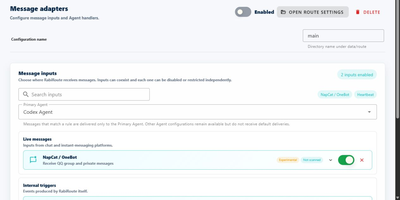
Which agent should answer a question that just arrived in your QQ group, and how much of the conversation should it see? RabiRoute is the self-hosted message gateway that answers those routing questions before your agent ever wakes up. Chat messages from QQ groups and direct chats (through NapCat and OneBot), webhooks, schedules, voice, desktop selections, and device events all arrive at one gateway, and message Routes decide which agent or local program receives each one. Every role keeps its own message history plus references to plans, memories, and skills, while each Route limits how many recent messages travel with a delivery. Roles can also fire agents on interval, time-window, daily, or one-time schedules, or run a configured local script, so recurring checks and reports happen without anyone typing a prompt. Replies to QQ, RabiLink, and other channels leave through a single sending API that validates targets, quoted messages, and sender identity, then records receipts for everything delivered. The Windows desktop side adds selected-text actions, screenshots, and annotations; speech, phone, glasses, wearable, and remote-computer clients connect as experimental integrations, and the Linux Host serves the Manager and browser WebGUI from a Node.js process. Running on a dedicated VPS on RepoCloud with guaranteed CPU, RAM, and SSD, full root SSH access, and a browser serial console. MIT licensed.
Paperlane
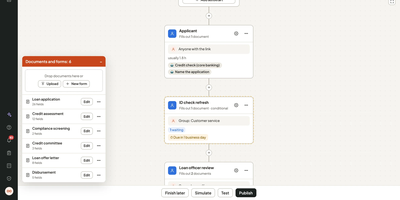
From public intake form to sealed, verifiable PDF, Paperlane carries every case along a route you draw on a canvas. Steps, branches with side-by-side lanes, jumps, and conditions snap together, and a checker flags broken links before you publish. Public start forms look customers up as they type; recipients open a secure link, sign by drawing or typing, and finish in English or Spanish without an account. Group steps wait in a shared queue where one teammate takes the task, deadlines count business days, and overdue work is reminded, reassigned, or escalated. Documents keep their status, revisions, comments, and audit trail, and the insights page names the slowest step and who holds the most open work. Bots number cases, fill Word templates, post to Slack or Teams, call your own APIs, and send signed webhooks. Sealed means sealed. Finished documents carry a fingerprint anyone can check on a public verify page. The AI planner turns a plain-words description into a draft workflow you review first, running on Ollama or LM Studio on your own hardware or on Claude in the cloud. An MCP server lets agents build workflows and complete steps with a person's permissions, and two-step sign-in, single sign-on, masked fields, and legal holds keep auditors calm. One install script sets up the app, HTTPS, a jobs worker, and nightly backups. Running on a dedicated VPS on RepoCloud with guaranteed CPU, RAM, and SSD, full root SSH access, and a browser serial console. AGPL-3.0 licensed.
Tucano
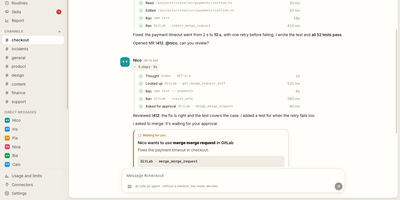
Tucano turns the coding agents you already use into a team that talks in channels, passes work between its members, and stops before anything real happens. Agents have names, roles, tools, and memory, and an @mention hands the turn to the next one, so one finds the bug, another fixes it, and a third reviews it. Connectors speak MCP for Jira, GitLab, GitHub, Slack, Datadog, or your own internal server, and each agent gets no access, read, or read and write per tool. Merges, purchases, posts, emails, and deletes arrive as approval cards showing the exact call, to approve once, always allow, or refuse with a reason, in the app or on Telegram. A Memory page lets you review, edit, and forget what agents learned, repeated paths become proposed skills, and skills from Claude Code and Codex import in one click. Routines run on a weekly calendar or when a connector reports a new issue, failing monitor, or email. Each agent picks its own harness and model and has a monthly token limit, while one Pause everything button halts the whole team. Agents can work in an isolated Linux computer or a live Chrome that you can take over. Server mode serves the same screens to a browser, listens on localhost by default, and pairs phones with one-time codes. Running on a dedicated VPS on RepoCloud with guaranteed CPU, RAM, and SSD, full root SSH access, and a browser serial console. Apache-2.0 licensed.
ShowAI
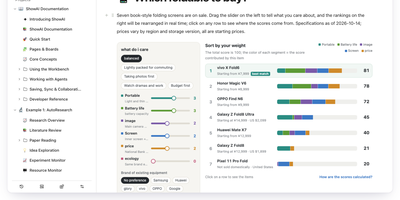
Your coding agent answers a question, and instead of a wall of Markdown you get a page you can actually use. ShowAI turns replies into interactive pages built from text, tables, charts, flow diagrams, sliders, and boards, so you can drag a weight, compare options, or step through an idea and watch the result change. Every page is saved as versioned files in a local project, with undo, retained drafts, and conflict protection, and the agent reads your edits before it continues. Select any text, cell, or board object to ask the agent to expand, reorganize, or visualize it, and run several conversations on one project in parallel. When a needed component is missing, the agent builds it, and pages that work can be distilled into templates. Export a page as standalone HTML, an inline fragment, or a static site. Connect a self-hosted ShowAI Server for projects shared by administrators, editors, and viewers, with account login and device management. Running on a dedicated VPS on RepoCloud with guaranteed CPU, RAM, and SSD, full root SSH access, and a browser serial console. MIT licensed.
uptimepage
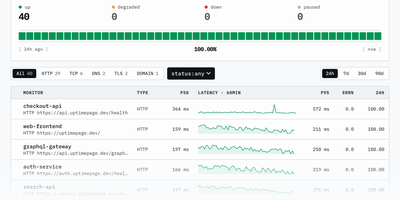
Uptime checks, a customer-facing status page, and on-call paging arrive in one self-hosted package, so a failing check can open an incident, page the right person, and update the public page without a second tool. Monitors cover HTTP, TCP, ICMP ping, DNS, TLS certificate expiry, domain expiry, cron heartbeats, and scripted browser login flows with per-step timings. Probe agents run in any region you choose, and the dashboard shows latency by region. Incidents open on failure and close on recovery, with acknowledgement to silence paging and reminders per monitor. Escalation policies page channels and schedules level by level, and layered on-call rotations support daily, weekly, or custom shifts, calendar overrides, and an iCalendar feed. Alerts reach Slack, Discord, Teams, Telegram, PagerDuty, SMS, WhatsApp, ntfy, Gotify, email, and webhooks. The public status page shows 90 days of uptime per component, maintenance windows, incident updates, and RSS, JSON, and email subscriptions. Everything can be driven by REST API, scoped tokens, a Terraform provider, or an MCP server for AI assistants. Self-hosted installs have no monitor limits and no plan to buy. Running on a dedicated VPS on RepoCloud with guaranteed CPU, RAM, and SSD, full root SSH access, and a browser serial console. AGPL-3.0 licensed.
MindSift
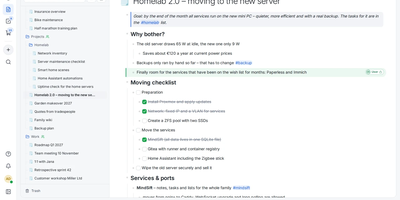
Thoughts have branches, and MindSift is an outliner where any bullet can nest, people write in one note live, and tasks and lists sit beside the notes. Zoom into any branch, or drag it with its children into another note. Wiki links reach single bullets and survive renames. A lock covers only the bullet being typed in, so nobody overwrites anybody, even offline. Type /canvas for shapes, docking arrows, and freehand, drawn alone or live with others. A checkbox in a note can become a full task with due date and alarm, synced both ways. Tasks show as a list, a kanban board, or a calendar. Alarms and a daily summary arrive by email, push, Discord, or webhook. Shopping lists read quantities from the text and tick off live on every phone. Quick Dump catches a thought by shortcut, voice, or share menu and spots dates like tomorrow 2pm without AI. Triage then empties the inbox card by card into tasks, notes, or list items. Agents get 33 tools for tasks, lists, notes, and the inbox under per-key permissions. OAuth lets claude.ai and ChatGPT connect, and badges show what a key changed. OpenID Connect, passkeys, invite links, and organizations let a household or team share one server. Each person's backup includes a plain Markdown vault that Obsidian can open. Running on a dedicated VPS on RepoCloud with guaranteed CPU, RAM, and SSD, full root SSH access, and a browser serial console. AGPL-3.0 licensed.
Drydock
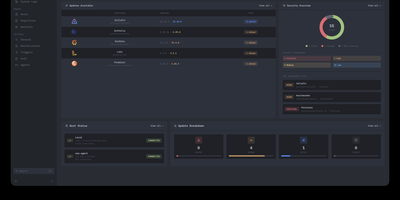
Deploying container updates without blind surprises is what Drydock delivers through a monitor-first inspection plane that evaluates image registries, scans CVE vulnerabilities, and automates rollbacks across distributed Docker infrastructure. Systems engineers track container fleets across twenty-three public and private registries including Docker Hub, GitHub Container Registry, Harbor, and Quay using cursor-based pagination and semver classification. The integrated Update Bouncer runs Trivy and Grype static scanners against incoming candidate layers, blocking deployments that fail configurable CVE severity policies while verifying cryptographic signatures through cosign. Operators configure declarative update schedules with stabilization countdown gates that hold back brand-new releases until defined burn-in periods elapse. When updates execute, Drydock creates pre-upgrade container snapshots and evaluates post-launch container health checks, instantly restoring previous image digests and network configs if failures occur. Distributed Portwing edge agents stream live container output and system logs over encrypted WebSockets, allowing central consoles to coordinate remote daemon updates without opening inbound host firewall ports. Automated event triggers dispatch granular notifications and update payloads across seventeen communication channels including Slack, Discord, Telegram, and Home Assistant MQTT brokers. Running on a dedicated VPS on RepoCloud with guaranteed CPU, RAM, and SSD, full root SSH access, and a browser serial console. AGPL-3.0 licensed.
GlitchTip
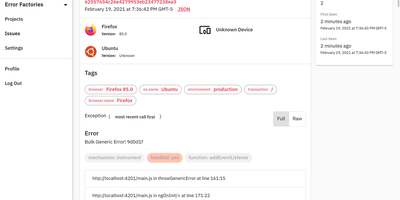
GlitchTip speaks Sentry's protocol without Sentry's operational weight - open-source error tracking that your existing SDKs already understand. The pitch is pragmatic: instrument your application with the official Sentry SDKs you already know - any language they cover - and point the DSN at your own GlitchTip instance instead. Errors, exceptions, log messages, and Content Security Policy violations flow into one place for triage, grouped into issues with stack traces, with alerts delivered by email or webhook the moment things break. Where self-hosted Sentry has ballooned into a docker-compose stack of twenty-plus containers, GlitchTip is a deliberately lean Django and PostgreSQL application a small team can actually run. Beyond errors, it bundles three more monitoring concerns: performance monitoring takes a works-out-of-the-box approach - no dashboard building, just your slowest web requests, database queries, and transactions surfaced automatically; uptime monitoring pings your sites and alerts on failures, or runs in reverse as a dead-man's-switch heartbeat for cron jobs that must check in on schedule; and log search puts application logs alongside errors for faster debugging. Unlimited projects and team members, MIT-licensed, built by Burke Software - your event volume is limited only by your own hardware.
AliangBoard
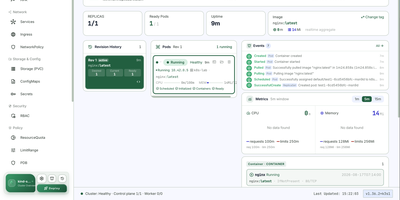
AliangBoard puts every Kubernetes cluster you run behind one web panel, where you manage resources yourself or ask an AI agent to do it with your approval. Connect each cluster with a bearer token or basic auth and the panel persists the connection, so switching clusters, namespaces, and workloads takes one click instead of another kubeconfig. More than thirty resource types stay in sync: create workloads, services, ingress, config, storage, and RBAC through structured forms, edit anything as YAML, apply multi-document manifests at once, and delete optimistically with automatic rollback when the API refuses. Pod work goes deep: a tmux-backed exec terminal survives browser refreshes, port-forwards resolve services to their backend pods, files move up and down with progress, and debug containers inject into running pods without restarting them. Day-two operations are buttons, not flag memorization: scale, rolling restart, rollout undo, manual CronJob triggers, and node cordon or drain. Global search, a layered namespace topology, live event streams, and CPU and memory metrics keep orientation effortless. Then there is the operator: an Agent workbench and MCP server let your LLM read logs, debug containers, and propose changes in natural language, while every write waits for a human click and lands in an audit log that names who did what. Running on a dedicated VPS on RepoCloud with guaranteed CPU, RAM, and SSD, full root SSH access, and a browser serial console. Apache-2.0 licensed.
Ferret
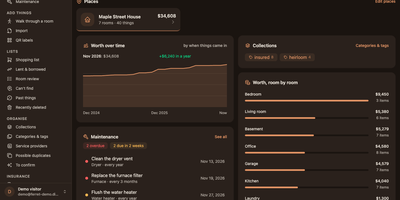
From the tent in the garage to the warranty on the fridge, Ferret keeps one searchable home inventory that your household runs on its own server. Properties, rooms, and boxes hold things with photos, receipts, manuals, serial numbers, and prices, and a quick add accepts a photo, a barcode scan, or a picture of a whole room to sort through. Printed QR labels on boxes and shelves open the list of what is inside. Warranties count down to the last day with a claim shortcut, return windows warn before they close, and maintenance repeats by date or by use, with reminders and how-to videos. Stock levels feed a shopping list, a lending log remembers who borrowed the saw, and a replacement forecast estimates what wears out and when. An insurance report totals value by room and category, exports PDF and spreadsheet files, and can be shared by link. Households have owners, admins, members, and read-only viewers, with invitations and single sign-on. Optional AI reads receipts, suggests details from photos, and answers questions in plain words, while a built-in MCP server lets Claude search, add, and update items with a key that can be read-only. Running on a dedicated VPS on RepoCloud with guaranteed CPU, RAM, and SSD, full root SSH access, and a browser serial console. MIT licensed.
Aurral
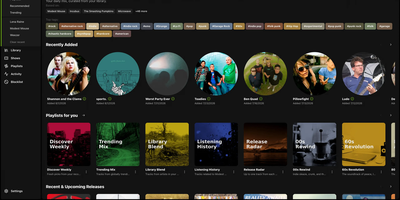
Discover, preview, and curate your personal music collection with Aurral, a self-hosted music discovery and library management server that turns listening history into automated playlists and album acquisitions. Connect your Last.fm, ListenBrainz, or Koito scrobble history to surface tailored artist recommendations, genre trends, upcoming releases, artist news, and nearby concert dates. Build scheduled rotating discovery flows that refresh automatically on your chosen cadence, or import existing playlists directly from Spotify, YouTube Music, Last.fm, and ListenBrainz. Preview tracks instantly in the browser before committing them to your permanent collection. Manage downloads through a built-in yt-dlp engine or route requests to slskd, SABnzbd, NZBGet, Prowlarr, deemix, and Lidarr with full queue, history, and upgrade controls. Stream your indexed library from the web player, connect Subsonic and OpenSubsonic apps such as Feishin or Music Assistant, and publish generated playlists straight to Navidrome, Plex, Plexamp, and Jellyfin. Multi-user profiles support granular permissions, custom discovery layouts, and single sign-on via OpenID Connect, Plex, Google, or reverse-proxy headers. Running on a dedicated VPS on RepoCloud with guaranteed CPU, RAM, and SSD, full root SSH access, and a browser serial console. MIT licensed.
Geo-Monitor
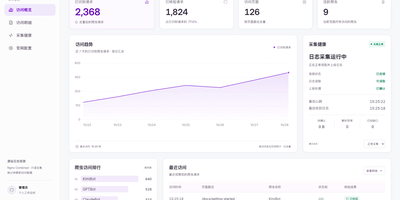
Search is being answered by AI crawlers first and humans second, yet most site owners cannot name a single bot that read their pages last week; Geo-Monitor answers that from the access logs you already have. A small collector sits beside Nginx or OpenResty, mounts the log read-only, and streams only new lines in batches, resuming after outages and surviving log rotation without ever touching your site's code. The console separates today, the last week, and the last month into identified requests, crawled pages, active crawlers, and trend lines, then drills into every visit with time, path, method, status code, claimed identity, and verification state. Identification and verification are deliberately different things here: a user agent only proves what a request claims to be, while a verified badge requires trusted log addresses and official IP evidence to agree. Twenty built-in identities cover OpenAI, Anthropic, Perplexity, Kimi, and Bytespider crawlers, and you can add, edit, or disable rules as new bots appear. Your sitemap syncs or imports as the content catalog, so coverage views show which pages crawlers actually reached, and collector health exposes heartbeat, backlog, and parsing problems. Running on a dedicated VPS on RepoCloud with guaranteed CPU, RAM, and SSD, full root SSH access, and a browser serial console. Apache-2.0 licensed.
Calends
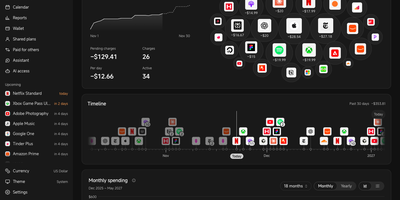
Subscriptions, family plans, and gift card balances share one private ledger in Calends, which shows what you pay, when it renews, and who still owes you. A subscription's history keeps its cycles, trials, intro prices, pauses, and plan switches, and a timeline plots each billing period by payment method or region. Past charges convert at historical exchange rates, forecasts use today's, and you pick the display currency. Shared plans follow each member's due dates, prepayments, waivers, and overdue days and suggest a prorated refund on exit, while Paid for others tracks what you front for friends. Wallet cards hold credit cards, store balances, and gift cards, and a balance runway shows when each runs dry and how much to top up. Reports total the year, set cash charged against true monthly cost, and draw a day-by-day heatmap and a money-flow diagram, while a checkup flags price hikes and duplicates. A calendar, a private ICS feed, and reminders to Telegram, Slack, Discord, ntfy, or any webhook show what is coming. A built-in assistant, running on your own model key, turns a pasted receipt or screenshot into a draft that waits for your confirmation. Claude Code, Codex, or Cursor can report what renews next week or record a price rise through 37 MCP tools behind read-only or read-write tokens, with dry-run previews. Running on a dedicated VPS on RepoCloud with guaranteed CPU, RAM, and SSD, full root SSH access, and a browser serial console. MIT licensed.
Mastyf
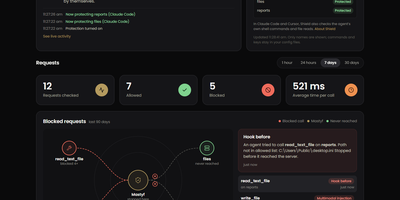
Between an AI agent and its tools sits Mastyf, a security gateway that checks every tool call against your rules before it runs. Home shows whether Protection is on; switching it on routes the MCP servers of Claude Code, Cursor, VS Code, Windsurf, Cline, and Claude Desktop through the proxy and catches servers added later within seconds. Blocked calls never reach the tool. Rules cover prompt injection, path traversal, secret leaks, shell injection, SSRF, encoding tricks, runaway token spending, and tool definitions that change mid-session. Policies are YAML you edit in the dashboard or any editor, with audit, warn, and block modes, hot reload, and a version history with diffs and one-click restore. Starter templates cover HIPAA, PCI-DSS, GxP, and data residency. The dashboard streams every decision into an Activity trail with a heatmap, tests sample calls against your rules, and tracks token spend per server against a monthly budget. Block alerts go to Slack, PagerDuty, or any webhook, and decisions can stream to Splunk, Elastic, OpenTelemetry, or syslog. Threat Lab uses a local Ollama model to invent attack tests and propose new rules, which apply only after you approve them. A client library with LangChain and OpenAI Agents adapters and an HTTP check service let custom agents ask before each tool runs. Running on a dedicated VPS on RepoCloud with guaranteed CPU, RAM, and SSD, full root SSH access, and a browser serial console. AGPL-3.0 licensed.
Workspace by hungga1711
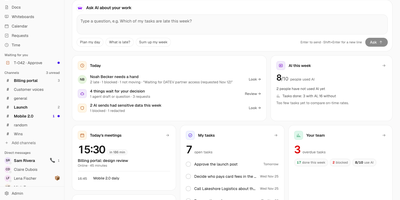
One installation runs a whole company's tasks, chat, docs, and AI assistant, with nothing phoning home. Projects live on Kanban boards, lists, and Gantt timelines, with subtasks, blockers, recurring work, and goals that roll up per person and department. Channels, threads, polls, and calls run alongside the work, and task references in messages become live chips. Docs get real-time co-editing, whiteboards turn sticky notes into tasks, and meetings keep agenda, minutes, and action items. Leave, purchases, and trips go through approval; clock-in follows each country's holidays. Then add AI on purpose. Hand any task to a workflow of model steps, commands, checks, and human approvals; the run stops wherever a person has to decide. Twenty-two templates cover engineering, sales, support, finance, and legal. Runs execute on the company model, inside a sandbox, or on the assignee's own computer with Claude Code, Codex, or Gemini CLI. A built-in assistant fields questions about tasks and leave, drafts Word, Excel, and PowerPoint files, and holds every change for your confirmation. AI Insights stays off until an admin enables it and each person opts in; it flags secrets and ID numbers before a prompt leaves and compares tasks finished with and without AI. Imports from Jira, Trello, Asana, ClickUp, Notion, Slack, and CSV bring existing work along. Running on a dedicated VPS on RepoCloud with guaranteed CPU, RAM, and SSD, full root SSH access, and a browser serial console. MIT licensed.
Nyro
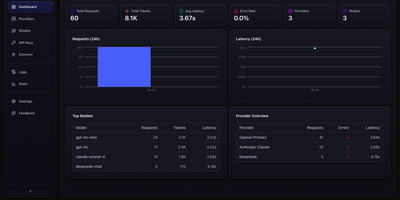
Point Claude Code, Codex CLI, Gemini CLI, or any OpenAI, Anthropic, or Gemini SDK at one address and Nyro routes every request to whichever model provider you choose. The gateway translates protocols on the fly, including streaming, reasoning blocks, and tool calls, so a tool built for one API can run on a model from another. Define virtual model names, bind each to one or more providers, and pick weighted load balancing or priority failover; unhealthy targets are skipped and recover automatically. Issue API keys with limits on requests and tokens per minute and per day, and bind each key only to the models it may call. Exact and semantic caching return repeated answers instantly. A request log records provider, model, token counts, latency, and streaming speed, and usage charts break traffic down by model and provider. The Connect page generates ready-to-paste samples in Python, TypeScript, and cURL, plus one-click configuration for popular coding CLIs. Choose an embedded database for a single host or an external PostgreSQL or MySQL server for production, and run the gateway, the admin UI, or both as separate processes. Running on a dedicated VPS on RepoCloud with guaranteed CPU, RAM, and SSD, full root SSH access, and a browser serial console. Apache-2.0 licensed.
GNO
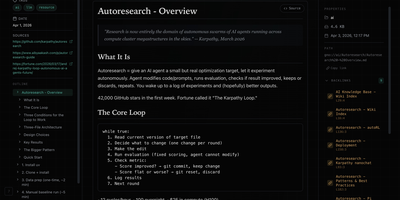
Search your local notes, PDFs, Office files, and code with GNO, and "how we handle retries" finds the paragraph about exponential backoff that never uses the word. Keyword and semantic retrieval run together, with reranking at higher depths, and --explain shows score traces for each result. Questions on the Ask page come back with citations that resolve to the source passage. Verified mode withholds the draft unless one closed bundle of evidence supports every claim. The browser workspace adds a cross-collection folder tree and split-view Markdown editing with live preview. PDFs open as native pages, and an interactive graph maps how your documents relate. Quick capture sits on the N key. Context Capsules bundle exact line spans for one goal and list what could not be found. Agents reach the same index through an MCP server that installs into ten clients, including Claude Code, Cursor, and Zed. Write tools stay off until you switch them on. A headless daemon watches folders, syncs, and embeds changes to keep the index current. It can serve MCP to remote agents behind a bearer token and Host and Origin allowlists. Models run locally, with no GPU or account required and no telemetry. Per-collection egress policy, local only, LAN, or remote, keeps client files local while personal notes use a GPU box on your network. Running on a dedicated VPS on RepoCloud with guaranteed CPU, RAM, and SSD, full root SSH access, and a browser serial console. MIT licensed.
Spanlens
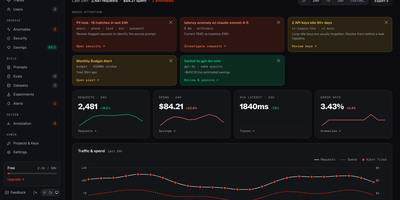
A drop-in proxy sits between an app and OpenAI, Anthropic, or Gemini and logs each call's cost, tokens, latency, and full prompt for debugging and spend control. Adoption means changing a base URL or running a CLI wizard that patches existing client calls. A surprise bill? Filter requests by model or key, check per-end-user totals, then open any one to read the messages and the reply, even when it streamed. A slow agent? Its run opens as a waterfall timeline with the critical path marked, or as a node graph for LangChain and LangGraph traces. Spend, latency, and error spikes are measured against a seven-day baseline, and alert rules route breaches to email, Slack, or Discord. Savings recommendations point to cheaper models for simple tasks, with estimated monthly dollars and a simulate button. Detectors flag emails, phone numbers, card numbers, and prompt-injection attempts, and a project can block injections outright. Prompt edits keep versions with diffs and A/B traffic splits, while LLM judges and a human rating queue score the outputs. Workspaces carry admin, editor, and viewer roles, and every invitation or role change is logged with who made it. Cursor or Claude Desktop can query the same data through a bundled MCP server. Running on a dedicated VPS on RepoCloud with guaranteed CPU, RAM, and SSD, full root SSH access, and a browser serial console. MIT licensed.