Casibase
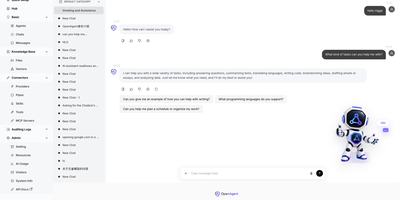
Casibase lets organizations build AI-powered knowledge bases that answer questions from their own documents, connecting to 30+ model providers through a unified admin interface with RAG retrieval and multi-agent orchestration via MCP and A2A protocols. The platform plugs into OpenAI GPT-4o, Anthropic Claude, Meta Llama, Google Gemini, DeepSeek, Ollama local models, HuggingFace, Azure OpenAI, and additional providers, while embedding APIs from OpenAI Ada and Baidu handle vector representation of ingested documents. Document ingestion parses TXT, Markdown, DOCX, PDF, CSV, XLSX, and PPTX files with intelligent chunking strategies for optimal retrieval accuracy. The built-in chat interface provides real-time AI conversations with manual session handover for human agent escalation, and comprehensive chat session logging enables audit trails for compliance. Enterprise identity management integrates Casdoor for Single Sign-On supporting GitHub, Google, WeChat, and OIDC providers with fine-grained access control via the Casbin permission engine. The multi-tenant architecture supports isolated knowledge bases per organization with role-based user management and configurable storage, model, and embedding providers per tenant. The React frontend with Ant Design v5 provides a polished admin dashboard for managing providers, knowledge stores, chat sessions, and user access, while the Go backend with Beego framework handles API logic with MySQL or MariaDB persistence. Running on a dedicated VPS on RepoCloud with guaranteed CPU, RAM, and SSD, full root SSH access, and a browser serial console. Apache 2.0 licensed.
TrailBase
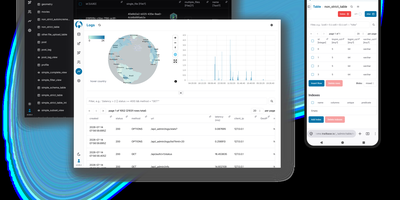
With 5,400+ GitHub stars and sub-millisecond response times that eliminate the need for dedicated caches entirely, TrailBase consolidates your database, API server, auth service, realtime subscriptions, and admin interface into a single Rust binary weighing under 40MB. The platform generates type-safe CRUD APIs automatically from your SQLite schema with configurable access control rules using SQL expressions, while realtime subscriptions push data changes to connected clients via Server-Sent Events. The embedded Wasmtime runtime executes custom server-side logic as WebAssembly components compiled from Rust, JavaScript, Python, or any language targeting WASI, enabling complex business logic without external services. First-class geospatial support through the in-house LiteGIS GEOS extension provides GeoJSON integration, spatial indexing via R-Trees, and query operators including @within, @intersects, and @contains for location-based applications. Client SDKs span JavaScript/TypeScript, Dart/Flutter, Rust, C#/.NET, Swift, Kotlin, Go, and Python — covering mobile, web, desktop, and IoT platforms. The admin dashboard offers visual schema editing, a data browser, Record API configuration, OAuth provider setup, user management, SQL query editor, ERD visualization, and server logs. Experimental PostgreSQL support (v0.28+) allows connecting to existing Postgres instances via connection string. Deploy via a single binary, Docker container, or the one-line install script across Linux, macOS, and Windows. Running on a dedicated VPS on RepoCloud with guaranteed CPU, RAM, and SSD, full root SSH access, and a browser serial console. OSL-3.0 licensed.
Kokoro FastAPI
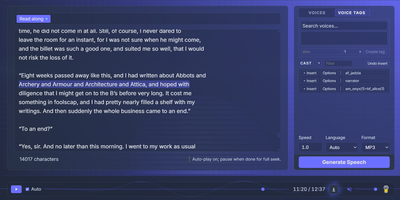
Kokoro-FastAPI turns text into natural-sounding speech across eight languages by serving the 82-million-parameter Kokoro-82M model through an OpenAI-compatible REST API, so any existing OpenAI SDK client can generate audio by just changing the base URL. With over 5,300 GitHub stars since December 2024, the fully Dockerized FastAPI server covers American English, British English, Spanish, French, Hindi, Italian, Japanese, Brazilian Portuguese, and Mandarin Chinese with language-specific phoneme processing. Inline voice mixing blends multiple profiles using weighted ratios like af_bella(2)+af_heart(1), automatically normalizing weights and caching combined voicepacks as PyTorch tensor files for reuse. Audio streams in real time over HTTP with configurable chunk sizes, or generates complete files in MP3, WAV, OPUS, FLAC, AAC, or PCM formats with speed control from 0.25x to 4.0x. Per-word timestamped captions with speaker-tagged voice labels enable subtitle generation for podcasts, audiobooks, and accessibility workflows. Pre-built Docker images support NVIDIA GPU acceleration via CUDA, experimental AMD GPU inference via ROCm, and CPU-only deployment on linux/amd64 and linux/arm64 architectures, with Apple Silicon MPS support available through direct UV execution. The integrated web interface at port 8880 provides browser-based speech generation, while the Swagger UI at /docs exposes the full API reference. Debug endpoints report system statistics for monitoring inference load. Running on a dedicated VPS on RepoCloud with guaranteed CPU, RAM, and SSD, full root SSH access, and a browser serial console. Apache 2.0 licensed.
Plunk
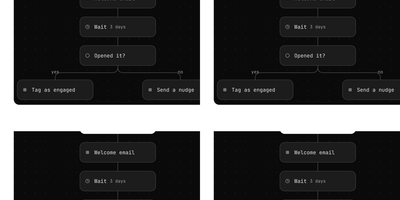
Plunk consolidates transactional emails, marketing campaigns, and drip automation into one platform riding AWS SES at roughly one-tenth of a cent per message, with zero per-contact charges regardless of list size. The Turborepo monorepo architecture separates the Express.js API server (handling REST requests with Prisma ORM against PostgreSQL) from a dedicated BullMQ worker process that consumes email, campaign, and workflow jobs independently for fault isolation and horizontal scaling. Transactional emails support HTML bodies, template variable substitution via React Email components, attachments, and custom headers with dedicated SMTP relay on ports 465 and 587 for integration with existing frameworks. The campaign system sends newsletters and product updates to full contact lists or dynamically segmented audiences based on contact properties and behavioral events, with scheduling, A/B testing, and performance tracking for opens, clicks, and bounces. The workflow automation builder creates event-triggered sequences with delays, conditional branches, and webhook steps for lifecycle campaigns like onboarding drip sequences and re-engagement flows. Contact management stores unlimited contacts with custom data fields, CSV import, full activity history, and dynamic segmentation. Custom domain verification with DKIM and SPF ensures deliverability, while inbound email processing handles incoming messages with custom routing rules. Docker Compose deployment runs five containers including PostgreSQL, Redis, MinIO for S3-compatible storage, and ntfy for notifications. Running on a dedicated VPS on RepoCloud with guaranteed CPU, RAM, and SSD, full root SSH access, and a browser serial console. AGPL-3.0 licensed.

Open Canvas
Open-source alternative to OpenAI's Canvas — a collaborative writing and coding environment where AI agents help you draft, edit, and refine documents through an agentic architecture built on LangGraph. The dual-mode editor combines a BlockNote rich text editor for live-rendered markdown with a CodeMirror-based code editor supporting syntax highlighting across multiple programming languages, letting you switch between prose and code artifacts within the same session. The built-in reflection agent automatically generates style rules and user insights from your chat history, storing them in a shared LangGraph memory store that persists across sessions for increasingly personalized assistance. Pre-built quick actions provide one-click access to common writing transformations including summarize, expand, simplify, and translate, while coding actions offer explain, refactor, add comments, and convert between languages. The monorepo architecture separates the Next.js 14 frontend from the LangGraph agent backend, connecting via HTTP and WebSocket protocols through the @langchain/langgraph-sdk client. Seven LLM providers are supported out of the box — OpenAI, Anthropic Claude, Google Gemini, Fireworks AI, Groq, Azure OpenAI, and local Ollama models — with Supabase handling authentication and data persistence. Deploy via Docker or build from source. Running on a dedicated VPS on RepoCloud with guaranteed CPU, RAM, and SSD, full root SSH access, and a browser serial console. MIT licensed.
Unkey
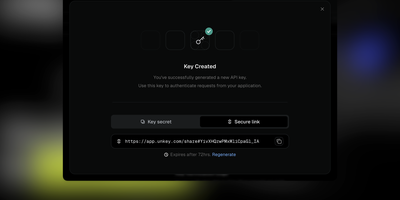
Unkey is the open-source platform that unifies API key management, rate limiting, deployment, and observability into a single control plane. The Go API service validates keys with sub-millisecond latency using regional Redis caches and MySQL 8.0 persistent storage, while ClickHouse captures every verification event for per-key and per-keyspace analytics with filterable time-series charts, request counters, and active key tracking. Keyspaces organize API keys by product, environment, or tier, each configurable with custom prefixes, byte lengths, IP whitelists, encrypted key recovery, and delete protection. Per-key settings include expiration dates, rate limit quotas with configurable windows, RBAC roles and permissions, owner identities linking multiple keys to a single user or organization, and key rotation with grace periods from immediate revocation through 24-hour overlap. The deployment pipeline connects GitHub repositories for automatic Docker container builds, generates preview environments per commit, promotes tested versions to production, and validates releases with OpenAPI diff detection flagging breaking changes before production. The edge gateway authenticates and rate-limits requests at the closest region before routing to the nearest API instance. Immutable audit logs track every key creation, verification, deletion, and configuration change with actor, timestamp, and event metadata. The CLI provides terminal access to key management, analytics queries, and deployment operations. On RepoCloud, deploy Unkey on a dedicated VPS with Docker, root SSH access, and complete control over your API infrastructure, all under the AGPL license.
BookOrbit
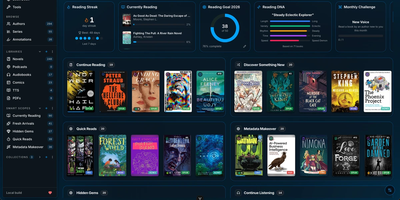
Consolidate your entire digital library into a self-hosted reading sanctuary with BookOrbit, an open-source media platform that organizes ebooks, audiobooks, comic archives, and research PDFs within a personal private cloud. Readers can enjoy multi-format media directly through responsive browser readers that support EPUB, CBZ, and M4B formats without external browser extensions. The platform synchronizes reading bookmarks, highlights, and completion statuses across web interfaces, Kobo ereaders, and KOReader devices. An automated metadata enrichment engine queries fourteen upstream bibliographic indexes, downloading cover artwork, chapter breakdowns, author biographies, and series taxonomies. The staging workspace allows librarians to inspect incoming files, review suggested metadata revisions, and embed updated tags directly into physical storage archives before shelving. Custom reading dashboards track annual book goals, calculate daily streaks, and plot reading habit radar charts. Multi-user configurations support distinct per-user collections, granular content permissions, and single sign-on authentication through OpenID Connect providers. Power users can export private OPDS feeds to external mobile reading applications or push books directly to connected Kindle hardware. Running on a dedicated VPS on RepoCloud with guaranteed CPU, RAM, and SSD, full root SSH access, and a browser serial console. GNU AGPL v3.0 licensed.
Shlink
With over 5,100 GitHub stars and eight years of active development since 2016, Shlink has become the definitive self-hosted URL shortener for teams that need unlimited links, full visitor analytics, and complete data ownership without per-link pricing or monthly caps. The PHP backend built on the Mezzio framework with Doctrine ORM serves redirects through any number of custom domains on a single instance, generating unique short codes or accepting custom slugs including multi-segment paths and emoji characters. Every click is tracked with anonymized visitor data including geolocation by country, city, and coordinates, browser and operating system identification, referrer source, and device type classification, all stored in your choice of MySQL, MariaDB, PostgreSQL, Microsoft SQL Server, or SQLite. Dynamic redirect rules route visitors to different destinations based on geolocation, device type, or browser language, enabling targeted campaigns from a single short URL. The REST API exposes every operation with OpenAPI documentation and an interactive sandbox at api-spec.shlink.io, while the CLI provides equivalent functionality for scripting and automation. The official progressive web app at app.shlink.io manages multiple Shlink instances from a single interface with URL creation, tag management, and detailed visit charts. Real-time event integration supports both Mercure and RabbitMQ for webhook-style notifications on new visits. Third-party imports migrate existing short URLs from Bitly and YOURLS with visit history preserved. Running on a dedicated VPS on RepoCloud with guaranteed CPU, RAM, and SSD, full root SSH access, and a browser serial console. MIT licensed.
Agent Gateway
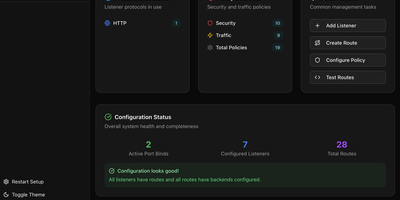
Backed by the Linux Foundation with contributions from AWS, Cisco, IBM, Microsoft, Red Hat, and Shell, Agentgateway is the first data plane built from the ground up for AI agent workloads — providing a unified Rust-based proxy that handles conventional HTTP and gRPC traffic alongside MCP tool servers, A2A agent communication, and LLM inference endpoints through a single deployment. The LLM gateway routes requests to OpenAI, Anthropic, Gemini, AWS Bedrock, and other providers through an OpenAI-compatible unified API with per-tenant budget controls, spend tracking, prompt enrichment, load balancing across multiple model endpoints, and automatic failover when providers experience outages. The MCP gateway federates multiple tool servers behind one endpoint, supporting stdio, HTTP/SSE, and Streamable HTTP transports with built-in OAuth authentication compliant with the MCP auth specification, integrating Auth0 and Keycloak out of the box. OpenAPI integration exposes existing REST APIs as MCP-native tools without code changes, enabling legacy services to participate in agent workflows. Policy-based RBAC controls which agents access which tools, while OpenTelemetry integration provides distributed tracing across agent communication chains. Deploy as a standalone binary with flat YAML configuration or on Kubernetes using the built-in controller with Gateway API support for declarative infrastructure-as-code management. Running on a dedicated VPS on RepoCloud with guaranteed CPU, RAM, and SSD, full root SSH access, and a browser serial console. Apache 2.0 licensed.
Isso
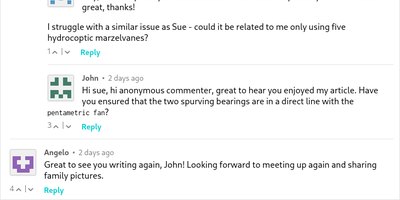
Named from the German "Ich schrei sonst" - roughly "or I'll scream" - Isso is a lightweight Python/JavaScript commenting server, a drop-in Disqus replacement for people who noticed what Disqus does to reader privacy and page load times. The design premise is printed right in the docs: comments are not Big Data. So the backend is a single SQLite file rather than a database cluster, and the entire client is one embeddable JavaScript file - 65 kB, 20 kB gzipped - that you drop into any static site, blog, or CMS. Commenters write in Markdown, need no account, and can edit or delete their own comments within a configurable window (15 minutes by default). Spam control comes from an optional moderation queue: held comments stay invisible until you activate them via an admin interface or email notification links. Migration is a first-class feature, with importers for Disqus and WordPress exports, so years of existing threads move over intact. Because everything is server-rendered from your own instance, no third party tracks your readers, and real-world switchers report smaller pages and faster loads than the Disqus embed. MIT-licensed, running since 2012.
Rallly
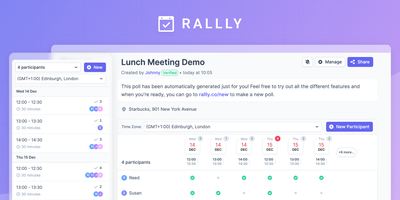
What Doodle did before ads and paywalls took over: Rallly (three L's) lets you propose a few dates, share a link, and watch an availability grid fill in - no email threads, no forced accounts, no "$6.95/month to remove ads." The availability grid makes the winning slot obvious at a glance, comments on each poll keep the "I can do Tuesday if we start late" discussion attached to the decision instead of buried in chat, and email notifications fire as votes and comments arrive. When consensus lands, finalize the winning option and everyone gets notified. The stack is modern TypeScript - Next.js, tRPC, Prisma over PostgreSQL, Tailwind - with a clean, genuinely mobile-friendly UI, dark mode, and community translations in 10+ languages. Self-hosting means unlimited polls and unlimited participants with meeting data on your server rather than a scheduling SaaS. It pairs naturally with Cal.com: Rallly answers "which time works for everyone?", Cal.com handles "book a slot on my calendar." AGPL-licensed.
Treg
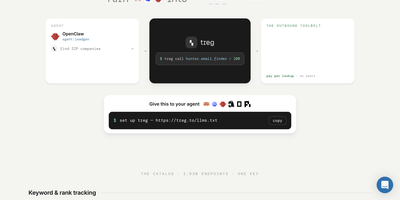
With over 330 GitHub stars and described as "OpenRouter, but for agent tools instead of models," Treg is the unified tool registry that gives your AI agent one base URL, one token, and instant access to approximately 2,800 cataloged endpoints across 56 providers — SEO and backlink analysis via Semrush and Moz, social media intelligence from TikTok and Instagram, people and company enrichment through Crunchbase and Hunter, media buying, scraping, and SERP data — all priced per call from fractions of a cent with no provider signup required. The FastAPI backend with PostgreSQL stores credential bindings and injects them server-side into every proxied request, ensuring API keys and OAuth tokens never touch the agent or local machine while every call is audit-logged. Teams register their own paid API accounts, OAuth connections, vendor CLIs like Stripe, GitHub CLI, Vercel, and gcloud, plus custom SKILL.md definitions — all callable by every teammate's agent through a single treg token with automatic credential injection. The evidence-based tool selector shows success rate, response speed, and last-seen timestamp for each provider, so agents pick tools on measured performance rather than guesswork. Bring-your-own-key routes bypass metering entirely, and the one-dollar free credit on every new team lets agents start calling immediately. The Vue.js web dashboard provides team management, audit logs, catalog browsing, and guided onboarding. Self-host with pip install tools-registry[server] on a dedicated VPS on RepoCloud with guaranteed CPU, RAM, and SSD, full root SSH access, and a browser serial console. Apache-2.0 licensed.

WriteFreely
With over 5,100 GitHub stars and a proven track record powering more than 550,000 blogs on the Write.as hosted platform since 2018, WriteFreely strips blogging down to its essential purpose — writing — by removing news feeds, notifications, likes, and engagement metrics that distract from the creative process. The Go binary deploys on any platform as a single executable with SQLite for zero-dependency setups or MySQL and MariaDB for larger installations, consuming minimal system resources and running comfortably on hardware as small as a Raspberry Pi. The auto-saving Markdown editor provides a clean writing environment with instant draft preservation, while published posts render with typography-focused CSS that puts content front and center for readers. ActivityPub federation connects every blog to the fediverse, allowing Mastodon, Pleroma, and other ActivityPub platform users to follow blogs directly, receive new posts in their timelines, and boost or favorite content to their followers. Multi-blog support lets writers maintain separate blogs with distinct pen names from a single account without revealing their association, while OAuth 2.0 integration enables single sign-on onboarding from existing identity providers. Hashtag categorization organizes posts by topic, pinned posts create static pages for permanent content, and draft mode lets writers compose privately before publishing. Blog elements are localized in over 20 languages with first-class right-to-left script support for Arabic, Hebrew, and other RTL languages. Running on a dedicated VPS on RepoCloud with guaranteed CPU, RAM, and SSD, full root SSH access, and a browser serial console. AGPL-3.0 licensed.
Restreamer
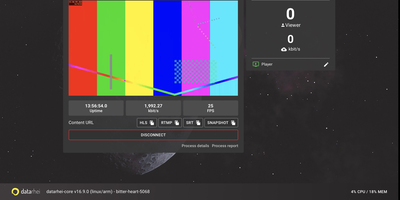
Point OBS or a hardware encoder at Restreamer's built-in RTMP or SRT ingest and it serves your website while rebroadcasting to YouTube Live, Twitch, Facebook, Vimeo, TikTok, LinkedIn, PeerTube, and anything else that accepts RTMP, SRT, or HLS - a complete self-hosted live-streaming server from datarhei. That multistreaming normally costs a monthly Restream.io subscription; here it's one FFmpeg process per destination on your own hardware. The web UI is genuinely approachable, with a wizard that walks beginners through camera setup, while professionals get the full surface: multiple audio/video inputs (USB, RTSP network cameras, virtual devices), codec and processing settings, separate audio muxing, and hardware acceleration via Nvidia CUDA, Intel VAAPI, or Raspberry Pi. Serving your own audience is first-class - a built-in Video.js player embeds in your site, a ready-made publication website streams without any embedding work, HLS chunk sizes are tunable, and automatic Let's Encrypt handles HTTPS. Viewer and bandwidth monitoring with limits keeps traffic costs predictable, and it's GDPR-friendly: no third-party provider, no audience data stored. A fully Swagger-documented REST API drives automation. SRT support keeps latency under a second.
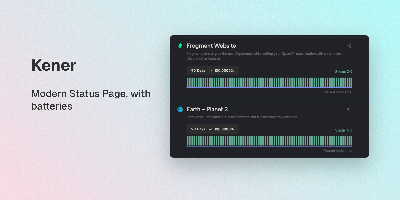
Kener
A polished public status page without Statuspage prices or a heavyweight observability suite: Kener is a status and uptime monitoring system built with SvelteKit and Node.js. It runs 11 monitor types - API, Ping, TCP, DNS, SSL certificate, SQL query, Heartbeat, gRPC, and GameDig game-server checks among them - each with configurable intervals and thresholds. Incident management covers the full lifecycle: structured timelines from investigation through resolution, acknowledgements, and subscriber-visible updates, plus maintenance windows with RRULE-based recurring schedules and automatic status transitions. Notifications reach email, Slack, Discord, and custom webhooks through trigger-based workflows with template-driven messaging. One instance can serve multiple branded status pages - per product, team, or region - with custom logos, colors, and CSS, localization into 21 languages, timezone-aware displays, and server-rendered pages that stay fast and SEO-friendly. Operations tooling includes role-based access for teams, API key management, a secrets vault, analytics integrations (Google Analytics, Plausible, Umami, and others), and a REST API with 17+ endpoints for automating incidents and monitors from CI/CD. MIT-licensed; Docker deployment with Redis, SQLite by default, PostgreSQL or MySQL for production.
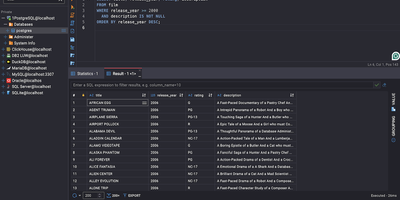
CloudBeaver
CloudBeaver puts a full-featured database management environment in your browser, connecting to PostgreSQL, MySQL, SQL Server, Oracle, ClickHouse, and over 100 additional engines through one unified interface that requires no desktop client installation. The Java server exposes a TypeScript/React frontend through a GraphQL API where teams can browse schemas, edit data, visualize relationships, and execute queries across all connected databases in a single workspace. The SQL Editor provides syntax highlighting, auto-completion with fuzzy search, AI-assisted SQL generation from natural language prompts, script management with save/download/upload capabilities, execution plan visualization, and multi-tab result display. The Data Editor enables direct cell editing, filtering, sorting, and bulk data modification with support for spatial GIS data rendering. Database administrators access a Navigator panel for browsing schemas, tables, views, foreign tables, triggers, dependencies, and stored procedures across all connected databases. ER Diagrams visualize table relationships and schema structure, while the Visual Query Builder constructs queries without hand-writing SQL. Multi-user administration provides role-based access control, connection sharing with configurable permissions, and session management. SSH tunneling secures remote database connections, and data can be exported or imported in multiple formats. Query History tracks all executed statements with timestamps and execution statistics. Running on a dedicated VPS on RepoCloud with guaranteed CPU, RAM, and SSD, full root SSH access, and a browser serial console. Apache 2.0 licensed.
Tau
Tau delivers a complete self-hosted cloud platform where Git is the control plane and WebAssembly is the runtime. The Go binary deploys as interconnected nodes that form a P2P network using libp2p for automatic service discovery, eliminating Kubernetes entirely. Serverless functions compile to WebAssembly for secure multi-tenant execution with automatic horizontal scaling — write in Go, Rust, AssemblyScript, or C and deploy by pushing to Git. Branch-based environments map Git branches to isolated deployments, so staging and production run identical infrastructure from different refs. Static website hosting serves frontends with global distribution and automatic content-addressed deduplication via IPFS-derived storage. The built-in K/V database provides distributed storage with automatic replication across nodes, while object storage handles file management with content addressing. Pub/Sub messaging enables real-time communication between functions and external services including WebSocket support. Spore Drive automates multi-host deployment and rolling updates from a single command across bare metal or VMs running Ubuntu. The Dream CLI provides a complete local development environment that mirrors production exactly — same services, same routing, same deployment flow. Zero-configuration HTTPS provisions TLS certificates automatically for custom domains. The web console at console.taubyte.com provides visual project management, or use the tau CLI for Git-native workflows. Running on a dedicated VPS on RepoCloud with guaranteed CPU, RAM, and SSD, full root SSH access, and a browser serial console. BSD-3-Clause licensed.

Colanode
With nearly 5,000 GitHub stars and a Hacker News launch that garnered 147 points, Colanode delivers the first genuinely local-first alternative to both Slack and Notion in a single self-hosted workspace — writing every operation to a client-side SQLite database before syncing to your server, so teams work at full speed offline, on planes, or through intermittent connections without ever losing a draft. The real-time chat system provides channels and direct messages with instant delivery via WebSocket, while the rich text editor offers Notion-style block-based pages for documents, wikis, meeting notes, and knowledge bases with headings, code blocks, embeds, and nested hierarchies. Customizable databases organize structured data with custom fields and three dynamic views — table for spreadsheet-style browsing, kanban for visual workflow boards, and calendar for time-based planning. Conflict-free Replicated Data Types powered by Yjs handle concurrent editing across pages and database records: multiple users modify the same document simultaneously and the system merges changes automatically without manual conflict resolution. File management supports upload, sharing, and organization within workspaces using pluggable storage backends including local filesystem, S3-compatible services, Google Cloud Storage, and Azure Blob Storage with TUS resumable uploads for large files. The server runs Fastify with Zod validation on Node.js 20+, persists to PostgreSQL with pgvector extension, uses Redis for event broadcasting, and deploys via a single Docker image. Running on a dedicated VPS on RepoCloud with guaranteed CPU, RAM, and SSD, full root SSH access, and a browser serial console. Apache-2.0 licensed.