Clawboo
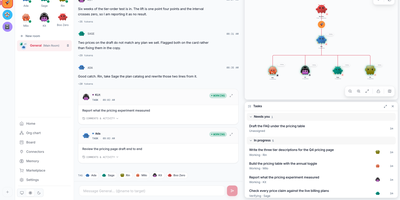
Describe the outcome once, in plain language, and a small crew of AI agents divides the work between them and reports back in the same chat. You type the request in the team chat; Boo Zero, the team lead, splits it into jobs on a shared board and hands each card to the teammate best placed to do it. Teammates run on Claude Code, Codex, Hermes, OpenClaw, or Clawboo's built-in runtime, and one team can mix them freely, so the researcher, the writer, and the coder can each work on their strongest tool. You follow every card live on the board and in the chat, watch the team graph to see who is doing what, and add a reviewer agent when a second pair of eyes matters. Finished work returns to Boo Zero, which pulls the pieces together and answers you in the chat. Ready-made teams from the marketplace cover marketing squads, dev teams, and research crews, and you can bring an API key from Anthropic, OpenAI, OpenRouter and more, a free local model through Ollama, or your ChatGPT subscription through the Codex CLI. Spend is tracked per team with budget warnings before costs surprise you. Running on a dedicated VPS on RepoCloud with guaranteed CPU, RAM, and SSD, full root SSH access, and a browser serial console. MIT licensed.
Wraft
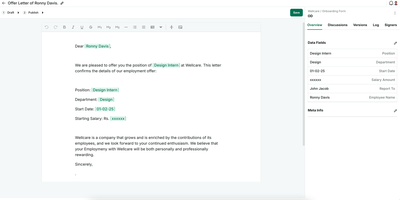
Wraft takes the documents your business runs on, from offer letters and contracts to reports, and gives them a proper lifecycle instead of a life scattered across word processors and email threads. Designers capture the house style once as themes and layouts, template authors build documents from reusable blocks and variants with dynamic fields, and everyone else simply fills in the values and generates a finished, on-brand PDF. Flows define how a document travels from drafting through review and approval to signing and distribution, with an activity log that shows who touched it and when. Pipelines go further, turning one set of data inputs into many generated documents automatically, which is how a hundred personalized letters stop being a hundred manual edits. Workspaces keep teams, roles, and fine-grained permissions separate per organization, imported templates bring existing documents into the system, and because everything is stored as Markdown and JSON your content stays readable and portable long after any single tool. Running on a dedicated VPS on RepoCloud with guaranteed CPU, RAM, and SSD, full root SSH access, and a browser serial console. AGPL-3.0 licensed.
WPMgr
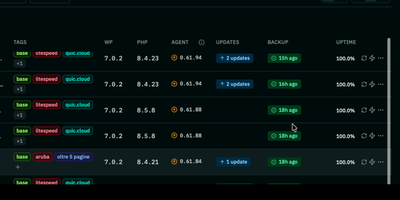
One dashboard for every WordPress site you look after: that is WPMgr, a self-hosted control panel that replaces dozens of separate wp-admin tabs with a fleet view you own. Enroll a site by URL, paste a one-time code into its agent plugin, and the connection flips live on its own. From there the daily grind changes shape. Backups stream straight out of PHP with no mysqldump and no shell access, chunked and deduplicated, scheduled per site, and restorable as a whole site or just the database. Updates stop being a weekend ritual: preview the run dry, apply it across the fleet, and let the automatic snapshot and health check roll back a bad release before a client notices. Uptime probes split DNS, TLS, and time-to-first-byte, flag certificates about to expire, and open exactly one incident per outage instead of a storm of alerts. The Sites grid leads with a fresh screenshot of every homepage, so the dead site is visible before the client calls. Core files get diffed against official WordPress.org checksums, brute-force logins meet escalating lockouts, and an IP firewall fires before other plugins load. Page caching, Redis object cache, image optimization, and per-site email fill the remaining gaps, and every command between dashboard and agent is signed so nothing can be forged in transit. Running on a dedicated VPS on RepoCloud with guaranteed CPU, RAM, and SSD, full root SSH access, and a browser serial console. AGPL-3.0 licensed.
MuckScraper
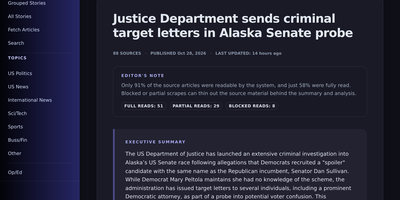
Reading the news should not mean opening twelve tabs about the same event, so MuckScraper folds every outlet's version into one story and shows you how the coverage differs. A scheduler fetches RSS feeds several times a day, with optional NewsAPI and GNews keys adding more sources, and each article is embedded and matched against recent stories so wire copies and follow-ups land together instead of flooding your feed. Every story carries a bias balance: how many left, center, and right outlets covered it, with each outlet rated from AllSides data or scored by the model where no rating exists. Local language models write the story summary and a deeper report comparing how each side frames the event, what is contested, and what nobody is mentioning, while guardrails reject cut-off summaries and figures that never appeared in the sources. Opinion columns stay in their own lane, linked to the stories they argue about and rounded up separately, never counted as news coverage. Twice a day the system publishes a balanced edition of twenty stories, and every past edition stays readable alongside full-text search across your whole archive. Reader, scraper, and admin roles decide who can simply read, who can trigger fetches, and who manages feeds, prompts, and users. Running on a dedicated VPS on RepoCloud with guaranteed CPU, RAM, and SSD, full root SSH access, and a browser serial console. MIT licensed.
B1Admin
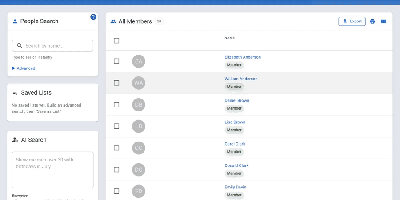
Churches run on spreadsheets and memory until B1Admin gives members, visitors, groups, attendance, and giving one shared home that the whole staff can trust. You keep detailed records on members and guests, follow up with visitors before they drift away, and coordinate small groups with their own rosters and communication. Sunday morning runs smoother with attendance tracking and a self check-in app, so families register children and members mark themselves present without a paper bottleneck at the door. Donations are tracked with detailed reports for the treasurer, online giving connects through Stripe, PayPal, or Kingdom Funding with recurring gifts and webhook-confirmed settlements, and custom forms collect registrations, signups, and requests without a separate forms tool. The same deployment serves your public website at the root, the admin dashboard for staff, a member portal where congregants manage their own information, and an API for integrations, all behind automatic HTTPS on one domain. Upgrades back up your data first, and because it is free and open source, a small church gets the same system as a large one. Running on a dedicated VPS on RepoCloud with guaranteed CPU, RAM, and SSD, full root SSH access, and a browser serial console. MIT licensed.
Solectrus
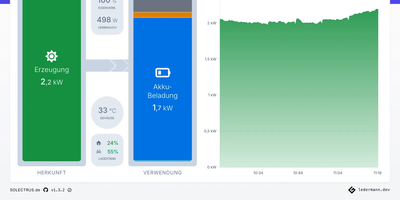
The inverter app tells you the sun shone; SOLECTRUS tells you what that sunshine was worth. It is a dashboard for your whole photovoltaic system that balances every watt: what the panels produced, what the house consumed, what the battery stored, and what crossed the grid meter in either direction, for any period you care to name. Up to five generators, from the main roof array to a balcony power plant, appear individually or summed, and up to twenty custom consumers, wallbox included, get their own accounting. The Power-Splitter shows how much green electricity actually landed in the car, the heat pump, or the washing machine, and what each load truly cost once lost feed-in revenue counts. Enter your electricity prices and feed-in tariff, including their changes over the years, and it computes savings, self-consumption costs, return, and the day the system has paid for itself from measured data rather than the sales brochure. Forecasts from pvnode, Solcast, or Forecast.Solar look up to seven days ahead using your location, orientation, tilt, and peak capacity. Heat pump owners see generated heat and coefficient of performance beside the power draw. Everything lands in InfluxDB and stays there, with daily aggregation keeping multi-year views fast, trends against last month or last year, and a Top-10 of your best and worst days. Running on a dedicated VPS on RepoCloud with guaranteed CPU, RAM, and SSD, full root SSH access, and a browser serial console. AGPL-3.0 licensed.
AKB
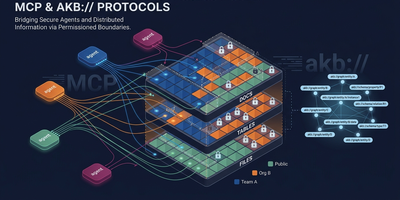
Achieving 98.4% Recall@5 on LongMemEval-S without a reranker, AKB is the agent-native knowledge infrastructure giving Claude Code, Cursor, Windsurf, and any MCP-aware agent persistent organizational memory — a drop-in replacement for Confluence or Notion where AI agents read and write directly rather than scraping human-formatted pages. Documents are stored as Markdown with YAML frontmatter in Git bare repositories (full version history, branching, diff), while PostgreSQL 16 serves as source of truth for chunk text, metadata, and BM25 vocabulary, with dense embeddings handled by a pluggable vector store (pgvector default, Qdrant optional, or managed Seahorse). Agents interact through 20+ MCP tools — akb_put, akb_search, akb_browse, akb_relations, akb_sql, akb_edit, akb_history — performing hybrid dense plus BM25 search fused via Reciprocal Rank Fusion in one call. The URI graph (depends_on, related_to, implements relations) lets agents traverse knowledge connections without external graph databases. Multi-tenant vault isolation is enforced at the PostgreSQL ACL level with per-user roles and SET LOCAL ROLE for SQL sandboxing. Event fanout streams structured events to Redis Streams for external consumers (synthesis bots, digest agents, audit trails), and a hash-chained append-only audit log integrates with enterprise SIEMs. Ships with agent plugins for Claude Code and Codex (session capture, wiki ingest, lifecycle hooks), Kubernetes kustomize manifests, and Open Knowledge Format export. Running on a dedicated VPS on RepoCloud with guaranteed CPU, RAM, and SSD, full root SSH access, and a browser serial console. BSL 1.1 licensed (free under 100 seats, auto-converts to Apache 2.0 after four years).
Basjoo
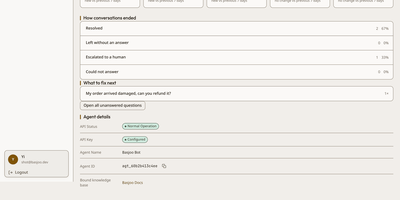
Support tickets that repeat the same twelve questions all week can answer themselves when Basjoo turns your website and documents into an embeddable AI support agent you host yourself. Knowledge bases are built independently of agents, fed by crawling a single page or an entire site, or by uploading PDF, Word, Excel, HTML, and text files that are parsed into searchable chunks. Visitors chat through a widget added with one script tag, in a floating bubble, inline frame, or iframe, and answers stream back with source citations so people can verify what the bot claimed. A curated question and answer index is matched before retrieval, which means correcting a wrong answer takes effect immediately without reindexing the whole collection, and a keyword fallback mode can answer matched questions with no model key at all. When a conversation needs a person, operators watching the live session wall can take over, reply with saved macros, release the chat back to the bot, or resolve it, with business hours deciding when the bot is off duty. Lead capture forms, an unanswered question queue that groups repeats into future answers, thumbs feedback rolled into analytics, and signed outbound webhooks for seven event types round out the operator side. Running on a dedicated VPS on RepoCloud with guaranteed CPU, RAM, and SSD, full root SSH access, and a browser serial console. MIT licensed.
KeiRouter
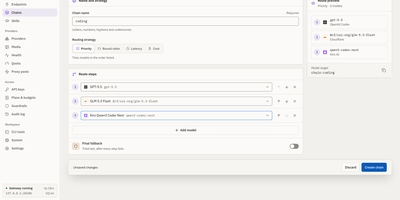
One endpoint, 130+ models from 90+ providers: KeiRouter is a self-hosted AI gateway, so apps, coding tools, and agents connect once and stop juggling provider keys. Your code speaks OpenAI Chat, OpenAI Responses, Anthropic Messages, or native Gemini, and KeiRouter translates to whichever upstream you want, including AWS Bedrock, Azure AI Foundry, Vertex, Snowflake Cortex, and self-hosted runtimes like Ollama and vLLM. Fallback chains keep requests moving when a provider goes down or hits a rate limit, using priority, round-robin, latency, or cost ordering, so coding sessions do not stop mid-task. Five token savers compress prompts on the way in and trim responses on the way out, with a live dashboard showing savings recovered. A response cache answers repeated prompts instantly for zero marginal cost, with optional semantic matching. Per-key budgets and rate plans set USD, token, RPM, and concurrency limits with auto-cutoff, stopping surprise bills. Guardrails scan for PII, prompt injection, toxicity, and banned topics at global, provider, model, chain, and key scopes, with a monitor showing what got blocked and what it cost. The dashboard tracks usage by provider and model, latency, a live console tracing each request through its fallbacks, and provider health. You can import from 9router or OmniRoute, white-label the portal for your team, and run replicas on Postgres and Redis for high availability. Running on a dedicated VPS on RepoCloud with guaranteed CPU, RAM, and SSD, full root SSH access, and a browser serial console. MIT licensed.
LAN Sheriff
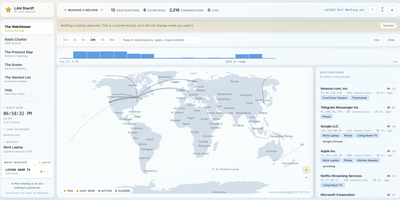
Self-hosted and account-free, LAN Sheriff watches where your devices send their traffic, plots each destination on a live world map, and flags anything that looks suspicious. Click a destination on the Watchtower for its country and city, owning organization, reverse DNS, protocol, port, byte counts, duration, and responsible app or device; filter by device, app, country, organization, or protocol, or scrub back through history. Radio Chatter streams the DNS lookups it can see, surfaces first-seen domains, and labels tracker, ad, telemetry, and malware domains without ever blocking them. The Precinct Map diagrams observed traffic, while the Roster inventories every device by IP, MAC, manufacturer, hostname, inferred type, and services, and alerts you when an unrecognized one joins. The Wanted List applies eight rules, including beaconing, machine-generated domains, port scans, plaintext credentials, and volume anomalies, and explains each finding in a plain sentence rather than a mystery score. Deputy Mode needs no privileges and names the application behind each connection, while Patrol Mode adds packet capture for DNS lookups and traffic volumes. Pair installations with a code to widen your view, export any view as CSV or JSON, and send alerts to webhook, ntfy, Discord, or Slack. Running on a dedicated VPS on RepoCloud with guaranteed CPU, RAM, and SSD, full root SSH access, and a browser serial console. AGPL-3.0 licensed.
Subatic
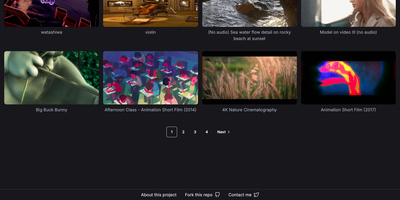
Your own video hosting site that behaves like the big platforms: upload a file, share a link, and anyone can press play. Subatic takes care of everything between those two moments. Drop in a raw video and the transcoding pipeline converts it into web-ready formats, stores the finished files in S3-compatible storage, and publishes a clean watch page with the title and an animated thumbnail that previews the content before a click. Playback streams directly from the storage bucket, so a Cloudflare R2 bucket with caching turns your little server into a video host whose delivery costs stay close to zero as views climb. A public homepage grid showcases your latest uploads with those moving thumbnails, and visitor counts can flow into Umami or Plausible if you want audience numbers without handing viewers to a third-party tracker. Creator accounts handle uploading, and one Docker Compose file brings up the whole stack: the app, the transcoder, MinIO for local object storage and PostgreSQL. A teacher can post course videos without platform rules, a band can share rehearsal footage, and a homelab can keep family clips on hardware in the closet. Running on a dedicated VPS on RepoCloud with guaranteed CPU, RAM, and SSD, full root SSH access, and a browser serial console. GPL-3.0 licensed.
Iso
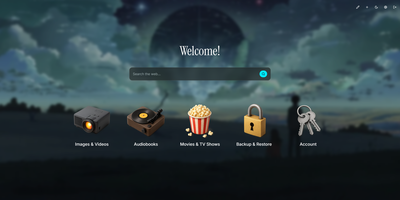
Drop a single container onto your host to launch Iso, a minimalist self-hosted startpage and service launcher that organizes every homelab web application behind a clean isometric icon grid and integrated search bar. No external database is required. Everything lives inside one human-readable JSON file or gets edited directly through the in-browser visual configuration modal. Add new service tiles in seconds, drag to reorder their display priority, and pick from a curated library of 3D isometric icons or upload custom graphics up to 25 megabytes. Switch instantly between built-in color palettes like Amethyst or upload a custom wallpaper with adjustable background blur and opacity sliders. A central search bar sits at the top of your startpage, routing queries directly to Google, DuckDuckGo, Startpage, Qwant, Searx, Bing, or any custom query URL template. Localize the interface into English, Spanish, French, or German with a single toggle. Custom greeting banners and optional page-load animations personalize the daily browsing experience for family members or lab users. Protect the dashboard and its visual editor behind shared password authentication configured via environment variables. Running on a dedicated VPS on RepoCloud with guaranteed CPU, RAM, and SSD, full root SSH access, and a browser serial console. MIT licensed.
Mixarr
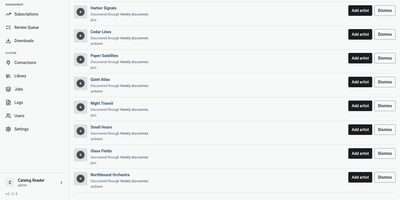
Your next favorite artist is probably already hiding in a playlist, chart, or listening history you never check. Mixarr pulls discovery sources from Spotify, TIDAL, Last.fm, ListenBrainz, Deezer, Discogs, Plex, Jellyfin, MusicBrainz, and Bandcamp into one compact catalog built for Lidarr users. Fifty-six subscription types cover playlists, charts, tags, recommendations, user libraries, and followed artists, each running on its own schedule while you get on with listening. Every discovery lands in a review queue where you preview, approve, or reject it, with clear outcomes distinguishing added, already present, failed, and identity-required results instead of silent shrugs. The artist inspector shows identity, library membership, source provenance, and release chronology without losing your place in the catalog. Its Collaboration Constellation draws an interactive graph of the musicians, producers, and engineers actually credited on records, so you can follow a session player from a rock album to a string quartet and send whoever you find straight to Lidarr. Optional AI recommendations from OpenAI, Anthropic, Gemini, or a local Ollama model analyze your library for what is missing, and library health tools repair missing metadata. One container carries the API, web interface, database, and cache to your server. Running on a dedicated VPS on RepoCloud with guaranteed CPU, RAM, and SSD, full root SSH access, and a browser serial console. GPL-3.0 licensed.
llamactl
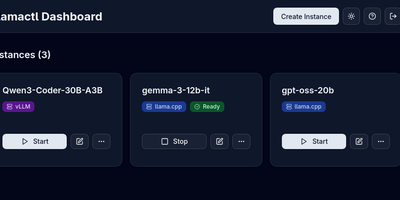
One dashboard and one API address for every local model you run, across llama.cpp, vLLM and MLX: that is llamactl. Create an instance in the web UI, pick a backend, and the server assigns ports and API keys, starts the model, and shows its health next to every other instance you run. Models download straight from HuggingFace inside the dashboard, in GGUF for llama.cpp or Safetensors for vLLM, so stocking a new model never means juggling command lines and file paths. Your applications keep talking to familiar endpoints, because llamactl exposes OpenAI chat completions and Anthropic messages routes and sends each request to the model named in the call. A llama.cpp router instance can serve several models from one process and load them on demand, and idle instances stop on a timer or make room through LRU eviction when the GPU gets crowded. Groups cap how many heavy models run at once, backends can live in Docker containers with GPU access, and instances on other machines appear in the same central dashboard with automatic routing. API keys minted in the UI guard both inference and management calls. Running on a dedicated VPS on RepoCloud with guaranteed CPU, RAM, and SSD, full root SSH access, and a browser serial console. MIT licensed.
Simon
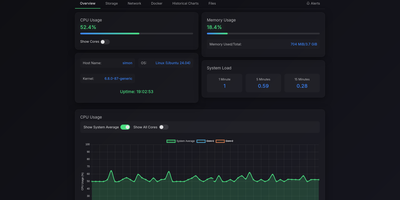
Simon is a lightweight self-hosted system monitor that shows live CPU, memory, disk, and network metrics for your server and its Docker containers in one web dashboard, with threshold alerts and a built-in file browser. Open the dashboard to watch real-time gauges alongside historical charts, so a slow memory leak becomes visible hours before it takes a service down. Every running container appears with its own CPU and memory stats, and its logs open in a searchable viewer, so routine diagnosis never needs a terminal session on the host. The file browser lets you navigate the directories you choose to expose, preview file contents, upload with drag and drop, create folders, and move or delete items. Downloads support range requests, which means large files resume cleanly after a dropped connection and media files stream instead of failing halfway. Alert rules fire when CPU, memory, disk, or network activity crosses thresholds you set, and notifications arrive through Telegram, ntfy, Gotify, Pushover, Pushbullet, Matrix, or any custom webhook. Prebuilt notification templates get common setups running in minutes, and password authentication keeps the dashboard private on a public server. Resource-constrained machines benefit most: the monitor runs comfortably on single-board computers and small instances where heavier monitoring stacks would consume the very memory they exist to watch. Running on a dedicated VPS on RepoCloud with guaranteed CPU, RAM, and SSD, full root SSH access, and a browser serial console. MIT licensed.
Maho
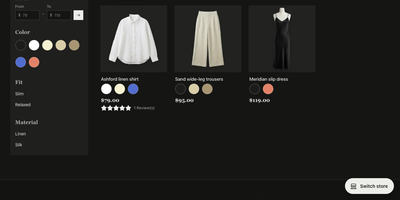
Sell from one storefront or eleven at once: Maho runs your whole shop, from the product grid shoppers browse to the admin grids where you run the business. Customers filter arrivals by price, color, size, fit, and material, open a product page with gallery, stock status, and reviews, and check out in one step with social login and saved cards. In the admin you build customer segments from lifetime value and last-order rules, shape Google Shopping feeds element by element in the XML builder, review revocation requests in a searchable grid, and set up gift cards with fixed amounts and lifetimes from the product tab. Eleven storefront themes come with a live theme editor, a drag-and-drop page builder, an image editor, and content versions, while marketing tools cover email automation, dynamic categories, and a blog. Multi-store setups run many websites, stores, and currencies from one installation, and payments span PayPal, Braintree, Mollie, Klarna, and more first-party modules. Running on a dedicated VPS on RepoCloud with guaranteed CPU, RAM, and SSD, full root SSH access, and a browser serial console. OSL-3.0 licensed.
LifeGLANCE
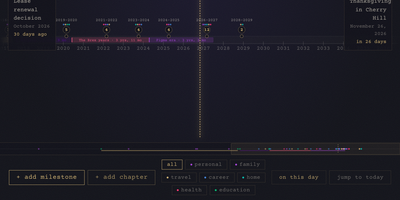
Birthdays, graduations, house moves, weddings, and the trip you keep promising yourself for next year all belong on the same line, and LifeGLANCE draws that line as one zoomable timeline of your life, past and future. Pan smoothly from a single week out to multiple decades, then zoom back in when a dense year needs room; cluster badges keep crowded stretches readable, and a minimap scrubbar jumps you across decades without endless scrolling. Each milestone carries a title, a date at day, month, or year precision, a category, a note, and a link, and you can attach photos, audio, and video directly to the moments they belong to. Birthdays and anniversaries repeat annually with an end year you set. Switch between All, Past, and Future views, search titles and notes in full text, or open On This Day to see what happened on this date in earlier years. A stats panel and summary modal turn the line into counts and patterns. Import calendar events from an ICS file, export the whole timeline as a high-resolution PNG, or back everything up and restore it as JSON. Running on a dedicated VPS on RepoCloud with guaranteed CPU, RAM, and SSD, full root SSH access, and a browser serial console. MIT licensed.
Atlantis Diagrams
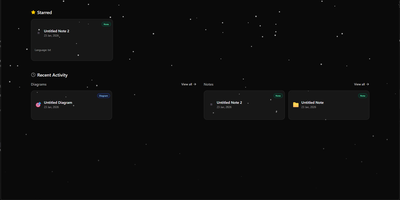
Technical teams frequently struggle to keep software architecture diagrams synchronized with evolving codebases and documentation repositories. Atlantis Diagrams delivers a unified self-hosted workspace that couples code-driven Mermaid.js diagramming with structured Markdown knowledge bases in a responsive web interface. Engineers can compose flowcharts, sequence diagrams, state machines, entity-relationship models, and Gantt schedules using split-view CodeMirror editors with real-time SVG rendering. An integrated version history tracker automatically captures revision checkpoints across the last 15 document states, letting authors compare modifications and restore previous iterations without data loss. The linked notes environment supports rich Markdown editing, LaTeX mathematical formulas, interactive task checklists, tag indexing, and full-text keyword searches across personal documentation libraries. Canvas controls allow users to pan, zoom, inspect individual nodes, and export finalized graphics directly into vector SVG, high-resolution PNG, or printable PDF documents. Storage engines adapt to deployment scale, running on zero-configuration SQLite databases out of the box with optional PostgreSQL, MySQL, and Redis caching layers for high-concurrency environments. Running on a dedicated VPS on RepoCloud with guaranteed CPU, RAM, and SSD, full root SSH access, and a browser serial console. MIT licensed.