Redmine
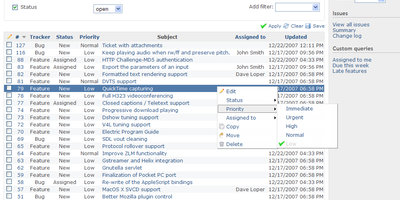
Nearly two decades running engineering organizations: Redmine is the veteran open-source project management and issue tracker, a Ruby on Rails application (GPLv2) still in active development. Its core strength is configurability: define your own trackers (bug, feature, task, or anything else), issue statuses, and role-based workflows that control exactly which transitions each role may perform, then extend records with custom fields of every type. Issues support subtasks, relations (blocks, precedes, duplicates), watchers, categories, and full journaled history, with saved custom queries and cross-project filtering for slicing the backlog any way you need. Around the tracker sit Gantt charts and calendars, a roadmap driven by versions, per-project wikis, forums, news, and document repositories, plus time tracking with estimated versus spent hours and activity-based reporting. Multi-project support runs deep - subprojects, per-project modules, and granular role-based permissions - and repository integration (Git, Subversion, Mercurial) links commits to issues automatically. Email notifications, inbound email-to-issue creation, LDAP authentication, a REST API, and a large plugin and theme ecosystem round it out. Recent 6.x releases brought substantial query and rendering optimizations. Self-hosting keeps your entire project history in your own database, free of per-seat licensing.
MantisBT
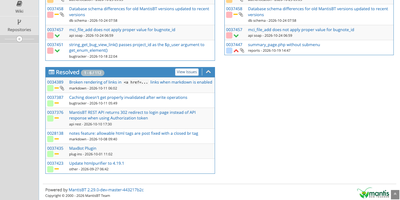
Every bug a team finds, from the first report to the day it is marked resolved, lives in one shared list in MantisBT, an open-source issue tracker. Reporters file issues with a summary, steps to reproduce, severity, and attachments, and email notifications reach the reporter, the handler, monitors, and note authors. Six access levels, from viewer to administrator, can be overridden project by project, and private projects stay hidden from users below the configured level. Administrators define their own status values, workflow transitions, and custom fields. Sub-projects inherit versions and categories from their parents, and issues link as related, parent and child, or duplicates. @mentions pull colleagues into a discussion, tags group related work, and a chronological history records who changed what. Triage works from stored and shared filters, the My View page, and summary charts, while a roadmap and changelog track what each version contains. Reporting comes through CSV and Excel export, optional time tracking with billing totals, and RSS feeds. Sign-in can use LDAP or Active Directory, scripts reach the tracker through REST and SOAP APIs, plugins extend the interface, and 50 languages are included. Running on a dedicated VPS on RepoCloud with guaranteed CPU, RAM, and SSD, full root SSH access, and a browser serial console. GPL-2.0-or-later licensed.