GO Feature Flag
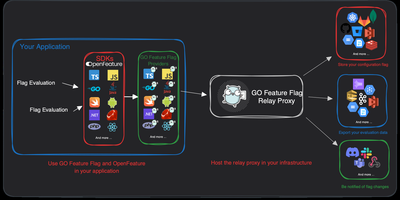
Release a feature to five percent of users today, everyone on Friday, and only beta testers in between, all by editing one file: that is the job GO Feature Flag does for your applications. Flags live in a YAML, JSON, or TOML configuration you store in Git, S3, Kubernetes, or any retriever you already trust, and a lightweight relay proxy serves evaluations to every service through the standard OpenFeature SDKs in many languages. Targeting rules aim flags at specific users, segments, or contexts, progressive rollouts raise percentages on a schedule, experimentation splits traffic for A/B tests, and scheduled changes flip flags while the team sleeps. Every evaluation can be exported to files, S3, Google Cloud Storage, or Kafka for analysis, and webhook or Slack notifiers announce the moment a flag changes. Because the data plane is your proxy and your file, any language your stack speaks, from mobile apps to backends, evaluates the same flags with identity, variation, and rollout logic decided centrally. Running on a dedicated VPS on RepoCloud with guaranteed CPU, RAM, and SSD, full root SSH access, and a browser serial console. MIT licensed.

Flagsmith
With over 6,400 GitHub stars, 130 contributors, and 512 releases, Flagsmith is the open-source feature flag and remote configuration platform that gives development teams granular control over feature releases, remote configuration values, user segmentation, and A/B testing from a single self-hosted dashboard. Feature flags support boolean toggles and remote config values simultaneously — every flag carries both an enabled state and a configurable value, letting teams deploy functional and visual changes without code modifications or app store approvals. User segments target audiences by attributes, percentage rollouts, and custom rules, enabling beta testing, canary releases, and gradual feature rollouts with real-time toggle control. Multivariate flags split traffic across multiple variations with configurable percentage weights for A/B and multivariate testing with analytics integration. The flag evaluation engine runs server-side with local evaluation mode in SDKs for sub-millisecond performance without network calls, supporting 15+ languages including TypeScript, Python, Java, C#/.NET, Go, Ruby, PHP, Swift, Kotlin, Flutter, React, and Next.js. The REST API and webhooks enable integration with CI/CD pipelines, and pre-built connectors exist for Datadog, New Relic, Amplitude, Mixpanel, Segment, Heap, Rudderstack, and Slack. Built on Django with a React frontend, self-hosting deploys via Docker Compose with PostgreSQL, or via Helm charts and the OpenShift Operator for Kubernetes environments. Change history provides a complete audit trail of flag modifications. Running on a dedicated VPS on RepoCloud with guaranteed CPU, RAM, and SSD, full root SSH access, and a browser serial console. BSD-3-Clause licensed.