FalkorDB
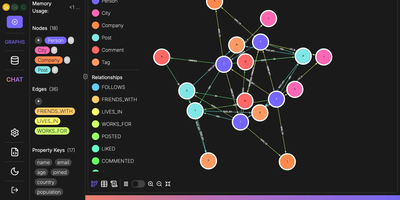
FalkorDB is the first queryable property graph database to leverage sparse adjacency matrices and linear algebra for graph traversal, replacing traditional pointer-chasing with GraphBLAS-accelerated computation. Originally the RedisGraph engine, it was relaunched as FalkorDB in 2023 and rewritten from C to Rust in 2026 for improved memory safety and performance. The database supports the OpenCypher query language with proprietary extensions, translating queries into linear algebra expressions that exploit AVX hardware acceleration. Indexing options include full-text search, vector similarity for embedding-based retrieval, and range indexing, while connectivity supports both the RESP protocol for Redis clients and the Bolt protocol for Neo4j-compatible tooling. The GraphRAG SDK enables ingestion of documents in text, PDF, and Markdown formats into knowledge graphs, with schema-guided entity extraction, hybrid retrieval combining vector and graph traversal, relationship expansion, and cited answers for LLM applications. Official client libraries cover Python, Node.js, Java, Rust, Go, PHP, and C#. Multi-tenant support handles over 10,000 concurrent graphs with zero overhead and full isolation. Docker deployment runs the falkordb/falkordb image on ports 6379 for the database server and 3000 for the built-in browser UI, with persistent volume storage and optional authentication. A production falkordb-server image excludes the browser for lighter deployments. On RepoCloud, deploy FalkorDB on a dedicated VPS with root SSH access, persistent storage for your graph data, and complete control over authentication, thread count, and memory configuration, all under the SSPLv1 license.
Dgraph
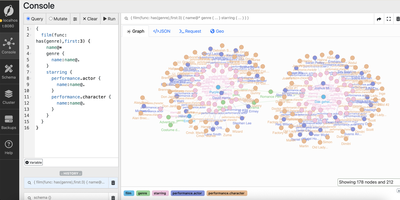
Dgraph is a distributed graph database that answers connected-data questions, such as who follows whom or which parts depend on which suppliers, in a single query instead of a pile of joins. Describe your data in a GraphQL schema and Dgraph generates a GraphQL API with its graph backend, or write DQL, the native query language, for deeper traversals. Indexes handle full-text search, regular expressions, and geo queries, and vector indexes add similarity search over embeddings. Transactions stay ACID across the cluster, replication is consistent, and data shards rebalance themselves as the dataset grows. Ratel, the companion web IDE, runs queries and mutations, draws results as a graph, edits the schema, lists cluster nodes, and manages backups. Bulk Loader fills a new cluster with large datasets, while Live Loader adds or upserts records into a running one. Access control lists and namespaces keep tenants apart within one cluster. It suits data spread across more than ten tables linked by foreign keys, sparse records that fit poorly in SQL, and schemas that must stay simple to read and change. Running on a dedicated VPS on RepoCloud with guaranteed CPU, RAM, and SSD, full root SSH access, and a browser serial console. Apache-2.0 licensed.
Neo4j
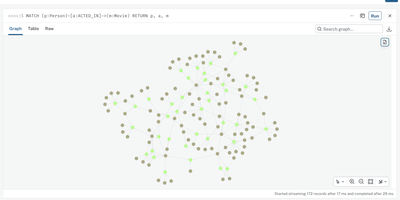
Some questions are really about how things connect, and Neo4j is the graph database that stores your data as nodes and relationships so those connections become the thing you query. Model people, products, accounts, devices, or transactions as labeled nodes with properties, then draw typed, directed relationships between them and traverse multi-hop paths in a single Cypher query instead of stacking SQL joins. The built-in Neo4j Browser renders query results as interactive node diagrams, so you can expand a fraud ring, a dependency chain, or a recommendation neighborhood visually and share the picture with your team. Cypher reads like the picture it queries: MATCH patterns describe shapes in the graph, filters narrow them, and aggregations roll up counts, sums, and shortest paths. Store embeddings as node properties and build vector indexes over them, then combine similarity search with graph traversal so matches can be filtered by owner, connections, or freshness. Full-text indexes search names, descriptions, and documents, while uniqueness constraints keep identifiers honest at write time. Bulk-load millions of nodes from CSV files with the offline import tool, then keep data flowing in through official drivers for Python, JavaScript, Java, Go, and .NET applications. Fraud teams trace shared phones and cards between accounts, platform teams map microservice dependencies before a migration, and security analysts hunt lateral movement through identity graphs. Running on a dedicated VPS on RepoCloud with guaranteed CPU, RAM, and SSD, full root SSH access, and a browser serial console. GPL-3.0 licensed.