Unleash
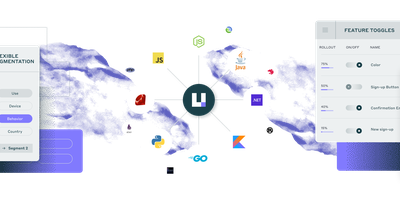
Deployment decoupled from release: Unleash, the most popular open-source feature management platform on GitHub, is a Node.js server backed by PostgreSQL. Ship code dark, then control who sees it through activation strategies: gradual percentage rollouts, targeting by user ID, IP, hostname, or application name, custom constraints against your own context fields, and scheduled or time-limited releases. Strategies stack - a flag activates if any strategy matches - and strategy variants layer A/B versions on top of the on/off decision. Each flag carries per-environment configurations, so a feature can run at 100% in staging while canarying at 5% in production. Backend SDKs (Node.js, Java, Go, Python, Ruby, .NET, PHP, Rust, and more) fetch configuration and evaluate flags locally, so a flag check adds zero network latency to request paths; frontend SDKs for React, Vue, Svelte, iOS, Android, and Flutter evaluate through a proxy layer. Flag hygiene is built in: flags are typed (release, experiment, operational, kill-switch, permission) with expected lifetimes, and Unleash marks overdue flags as potentially stale and surfaces unknown flags your SDKs request but that don't exist. Self-hosting via Docker keeps flag data, targeting rules, and evaluation infrastructure entirely on your side.

Flagsmith
With over 6,400 GitHub stars, 130 contributors, and 512 releases, Flagsmith is the open-source feature flag and remote configuration platform that gives development teams granular control over feature releases, remote configuration values, user segmentation, and A/B testing from a single self-hosted dashboard. Feature flags support boolean toggles and remote config values simultaneously — every flag carries both an enabled state and a configurable value, letting teams deploy functional and visual changes without code modifications or app store approvals. User segments target audiences by attributes, percentage rollouts, and custom rules, enabling beta testing, canary releases, and gradual feature rollouts with real-time toggle control. Multivariate flags split traffic across multiple variations with configurable percentage weights for A/B and multivariate testing with analytics integration. The flag evaluation engine runs server-side with local evaluation mode in SDKs for sub-millisecond performance without network calls, supporting 15+ languages including TypeScript, Python, Java, C#/.NET, Go, Ruby, PHP, Swift, Kotlin, Flutter, React, and Next.js. The REST API and webhooks enable integration with CI/CD pipelines, and pre-built connectors exist for Datadog, New Relic, Amplitude, Mixpanel, Segment, Heap, Rudderstack, and Slack. Built on Django with a React frontend, self-hosting deploys via Docker Compose with PostgreSQL, or via Helm charts and the OpenShift Operator for Kubernetes environments. Change history provides a complete audit trail of flag modifications. Running on a dedicated VPS on RepoCloud with guaranteed CPU, RAM, and SSD, full root SSH access, and a browser serial console. BSD-3-Clause licensed.
GrowthBook
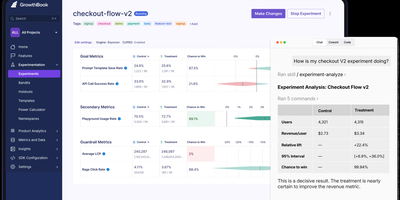
Used by over 3,000 organizations including Dropbox, Khan Academy, Sony, Pepsi, Wikipedia, and Mistral, GrowthBook is the open-source experimentation platform that handles over 100 billion feature flag evaluations daily across its cloud and self-hosted deployments. Feature flags support advanced targeting with user attributes, gradual percentage rollouts, prerequisite dependencies, and scheduled launches, with both client and server SDKs evaluating flags locally from a cached payload for sub-millisecond performance with zero network calls per check. The warehouse-native architecture queries experiment results directly from 11 data sources including BigQuery, Snowflake, Databricks, Redshift, ClickHouse, Mixpanel, and PostgreSQL, eliminating duplicate data pipelines. The statistics engine implements CUPED variance reduction, sequential testing, Bayesian analysis, post-stratification, multi-armed bandits, and sample ratio mismatch checks with fully open-source methodology. Product analytics provides dashboards with funnels, retention cohorts, and event-based tracking shareable across teams. Twenty-four SDKs cover React, Next.js, Node.js, Python, Go, Ruby, PHP, Java/Kotlin, Swift, C#/.NET, Rust, Elixir, Angular, and edge runtimes including Cloudflare Workers, Fastly Compute, and Lambda@Edge. The MCP server and REST API enable AI coding agents to create features, start experiments, and manage stale flags programmatically. Self-hosting deploys via Docker Compose with MongoDB, or via Helm charts on Kubernetes, with the same codebase powering both open-source and managed cloud offerings. Running on a dedicated VPS on RepoCloud with guaranteed CPU, RAM, and SSD, full root SSH access, and a browser serial console. MIT licensed.
FeatBit
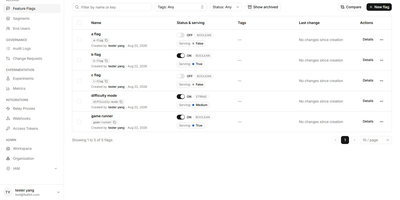
Engineering and product teams ship code to production daily with FeatBit, an enterprise feature flag and experimentation platform that controls exactly which user segments, regions, or percentage rollouts see each new capability. When a regression appears in production, operators toggle an instant kill switch, dial back canary weights from full traffic to one percent, or restrict access to internal QA accounts without redeploying containers. Reusable user segments group customers by subscription tier, device property, or custom attributes for consistent targeting across environments. Server-side and client-side SDKs for .NET, Java, Go, Python, Node.js, React, React Native, JavaScript, and OpenFeature synchronize flag states over WebSockets in under 100 milliseconds and evaluate rules locally in memory. Built-in A/B/n experimentation links flag variations to custom conversion events, click tracking, and pageview metrics so teams can validate product hypotheses with live telemetry. Scheduled rollouts, multi-step approval workflows, flag triggers, and webhook integrations with Slack, Datadog, Grafana, New Relic, and OpenTelemetry keep release operations auditable. Role-based access control and single sign-on govern every flag change. Running on a dedicated VPS on RepoCloud with guaranteed CPU, RAM, and SSD, full root SSH access, and a browser serial console. MIT licensed.