Mailflow
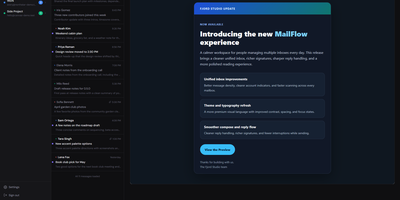
Mailflow gathers every mailbox you own, the work account, the personal one, and the address stranded at a provider you left years ago, into one unified inbox hosted on your own server. All accounts merge into a single stream sorted by date, then sort themselves into Primary, Newsletters, Social, Notifications, and Other tabs, with a reclassify button for the ones that land wrong. Conversations group into threads, one click unsubscribes from detected newsletters, and full-text search reaches across every connected account at once. Writing mail gets a proper editor with formatting, tables, emoji, attachments, and smart address completion that learns from what you send, while inbox rules and a block list quietly move, archive, star, or trash messages by sender, subject, or content before you ever see them. New mail arrives with real-time toasts and push notifications, the interface installs as an app, speaks eleven languages, and can be reshaped with layouts, themes, and your own CSS. Accounts stay protected with two-factor authentication and single sign-on, contacts sync out over CardDAV, and an optional AI assistant can summarize a thread or draft the reply you are avoiding. Running on a dedicated VPS on RepoCloud with guaranteed CPU, RAM, and SSD, full root SSH access, and a browser serial console. AGPL-3.0 licensed.
Zero Email
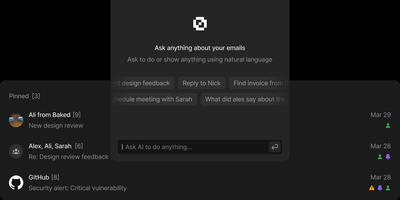
Zero unifies Gmail, Outlook, and IMAP accounts into a single AI-enhanced inbox with keyboard-driven navigation that matches premium email clients in speed. Backed by 10,000+ stars and positioned as the alternative to Superhuman, it keeps your email data in your own PostgreSQL database while LLM agents handle categorization, priority sorting, draft composition, and natural language mailbox queries. You choose whether models run locally or through cloud providers you control. The Next.js and React interface delivers customizable keyboard shortcuts for every action: reading, archiving, labeling, composing. A WorkflowEngine defines automated multi-step rules including label application, bulk archiving, and conditional routing based on sender, subject, or content analysis. Built on Drizzle ORM with Better Auth handling Google OAuth, styled with TailwindCSS and Shadcn UI components, the interface is polished without being bloated. MCP integration exposes email management tools to external AI assistants for programmatic inbox control through standardized protocols. The Nizzy CLI handles environment configuration, database synchronization, and development server orchestration. Deploys via Docker Compose with a single database initialization command. Running on a dedicated VPS on RepoCloud with guaranteed CPU, RAM, and SSD, full root SSH access, and a browser serial console. MIT licensed.
Talo
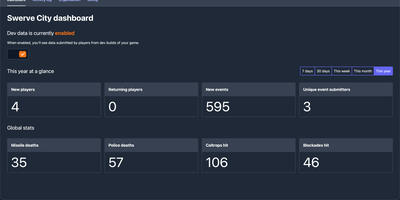
Shipping a game is hard enough without also building account systems, and Talo is the self-hosted backend that gives your Godot or Unity title player authentication, leaderboards, cloud saves, and analytics on infrastructure you control. Players persist across sessions with segments you define, so you can group testers, whales, or speedrunners and treat each group differently. Leaderboards sort ascending or descending, refresh on daily or weekly schedules, hide suspicious entries from the dashboard, and sync with Steamworks in one click. Event tracking records individual and global player actions, and the dashboard turns that stream into charts you can filter by group when a balance patch lands badly. Game saves load and store flexible state that also works offline, while global and per-player stats track everything from completions to currency earned. Live config lets you tune game settings from the web and push changes to running games with zero downtime. Channels carry real-time messages between subscribed players, presence shows who is online with custom statuses, and relationships add friends and followers when your game grows social. Steamworks, Google Play Games, and Apple Game Center integrations verify ownership and authenticate players through the platforms they already use. Running on a dedicated VPS on RepoCloud with guaranteed CPU, RAM, and SSD, full root SSH access, and a browser serial console. MIT licensed.
II-Agent
II-Agent is an autonomous AI agent platform that ranked first on the GAIA benchmark by combining multi-step task planning with a full-stack execution environment spanning research, coding, browsing, and content creation. The platform runs a React frontend on port 1420 backed by FastAPI on port 8000, with PostgreSQL for persistence, Redis for task queuing, and MinIO for S3-compatible file storage, all deployable via Docker Compose. Users switch between Anthropic Claude, OpenAI GPT, and Google Gemini mid-conversation using bring-your-own-key authentication. Task domains include deep research with source triangulation, website and mobile app generation from prompts, storybook creation with illustrations, video and image generation via Google Veo and Imagen, presentation building with live collaborative editing, and document manipulation covering PDF extraction, Excel formulas, Word editing, and PowerPoint creation. Built-in connectors integrate Gmail, Slack, GitHub, Notion, Google Calendar, Discord, Dropbox, and Canva for workflow automation. A sandboxed code interpreter runs Python while browser automation with vision capabilities handles web interactions. Custom skills let teams package and reuse workflows. Context management handles up to 120,000 tokens with intelligent window sizing. 3,400+ GitHub stars. Apache-2.0 licensed.
DispatchMail
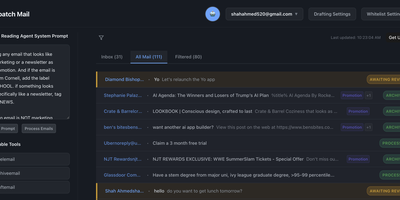
DispatchMail is an SuperHuman alternative and delivers a self-hosted AI email assistant that processes your Gmail inbox through configurable OpenAI prompts without sending data to third-party cloud services beyond the LLM API itself. The Flask backend connects to Gmail via IMAP, retrieves new messages according to your schedule, and routes them through customizable whitelist rules based on sender address, subject keywords, or natural language descriptions before AI processing begins. Two distinct prompt configurations control behavior — the Reading Prompt instructs how the AI should analyze and classify incoming messages, while the Draft Prompt defines how responses should be composed, letting you maintain consistent tone and policy across all automated replies. Whitelist filtering ensures the AI only processes messages you explicitly authorize, preventing unnecessary API costs and keeping sensitive emails out of the LLM pipeline entirely. The React web interface provides inbox management with message previews, AI-generated summaries, draft editing with human-in-the-loop approval before sending, and configuration panels for prompts and rules. Automatic labeling and archival organize processed messages into categories without manual intervention. The sender research feature uses LLM-powered deep analysis to build background profiles of email contacts. All email content, credentials, and processing results persist in a local SQLite database with zero cloud storage dependencies. Running on a dedicated VPS on RepoCloud with guaranteed CPU, RAM, and SSD, full root SSH access, and a browser serial console. Apache-2.0 licensed.