SwarmClaw
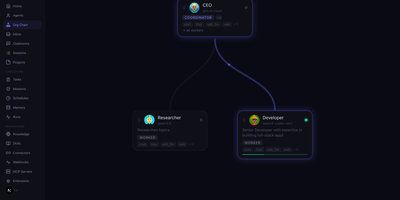
Running a single AI agent is straightforward; running a team of specialized agents that delegate tasks, share memory, and coordinate through structured workflows requires an orchestration layer, and that is exactly what SwarmClaw provides. Define a hierarchy of agents in an org chart where a Coordinator (your CEO agent) delegates research tasks to a Researcher, coding tasks to a Developer, and design tasks to a Designer, each configured with its own LLM provider, tool permissions, and skill set. The Task Board presents a Kanban view of all work items across Backlog, Queued, Running, and Completed columns, with each task card showing its assigned agent, tags, due dates, and approval gates that pause execution until a human reviews and approves. Agents execute work using built-in tools for file operations, shell commands, browser automation, and persistent memory, plus any MCP server you connect via stdio, SSE, or streamable HTTP transport. Durable structured sessions support branching logic, repeat loops, parallel branches with explicit joins, and restart-safe run state that survives crashes without losing progress. Over 23 LLM providers ship built-in: Claude Code CLI, OpenAI, Anthropic, Google Gemini, DeepSeek, Groq, Mistral, xAI Grok, Fireworks, Ollama, and more. Connectors push messages to Discord, Slack, and Telegram, while cron schedules and webhooks trigger agent runs automatically. Running on a dedicated VPS on RepoCloud with guaranteed CPU, RAM, and SSD, full root SSH access, and a browser serial console. MIT licensed.
Letta
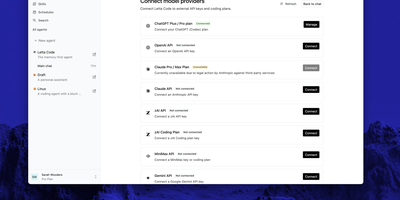
With over 24,000 GitHub stars and origins in the MemGPT research paper on virtual context management, Letta has evolved into the leading open-source platform for building AI agents that maintain persistent memory, identity, and continuity across sessions rather than operating as stateless prompt-response loops. The core architecture uses memory blocks — structured, labeled text chunks that reside permanently in the agent's context window — allowing agents to programmatically rewrite their own memory, learn new skills, and improve through a sleeptime dreaming process that runs reflection and memory organization during idle periods. The self-hosted App Server deploys via Docker and exposes a WebSocket API on port 4500, letting the TypeScript Agent SDK connect from any application using local, remote, or cloud backends. Agents support git-versioned memory through MemFS where every memory change is tracked and auditable, multi-agent communication via subagents, scheduled tasks, and integration with messaging platforms including Slack, Discord, Telegram, WhatsApp, and Signal. The platform is fully model-agnostic, routing to OpenAI, Anthropic, xAI, or self-hosted open-weight models through Ollama depending on cost, performance, and data residency requirements. The Agent File format serializes complete agent state — memory, skills, prompts, and conversation history — into portable snapshots. Desktop applications for macOS, Windows, and Linux provide native interfaces alongside the terminal CLI and web chat at chat.letta.com. Running on a dedicated VPS on RepoCloud with guaranteed CPU, RAM, and SSD, full root SSH access, and a browser serial console. Apache-2.0 licensed.
Dify
Dify turns the notoriously complex process of building production-grade AI applications into a visual drag-and-drop experience that teams can actually ship and maintain. With over 87,000 GitHub stars and backing from prominent investors, the platform has become the go-to open-source LLMOps solution for organizations that refuse to be locked into proprietary AI stacks. The visual workflow canvas lets developers wire together LLM calls, conditional logic, iteration loops, tool invocations, and human-in-the-loop checkpoints without writing boilerplate integration code. Its RAG pipeline engine handles the full document lifecycle from ingestion of PDFs, Word documents, and HTML through configurable chunking strategies, embedding with models from OpenAI or open-source alternatives, vector storage in Weaviate, Qdrant, Pinecone, or pgvector, and hybrid semantic-plus-keyword retrieval with citation tracking. Dify integrates with hundreds of model providers including OpenAI GPT-4o, Anthropic Claude, Google Gemini, Mistral, Llama, and any OpenAI-compatible endpoint like Ollama for fully local inference. The agent framework supports both ReAct and function-calling strategies with 50-plus built-in tools spanning Google Search, DALL-E, Stable Diffusion, WolframAlpha, and custom API definitions. Published apps can be deployed as hosted web interfaces, embedded chat widgets, REST API endpoints, or MCP-compatible tools. Enterprise features include role-based access control, SSO integration, and audit logging. A built-in marketplace enables teams to share and reuse model providers, tools, and workflow templates across projects. Running on a dedicated VPS on RepoCloud with guaranteed CPU, RAM, and SSD, full root SSH access, and a browser serial console. Apache 2.0 licensed with an open-source community edition.