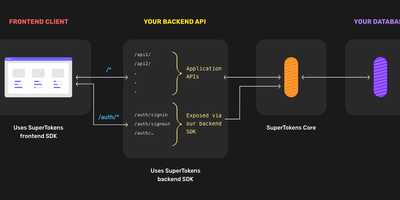
Supertokens Core
Authentication that lives inside your application rather than behind a redirect to an external identity provider - SuperTokens takes a fundamentally different architecture from Auth0 and AWS Cognito. Three tiers make that work - frontend SDKs (React, Angular, Vue, vanilla JS, React Native) render overridable login UI and manage tokens; backend SDKs (Node.js, Python, Go) expose auth endpoints on your own API domain; and SuperTokens Core, the piece you host here, is the stateless HTTP service handling core auth logic, password hashing, token signing, and database operations against PostgreSQL. The recipe system keeps features decoupled: use email/password, social login, passwordless (magic links, OTP), phone-password, multi-factor authentication (TOTP, WebAuthn), user roles, and microservice auth - individually or combined; you can even use SuperTokens purely for session management alongside another login provider. Sessions are where it shines: rotating refresh tokens with theft detection, automatic access-token refresh, CSRF protection, and secure cookie handling out of the box - the details that become vulnerabilities when hand-rolled. Verification happens locally in your backend via cached JWT signing keys, so the Core stays off the hot path. Self-hosted means no user limits, free forever, with all user data in your database. Apache-licensed.
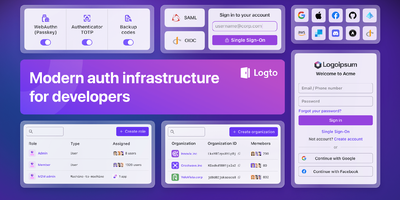
Logto
With over 14,000 GitHub stars, 1 million managed identities on Logto Cloud, and continuous releases through version 1.42.0 in July 2026, Logto has emerged as the most credible open-source alternative to Auth0, Clerk, and AWS Cognito by packaging OIDC, OAuth 2.1, enterprise SSO, multi-tenancy, and RBAC into a single MPL-2.0 codebase that self-hosts for free with no per-MAU pricing surprises. Every Logto tenant operates as a fully compliant OpenID Provider supporting PKCE-only public clients, DPoP token binding, and RFC 9068 JWT access tokens. Pre-built sign-in flows handle email, phone, social login via Google, Facebook, Azure AD, and dozens of connectors, passkey authentication, and multi-factor verification through TOTP and WebAuthn. Organizations enable first-class multi-tenancy where users belong to multiple tenants with per-organization RBAC scopes on API resources. Enterprise SSO connects to Okta, Entra ID, and any SAML or OIDC identity provider. SDKs for over 30 frameworks including React, Next.js, Angular, Vue, Flutter, Go, and Python integrate authentication into SPAs, web apps, mobile apps, APIs, machine-to-machine, and CLI tools. The admin console provides user management, audit logs, webhook event subscriptions, and custom domain configuration. Personal Access Tokens and token exchange support AI agent architectures and MCP server authentication. Running on a dedicated VPS on RepoCloud with guaranteed CPU, RAM, and SSD, full root SSH access, and a browser serial console. MPL-2.0 licensed.
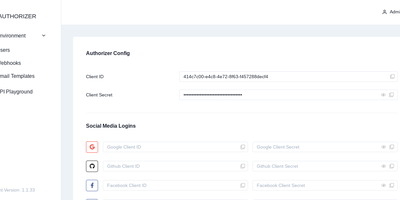
Authorizer
Your users belong in your own database - Authorizer, an open-source authentication and authorization server shipping as a single Go binary, keeps them there. It connects to 13+ backends - PostgreSQL, MySQL, SQLite, SQL Server, MariaDB, MongoDB, Cassandra, ScyllaDB, ArangoDB, DynamoDB, Couchbase, YugabyteDB, PlanetScale, and CockroachDB - so identity data lives beside the application it protects instead of in an auth vendor's cloud. The server is fully OAuth 2.0 and OpenID Connect compliant, including authorization code flow with PKCE, a JWKS endpoint, token revocation, and nine JWT signing algorithms. Login options cover email/password, magic links, TOTP multi-factor, SMS OTP via Twilio, and social providers including Google, GitHub, Apple, Microsoft, and Discord. Authorization goes beyond roles: an embedded OpenFGA engine provides Zanzibar-style relationship-based permission checks in process. APIs are exposed over GraphQL, REST, and gRPC, with SDKs for JavaScript, React, Go, and Python, plus themeable built-in login pages and an admin dashboard. Apache 2.0 licensed.
Hanko
Backed by 9,000+ GitHub stars and developed by a Germany-based team with deep FIDO2 expertise, Hanko delivers the open-source authentication platform that replaces Auth0, Clerk, and Firebase Auth with a passkey-first architecture built on phishing-resistant WebAuthn credentials. The Go backend exposes both public and administrative HTTP APIs handling passkey registration and login, password authentication, email passcodes, TOTP-based MFA, security key verification, server-side sessions with remote revocation, and JWT issuing with configurable expiry and refresh policies. OAuth SSO connects Apple, Google, GitHub, Microsoft, and custom OIDC providers, while SAML Enterprise SSO integrates corporate identity providers for single sign-on across the organization. Hanko Elements provides framework-agnostic web components that embed complete onboarding, login, and user profile flows into any application with two lines of code, fully customizable via CSS variables and supporting i18n with custom translations. The JavaScript frontend SDK handles API communication, credential management, and session state for teams building custom authentication UIs without the pre-built components. Webhooks notify external services of authentication events including user creation, login, email verification, and password changes. Privacy-first design principles enforce data minimalism with user-deletable passwords and configurable identifier strategies supporting email-only, username-only, or combined approaches. Docker deployment starts the backend with PostgreSQL or MySQL, serving both APIs on configurable ports. Running on a dedicated VPS on RepoCloud with guaranteed CPU, RAM, and SSD, full root SSH access, and a browser serial console. AGPL-3.0 (backend) / MIT (frontend) licensed.