Velociraptor
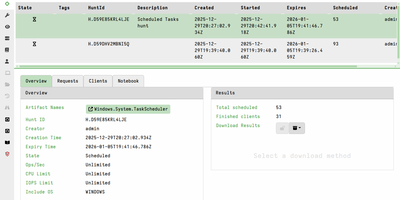
Hunting for a suspicious file, process, or registry key across every endpoint becomes a single hunt in Velociraptor, an endpoint visibility and digital forensics platform. A web console sends tasks to clients on Windows, Linux, and macOS machines, which hold a persistent connection and run each task as soon as it is issued. A hunt runs a VQL artifact, one of more than 400 built in, across selected endpoints, picks up machines that reconnect later, and tracks which hosts have answered. Each hunt and collection opens into a notebook where markdown and live VQL cells group, filter, and timeline the results. A virtual file system browses a client's directories and fetches files through file, NTFS, and registry accessors, with hex and text viewers. Offline collectors bundle chosen artifacts into one binary that writes an optionally encrypted container for later import, suiting machines that never reach the server. Client event queries stream telemetry such as DNS lookups to the server, and server event queries can alert Slack, email, Elastic, or Splunk. Quarantine confines a host's network traffic to the Velociraptor server, and the Shell page runs commands on it. Sign-in works through Google, Azure, GitHub, OIDC, or SAML, with reader, analyst, investigator, and administrator roles. Responders reach for it during threat hunts, compromised host triage with KapeFiles targets, and dead disk image analysis. Running on a dedicated VPS on RepoCloud with guaranteed CPU, RAM, and SSD, full root SSH access, and a browser serial console. AGPL-3.0 licensed.
Deploy