Cadence Workflow
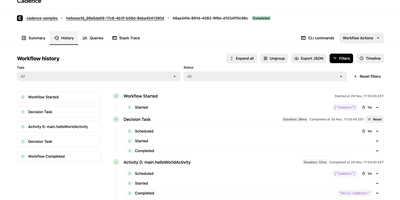
An order that waits days for a payment or a manager's approval survives crashes, restarts, and deployments in Cadence, a workflow engine that resumes each process exactly where it stopped. Developers write the order's logic as ordinary Go or Java code. The engine records every step in an event history and replays it to rebuild state on any worker. Activities send the emails, call the APIs, and write the database rows, each with its own retry policy, timeout, and heartbeat. A durable timer waits seconds or months without holding a thread, a cron schedule launches recurring runs, and a signal delivers the payment confirmation into the running workflow. Queries read its state without changing it, child workflows split big processes into reusable parts, and versioning allows code changes while older executions are still in flight. Domains separate teams and applications, task lists carry their own rate limits and priorities, global domains replicate across clusters and fail over between them, and archival retains closed histories. Cadence Web finds executions with SQL-like queries, lays out event history as a grouped table or a timeline, and exposes payloads, pending activities, and stack traces. It can start, reset, signal, cancel, or terminate runs, with batch actions for thousands of workflows at once. Running on a dedicated VPS on RepoCloud with guaranteed CPU, RAM, and SSD, full root SSH access, and a browser serial console. Apache-2.0 licensed.
Temporal
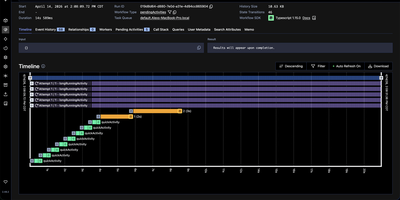
Powering mission-critical infrastructure at OpenAI, Cursor, Replit, Lovable, Retool, and Snap with over 22,000 GitHub stars, Temporal is the durable execution platform that originated from Uber's Cadence project — built by the creators of AWS SQS, AWS SWF, and Azure Durable Functions with nine years of production-proven reliability. The workflow-as-code model lets developers write business logic in Go, Java, Python, TypeScript, .NET, PHP, or Ruby using native SDKs, while the Temporal Server automatically persists state at every step, replays from failures, retries activities with configurable backoff policies, and manages task queues without developers writing reconciliation logic. Workflows support signals for external event injection, timers for scheduled delays, child workflows for decomposition, and queries for real-time state inspection — all backed by deterministic replay over an event-sourced history that guarantees exactly-once semantics. The Web UI provides visual workflow execution inspection with event timelines, pending activity monitoring, namespace management, and worker health dashboards. Persistence supports PostgreSQL, MySQL, or Apache Cassandra for horizontal scalability, with Elasticsearch or OpenSearch for advanced workflow visibility queries. Multi-cluster replication enables global failover across data centers. The self-hosted stack deploys via Docker Compose with the auto-setup image, PostgreSQL, Web UI, and admin tools — operational within 30 minutes. Running on a dedicated VPS on RepoCloud with guaranteed CPU, RAM, and SSD, full root SSH access, and a browser serial console. MIT licensed.