BillionMail
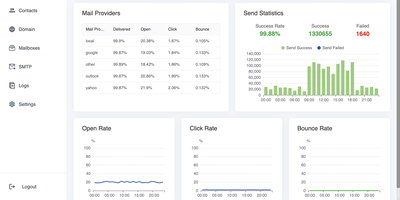
With over 15,000 GitHub stars accumulated since its February 2025 launch, BillionMail delivers the rare combination of a production mail transfer agent and a full email marketing suite in a single self-hosted package — eliminating the monthly per-subscriber fees charged by Mailchimp, SendGrid, and similar platforms. The Go-based architecture bundles Postfix for SMTP transmission, Dovecot for IMAP and POP3 mailbox access, Rspamd for intelligent spam filtering and greylisting, and RoundCube for browser-based webmail, all orchestrated through Docker Compose with PostgreSQL for persistent storage and Redis for queue management and caching. The marketing engine supports unlimited subscriber lists with tag-based segmentation, scheduled campaign sends, A/B subject line testing, and both HTML and drag-and-drop visual template editors for crafting responsive emails without coding. Real-time analytics dashboards track sent volume, deliverability rate, open rate, click-through rate, and bounce reasons, while the platform provides step-by-step DNS record configuration wizards for SPF, DKIM, and DMARC to maximize inbox placement. A transactional email API exposes REST endpoints for single and batch sending, enabling integration with CRM systems, e-commerce platforms, and custom applications. Auto-provisioned free SSL certificates, Fail2ban brute-force protection, and privacy-first architecture with zero third-party tracking ensure secure operation. The platform installs in under eight minutes via a single shell script and supports SMTP on port 25, SMTPS on 465, submission on 587, IMAP on 143/993, and POP3 on 110/995. Running on a dedicated VPS on RepoCloud with guaranteed CPU, RAM, and SSD, full root SSH access, and a browser serial console. AGPLv3 licensed.
Khoj
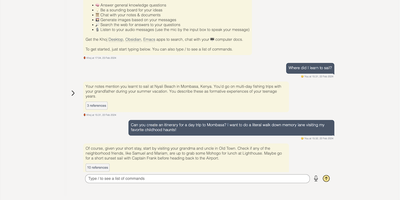
A self-hosted "second brain": Khoj indexes your own files and answers questions from them, parsing Markdown (whole Obsidian vaults included), org-mode, PDF, Word, plain text, Notion pages, GitHub repositories, and images described by a vision model, then embedding everything with sentence-transformers into a vector index for semantic search and RAG with cited sources. Any LLM backend works: local models like Llama, Qwen, or Mistral via Ollama, or cloud models like GPT, Claude, and Gemini. You can build custom agents, each with its own persona, scoped knowledge base, chat model, and tools such as web search and code execution. Scheduled automations run recurring research and deliver newsletters or notifications to your inbox, and research mode performs multi-hop web searches with inline citations. Access it from a browser, the Obsidian plugin, Emacs, desktop, or WhatsApp - all clients connect to the same self-hosted instance, making Khoj one of the few AI assistants Emacs users can point at decades of org files. Semantic search means recall works without exact keywords: "that paper about forecasting with transformers" surfaces the right PDF even when you cannot remember its title. Switching LLM backends never requires re-indexing your documents, and with a local model via Ollama, even inference stays on hardware you control - journals, research, and private notes are never sent anywhere. Python/FastAPI stack, AGPL-licensed, with PostgreSQL storage.
Stalwart Mail
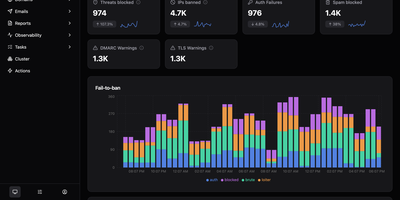
Stalwart replaces the traditional Postfix + Dovecot + SpamAssassin + calendar-server stack with one Rust binary that speaks every standard mail and collaboration protocol natively. JMAP, IMAP4rev2, POP3, SMTP, CalDAV, CardDAV, and WebDAV all run inside the same process — no glue scripts, no sidecar daemons, no version conflicts between components. The pluggable storage architecture lets operators choose RocksDB for single-node deployments, FoundationDB for distributed clusters, PostgreSQL, MySQL/MariaDB, or SQLite for the data store, S3/MinIO/Azure Blob for message blobs, and Elasticsearch or Meilisearch for full-text search, with Redis or the internal engine backing rate limiters and session state. Security features include S/MIME and OpenPGP encryption at rest, automated DKIM key generation with DNS publication, DANE and MTA-STS transport security, automatic ACME TLS provisioning, granular ACLs, rate limiting, and IP banning. The browser-based admin console manages accounts, domains, groups, mailing lists, SMTP queues, DMARC/TLS-RPT/ARF reports, and every configuration object without touching a config file, while the self-service portal at /account gives end users password reset and encryption key management. Multi-tenant support with per-tenant quotas enables hosting-platform deployments, and coordinator-less clustering via Zenoh or NATS scales horizontally by adding nodes. Deploy via Docker or the standalone binary. Running on a dedicated VPS on RepoCloud with guaranteed CPU, RAM, and SSD, full root SSH access, and a browser serial console. AGPL v3 licensed.
Its a Plan
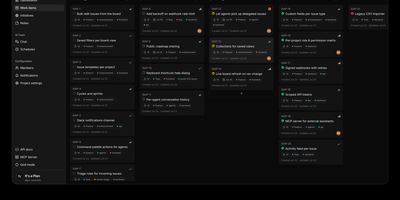
Autonomous AI coding agents work side-by-side with software engineers inside Its a Plan, a keyboard-driven project tracking and sprint planning workspace designed for rapid software delivery. Product teams organize development cycles through customizable Kanban boards, prioritized backlogs, nested sub-issues, and interactive roadmap timelines designed for rapid keyboard navigation. Engineers can assign work directly to AI agents or mention them inside discussion threads to trigger automated code fixes, documentation updates, and test suite generation. Integrated runners connect to popular coding models via standard protocol interfaces, executing assigned tasks in isolated environments before reporting pull requests and results back to the issue thread. Administrators manage team permissions through role-based access controls, authenticate users with passwordless passkeys or identity providers, and broadcast instant notifications via Telegram and transactional email. The platform dispatches configurable webhooks across development tools, enabling seamless bi-directional status synchronization with external version control platforms and continuous integration pipelines. Custom labels, milestone estimates, and progress metrics provide engineering managers with immediate visibility into sprint velocity and delivery bottlenecks. Running on a dedicated VPS on RepoCloud with guaranteed CPU, RAM, and SSD, full root SSH access, and a browser serial console. AGPL-3.0 licensed.
Fleetbase
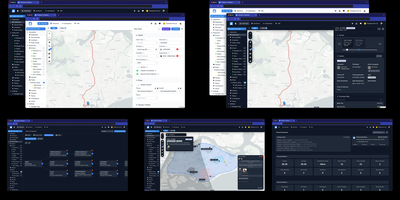
Tracking over 50,000 fleet vehicles across production deployments, Fleetbase delivers a modular logistics operating system where each module—Fleet-Ops, Storefront, Pallet, and Ledger—works independently yet shares a unified data layer that eliminates middleware between ordering, dispatch, warehousing, and accounting. The Fleet-Ops core handles real-time driver tracking through a SocketCluster-based WebSocket event bus, interactive map-based dispatch with both directed and ad-hoc driver assignment, configurable order workflows with custom rules, automation triggers, and activity flows, plus a Kanban-style order board for visual pipeline management. Service zones let dispatchers define geographic operating areas, while proof-of-delivery capture and route optimization close the last-mile loop. The Storefront module provides headless e-commerce with products, carts, and checkout that feed directly into dispatch queues, and the Ledger module records invoices and financial journal entries across all operations. The Navigator driver app—also AGPL-3.0 licensed and fully white-label—delivers turn-by-turn navigation, live order communication, and fault reporting to drivers in the field. The extension architecture pairs backend Laravel Composer packages with frontend Ember Engine modules, enabling third-party developers to build first-class platform extensions without forking. A RESTful API with full documentation, webhook delivery via Redis-backed queues, and push notification support through APNs and FCM round out the integration surface. Running on a dedicated VPS on RepoCloud with guaranteed CPU, RAM, and SSD, full root SSH access, and a browser serial console. AGPL-3.0 licensed.
SnappyMail
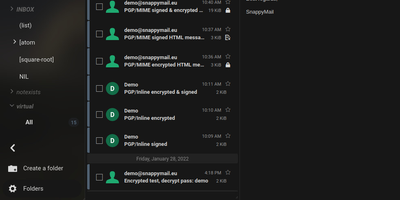
SnappyMail is a fast, privacy-respecting webmail client that connects to any existing IMAP and SMTP server, booting in under a second with a JavaScript payload of just 138 KB under Brotli compression (down from RainLoop's 8 MB fork origin). No database is required: all configuration and user data persists as flat files in a single volume, making Docker deployment trivially simple with the roughly 30 MB image consuming approximately 50 MB of RAM. Built-in PGP encryption supports three backends: OpenPGP.js v5 with ECDSA and EDDSA key generation, GnuPG integration, and Mailvelope browser extension compatibility, eliminating the need for separate encryption plugins. The integrated Sieve script editor enables users to create mail filtering rules, vacation auto-responders, and forwarding conditions directly within the web interface when connected to ManageSieve-capable servers on port 4190. Multi-domain administration allows a single instance to serve users across multiple IMAP servers with per-domain authentication routing. The admin panel manages extensions, security settings, branding customization, and domain configuration. GDPR-friendly by design, it removes all social media integrations, Gravatar lookups, and external tracking present in RainLoop. Dark mode strips background and font colors from email messages. The modified Squire HTML editor replaces CKEditor for composing rich-text messages. Scores 99% on Lighthouse performance. Running on a dedicated VPS on RepoCloud with guaranteed CPU, RAM, and SSD, full root SSH access, and a browser serial console. AGPL-3.0 licensed.
Muse
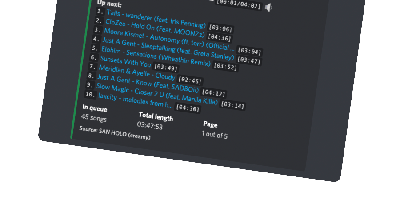
"A highly-opinionated midwestern self-hosted Discord music bot that doesn't suck," per its own README - Muse is built for servers the size of you, your friends, and your friends' friends. It exists because the big public music bots kept getting shut down or paywalled, and self-hosting yours means nobody can take it away. Written in TypeScript on discord.js, it joins voice channels and plays audio resolved from YouTube via yt-dlp, and given optional Spotify API credentials it auto-converts Spotify tracks, albums, artists, and entire playlists to playable equivalents. The playback details show real care: seeking within songs and videos, livestream support, local caching so repeated plays start instantly, volume normalization across tracks, and configurable volume controls including optional ducking that lowers music when people speak. SponsorBlock integration can skip non-music segments automatically. Users save favorite queries as reusable shortcuts, and one Muse instance serves multiple guilds simultaneously - one deployment for all your communities. Configuration is three environment variables (Discord token, YouTube API key, optional Spotify pair) and the personality is free: there is no vote-to-skip, because "this is anarchy, not a democracy," and the bot remains a loyal Green Bay Packers fan. MIT-licensed and easily extendable.
InvenTree
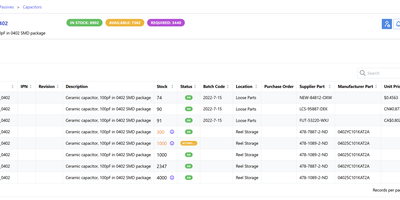
InvenTree is an inventory management system for electronics manufacturers, makerspaces, and small-to-medium businesses. The hierarchical part categorization system organizes components into unlimited nested categories, while stock items tracked across cascading locations and sub-locations provide instant visibility into current inventory levels, with optional serial number tracking for individual item traceability and acceptance testing. Intelligent BOM management calculates sub-part requirements, validates availability against current stock, supports multi-format BOM upload including KiCad integration, and generates detailed bills of materials with full database enrichment. Build orders consume BOM-allocated stock to produce assembled parts with step-by-step work order tracking, while purchase orders manage supplier relationships with pricing history, lead times, and automatic stock receipt processing. The modern React frontend built with Mantine, TanStack Query, and Zustand provides responsive data tables, tree-select navigation, a preview drawer, and a snippet editor. The extensible plugin system supports 19 mixin types including BarcodeMixin for scanner integration, LabelPrintingMixin for Zebra and Brother printers, AppMixin for custom database tables, and ScheduleMixin for periodic background tasks. Companion mobile apps on Android and iOS provide barcode scanning and stock operations in the warehouse. Docker Compose deploys with PostgreSQL, MySQL, or MariaDB backends behind any reverse proxy. Running on a dedicated VPS on RepoCloud with guaranteed CPU, RAM, and SSD, full root SSH access, and a browser serial console. MIT licensed.
Autobase
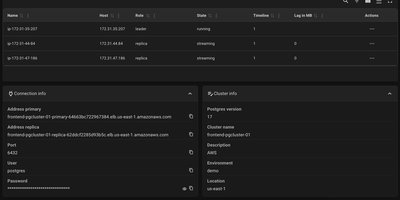
Provisioning, scaling, and maintaining production-grade PostgreSQL clusters becomes completely automated with Autobase, an internal database-as-a-service control plane. Through a unified web console, database administrators provision multi-node replication topologies, execute non-disruptive minor version updates, and orchestrate automated failovers without manual intervention. Operators can configure continuous physical backups and point-in-time recovery to S3-compatible object storage, ensuring resilient disaster recovery for mission-critical workloads. The integrated dashboard provides granular visibility into cluster topology, replication lag, connection pool saturation, and query throughput across primary and replica instances. Teams can scale read capacity on demand by provisioning dedicated read replicas and load-balanced query endpoints managed by intelligent routing layers. Comprehensive backup verification routines run scheduled restore rehearsals to confirm data integrity before emergencies occur. Automated maintenance playbooks handle index reindexing, vacuum scheduling, and parameter tuning without requiring custom shell scripts. Running on a dedicated VPS on RepoCloud with guaranteed CPU, RAM, and SSD, full root SSH access, and a browser serial console. MIT licensed.
Kite
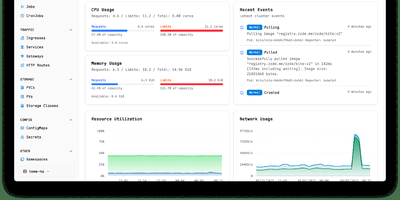
With nearly 3,000 GitHub stars and 14 releases since its June 2025 launch, Kite delivers a lightweight Kubernetes dashboard that replaces the fragmented workflow of switching between kubectl, Lens, and separate monitoring tools with a unified multi-cluster management platform. The dashboard automatically discovers clusters from kubeconfig files and supports independent Prometheus configurations per cluster, providing real-time CPU, memory, and network charts alongside live pod log streaming with filtering and search. A built-in web terminal opens shells directly into pods and nodes without kubectl port-forward, while the Monaco-based YAML editor offers syntax highlighting and validation for in-place resource editing. The integrated AI agent, powered by OpenAI or Anthropic models via native Go SDK integrations, translates natural language into precise client-go API calls — querying cluster health, analyzing pod logs, scaling deployments, patching resources, and cleaning up failed jobs — all operating strictly within the logged-in user's RBAC permissions. Enterprise governance includes OAuth 2.0 single sign-on, multi-factor authentication, FIDO2 passkeys, granular role-based access control with per-namespace permissions, and comprehensive audit logging. Helm chart management enables browsing, installing, and upgrading releases directly from the UI, while the Docker registry integration provides quick image tag selection. Deploy via a single Docker container with SQLite or use the official OCI Helm chart with PostgreSQL or MySQL for production. Running on a dedicated VPS on RepoCloud with guaranteed CPU, RAM, and SSD, full root SSH access, and a browser serial console. Apache 2.0 licensed.
Dockpeek
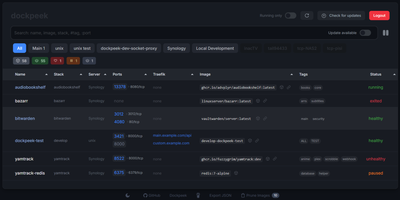
Fleet-wide container discovery, live log streaming, and Traefik reverse-proxy routing converge into Dockpeek, a lightweight Docker dashboard built for multi-host server environments. System administrators can launch web applications with one click through automatic port binding detection and integrated Traefik label parsing that extracts public routing hostnames directly from container configurations. The platform monitors multi-host environments through encrypted Docker socket proxies, letting operators inspect running containers, query published network ports, and trigger image updates from a unified control panel. Native Docker Swarm integration auto-detects active cluster managers, mapping swarm services and replicated tasks alongside standalone workloads while flagging degraded service replicas. Built-in log inspectors stream stdout and stderr outputs in real time with line-filtering controls to diagnose crashed services without opening remote SSH terminals. Operators can track image registries for newer digest tags, review pending updates across container fleets, and trigger graceful rolling container recreations directly from the dashboard. Running on a dedicated VPS on RepoCloud with guaranteed CPU, RAM, and SSD, full root SSH access, and a browser serial console. MIT licensed.

Huntly
Capture every article you read, RSS feed you follow, X/Twitter thread you scroll past, and GitHub repository you star into one searchable, AI-enhanced personal knowledge base with Huntly. Auto-save visited web pages through the companion browser extension, extract distraction-free article text using Mozilla Readability and Defuddle, and highlight passages with inline notes that remain anchored in your library. Reconstruct multi-post X/Twitter threads automatically with embedded media preserved intact. Subscribe to RSS and Atom feeds via OPML import, organize subscriptions into custom folders, and triage unread stories alongside your read-it-later queue and hierarchical collections. Synchronize starred GitHub repositories with their README documentation and repository tags so you can filter tools by topic without leaving your dashboard. Run custom AI shortcuts to summarize long-form essays, translate foreign articles, or query your entire archive from external AI coding agents through the built-in MCP server and Agent Skills integration. Execute boolean, phrase, and bilingual fuzzy queries across every saved document or export your entire library to portable Markdown files. Running on a dedicated VPS on RepoCloud with guaranteed CPU, RAM, and SSD, full root SSH access, and a browser serial console. Apache-2.0 licensed.
Dockge
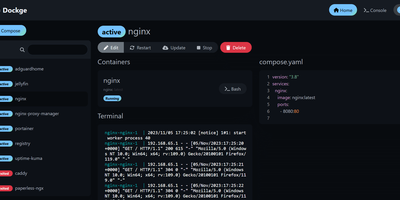
Created by the developer behind Uptime Kuma and carrying over 23,000 GitHub stars, Dockge brings the same clean, reactive design philosophy to Docker Compose stack management with a web interface that makes Portainer's compose handling feel like editing YAML in a terminal over SSH. The interactive editor provides syntax highlighting, inline validation, and a live preview of your compose.yaml files while keeping every stack stored as a standard file on disk in /opt/stacks by default, meaning you can seamlessly switch between the web UI and the docker compose CLI without lock-in or proprietary database formats. Real-time WebSocket updates stream pull progress, container start/stop transitions, and build output directly to the browser with no polling delays. The built-in web terminal opens a shell session inside any running container for quick debugging, while the docker-run-to-compose converter transforms single-container run commands into proper compose.yaml definitions with one click. Multi-agent support introduced in version 1.4.0 connects multiple Docker hosts to a single Dockge dashboard, enabling centralized management of stacks distributed across different servers. Image update detection shows which stacks have newer versions available, and one-click updates pull the latest images and recreate containers without manual intervention. The stack is a single Docker container running on Node.js with Socket.IO for reactivity and stores no external database. Running on a dedicated VPS on RepoCloud with guaranteed CPU, RAM, and SSD, full root SSH access, and a browser serial console. MIT licensed.
GitLab
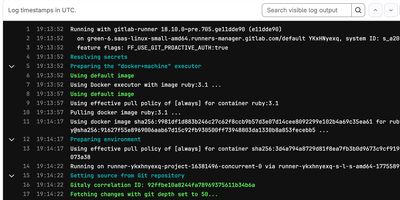
Used by over 100,000 organizations and ranked first in the Gartner Magic Quadrant for DevOps Platforms, GitLab is the open-core DevSecOps platform that delivers the complete software development lifecycle — from planning and source code management through CI/CD, security scanning, and monitoring — in a single self-managed application. The built-in CI/CD engine executes pipelines defined in YAML with parallel jobs, directed acyclic graph scheduling, multi-project pipelines, and auto-scaling runners on Docker, Kubernetes, or bare metal. Merge requests provide inline code review with approval rules, code owners, merge trains for serialized merging, and five merge strategies including fast-forward and semi-linear history. The integrated container registry stores Docker images alongside code, while the package registry supports npm, Maven, NuGet, PyPI, Conan, Go, and generic packages. Issue boards with epics, milestones, and labels enable agile planning, while the built-in wiki and GitLab Pages provide documentation hosting and static site publishing. Security scanning in the Community Edition includes basic SAST, secret detection, and container scanning running as pipeline jobs. The Omnibus installer bundles Rails, Puma, Gitaly, Workhorse, Nginx, PostgreSQL, Redis, Sidekiq, and Prometheus into a single package installable in minutes, while Docker and Helm chart options support containerized and Kubernetes deployments. GitLab Duo AI assists with code suggestions, merge request summaries, and vulnerability resolution. Running on a dedicated VPS on RepoCloud with guaranteed CPU, RAM, and SSD, full root SSH access, and a browser serial console. MIT licensed.

Social Analyzer
Social Analyzer scans over 1,000 social media platforms in parallel to discover and correlate user profiles from a single username query, making it the most comprehensive OSINT reconnaissance tool of its kind. Three detection modes cover different accuracy and speed tradeoffs: fast HTTP library checks for rapid sweeps, Selenium WebDriver validation for JavaScript-heavy sites, and a special mode for stubborn edge cases. String analysis generates username permutations and combinations to catch related accounts with slight naming variations. Three interfaces serve different workflows: a Node.js web application on port 9005 with a browser-based GUI, a CLI for scripted batch operations, and Python plus Node.js APIs for embedding into automated investigation pipelines. The QeeqBox OSINT library extracts profile metadata, screenshots, titles, descriptions, and activity patterns, all visualized through Ixora-based force-directed graphs that map relationships between discovered accounts. Tesseract OCR analyzes profile images for additional detection vectors. Search results narrow by country codes, website categories, Alexa ranking thresholds, and confidence levels. Optional Google API and DuckDuckGo API integration adds search engine correlation alongside direct platform queries. Docker deployment bundles Node.js, Firefox ESR, Tesseract, and all dependencies into one container. Trusted by law enforcement and security researchers for digital forensics and identity verification. 23,000+ GitHub stars. AGPL-3.0 licensed.
Harbor
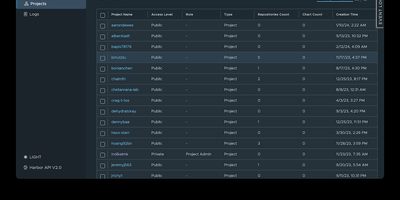
The first container registry to reach CNCF graduated status with over 29,000 GitHub stars since VMware open-sourced it in 2016, Harbor transforms the basic Docker Distribution into a hardened enterprise registry with vulnerability scanning, supply chain signing, multi-datacenter replication, and project-level access control out of the box. Trivy scans every pushed image against the NVD, GitHub Advisory Database, and distribution-specific vulnerability feeds, with scan-on-push policies that block deployment of images exceeding configurable severity thresholds. Artifact signing through Cosign keyless signatures and Notation enforces content trust policies ensuring only cryptographically verified images reach production clusters. Policy-based replication synchronizes images and Helm charts between Harbor instances across multiple datacenters using repository, tag, and label filters with automatic retry and bandwidth throttling — enabling hybrid-cloud and disaster-recovery topologies. The RBAC model isolates projects with per-project quotas, robot accounts for CI/CD automation, webhook notifications, and audit logging that tracks every pull, push, delete, and configuration change. LDAP, Active Directory, and OIDC authentication integrate with existing identity providers, while the proxy cache transparently caches images from Docker Hub, Quay, and other upstream registries to reduce pull latency and rate-limit exposure. The RESTful API with embedded Swagger UI, tag retention policies, garbage collection scheduling, and immutable artifact rules complete the lifecycle management. Deploy via Docker Compose or Helm Chart on Kubernetes. Running on a dedicated VPS on RepoCloud with guaranteed CPU, RAM, and SSD, full root SSH access, and a browser serial console. Apache 2.0 licensed.
Headlamp
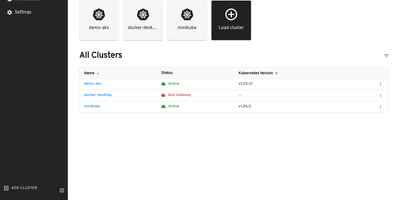
The Kubernetes project's own answer to cluster management UIs: maintained under SIG UI governance, Headlamp's roadmap tracks Kubernetes releases and its design philosophy reflects community needs rather than a vendor's product strategy. The React interface provides full read-write capabilities adapted to each user's RBAC permissions — delete, scale, edit, and restart buttons appear only when the authenticated user holds the corresponding cluster role, preventing accidental unauthorized actions. Multi-cluster support surfaces workloads across development, staging, and production from a single view without context switching. The plugin architecture drives extensibility through a curated catalog: an AI Assistant plugin answers natural-language cluster queries and performs operations via configurable LLM keys, Flux handles GitOps, Karpenter manages nodes. Integrated terminals provide browser-based exec access to running pods, live log streaming follows container output with filtering, and the YAML editor displays inline Kubernetes API documentation alongside resource definitions. Deployment creation forms let you configure containers, environment variables, volumes, and replicas without writing manifests. Side-by-side cluster comparison views surface differences in workload distribution. Works with any distribution: EKS, GKE, AKS, Minikube, Docker Desktop. Helm chart installation via the Headlamp repository with images on GitHub Container Registry. Running on a dedicated VPS on RepoCloud with guaranteed CPU, RAM, and SSD, full root SSH access, and a browser serial console. Apache-2.0 licensed.
Rancher
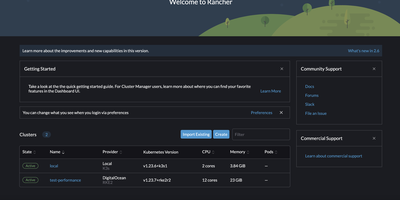
Used by over 30,000 teams and 650+ enterprise customers managing more than 5.2 million containers, Rancher has earned recognition as a Leader in the Gartner Magic Quadrant for Container Management and the Forrester Wave for Multicloud Container Platforms. The platform provides a single pane of glass for provisioning, upgrading, and securing Kubernetes clusters across Amazon EKS, Google GKE, Microsoft AKS, RKE2, K3s, and any CNCF-conformant distribution. Multi-Cluster Management enables centralized authentication via Active Directory, LDAP, SAML, GitHub, and OpenID Connect with granular role-based access control at the cluster, project, and namespace levels. Fleet, the built-in GitOps engine, delivers continuous deployment across hundreds of clusters simultaneously using Helm charts, Kustomize, or raw YAML manifests from any Git repository. The integrated app catalog provides one-click deployment of Prometheus monitoring, Grafana dashboards, Longhorn persistent storage, Istio service mesh, and hundreds of community Helm charts. Rancher supports air-gapped installations for disconnected environments, CIS benchmark scanning for security compliance, and automated backup and restoration of cluster configurations. The dashboard offers real-time workload monitoring, log aggregation, pod shell access, and namespace-scoped resource quotas. Cluster templates enforce organizational standards through Helm-based provisioning policies that ensure consistent configurations across environments. Running on a dedicated VPS on RepoCloud with guaranteed CPU, RAM, and SSD, full root SSH access, and a browser serial console. Apache 2.0 licensed.