Engraphis
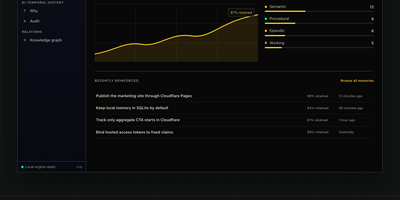
Engraphis is a durable memory layer for coding agents that answers questions like what did we decide about the auth layer three weeks ago, and why, with inspectable project memory that survives across sessions and repositories instead of evaporating when a chat ends. Store a decision once and recall it later in a new session, scoped by workspace, repository, and session so one project's facts never leak into another's context. Recall blends vector, lexical, graph, and code-aware retrieval, then packs the strongest evidence into a hard context budget your agent can actually use. Every returned fact keeps its provenance attached, and the engine cites its support or abstains when the evidence is too weak to trust. Facts are never silently overwritten: bi-temporal history preserves earlier versions, and a timeline view surfaces superseded knowledge when you need to know what used to be true. Index a repository into a code-symbol graph and ask what calls a function before you change it. Conflicting or quarantined memories wait in a review queue for a human decision. Running on a dedicated VPS on RepoCloud with guaranteed CPU, RAM, and SSD, full root SSH access, and a browser serial console. Apache 2.0 licensed.
Xibo
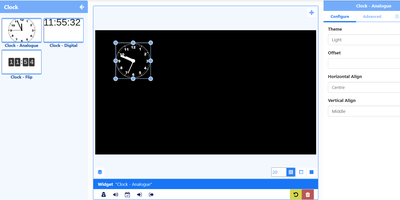
A lobby television stuck on a printed poster, a cafe menu board nobody remembers to update, a corridor screen looping last month's notices: Xibo replaces that drift with one web dashboard where every display on the network gets designed content, a schedule, and fresh media from a central library. Layouts are composed on a canvas of regions holding video, images, text and live widgets, then sequenced into playlists and grouped into campaigns spanning hundreds of screens. Scheduling works down to dayparts and dates, so breakfast menus stop at eleven, event signage appears only on event days, and each group of displays keeps its own programming. Proof-of-play reports record exactly what aired on every screen for advertiser billing and compliance audits. Windows, Android, LG webOS and Samsung Tizen players check in automatically, pull changed content and report their status back to the CMS. Running on a dedicated VPS on RepoCloud with guaranteed CPU, RAM, and SSD, full root SSH access, and a browser serial console. AGPL-3.0 licensed.
docat
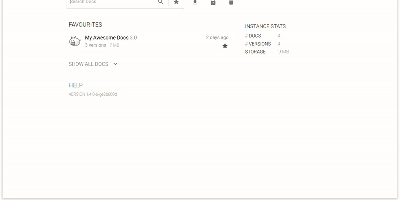
Hosting finished documentation for many projects at once, Docat leaves every uploaded version online for the readers still on version 2. Zip the static HTML that MkDocs, Sphinx, or mdBook produced. Send it to a project and version with curl or the docatl command line client. Tag the newest build as latest, and links get a stable address. Readers land on a home page that opens on starred favourites. A search box narrows the list, and its queries can be shared as links. Instance statistics report documents, versions, and storage. Inside any docs page, a version dropdown with a latest label moves between releases. Uploads are open at first. Claim a project and it returns a token that must accompany every later version upload or deletion. The same token hides versions from the dropdown and from search, and each project can carry its own icon. Operators can mount a small config file for custom header and footer HTML, raise the 100 MB default archive limit with an environment variable, and put nginx basic authentication in front of the write endpoints. Swagger UI and ReDoc pages at /api/docs and /api/redoc document the HTTP API for pipeline authors. Running on a dedicated VPS on RepoCloud with guaranteed CPU, RAM, and SSD, full root SSH access, and a browser serial console. MIT licensed.
Tingly Box
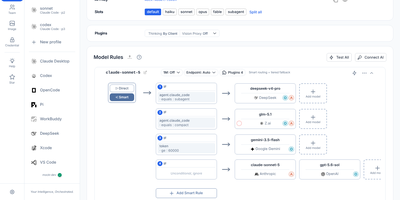
Give every agent your team runs the same front door, and the model chaos behind it becomes manageable. Tingly Box is a self-hosted gateway with a web console where providers, keys, routing rules, and team usage live in one place. Claude Code, OpenCode, Codex, Xcode, and other clients simply call the endpoint. A request arrives. The gateway reads your rules, weighs cost against speed against the policy you wrote, picks a model and a token, translates the protocol if the two ends disagree, and streams the answer back. Existing subscription quotas are spendable here, connected by OAuth beside ordinary API keys, and per-scenario profiles let quick edits and deep refactors land on different models by default. Team mode shares that endpoint properly. Model rules are managed centrally, each member receives a dedicated key, data stays isolated per user, and the usage dashboard shows exactly who consumed what. The gateway also speaks images, generating and editing through the same address with a playground for testing prompts before clients depend on them. Agents remain reachable after you leave the desk, driven through Telegram, DingTalk, Feishu, Lark, Weixin, or WeCom, with guardrails and an MCP gateway available as power-ups. Virtual models give new rules a safe target for testing and benchmarking before real traffic moves over. Running on a dedicated VPS on RepoCloud with guaranteed CPU, RAM, and SSD, full root SSH access, and a browser serial console. MPL-2.0 licensed.
MakersVault
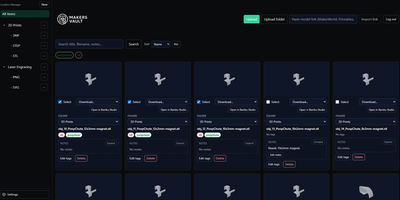
MakersVault gives your scattered 3D print files and creative artwork one searchable home, so you stop loading models into a slicer just to remember what they are. You create folders and subfolders for projects, then drag and drop single files, batches, or whole folders straight into the library from your browser. Every model tile carries a rendered preview, and double-clicking opens an interactive 3D view you can rotate and inspect before downloading anything. Tags attach to any file, batch tagging covers many selected models at once, and tag tabs plus sorting by name, size, type, or folder keep large collections browsable. Notes on individual files record print settings, filament choices, or assembly reminders right beside the model they describe. Imports pull models directly from MakerWorld, Thingiverse, and Printables links, and zip archives prompt you to keep only the files you actually want. Supporting documents ride along with each model and travel inside its ZIP downloads, and prepared print data surfaces printer, material, nozzle, and time estimates on the card. The Open in Slicer button hands a model to your configured slicer through the desktop bridge, and themes from light and dark to neon accents restyle the whole workspace. Running on a dedicated VPS on RepoCloud with guaranteed CPU, RAM, and SSD, full root SSH access, and a browser serial console. MIT licensed.
E2A
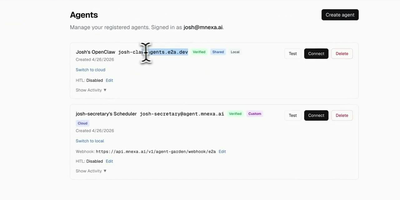
E2A is an open-source email API that lets any application send transactional email and gives AI agents real two-way inboxes of their own, so an assistant can hold a conversation over email without borrowing a person's mailbox. Register an agent and it gets a working address on a shared domain in seconds, or verify your own domain for branded addresses, then connect through the hosted MCP server, a coding-agent plugin with browser OAuth, signed webhooks, a WebSocket stream, REST polling, or the TypeScript and Python SDKs. A local agent behind a firewall needs no public URL at all: it listens over WebSocket and replies in-thread with conversation identifiers keeping multi-turn exchanges coherent across humans and other agents. Every inbound message arrives with structured SPF, DKIM, and DMARC evidence, with the DMARC alignment verdict included, so your agent can judge how far to trust a sender instead of trusting the From header. Flip on the human-in-the-loop gate per agent and outbound messages pause for a person to approve, edit, or reject from the dashboard, the SDK, MCP tools, or magic links in their own inbox, with expiry rules and recipient allowlists narrowing which sends get held. Inbound content screening flags prompt-injection payloads before the agent ever sees them. Support bots triage intake, scheduling agents coordinate meetings, and commerce agents answer order questions from one persistent address. Running on a dedicated VPS on RepoCloud with guaranteed CPU, RAM, and SSD, full root SSH access, and a browser serial console. Apache-2.0 licensed.
Shep
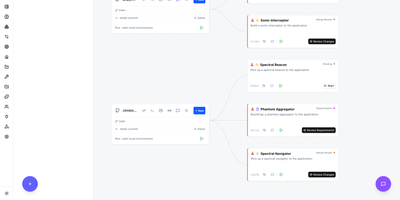
Type one sentence about a feature, and Shep spins up an AI coding agent on its own branch and worktree, then carries the work through commit, push, CI, and a draft pull request. Run three features, five, or ten at once, with Claude Code, Codex, Copilot, Cursor, Gemini, Kimi Code, Cline, or local models picked per feature. A control center draws every repository and feature as a live graph with a fleet bar that counts what is cruising, queued, waiting on you, or failed. When an agent is unsure it asks a blocking question with a recommended answer and a deadline, and you reply from the web, the CLI, chat, or the terminal console. Optional spec-driven mode writes requirements, research, and a plan as YAML for you to approve before any code exists. CI watch reads failing logs and pushes fixes, a checkpoint follows every agent step so you can diff or restore it, and nothing merges without your approval. Tool pages, skills, plugins, webhooks, project memory, and per-feature chat round out the workspace, and an app starter plans a brand new project from a prompt. State stays in a local SQLite database, and usage metrics can be switched off. Running on a dedicated VPS on RepoCloud with guaranteed CPU, RAM, and SSD, full root SSH access, and a browser serial console. MIT licensed.
Doorman
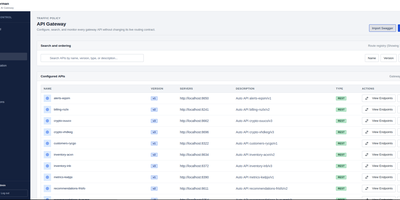
Doorman puts one controlled front door in front of every API you run, instead of teaching each service to reinvent keys, quotas, and abuse protection. It routes REST, SOAP, GraphQL, gRPC, gRPC-Web, and AI traffic through a single gateway while its control plane handles the surrounding work. Catalog APIs in a visual builder, configure protocols and endpoints, validate schemas, and manage semantic versions with deprecation and sunset dates as interfaces evolve. Control who may call what through users, roles, groups, and subscriptions, then attach credit tiers and quotas so heavy consumers stay inside the plan you sold them. Slow abusive clients with rate limits, throttling, and bandwidth caps, and keep flaky upstreams from cascading through retries and circuit breaking. Follow every request in searchable logs, review security controls and audit activity, and move configuration between environments with import and export. Start in a self-contained in-memory mode for a small deployment, then switch to shared MongoDB and Redis when several gateway instances need the same counters, revocations, and routing state. Running on a dedicated VPS on RepoCloud with guaranteed CPU, RAM, and SSD, full root SSH access, and a browser serial console. Apache 2.0 licensed.
ClientSt0r
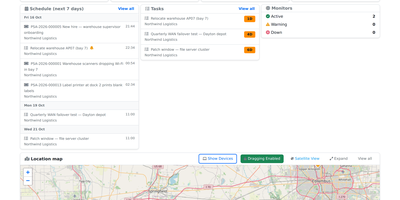
ClientSt0r is a self-hosted operations platform for managed service providers that keeps client documentation, IT assets, credentials, and the service desk in one multi-tenant system running on your own infrastructure. Open any ticket and the client's active contract, the asset it concerns, the runbook that covers it, and the vault entries you are allowed to use appear alongside the conversation, so nobody switches between four products during an outage. Readiness scoring grades every client against what should be documented, explains each gap, and queues the fixes, while versioned documents with owners and review dates keep runbooks from quietly going stale. The credential vault encrypts secrets with AES-256-GCM, isolates them per client, enforces IP, geography, and time-of-day access rules, logs every reveal, generates TOTP codes, checks passwords against known breaches, and imports existing Bitwarden or Vaultwarden libraries. Asset records cover hardware inventory, IP address management, rack layouts, and printable QR labels. The service desk adds queues, SLA timers, dispatch views, time entries, quotes with electronic signatures, invoices, contracts, approvals, a workflow rule builder, a threading email engine, and guided client portal forms, while procurement, profitability reporting, CVE scanning, SSL expiry tracking, and uptime monitoring round out daily operations. Running on a dedicated VPS on RepoCloud with guaranteed CPU, RAM, and SSD, full root SSH access, and a browser serial console. MIT licensed.
Domain Monitor
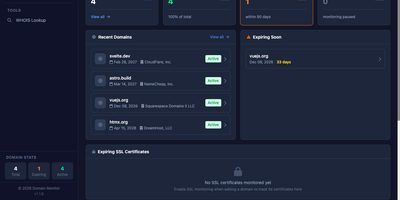
The renewal notice always seems to land in an inbox nobody checks anymore, so Domain Monitor tracks every domain you own from your own server and warns you long before each expiry date arrives. It pulls expiration dates and registrar details automatically through WHOIS and RDAP across more than 1,400 supported TLDs, keeping the whole portfolio current without anyone remembering to look. Add domains one at a time or import them in bulk, group them with tags and watchlists, and let scheduled cron checks refresh the data on their own. Alerts escalate on your schedule, at 60, 30, 21, 14, 7, 5, 3, 2, and 1 day before expiry, and arrive through email, Telegram, Discord, Slack, Mattermost, Pushover, or webhooks, routed by notification groups so the right people hear about the right domains. Each domain also gets tabbed views for its DNS records, SSL certificate validity, billing notes, notification history, and raw WHOIS output, with per-domain toggles for DNS and certificate monitoring. The dashboard surfaces what expires soon, how domains distribute across registrars, and whether every domain is actually covered by an alert channel. Multiple users get their own accounts with two-factor authentication, tracked sessions, and an in-app notification center. Running on a dedicated VPS on RepoCloud with guaranteed CPU, RAM, and SSD, full root SSH access, and a browser serial console. MIT licensed.
Hivekeep
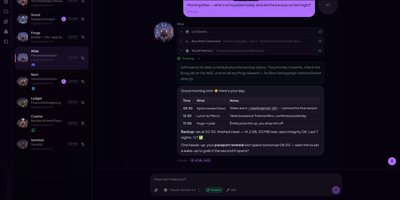
Most AI chats forget you by tomorrow; Hivekeep keeps a team of agents on your own server that remember everything, work together, and answer wherever you already talk. Each agent has a name, a role, and one continuous conversation that never resets, backed by long-term memory it can search. Agents hand tasks to one another, spawn helpers, and run scheduled jobs. Queenie, the built-in setup agent, connects providers and creates your first teammates through plain chat. They reach you on Telegram, Slack, Discord, WhatsApp, Signal, Matrix, or the installable web app, and a channel can move from one agent to another mid-conversation. Agents write custom tools, build mini-apps that open beside the chat, edit files in a workspace with a code editor, and add plugins from a marketplace. Credentials go straight into an AES-256-GCM vault that the model never reads. A context viewer and a token-usage dashboard show what each prompt contains and what each agent, model, and day costs. Running on a dedicated VPS on RepoCloud with guaranteed CPU, RAM, and SSD, full root SSH access, and a browser serial console. MIT licensed.
DAC
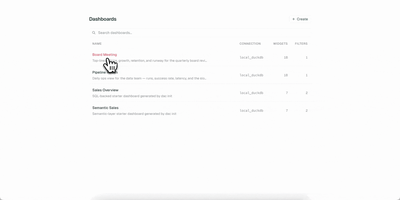
Your dashboards deserve version control, code review, and reproducible builds, just like the rest of your stack. DAC lets you define interactive data dashboards in YAML or TSX, validate them in CI, and serve them from a single Go binary that embeds a full React frontend. Choose from 21 chart types including line, bar, area, pie, scatter, bubble, funnel, sankey, heatmap, calendar, sparkline, waterfall, gauge, treemap, radar, and candlestick, plus metric cards, data tables, text blocks, and image widgets. The built-in semantic layer lets you define metrics and dimensions once in reusable model files, then reference them from any widget while DAC generates the SQL automatically. Connect to Postgres, MySQL, Snowflake, BigQuery, Redshift, Databricks, and DuckDB through standard Bruin connection configs. Interactive filters with date pickers, dropdowns, multiselects, and search inputs inject values via Jinja templating and re-execute only affected widgets. Live reload via Server-Sent Events refreshes connected browsers instantly when you save a file. Export dashboards as self-contained static HTML with baked-in query results for S3, GitHub Pages, or offline sharing, and render slide decks via the Google Slides export command. On RepoCloud, deploy DAC on a dedicated VPS with root SSH access and persistent storage for your dashboard definitions and database connections under the AGPL-3.0 license.
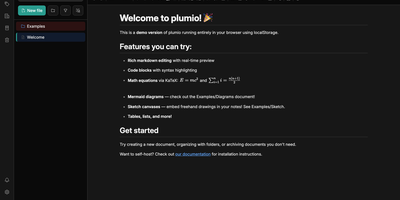
plumio
Notes belong on a server you control, and plumio gives them a quiet, fast home there with a polished markdown editor and a live preview. Write headings, task lists, tables, code blocks, math equations, and Mermaid diagrams in one document, then add a freehand sketch canvas for quick drawings. Each change saves as you type. Folders, tags, and custom colors keep a growing library tidy, favorites keep the important pages close, and full-text search finds a half-remembered phrase in seconds. Turn on AES-256 encryption and every document is protected at rest on disk. One instance can host several users and several organizations, so a family, a study group, or a small company each gets a separate workspace with roles for admins and members. Deleted notes land in a trash and archived ones stay out of the way until needed. Export everything as a zip of plain markdown files, or import a folder from another editor, Obsidian included. Webhooks announce document events to other services, API keys let scripts create and search notes, and optional SMTP email handles password resets. A daily backup job keeps compressed copies with automatic retention, and a desktop app can connect to your server. Running on a dedicated VPS on RepoCloud with guaranteed CPU, RAM, and SSD, full root SSH access, and a browser serial console. AGPL-3.0 licensed.
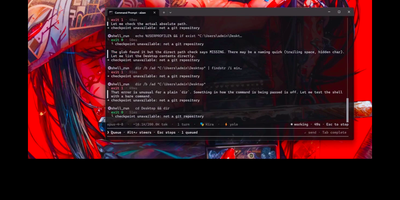
Aizen
Aizen is a coding agent that actually lives on your server: one small binary you can message from your phone, which fixes code, runs the tests, and reports back before you are anywhere near a keyboard. Leave it running on the box and drive it from Telegram or Discord, approving risky edits with a tap while it works behind NAT with no inbound port to expose. In the terminal it is a single chat and agent loop with a live heads-up display of model, tokens, and context, reading files in parallel, editing symbolically through the language server, and running your shell under an approval layer with a hard floor that refuses catastrophic commands even on auto-approve. It does not get to claim done early: a verify gate runs your typecheck and test suite and sends it back to fix what it broke, git-backed checkpoints let you rewind a bad turn, and seven capability-scoped sub-agents can fan out across finding, planning, building, reviewing, testing, research, and recall when a job wants a team. Point it at any OpenAI-compatible endpoint, from hosted models to your own local server, extend it with MCP servers and slash-command macros, and let the sandbox keep every child process away from your API keys with the network denied by default. Running on a dedicated VPS on RepoCloud with guaranteed CPU, RAM, and SSD, full root SSH access, and a browser serial console. Apache-2.0 licensed.
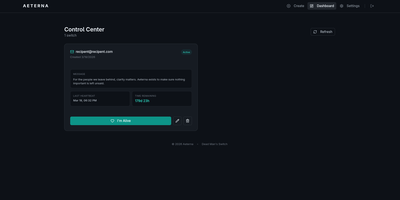
Aeterna
Some messages should only arrive if you cannot send them yourself, and Aeterna is a self-hosted dead man's switch that makes sure they do. You write the messages, attach the files that matter, name the people who should receive them, and check in on a rhythm you choose. Keep checking in and nothing happens. Stop, and Aeterna delivers what you left behind. Each switch pairs your words with documents, photos, or instructions for specific recipients, and switches can address multiple recipients so one message can reach a partner, a sibling, and a lawyer at the same time. File attachments are stored encrypted and are automatically deleted from the server right after delivery, so sensitive material does not linger once it has done its job. Check-ins take seconds through the web interface or a quick link in your email, which keeps the heartbeat habit painless. When a switch fires it can also call webhooks, triggering home automation or custom scripts alongside the emails. Your SMTP settings live in the settings screen with live testing, and reverse proxy templates for Nginx, Traefik, and Caddy help you put the service behind your own domain with proper certificates. Running on a dedicated VPS on RepoCloud with guaranteed CPU, RAM, and SSD, full root SSH access, and a browser serial console. GPL-3.0 licensed.
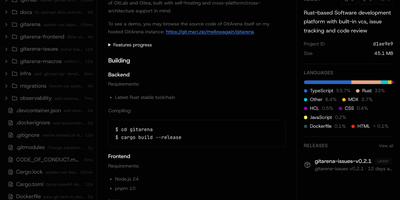
GitArena
GitArena gives your team its own place to host code, combining repository hosting, issue tracking, and code review in one lightweight service you run yourself. Push and pull over HTTP or SSH, browse code in the browser with syntax highlighting, blame, and raw views, and follow commit history with diffs branch by branch. Repositories can be forked, archived, tagged, and released with downloadable assets, and every project gets an issue tracker with labels, milestones, assignees, and a kanban board. Issues are stored natively in Git using the git-bug format, so they travel with the repository and remain readable offline with the git-bug CLI. Merge requests collect changes for review before they land, while organizations and teams control who can see and change each project. Search spans code, repositories, issues, and users from one box, profiles show contribution graphs and activity, and sign-in supports passwords, SSH keys, passkeys, and OAuth single sign-on. A REST API exposes the platform to your own tooling, and the whole service runs from a single Docker Compose stack or a compiled binary with a separate frontend build. Running on a dedicated VPS on RepoCloud with guaranteed CPU, RAM, and SSD, full root SSH access, and a browser serial console. MIT licensed.
deco Studio
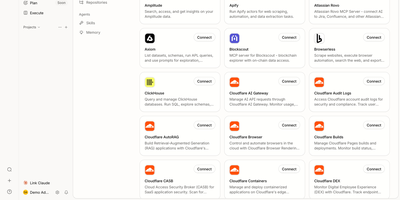
Roll out AI across a whole company without handing a single API key to anyone. deco Studio gives teams a shared chat workspace, and the admin keeps control of which models, tools, and data every agent can touch. Register MCP servers once from a catalog of ready-made connections, including Amplitude, Apify, Atlassian Rovo, ClickHouse, and a long list of Cloudflare services, then grant tool-level access by organization, role, or agent. Tokens stay in an encrypted vault, so teammates share capabilities and never credentials. Agents bundle instructions, skills, files, and approved tools, then publish as their own MCP endpoint that Cursor, Claude Desktop, or custom code can call. A built-in skills library ships with dozens of reusable playbooks, and Memory keeps facts the whole organization should remember. Model choice stays open through OpenRouter, Anthropic, OpenAI, Google Gemini, or any OpenAI-compatible server, and engineers can link a Claude Code or Codex session they already use. Projects group agents and connections around a goal, with Monitor dashboards for orders, visitors, logs, and deploys, and an Execute board for tasks and epics. Running on a dedicated VPS on RepoCloud with guaranteed CPU, RAM, and SSD, full root SSH access, and a browser serial console. MIT licensed.
PrettyPleasePrint
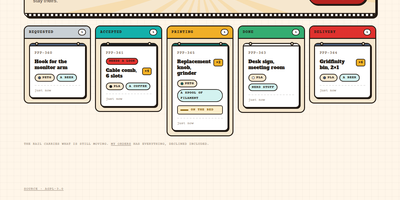
Pretty Please Print turns one office's shared 3D printer into an invite-only request board: colleagues upload a model and follow it from request to delivery. Requesters upload an STL or 3MF file, or start from a Printables link the owner enabled, and the mesh renders in the browser, auto-framed and draggable, so everyone checks the geometry first. Every request becomes a ticket that the printer owner moves through Requested, Accepted, Printing, and Delivery, or declines with a reason, and requesters can withdraw their own print before it reaches the bed. Slicer specifics like layer height, infill, supports, and temperatures ride along as notes on the ticket, a low, medium, or high priority keeps the owner's queue ordered, and a conversation thread on each ticket replaces lost chat threads. The owner curates the materials and colours on the shelf, with swatches and a rainbow whatever option, and defines the tips requesters can offer, preferred ones starred. Finished jobs collect in a filterable history: Print again reopens the form with the model copied server-side and fields adjustable, and one click sends a model straight to PrusaSlicer. Accounts are invitation-only; access can be revoked with a global sign-out, every change lands in an audit trail that cannot be edited, and the same tickets are exposed over a JSON API documented in OpenAPI 3.1 with a Swagger console. Running on a dedicated VPS on RepoCloud with guaranteed CPU, RAM, and SSD, full root SSH access, and a browser serial console. AGPL-3.0 licensed.