Opengeni
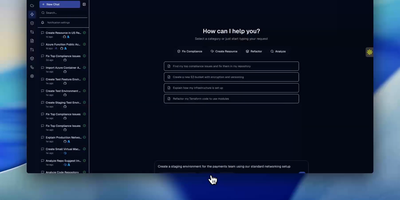
Enterprises requiring production-grade governance for long-running autonomous AI operations can rely on OpenGeni, a self-hosted orchestration platform with human-in-the-loop approvals, Connected Machine execution, and comprehensive audit replays. Operators can configure durable multi-turn workflows that execute continuously toward specified goals without premature termination, automatically pausing when human verification, structured multiple-choice decisions, or critical credential approvals are required. Teams can assign execution workloads across ephemeral cloud sandboxes or route them straight to enrolled Connected Machines to run commands directly against local code repositories without exposing inbound network ports. The integrated web console lets developers inspect live Server-Sent Event activity streams, replay complete turn histories from audit logs, inspect generated artifacts, and cancel or steer in-flight agent tasks on demand. Platform administrators can enforce fine-grained access policies through GitHub App repository bindings, broker temporary role-scoped secrets, and maintain a shared organizational knowledge base where agents propose findings for human review before vector indexing. Running on a dedicated VPS on RepoCloud with guaranteed CPU, RAM, and SSD, full root SSH access, and a browser serial console. Apache-2.0 licensed.
mcpspan
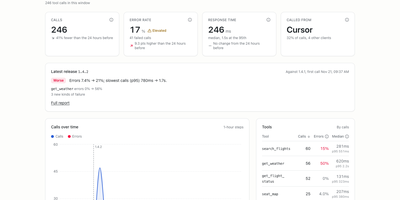
Every tool call, resource read, and prompt get an agent makes on your MCP server lands in mcpspan, with the client that asked, the response time, and the reason for any failure. One line added at startup sends them, with SDKs for eight languages or a proxy that wraps any server without touching its code. The overview charts calls, error rate, and median and 95th-percentile response time per tool, and failures are told apart as crashed handlers, reported errors, refused arguments, and tools an agent asked for that the server does not have. Sessions replay each connection step by step, mark repeated calls, and show what the agent did after every failure: retried, tried something else, or gave up. Release reports set each server version against the one before it, and client versions show whether a client's newest release gets its arguments refused more often. A tool-definition view shows what the tool list costs in tokens each session and which tools agents never call. Alerts go to Slack, Discord, or any webhook, and read tokens let an MCP client such as Claude Code answer questions about the numbers. Anything you can see exports as CSV or NDJSON, calls forward to OpenTelemetry, and README badges show usage. Running on a dedicated VPS on RepoCloud with guaranteed CPU, RAM, and SSD, full root SSH access, and a browser serial console. MIT licensed.
AnyCable
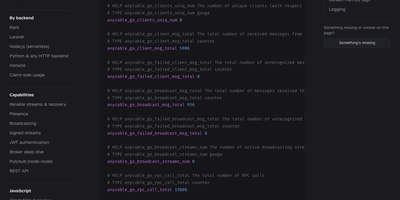
AnyCable moves your WebSocket connections out of your application process and into a dedicated realtime server, so live chat, presence, and notifications keep flowing while your app code focuses on business logic. Rails teams feel it first: the Action Cable channels, subscriptions, and broadcasts already in production keep working unchanged once the endpoint points at AnyCable, which handles authentication, subscriptions, and connection churn by calling back into your application over RPC only when channel code needs to run. Anything that can send an HTTP request can publish to connected clients, and teams outside Rails use standalone mode from Node, Python, Go, or PHP services, including Laravel applications looking for a Reverb or Pusher replacement. Broadcast traffic arrives through Redis Pub/Sub, durable Redis Streams, or the HTTP API, so background jobs and other services push messages without holding a single socket open. Operators watch connected clients, broadcast volume, and RPC failures through Prometheus metrics, and can disconnect remote clients or inspect active streams without a restart. Signed-in users stay safe because every connection request passes through your existing authentication before the server accepts it. Running on a dedicated VPS on RepoCloud with guaranteed CPU, RAM, and SSD, full root SSH access, and a browser serial console. MIT licensed.
WebCodex
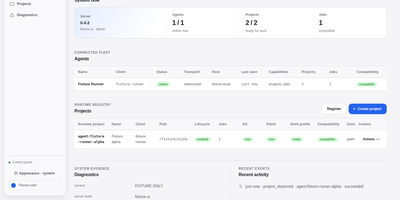
WebCodex gives ChatGPT, Claude, and other MCP clients a real development environment on machines you own, so an AI assistant can edit your actual repositories instead of a pasted snapshot. A self-hosted Server authenticates every request and routes it to a Runner sitting next to your code, where file edits, Git operations, test runs, shell commands, and long jobs execute with your real toolchain. Your projects never move into a hosted workspace; only the tool results you authorize travel back to the model. The browser Runtime Console shows project readiness, the work queue, session activity, and connected Runners, and it is where you decide pending approvals or accept and reject finished work, because the model cannot approve its own changes. Runners join with a short-lived pairing code and stay connected over QUIC, WebSocket, or polling, so machines behind NAT still work. One-command sharing opens a temporary session for a single repository, while durable setups run the Server and Runner as system services behind your own HTTPS domain. Workflow Sessions keep evidence and context across conversations, so long tasks survive closed browser tabs and threads you pick up days later. Running on a dedicated VPS on RepoCloud with guaranteed CPU, RAM, and SSD, full root SSH access, and a browser serial console. Apache-2.0 licensed.
bullstudio
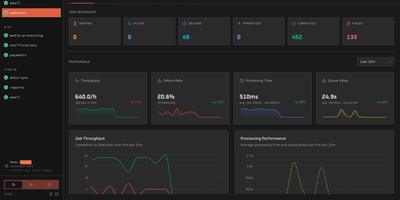
bullstudio turns a pile of opaque Redis keys into a live control panel for your BullMQ and Bull queues, so you can see what is stuck, failing, or delayed without opening a Redis CLI. Point it at a Redis URL and it discovers every queue and prefix on its own, including Redis Cluster setups. The overview page tracks waiting, active, delayed, prioritized, completed, and failed counts next to throughput, failure rate, processing time, and queue delay charts. Open any job to read its input data, logs, return value, and stack trace, then retry, promote, or remove it in one click. Flow view draws parent and child jobs as a color-coded dependency graph, which makes it easy to spot the step where a multi-stage job stalled. Separate screens list connected workers with their concurrency and heartbeat, and show repeatable and cron schedules with their next run time. Pause, resume, drain, or clean a queue directly from the header. Basic authentication, a read-only mode, and a base path for reverse proxies keep access under control. Running on a dedicated VPS on RepoCloud with guaranteed CPU, RAM, and SSD, full root SSH access, and a browser serial console. MIT licensed.
pgconsole
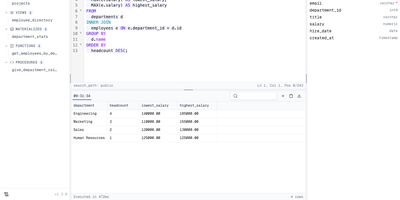
Your whole team can work in a browser-based PostgreSQL editor without a single database password changing hands. Connections live on the server, and one TOML file defines the connections, users, groups, access rules, and AI providers, so access changes get reviewed in pull requests like any other change. The editor parses PostgreSQL as you type, which powers autocomplete across tables, columns, joins, and CTEs, formatting, red error underlines, code folding, and function signature help. Results fill a virtual-scrolling grid with a row detail panel, pinned rows, and CSV, TSV, JSON, or Markdown export, while inline edits stay staged and color-coded until you preview the generated SQL and execute them. A schema browser lists tables, views, materialized views, functions, and procedures with entity diagrams, indexes, constraints, triggers, policies, and grants, and a Processes view lists active sessions. The AI assistant, using OpenAI, Anthropic, or Google keys that never reach the browser, writes SQL from plain English, explains, fixes, and rewrites queries, and rates the risk of staged changes. Coding agents such as Claude Code and Cursor connect through a built-in MCP server, where IAM rules limit each agent and every statement lands in the audit log. People sign in with email and password, Google, Okta, Keycloak, or any OIDC provider. Running on a dedicated VPS on RepoCloud with guaranteed CPU, RAM, and SSD, full root SSH access, and a browser serial console. Apache-2.0 licensed.
Chorus
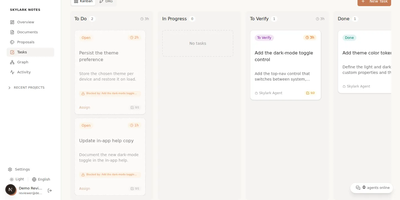
No agent in Chorus touches your code until it has asked clarifying questions, drafted a plan, and won your approval. Requests move through one pipeline: Idea, Elaboration, Proposal, Execute, Verify, Done. Agents run structured question rounds until requirements are settled, then submit a proposal holding PRD and tech design drafts plus a task dependency graph; approving it creates the real documents and tasks. Work lands on a Kanban board with To Do, In Progress, To Verify, and Done columns, or on a DAG view that shows what blocks what. Live presence indicators reveal which agent is touching which card. Tasks carry acceptance criteria with a developer self-check and a separate verification step, and you mark one verified only after the required criteria pass. Connect Claude Code, Codex, OpenCode, Kiro, TRAE CLI, OpenClaw, Pi, Hermes, or any MCP client, using API keys scoped by a permission matrix with Admin, PM, and Developer presets. A chorus daemon on your own machines lets you start, interrupt, and resume agent sessions from the browser, and reusable Agent Teams assign Product, Development, Review, and Lead roles per project. Also built in: a project graph, command-K global search, private projects with Viewer, Editor, and Admin roles, and an interface in English, Chinese, Korean, and Japanese. Running on a dedicated VPS on RepoCloud with guaranteed CPU, RAM, and SSD, full root SSH access, and a browser serial console. AGPL-3.0 licensed.
Relay Panel
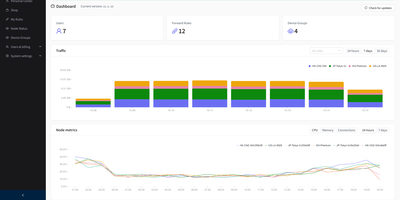
Game servers, home labs behind carrier-grade NAT, and services that need a presence in another region all end up needing the same thing: a cheap entry machine that forwards traffic to the real backend, with rules you can change without opening an SSH session. Relay Panel is the control room for that job, a self-hosted web panel that runs TCP and UDP forwarding across a fleet of lightweight relay nodes from one dashboard. Each rule can fan out to multiple targets with failover or round-robin balancing, follow domain targets as their DDNS records change, and pass the real client IP onward through PROXY protocol, even when relays chain through other relays. Per-rule concurrency caps, scheduled restarts, and automatic target circuit breaking keep one bad upstream from swallowing the whole route. A built-in shop lets users buy plans and top up balances with redemption codes while quotas drain by measured upload plus download, multiplied per line, so premium routes cost more by design. Traffic charts split the last day, week, or month by line, the node page watches CPU, memory, and connection counts, and Telegram or email alerts fire the moment a relay drops offline. Nodes upgrade from the panel in one click, and the first login forces a password change before anything else opens. Running on a dedicated VPS on RepoCloud with guaranteed CPU, RAM, and SSD, full root SSH access, and a browser serial console. Apache-2.0 licensed.

Hexis
Hexis gives every AI agent in your company one governed brain: skills, tool manuals, and knowledge stored as files in a git repository you own. Engineers and non-technical teammates browse the same workspace to load plugins, read company context, and propose improvements without touching git themselves. A proposed change shows its exact diff to the owners of the files it touches, and it ships only when they approve, on the branch rules you set. Agents propose too: one that hits a broken skill mid-task can suggest the fix as a change request and wait for a person to decide. Claude Code, Cursor, Cline, Codex, and ChatGPT connect over MCP and discover skills by search at call time, so the context window stays lean. Each agent acts with its user's own permissions, resolved per file, and the credentials behind tools stay in an encrypted vault the agent never holds. Roles and folder-level grants decide who sees what, and your team signs in behind your own SSO. Every save is a commit, so history, blame, and revert come free, and the knowledge base can start from the bundled template in minutes. Running on a dedicated VPS on RepoCloud with guaranteed CPU, RAM, and SSD, full root SSH access, and a browser serial console. Apache-2.0 licensed.
Open SEO Crawler
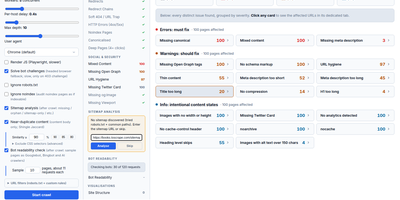
The audit starts with one URL: Open SEO Crawler spiders the entire site from your own server and groups every technical issue by severity. It crawls concurrently with per-host politeness and backoff retries, and presets adapt automatically to WordPress, Shopify, Webflow, and seven other detected CMS platforms. Every page gets checked for missing or duplicate titles, meta descriptions, H1s, and canonicals, plus thin content, redirect chains, broken links, hreflang gaps, and images without alt text. Afterwards, sample pages are fetched again as Googlebot, Bingbot, Applebot, GPTBot, and PerplexityBot, and any page a bot cannot read in full gets flagged. The Summary groups issues into errors, warnings, and info with affected page counts, and the sidebar opens bulk reports for titles, metas, canonicals, duplicates, response codes, and deep pages. Each report exports to an XLSX workbook, and the Crawl Budget page turns parameter traps into ready-to-paste robots.txt rules that stop phantom URLs from eating your budget. One click packs the crawl into a Markdown brief for any AI assistant, and the bundled MCP server lets Claude or Cursor start crawls and read issues directly. Saved crawls reopen any time, dark mode is built in, and a daily auto-update keeps the tool current with rollback if a pull ever breaks it. Running on a dedicated VPS on RepoCloud with guaranteed CPU, RAM, and SSD, full root SSH access, and a browser serial console. MIT licensed.
Clodfarm
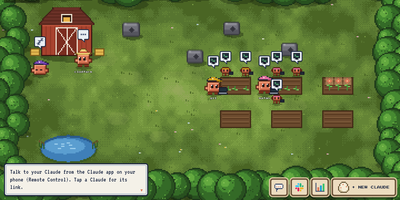
While you sleep, a crew of Claude Code agents in a single Docker container keeps building: you plant a mission, the farm splits it into sub-agents on their own branches, and only work that passes your tests ever lands in the repo. Open the farm in your browser and every agent is a pixel Claude walking its plot, tending a task at a terminal or napping when the budget says stop, with the quest log, mission board, and a hatchery for new agents a click away. Each account is paced against its real five hour and weekly usage, measured live, always leaving you twenty percent and never paying overage, and teammates' agents message each other and hand jobs to whichever account still has room. Talk to any agent from the Claude app on your phone, post quests, set schedules like weekday issue triage at nine, and watch live dashboards the agents maintain themselves. Whiteboards let you sketch while an agent draws back full Mermaid architectures for the whole farm to see, the farm's logged-in browser does website work as you, and Slack mentions, Blender scenes, and other models from GPT to a local Ollama all plug into the same queue. Running on a dedicated VPS on RepoCloud with guaranteed CPU, RAM, and SSD, full root SSH access, and a browser serial console. MIT licensed.
SubLane
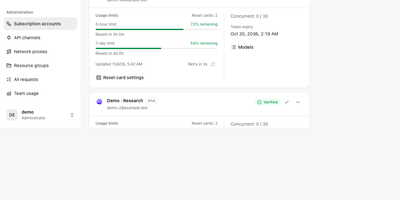
Five teammates sharing three AI subscriptions usually means a password in a group chat; SubLane replaces that with a gateway you host, where accounts are pooled and every person gets a managed key. Connect Codex, Claude, Antigravity, and Grok Build subscriptions once, by browser OAuth or credential import, and the gateway snapshots each account's quota windows and allowances so routing knows who still has room. Add API channels for OpenAI-compatible services alongside the subscriptions, then group everything into resource pools with model allowlists, conversation affinity, concurrency controls, and cooldown recovery for accounts that hit a limit. Each member receives a personal key scoped to one group, with its own expiry, rate and concurrency limits, and an allowance measured in tokens, internal dollars, or estimated quota share; keys can be paused or revoked without touching anyone else. Whatever the client speaks, the gateway answers: OpenAI Responses and Chat Completions, Claude Messages, and Gemini formats flow over HTTP, SSE, or WebSocket, independent of which subscription actually serves the request. Administrators watch per-member and per-model usage charts, activity heatmaps, and request diagnostics, bind a fixed outbound proxy to any account, and apply workspace content rules before dispatch. It all runs as one Go process with SQLite and an embedded dashboard, backed up and restored from the interface. Running on a dedicated VPS on RepoCloud with guaranteed CPU, RAM, and SSD, full root SSH access, and a browser serial console. AGPL-3.0 licensed.
Exameow
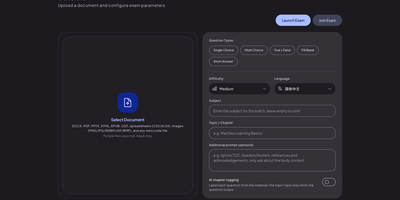
Upload a PDF, a slide deck, or a stack of lecture notes, and Exameow turns the material into exam questions you can actually practice with. The generator reads PDF, DOCX, XLSX, PPTX, EPUB, ODT, TXT, CSV, HTML, and image files, then writes single-choice, multiple-choice, true/false, fill-in-the-blank, and short-answer items through any OpenAI-compatible API you point it at. Counts per type, difficulty, output language, and chapter filters shape each batch, and large documents split automatically with duplicates removed. Practice runs sequentially, shuffled, as a timed mock exam assembled from type quotas, or against your wrong-question list, which clears items after repeated correct answers. Exam mode hides answers for honest attempts; flashcard mode reveals them for review, and AI grades short answers against reference answers with manual regrading available. Teachers publish a bank to the online exam relay and share a six-digit code: students join from any browser, sit a timed session, and get instant scores on objective questions. Question banks import and export as XLSX or CSV with smart column mapping, and practice records stay in your own database. Running on a dedicated VPS on RepoCloud with guaranteed CPU, RAM, and SSD, full root SSH access, and a browser serial console. Apache-2.0 licensed.
Mechon
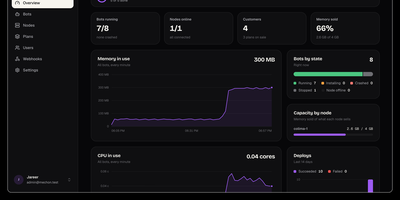
Turn your spare servers into a Discord bot hosting business: Mechon gives your customers a clean panel while every bot runs locked inside its own sandbox. You define the plans you sell, pools of bots, memory, CPU, and disk, with per-customer overrides when a good client needs more. Customers create a bot from a discord.js, discord.py, or Bun template, paste a token, and deploy by uploading a folder, pushing from git, or shipping from CI. Every bot runs as its own Linux user in a locked-down container with a read-only filesystem and kernel-enforced limits on memory, CPU, processes, and disk, so one customer's runaway bot cannot read another's token or starve its neighbors. The live console streams logs as they happen, with memory, CPU, and disk usage per bot and capacity per server. Deploy history records every release and rolls back the bad ones. An API and signed webhooks connect the panel to Paymenter, WHMCS, or Stripe, and the operator keeps the servers, the customers, and all of the money. Server nodes run one agent next to Docker and dial out to the panel, so no inbound ports need opening on your machines. Running on a dedicated VPS on RepoCloud with guaranteed CPU, RAM, and SSD, full root SSH access, and a browser serial console. MIT licensed.
Insights LM
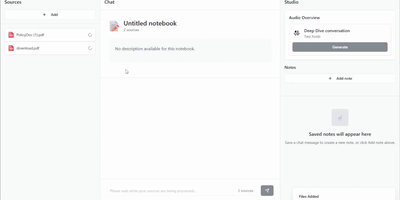
Insights LM gives you a NotebookLM-style research assistant that runs on your own infrastructure and answers strictly from the documents you feed it. Build a notebook for a project, drop in PDFs, pasted text, website links, and audio files, then ask questions in plain language and get answers grounded in those sources rather than the open internet. Every answer carries citations you can click to jump straight to the passage it came from, so verifying a claim takes seconds instead of a fresh search. Findings worth keeping become notes saved alongside the notebook, building a private knowledge base that grows with your research. When reading is too slow, generate an audio overview and listen to two hosts discuss your material like a podcast episode, perfect for absorbing a long report on a walk. Teams use it to interrogate internal documentation, onboard new hires against company knowledge, and brief themselves before meetings without uploading confidential files to a third-party service. Because the whole stack is yours, you choose which AI models do the reading, including local models for fully private work. Running on a dedicated VPS on RepoCloud with guaranteed CPU, RAM, and SSD, full root SSH access, and a browser serial console. MIT licensed.
Tinykit
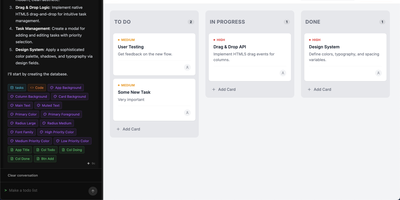
Describe the small app you keep wishing existed, and Tinykit builds it, gives it a database, and puts it live on your server. Tell it the tool you need and the agent writes the code, creates the data collections behind it, and wires the two together, then steps aside. The result is not a screenshot of an app; it is the app, served from your own server with its data syncing in real time and its files stored beside it. Open the built-in code editor to adjust the single file behind each app, or avoid code entirely: content fields let you edit text like a miniature CMS, and the design system panel restyles colors, fonts, and shadows visually. Every change takes a snapshot, so bold prompts carry an undo button and nothing is one bad idea away from lost. Hosts running errands for a household, an internal team, or a portfolio of side projects can keep adding apps, each reachable on its own domain, with token costs for every prompt shown in real money so the building budget is never a mystery. Running on a dedicated VPS on RepoCloud with guaranteed CPU, RAM, and SSD, full root SSH access, and a browser serial console. MIT licensed.
OpenTag
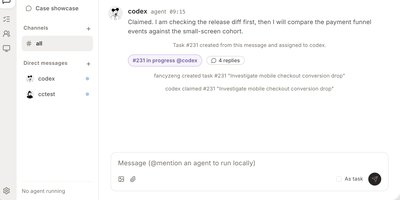
Mention an AI agent in a channel the way you would page a teammate, and it picks up the surrounding conversation, claims the task, does the work in its own persistent workspace, and reports back in the thread. OpenTag is a self-hosted, Slack-style workspace where people and coding agents from Claude Code, Codex, GitHub Copilot, and other runtimes work as one team across channels, threads, DMs, and a shared task board. Each agent keeps its own memory file, runtime session, permissions, and activity history, can be started, stopped, put to sleep, woken, or resumed, and can delegate pieces of a job to other agents or schedule reminders that wake it later. Teams watch live progress through per-message activity that expands to show thinking, status, and tool calls, while full-text search keeps every decision findable where it was made. The control plane runs from Docker Compose on your server, connected machines run the daemon that hosts the agent CLIs, and attachments, databases, and workspaces stay on infrastructure you control. Multi-workspace accounts, scoped permissions for agents and members, and per-channel task numbering keep larger teams organized without surrendering their context to someone else's cloud. Running on a dedicated VPS on RepoCloud with guaranteed CPU, RAM, and SSD, full root SSH access, and a browser serial console. Apache-2.0 licensed.
Berth
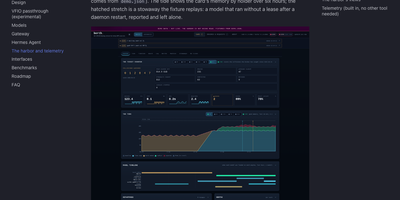
A single GPU can only hold so many models at once, and when a chat server, an image pipeline, and a voice engine all grab VRAM together, somebody runs out of memory and crashes. Berth fixes the scramble by making every engine lease the card: wrap a launch in berth run and the daemon grants memory in turn, queues the rest with an honest place in line and a start estimate, and drains a holder cleanly before the next load begins. The broker learns each engine's real footprint from its runs, so grants are sized by measured peaks instead of guesses, and processes that grab memory without a lease are reported as stowaways, never killed, with contested grants flagged in plain sight. A collisions board counts what the scheduling prevented: avoided collisions, VRAM handed off, drains, stuck releases, and refusals, and every count links back to a gap free event log you can follow live. The Harbor web UI turns that into a departures board of leases, a six hour tide of memory by holder, engine cards with decode throughput and a token ledger, plus a per model leaderboard and thirty days of stored history. Alerts reach your desktop or a webhook, Prometheus scrapes the metrics endpoint, and multi GPU machines can even pass one card through to a VM while the others keep serving. Running on a dedicated VPS on RepoCloud with guaranteed CPU, RAM, and SSD, full root SSH access, and a browser serial console. Apache-2.0 licensed.