Flipt
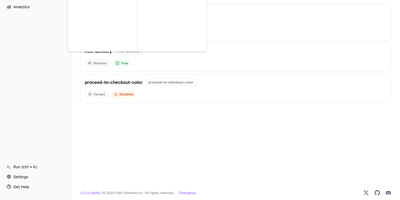
Backed by 4,800+ GitHub stars and trusted by teams replacing LaunchDarkly and Split with a self-hosted solution, Flipt v2 delivers the first truly Git-native feature management platform that treats feature flags as code stored in your own repositories. The architecture eliminates all database dependencies by building immutable in-memory snapshots from YAML flag definitions on every Git commit, delivering sub-millisecond evaluation latency with zero external runtime dependencies beyond the single Go binary. Multi-environment support maps directly to Git abstractions — separate repositories per environment, different directories within the same repository, or different branches — enabling teams to use their existing branching strategy, pull request workflows, and code review processes for flag changes. The evaluation engine supports boolean flags, multivariate string and numeric variants, segment-based targeting with constraint rules, percentage rollouts, and namespace isolation. Native SCM integration with GitHub, GitLab, BitBucket, Azure DevOps, and Gitea creates merge proposals directly from the UI with GPG-signed commits. Flipt implements the OpenFeature Remote Evaluation Protocol with official providers for Go, Node.js, Python, Java, C#, Ruby, and Web SDKs, enabling vendor-agnostic flag evaluation across all services. The gRPC API with REST HTTP gateway exposes flag management, evaluation, and analytics endpoints. Offline mode continues serving flags when the source repository is temporarily unavailable. Running on a dedicated VPS on RepoCloud with guaranteed CPU, RAM, and SSD, full root SSH access, and a browser serial console. Fair Core License (server) / MIT (client SDKs).
Codever
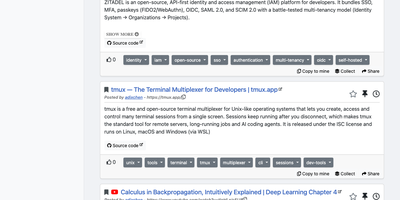
Every developer has a graveyard of browser tabs, chat messages, and stray text files holding links and code worth keeping; Codever replaces the graveyard with a bookmarks, notes, and snippets manager designed for developer workflows. Save a page in two clicks from Chrome or Firefox, drop selected text in as a snippet or note, or use the bookmarklet in any other browser, with title, description, and tags prefilled for you. From IntelliJ IDEA and Visual Studio Code you can push code straight into your library and pull it back without switching to the browser. Bookmarks carry descriptions and tags, and Pinned and Read Later lists sit beside your history so rediscovery takes seconds. Notes are written in Markdown and render with math, tables, and inline code, while snippets keep reusable code one search away with its context attached. Full text search spans bookmarks, notes, and snippets at once, with Brave, Google, Stack Overflow, and Bing one click away when the library comes up empty. Entries can be public, copied into your own collection, or gathered into curated sets for a team or topic. Accounts sign in through Keycloak with GitHub, Google, GitLab, or Stack Overflow, so a self-hosted instance fits the identity setup your team already uses. Running on a dedicated VPS on RepoCloud with guaranteed CPU, RAM, and SSD, full root SSH access, and a browser serial console. MIT licensed.
Zenko CloudServer
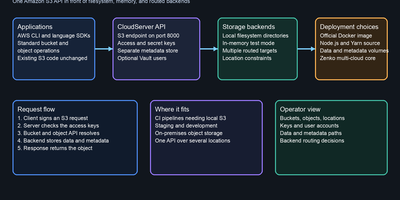
Zenko CloudServer is an open-source object storage server that speaks the Amazon S3 API, giving your applications one familiar endpoint for buckets and objects while the data itself lands on local disk or across several storage backends you choose. Developers point the standard AWS tools and SDKs at the server on port 8000, create buckets, and store objects with the same calls they would use against the public cloud, which makes it a practical stand-in for S3 in continuous integration pipelines, staging environments, and on-premises deployments that cannot send data outside the building. Single-backend mode writes to a filesystem directory you configure, an in-memory mode serves tests that need fast disposable storage, and multiple-backend mode routes each object by location constraint, so one bucket can keep hot data nearby and push colder copies to another target. Access keys and secret keys control who can read and write, metadata is stored separately from object data, and optional Vault integration handles user management for larger installations. The server ships as a Docker image for quick deployment and runs from source with Node.js and Yarn, and because it is the storage core of the Zenko multi-cloud data controller, the same API also fronts public cloud backends for teams building a single access layer over data stored in several places. Running on a dedicated VPS on RepoCloud with guaranteed CPU, RAM, and SSD, full root SSH access, and a browser serial console. Apache-2.0 licensed.
Flyimg
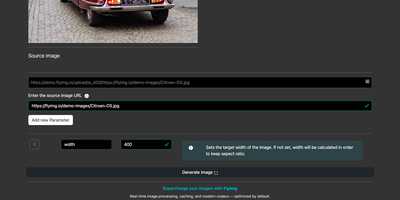
Flyimg generates every image size a website needs at request time, turning one original into resized, cropped, and compressed variants through a simple URL. Append options like width, height, crop, and quality to a request, and the service fetches the source image, transforms it, and serves the result, storing it in cache so the next request is answered instantly. Output defaults to AVIF for browsers that support it, with WebP and MozJPEG compression available for lean JPEG delivery, plus PNG and GIF when the source calls for them. Signed URLs keep strangers from using your server as a free image proxy, and domain restrictions limit which sources the service will fetch from. One Docker container gives a website or application a complete image pipeline: originals stay in whatever storage already holds them, and every thumbnail, banner, and product shot is produced at request time in exactly the dimensions the layout needs. Cache headers and repeat serving keep bandwidth costs predictable as traffic grows. Running on a dedicated VPS on RepoCloud with guaranteed CPU, RAM, and SSD, full root SSH access, and a browser serial console. AGPL-3.0 licensed.
TileServer GL
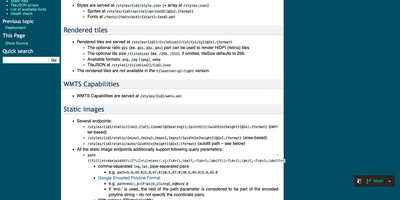
TileServer GL turns map data files on your server into the styled map tiles that websites and mobile apps expect, so your maps stop depending on a commercial tile provider and its usage bill. Feed it an MBTiles or PMTiles file, for example an OpenMapTiles extract of a city, a country, or the whole planet, and it serves vector tiles straight from the file to MapLibre GL JS, mobile SDKs, Leaflet, and OpenLayers clients. The full version renders raster tiles on the server side too, producing PNG, JPEG, and WebP images at standard or retina resolutions for clients that cannot draw vector maps. Cartography stays in your hands through GL styles: the server hosts the style JSON, sprites, and font glyphs, and every layer color, label, and road casing can be restyled and republished without touching the underlying data. GIS tools connect through WMTS capabilities documents, and TileJSON endpoints describe every served dataset for automatic client configuration. Static image endpoints answer with finished map pictures for reports, thumbnails, and emails, centered on coordinates or fitted to an area, with route lines and markers drawn onto the image on request. A built-in browser viewer lists your styles and data sources for a quick look at what is being served, terrain datasets can answer elevation queries by coordinate, and a health endpoint reports when the server is ready. Running on a dedicated VPS on RepoCloud with guaranteed CPU, RAM, and SSD, full root SSH access, and a browser serial console. BSD-2-Clause licensed.
Uwazi
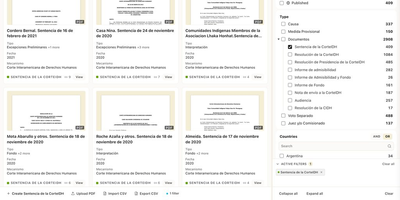
Human rights teams, legal researchers, and archivists use Uwazi to turn scattered documents and case records into searchable, structured collections that the public or trusted partners can explore online. You design templates that define exactly which fields each record carries, from dates and locations to people, organizations, and document types, then import material through the interface or in bulk from CSV files. Uploaded PDFs and documents become full-text searchable, so a phrase buried inside a scanned report is as findable as the metadata typed beside it. Relationships connect related entities across the collection, letting you trace how a person, an event, and a piece of evidence fit together instead of keeping them in isolated folders. Curators build public pages with live filters, maps, and visualizations drawn directly from collection data, while granular permissions decide which records stay private, which are shared with specific groups, and which are published for everyone. Multi-language support lets the same collection serve readers in several languages, and activity logs keep an audit trail of edits. Running on a dedicated VPS on RepoCloud with guaranteed CPU, RAM, and SSD, full root SSH access, and a browser serial console. MIT licensed.
Fonrex
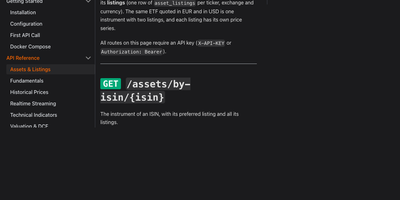
Good European market data is either expensive or wrong, so Fonrex runs it all on your server: a self-hosted API serving per-listing prices, cross-checked fundamentals, DCF valuations, and factor models for European and US shares, with no subscription or per-call meter. Every price is stored per listing in its own currency and dated by trading session, so AIR.PA resolves to Airbus rather than a same-ticker US namesake, and one ISIN can carry many listings cleanly. Fundamentals are cross-checked between sources first; figures that disagree with the consensus are rejected, and every answer names the sources it came from. Value any company three ways with FCF, EPS, and dividend DCF models, compare them side by side, and stress the result with a WACC by growth sensitivity matrix. Factor tools return Kenneth French returns for the US, Europe, and developed markets, compute listing factor exposure, and price equity with the risk-free rate of the right currency, alongside FRED and ECB rates, Treasury curves, and Eurostat indicators. Daily history spans ten years, split-adjusted with a dividend-adjusted close; live ticks stream over WebSocket, indicators and a screener run on your stored prices, and deduplicated news arrives per ticker or as a global feed. Results plug into OpenBB Workspace, Google Sheets, Python notebooks, and Zipline backtests, so spreadsheets, dashboards, and research pipelines all read the same numbers. Running on a dedicated VPS on RepoCloud with guaranteed CPU, RAM, and SSD, full root SSH access, and a browser serial console. AGPL-3.0 licensed.
Kinto
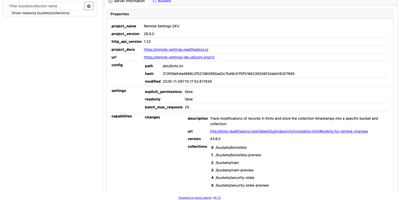
Web and mobile applications get a ready-made backend from Kinto: create buckets and collections through a REST API, save records as plain JSON, and every signed-in device reads the same data without any custom server code. Permissions attach to individual buckets, collections, and records, so you can keep a shared dataset public, limit a collection to a signed-in group, or hand a teammate write access to exactly one collection. Groups bundle people and carry permissions as a unit, which keeps multi-user applications tidy as rosters change. Synchronisation is the headline act: each object carries an incrementing revision number, clients poll for changes since a revision they already hold, and the JavaScript client stores data in IndexedDB so applications keep working offline and publish updates when the connection returns. Collections can declare a JSON schema, and the server rejects records that do not match, which stops malformed writes at the door. The history plugin records every change with its author, an audit trail you can query or roll back from. Records can carry file attachments, and the Kinto Admin web console renders buckets, collections, and records in a browser so you can inspect data, edit entries, and repair permissions without curl. Mozilla runs this model to deliver Firefox configuration and blocklists, and your VPS instance speaks the identical API. Running on a dedicated VPS on RepoCloud with guaranteed CPU, RAM, and SSD, full root SSH access, and a browser serial console. Apache-2.0 licensed.
Exceptionless
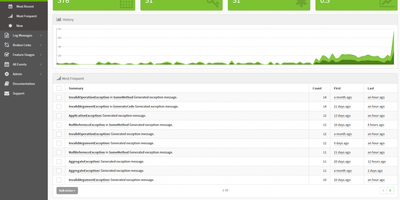
Exceptionless has earned over 2,400 GitHub stars and has been processing production errors since 2014 as the real-time event monitoring platform that captures far more than crashes. Built with ASP.NET Core on Elasticsearch for storage and Redis for caching, Exceptionless ingests exceptions, log messages, feature usage events, broken links, and custom event types through official SDKs for JavaScript, Node.js, .NET Core, ASP.NET, WPF, Web API, WebForms, Console apps, and React Native. Automatic event stacking groups related occurrences by exception type, message, and call stack into single actionable items, while manual stacking keys let developers create custom groupings for specific features or workflows. The real-time dashboard displays Most Frequent, Most Recent, and New event views with filtering by project, date range, environment, and custom tags. Stack management tracks resolution status with version-aware regression detection that automatically reopens resolved issues when the same error surfaces in a newer release. Webhook integrations connect to Slack, Discord, and external services through Zapier for automated issue tracking in GitHub Issues and Jira. Per-project notification settings control email and chat alerts for new errors, regressions, and critical events. OpenTelemetry support captures distributed traces alongside error data. The v8.6.0 release introduced a hosted Model Context Protocol server at the /mcp endpoint, enabling AI tools to query error data via OAuth-authenticated access. Deploy via Docker with the exceptionless/exceptionless image alongside Elasticsearch and Redis. Running on a dedicated VPS on RepoCloud with guaranteed CPU, RAM, and SSD, full root SSH access, and a browser serial console. Apache 2.0 licensed.
FlaskBB
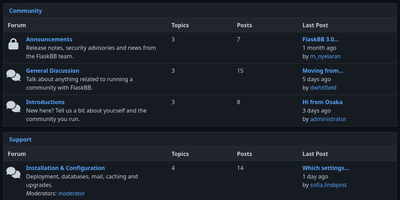
For communities that want a classic forum of their own, FlaskBB offers categories, topics, replies, and moderation tools the community controls. Members write posts in Markdown with an editor toolbar, syntax-highlighted code, and emoji, quote one another with a link back to the original post, and type @ plus three characters to get username suggestions. They upload avatars, attach files to posts and topics, and rely on unread tracking and a topic tracker to see what changed since their last visit. Group-based permissions and per-forum moderators decide who can read, post, and moderate. Administrators manage users, groups, forums, and reports from a side-navigation panel, hide or unhide topics and posts, remove every post of a spammer in one action, and switch on reCAPTCHA. Search highlights matching terms on its results page. Official plugins add private messages, a portal page, invite-only registration, likes, user ranks, and StopForumSpam checks, and an extension registry lists more plugins and themes. The Aurora theme comes in light and dark variants, and translations cover more than a dozen languages. Running on a dedicated VPS on RepoCloud with guaranteed CPU, RAM, and SSD, full root SSH access, and a browser serial console. BSD-3-Clause licensed.

Urlaubsverwaltung
One calendar answers who is away next week: Urlaubsverwaltung is a self-hosted leave and absence manager where employees request vacation, managers approve it, and sick notes and overtime balances live beside the requests. A request moves through waiting, provisionally approved, finally approved, rejected, or cancelled states, so employees and approvers always see where a decision stands. Department heads decide for their own teams, a second stage authority can add the final approval, the boss sees every request company wide, and office staff manage people, settings, and sick notes for others. Administrators configure which absence types exist, from annual and special leave to parental leave, sabbatical, training, and working from home, each with its own color and rules. Sick notes are recorded as full day, morning, or afternoon, including child sick notes, and a note can later be converted into vacation when plans change. Overtime gets the same care: staff log hours and minutes for any period, choose to add or reduce their balance, and attach a comment for the record. Personal, department, and company calendars collect every absence, secret iCal links feed external calendar apps, and optional Google Calendar synchronization pushes new and changed entries. Email notifications for submissions, upcoming absences, substitute duties, and overtime entries can be switched on per person, and a token protected REST API exposes persons, absences, sick notes, and workdays. Running on a dedicated VPS on RepoCloud with guaranteed CPU, RAM, and SSD, full root SSH access, and a browser serial console. Apache-2.0 licensed.

Isso
Named from the German "Ich schrei sonst" - roughly "or I'll scream" - Isso is a lightweight Python/JavaScript commenting server, a drop-in Disqus replacement for people who noticed what Disqus does to reader privacy and page load times. The design premise is printed right in the docs: comments are not Big Data. So the backend is a single SQLite file rather than a database cluster, and the entire client is one embeddable JavaScript file - 65 kB, 20 kB gzipped - that you drop into any static site, blog, or CMS. Commenters write in Markdown, need no account, and can edit or delete their own comments within a configurable window (15 minutes by default). Spam control comes from an optional moderation queue: held comments stay invisible until you activate them via an admin interface or email notification links. Migration is a first-class feature, with importers for Disqus and WordPress exports, so years of existing threads move over intact. Because everything is server-rendered from your own instance, no third party tracks your readers, and real-world switchers report smaller pages and faster loads than the Disqus embed. MIT-licensed, running since 2012.
Password Pusher
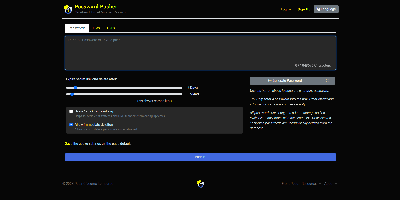
Credentials sitting forever in email threads and chat scrollback - Password Pusher solves that everyday security failure. Instead of pasting a password into Slack, you push it - a password, note, file, URL, or QR code - and share a unique one-time link that expires after a set number of views, a time limit, or both. Content is encrypted at rest with AES-GCM under a configurable master key, optionally guarded by a passphrase, and permanently deleted from the database the moment it expires; a retrieval-step option keeps URL-scanning bots from consuming views. Full audit logs record when each link was created and viewed (and by whom, with logins), and TOTP two-factor authentication can be required instance-wide. The delivery page is deliberately unbranded - no logos or confusing links for recipients - and the interface ships in 31 languages with light and dark themes. Automation runs through a JSON API (v2), an official CLI for pushing and expiring secrets from the terminal, a Chrome extension, and a catalog of third-party integrations. Apache-2.0 licensed Ruby on Rails, deployable via Docker, Kubernetes, or Helm, with SQLite or PostgreSQL storage - the sysadmin staple for sending credentials that clean up after themselves.
Saiku Analytics
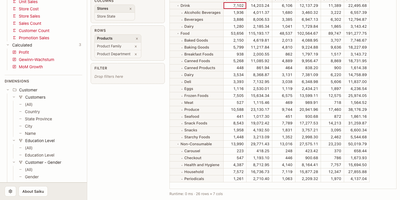
Point Excel, dashboards, and AI agents at one governed cube and Saiku Analytics, an open-source semantic layer, answers all three with the same numbers. The Query Editor writes the MDX as analysts drop measures and levels onto rows, columns, and filters, then shows a pivot grid or 16 chart types such as treemap and sunburst. Dashboards mix KPI, chart, table, text, and image tiles with cross-filtering, drill-down, conditional formatting, and forecast overlays, then export to PDF or PNG, share read-only links, or embed as a web component. An Excel add-in drops governed PivotTables that refresh live, and a Google Sheets add-on inserts cube data as tables that refresh in place. Agents get a typed REST API that lists cubes and measures, accepts JSON questions at /ai/query, and returns the exact field and legal values when validation fails. An MCP server connects Claude Desktop, Cursor, and Cline with a one-click .dxt install, and agent spaces limit each persona to chosen cubes and markdown skills. No semantic model yet? Saiku drafts cubes, dimensions, measures, and joins from a warehouse schema for review. Queries run on DuckDB, ClickHouse, Snowflake, BigQuery, Postgres, and dozens more databases, and model diff flags every saved query or dashboard a schema change would break. Okta and Entra ID provision accounts over SCIM 2.0, and sign-in runs through OIDC or SAML. Running on a dedicated VPS on RepoCloud with guaranteed CPU, RAM, and SSD, full root SSH access, and a browser serial console. Apache-2.0 licensed.
dpaste
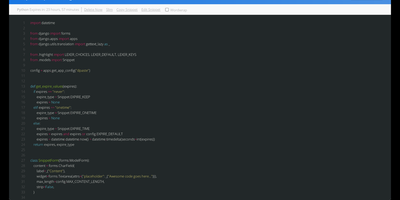
dpaste is a self-hosted pastebin that turns code snippets, log excerpts, and config files into short highlighted links with expiry and access rules you control. Paste code, stack traces, or plain notes, pick the language, and highlighting makes the result readable at a glance in the browser. Set the paste to expire in an hour, a week, a month, or never, or make it a one-time snippet that deletes itself after it has been viewed. Every paste offers a raw view for clean copying and terminal friendly reading, and random short slugs keep links tidy in tickets and commit messages. Scripts post through the API with a single request, so deploy tooling and CI jobs can publish their output where humans can read it. Run it standalone for the team, or fold it into an existing Django project as an app, and tune slug length, default language, maximum size, and expiry choices to your habits. Nobody has to wonder which public paste site a sensitive debug log landed on, because the bin answering the link is yours. Running on a dedicated VPS on RepoCloud with guaranteed CPU, RAM, and SSD, full root SSH access, and a browser serial console. MIT licensed.
Review Board
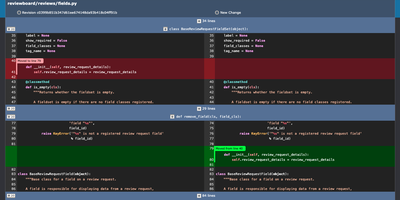
Before a change lands in the main branch, Review Board gives your team a self-hosted code review server where reviewers read the diff, open issues on specific lines, and sign off with a Ship It. Post a review request from the web or with RBTools, either before you commit or after, and every update becomes a new revision that stays in the history. Interdiffs show exactly what changed between revisions, and moved-code detection keeps rearranged blocks from drowning out real edits. Comments can open issues that reviewers later mark fixed or dropped. Images and Markdown files can be reviewed alongside code, with split, onion-skin, color, and side-by-side diffs for pictures. A dashboard with customizable columns separates incoming from outgoing requests by review group. Connect Git, Mercurial, Subversion, or Perforce repositories, including ones hosted on GitHub or GitLab, and review them all on one server. Slack and Discord notifications, Jenkins builds, and Review Bot linters report back inside the review. Private repositories and hidden or invite-only review groups restrict who sees what, with sign-in through Active Directory, LDAP, or SAML 2.0. A REST API, WebHooks, and Python extensions cover custom workflows. Running on a dedicated VPS on RepoCloud with guaranteed CPU, RAM, and SSD, full root SSH access, and a browser serial console. MIT licensed.
Easy Invoice PDF
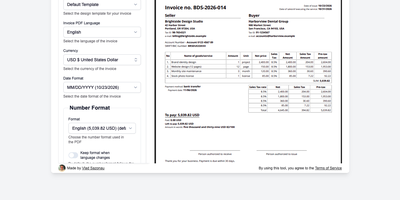
Freelancers, contractors, and small shops can turn a short form into a client-ready PDF invoice, with a live preview that redraws on every keystroke and no account to create. Fill in seller and buyer details, then add line items with quantity, unit, net price, and tax rate; net amounts, tax, totals, and the amount in words are calculated automatically. Item discounts take a percentage or fixed amount off any line under a custom label, and tax applies to the discounted figure. Pick a classic layout or a Stripe-style template, and add your logo as a JPEG, PNG, or WebP file. Invoices can be written in 13 languages, including Brazilian Portuguese, with 122 currencies, 18 date formats, and a number format setting that survives a language switch. Tax labels can read VAT, GST, Sales Tax, or anything else, or the tax columns can be dropped entirely. Bank account, SWIFT/BIC, payment method, due date, and notes sit alongside an optional QR code that can carry a payment link, UPI details, or contact information. Long invoices flow onto extra pages automatically. Saved seller and buyer profiles fill in the next invoice for you, and the data stays in the browser. Download the PDF or copy a shareable link that opens the same invoice for your client. Running on a dedicated VPS on RepoCloud with guaranteed CPU, RAM, and SSD, full root SSH access, and a browser serial console. AGPL-3.0 licensed.

FoJin
Ask a question about Buddhist scripture in plain language and get an answer that points to the exact passage it came from. FoJin brings thousands of texts from hundreds of digital libraries into one search box, so a reader no longer jumps between a dozen archives with different layouts. The AI assistant, called XiaoJin, answers with clickable citations that open the original text, and it can also reply in the voice of historical masters scoped to their own tradition. Search covers classics, translators, and catalog numbers, with filters by country and collection. Reading pages show full text, and parallel views line up translations in many languages, with Chinese, Pali, and Tibetan versions of the same sutra side by side. Thirty-nine dictionaries answer term lookups, a knowledge graph maps people, lineages, and places, and a data source directory shows what each collection offers. Readers can save collections, bookmarks, and annotations, then export citations in BibTeX, RIS, or APA. A read-aloud mode highlights each sentence in sync with audio. Quote verification confirms that a sentence really exists in the canon, and where. Running on a dedicated VPS on RepoCloud with guaranteed CPU, RAM, and SSD, full root SSH access, and a browser serial console. Apache-2.0 licensed.