Vigil
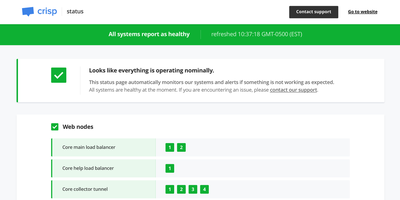
Vigil monitors your entire distributed infrastructure and generates a public status page from a single Rust binary small enough to run on a Raspberry Pi, consuming minimal CPU and memory while providing crash-free reliability. Four distinct monitoring modes cover every topology: poll probes check HTTP, TCP, SSH, and ICMP endpoints for reachability with configurable intervals and thresholds; push probes receive health reports from Vigil Reporter libraries embedded in your application code across Node.js, Python, Golang, Rust, TypeScript, Dart, and C#; local probes delegate monitoring to Vigil Local slave daemons running behind firewalls on separate LANs; and script probes execute custom shell commands for specialized health checks. Each monitored service transitions through healthy, sick, and dead states based on consecutive probe failures, with configurable thresholds controlling state transition sensitivity. When services change state, Vigil dispatches notifications through twelve alert channels including Slack, Email, Twilio SMS, Telegram, Pushover, Gotify, XMPP, Matrix, Zulip, Cisco Webex, and generic webhooks. The generated status page displays service groups organized by category with real-time replica status, system load metrics from reporter probes, and a maintenance announcement system for communicating planned downtime through the Manager HTTP API. Configuration uses a single TOML file defining all probes, services, and notification channels with no database dependency. Docker deployment pulls the official image with volume-mounted configuration. Running on a dedicated VPS on RepoCloud with guaranteed CPU, RAM, and SSD, full root SSH access, and a browser serial console. MPL-2.0 licensed.

Jump
Open a new tab and the whole homelab should answer two questions instantly: where is everything, and is it still alive? Sites appear as large tappable icons with custom artwork, or Jump fetches each service's original favicon on its own. Green means up, red means down: real-time status monitoring paints every entry, so a failed service announces itself before anyone files a complaint. Tags spread links across multiple pages, and the tag panel jumps between home, media, admin, or any grouping you invent. A keyboard shortcut opens search, matching names, tags, and URLs as you type, and the same box can hand a query to your chosen search engines for everything beyond the lab. Weather and local time sit in the corner through OpenWeatherMap, backed by your own background photos or a fresh Unsplash image each visit. Greeting, clock format, and site name are all switchable, and the layout adapts to a phone screen held in one hand. Configuration lives in plain mapped folders for backgrounds, favicons, search engines, and sites, so a backup is just a copy. It serves on port 8080 in Docker, installs on Kubernetes with a community Helm chart, or runs directly under PHP on a web server. Running on a dedicated VPS on RepoCloud with guaranteed CPU, RAM, and SSD, full root SSH access, and a browser serial console. MIT licensed.
Upstat
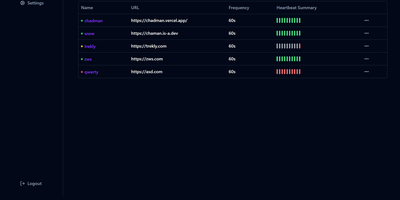
When a service you run goes down at 3 a.m., Upstat is the watcher that notices first and writes it down. Add any HTTP or HTTPS endpoint and it checks in every sixty seconds, building a living record of uptime, response latency, and ping times that you can read at a glance from status and latency charts. Certificate details sit alongside each monitor, so an expiring TLS certificate stops being a surprise outage waiting for a date. Each monitor can appear on public status pages, and you can run several of them, mapping different pages to different domains so customers, clients, or separate products each get their own honest view of what is up. When a check fails, a Discord notification heads to your channel with the news, and the dashboard keeps the incident in its history instead of letting it vanish into a chat scrollback. Install it as a progressive web app, keep its data in SQLite for a one-file setup or PostgreSQL when the deployment grows, and the whole thing stays on infrastructure you control. Running on a dedicated VPS on RepoCloud with guaranteed CPU, RAM, and SSD, full root SSH access, and a browser serial console. MIT licensed.