libSQL
libSQL bridges the gap between SQLite's legendary simplicity and the server-accessible database model developers expect from PostgreSQL and MySQL, adding network access, replication, and vector search while maintaining full file format and API compatibility. The sqld (SQL daemon) component transforms SQLite into a network-accessible database server accepting queries via HTTP with JSON payloads, WebSocket connections, and a Hrana protocol optimized for low-latency edge access. Client libraries for TypeScript, JavaScript, Rust, Go, and Python connect to sqld identically to any traditional client-server database, while the LD_PRELOAD compatibility layer enables switching existing SQLite applications from local to remote mode without code changes. Embedded replicas synchronize a local SQLite copy inside your application process with the primary server, delivering sub-millisecond read latency while maintaining consistency through streaming replication. Bottomless replication continuously backs up database state to S3-compatible object storage with generation-based snapshots and WAL page shipping, providing point-in-time recovery without manual backup scheduling. Native vector search enables semantic similarity queries directly within SQL using cosine distance functions, eliminating the need for external vector database infrastructure. Read replica support distributes query load across multiple sqld instances, and integration with mvSQLite adds multi-version concurrency for high-availability deployments. Created by Turso with 17,100+ stars and active production deployment. Running on a dedicated VPS on RepoCloud with guaranteed CPU, RAM, and SSD, full root SSH access, and a browser serial console. MIT licensed.
Typing Mind
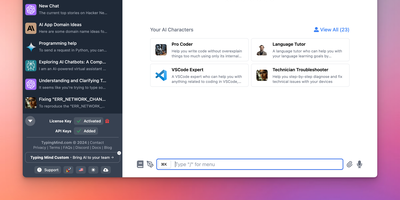
Bring your own API keys and work with OpenAI GPT models, Anthropic Claude, Google Gemini, Mistral, DeepSeek, Grok, Azure endpoints, and local models in one organized workspace: TypingMind is a unified chat frontend for large language models, replacing a browser tab per provider. Parallel chat sends the same prompt to multiple models and compares answers side by side, and models can be switched mid-conversation. A prompt library stores reusable, tagged prompts with variables, and the AI Agents system builds specialized assistants that bundle a base model, custom instructions, assigned plugins, and uploaded knowledge files for RAG. Plugins extend every connected model with web search, image generation (DALL-E, Stable Diffusion), Deep Research, URL reading via Firecrawl, and Zapier automation - plus MCP server integrations for Notion, Atlassian, and other external tools, and a JavaScript extension API for custom behavior. Chats store locally by default with optional sync. Self-hosting puts the interface on your own domain and, for teams, adds branding, member access limits, and shared prompt and agent libraries.
CCX
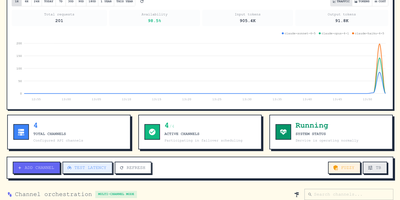
CCX gives every coding agent and chat client one stable address, and the real model providers can come and go behind it. Point Claude Code, Codex, or any SDK at the gateway and it forwards requests to the first healthy channel in a failover sequence, then moves down the list when an upstream returns errors. Each channel carries its own keys, model allowlist, proxy, and custom headers, and the Add Channel dialog detects a base URL and keys from pasted text. The admin console tracks requests, availability, tokens, and cost over ranges from one hour to a year, with a chart per model and a live success rate beside each channel. Drag a channel to change its priority, park it in the standby pool, or open its log to see the status, timing, and key of every call. Separate tabs cover Claude Messages, OpenAI Chat, Images, Vectors, Codex, and Gemini, and a dark theme and language switch are built in. Access is guarded by a proxy key and an optional admin key. Running on a dedicated VPS on RepoCloud with guaranteed CPU, RAM, and SSD, full root SSH access, and a browser serial console. MIT licensed.
Marimo
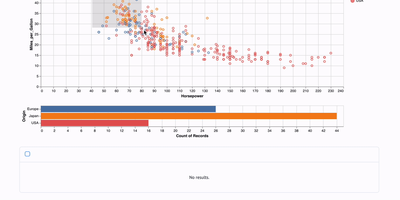
Marimo is a reactive Python notebook that treats cells like spreadsheet formulas: change one cell or interact with a UI widget and every dependent cell automatically re-executes, eliminating the hidden state bugs that make traditional notebooks unreliable. Backed by over 22,000 GitHub stars, notebooks are stored as pure Python files with PEP 723 inline metadata, making them Git-diffable, importable as modules, executable as CLI scripts with parameterized arguments, and testable with PyTest. Built-in SQL cells query Polars, Pandas, PyArrow, DuckDB, SQLite, PostgreSQL, and MySQL databases, with results automatically flowing into the reactive dependency graph. The AI-native editor provides GitHub Copilot autocomplete, context-aware assistants that access live runtime variables, inline code edits powered by configurable models from OpenAI, Anthropic, or local Ollama instances, and a pair mode that lets external AI agents connect over WebSocket. Notebooks become read-only interactive web applications with marimo run, collaborative authoring environments with marimo edit, or embedded flows inside existing FastAPI applications through ASGI middleware. Gallery mode serves multiple notebooks from a single instance with an auto-generated index page. The Docker image ships with SQL support, token-based authentication, health check endpoints at /health and /api/status, and configurable WebSocket or SSE kernel transport for proxy compatibility. Running on a dedicated VPS on RepoCloud with guaranteed CPU, RAM, and SSD, full root SSH access, and a browser serial console. Apache 2.0 licensed.
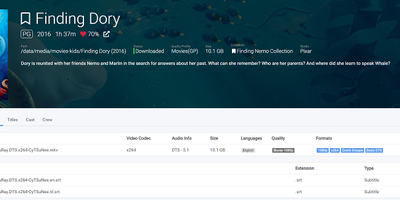
Radarr
The movie half of the *arr stack: Radarr is a .NET collection manager that automates acquiring films for Usenet and BitTorrent users the way Sonarr does for TV. Add a movie once and Radarr handles the rest: it monitors indexers and RSS feeds, grabs a matching release the moment one appears, sends it to SABnzbd, NZBGet, qBittorrent, Deluge, Transmission, rTorrent, or another connected download client, then imports, sorts, and renames the file into your library structure. Quality profiles are the control surface - define allowed resolutions and a cutoff, and Radarr keeps upgrading files automatically, replacing a DVD rip when a Blu-ray release lands. Custom formats go further, scoring releases by codec, HDR metadata, release group, streaming source, or arbitrary regex so the copy you want always wins the pick. Failed downloads retry with another release automatically; a manual search shows every candidate and explains why one was skipped. Release parsing recognizes director's cuts, special editions, AKA titles, and hardcoded subs. Plex and Kodi integration handles notifications, library refreshes, and metadata like posters, trailers, and subtitles, and a calendar view tracks upcoming releases. It pairs naturally with Jellyseerr for request management and shares its API conventions with the whole *arr ecosystem.
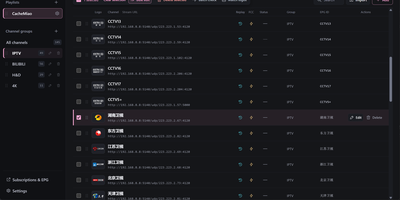
M3U Studio
M3U Studio turns a tangled IPTV playlist into a tidy, published subscription you would actually hand to your player. Import channels from an M3U or TXT file, pasted text, or a remote link, then organize them properly: drag single channels or whole multi-selections into new groups, rename, reorder, and watch the list reshape itself as you work. Nothing goes live until you say so. Edits accumulate in a draft with undo and redo, and publishing keeps the last 30 configurations so a bad change rolls back in seconds. Channel logos stop being a scavenger hunt, because a unified logo library matches artwork automatically by name and alias, with search and batch upload when you bring your own. Select a pile of channels and fix them together: replace URL text, change groups, set EPG addresses, or move copies into another playlist, then run response checks to spot dead streams before your player does. Each playlist publishes as its own M3U or TXT subscription, or merged into a combined feed, under a custom short address that is easy to type into a TV box. Per-channel EPG, catch-up, and fast channel change settings travel with the export. Running on a dedicated VPS on RepoCloud with guaranteed CPU, RAM, and SSD, full root SSH access, and a browser serial console. GPL-2.0 licensed.
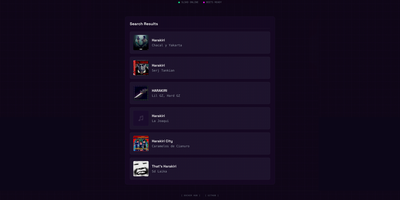
Soulbeet
One search is all it takes: type an album or track, press download, and Soulbeet turns the song you wanted into a tagged, filed library track inside Navidrome. It weighs the sources Soulseek offers through slskd, pulls the best one down, and hands the files to beets for tagging and organizing, with MusicBrainz matches scored in the open. When a match fails, the download stays put with its files intact, offering the candidates beets weighed, a paste-a-link MusicBrainz override, a retry, or an import-as-is using the file's own tags. Discovery keeps the shelves moving: connect Last.fm or ListenBrainz and the engine studies your listening to surface new tracks through track similarity, artist exploration, collaborative filtering, and genre exploration. Conservative, Balanced, and Adventurous profiles each keep their own Navidrome playlist, and a six-hour automation cycle refreshes picks, syncs ratings, prunes what expired, and regenerates the lists. Rating closes the loop in Navidrome: three stars or more promotes a track into the permanent library, one star deletes it, and unrated finds expire to make room. Households share the instance without sharing taste, because every user keeps private or shared folders, separate beets databases for duplicate detection, their own discovery profiles, and their own scrobble credentials. Light, medium, and full image tiers decide how deep tagging goes, adding AcoustID fingerprint matching, cover art, lyrics, and ReplayGain. Running on a dedicated VPS on RepoCloud with guaranteed CPU, RAM, and SSD, full root SSH access, and a browser serial console. MIT licensed.
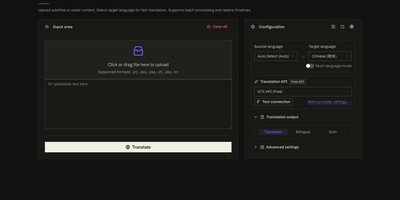
Subtitle Translator
A whole season of subtitles can be translated in a single drop, with every timecode left exactly where it was. Subtitle Translator strips cue numbers and timing out of each file, sends only the dialogue to the translation engine, and puts everything back afterward, so a model never gets the chance to scramble a timeline. Pick any of 120+ target languages, or turn on multi-language mode to export several at once. Engines range from DeepL, Google, and Azure to dozens of LLM providers, gateways, and any OpenAI-compatible endpoint, including a local Ollama or LM Studio model. Context-aware mode feeds surrounding lines to the model for steadier dialogue and consistent character voices, and a glossary keeps names and product terms fixed across episodes. Bilingual output stacks original and translation in one file, either as plain SRT or as ASS with separate styles for each line. SRT, VTT, ASS, and LRC convert between each other during translation. Translated lines are cached, so a rate-limit pause or a closed tab only costs the missing lines. A text extractor strips timing for summaries and scripts. The interface itself is available in 18 languages, and companion tools handle Markdown, JSON locale files, and plain text. A back catalog of course videos or fan-subbed episodes becomes a weekend job instead of a month-long slog. Running on a dedicated VPS on RepoCloud with guaranteed CPU, RAM, and SSD, full root SSH access, and a browser serial console. MIT licensed.
pi-dispatch
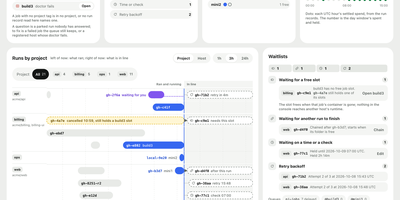
pi-dispatch turns one AI coding agent into a swarm that works in the background and reports to a single web page. Jobs start from a nightly schedule, a labeled issue, or a comment, then wait in one shared queue until a machine has room. Each job runs in a sealed box that is thrown away afterwards, reaches only the internet addresses you allow, and stops at the dollar limits you set per day, week, and month. When an agent hits a decision, it parks a question with options and a recommendation, and no model spend accrues until you answer. The overview shows what needs you, what is queued, what is running, and what today has cost. A Zero touch page tracks how often runs needed a person, per project, so you can see how far to step back. On GitHub, GitLab, Forgejo, and Azure DevOps the work ends as a proposed change that a human merges. Fleet, Spend, Triggers, and Models pages cover several machines, budgets per project, and fallback models. Running on a dedicated VPS on RepoCloud with guaranteed CPU, RAM, and SSD, full root SSH access, and a browser serial console. MIT licensed.
NornicDB
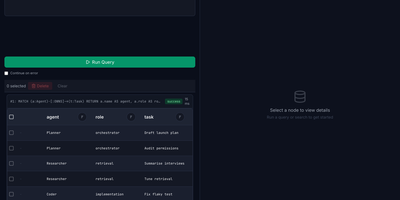
Agents forget things, and a graph database that learns is a fine place to keep what they should remember. NornicDB stores connected data as nodes and relationships, then answers Cypher queries from the browser console or from any Bolt driver you already use. Results appear in a sortable table, and selecting a row opens node details with labels, properties, and a Find Similar action. Switch to the Graph Explorer to see a node's neighborhood drawn as a graph, with a depth setting and filters for labels, edge types, and properties. Vector and full-text search run beside traversal, so one database can answer both who is connected and what is similar. Historical reads keep earlier states available through MVCC, and a lifecycle page shows pressure, prune runs, and schedules. Knowledge policies define decay and promotion rules for agent memory, and API tokens secure MCP and other integrations. Running on a dedicated VPS on RepoCloud with guaranteed CPU, RAM, and SSD, full root SSH access, and a browser serial console. MIT licensed.
WPMgr
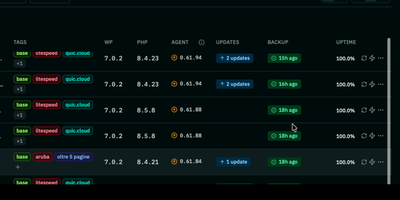
One dashboard for every WordPress site you look after: that is WPMgr, a self-hosted control panel that replaces dozens of separate wp-admin tabs with a fleet view you own. Enroll a site by URL, paste a one-time code into its agent plugin, and the connection flips live on its own. From there the daily grind changes shape. Backups stream straight out of PHP with no mysqldump and no shell access, chunked and deduplicated, scheduled per site, and restorable as a whole site or just the database. Updates stop being a weekend ritual: preview the run dry, apply it across the fleet, and let the automatic snapshot and health check roll back a bad release before a client notices. Uptime probes split DNS, TLS, and time-to-first-byte, flag certificates about to expire, and open exactly one incident per outage instead of a storm of alerts. The Sites grid leads with a fresh screenshot of every homepage, so the dead site is visible before the client calls. Core files get diffed against official WordPress.org checksums, brute-force logins meet escalating lockouts, and an IP firewall fires before other plugins load. Page caching, Redis object cache, image optimization, and per-site email fill the remaining gaps, and every command between dashboard and agent is signed so nothing can be forged in transit. Running on a dedicated VPS on RepoCloud with guaranteed CPU, RAM, and SSD, full root SSH access, and a browser serial console. AGPL-3.0 licensed.
Alexandrie
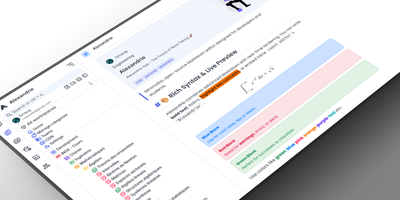
Alexandrie provides a structured knowledge base with an extended Markdown editor, granular per-document permissions, and offline editing through its progressive web app. The CodeMirror 6 editor goes well beyond standard Markdown with colored containers, academic callout blocks, KaTeX math expressions, syntax-highlighted code blocks, footnotes, interactive checkboxes, cards, panels, and a custom snippet system with import and export. Full-text search via the Ctrl+K command center returns instant results with content snippets and relevance ranking across all workspaces. Five permission levels covering None, Read, Write, Admin, and Owner apply per document and per user, while OIDC single sign-on integrates with Google, GitHub, Microsoft, Discord, and any OpenID Connect provider. Documents organize into a hierarchical tree of workspaces, categories, and nested entries with tags, bookmarks, pinned notes, and custom icons. Integrated Kanban boards handle task management within each workspace without switching applications. The PWA installs on any device for full offline editing with seamless sync when connectivity returns. Voice-to-text dictation captures notes hands-free, and one-click ZIP backup exports all documents, files, and settings as a portable archive. Over 2,000 GitHub stars and 41 releases back the project. The Docker Compose stack orchestrates the Nuxt 4 frontend, Go Gin backend, MySQL 8 database, and S3-compatible RustFS object storage. Running on a VPS on RepoCloud with guaranteed CPU, RAM, and SSD, full root SSH access, and a browser serial console. MIT licensed.
Nao
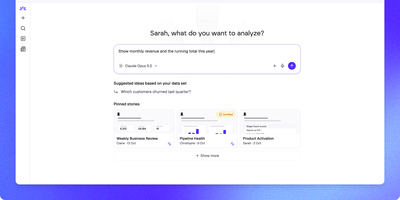
Your analysts write the context once, and everyone else just asks questions: nao turns your warehouse into an analytics agent that answers in plain English, showing the SQL and source files behind every answer. The data team builds the context layer by syncing warehouse schemas, dbt projects, documentation, and business rules into files the agent reads, then tests key questions offline against expected SQL before any change ships. Colleagues ask from the web chat, Slack, Teams, or any MCP client, and turn good answers into live dashboards, data apps, and slide stories they share with their team. Every conversation can be replayed, and when an answer earns a downvote, context recommendations turn the mistake into a fix that arrives as a pull request. You bring your own model key from any provider, sign people in with Google, GitHub, or GitLab, and keep warehouse permissions intact as queries run. Dashboards from Metabase or Tableau migrate over instead of starting blank. Running on a dedicated VPS on RepoCloud with guaranteed CPU, RAM, and SSD, full root SSH access, and a browser serial console. Apache-2.0 licensed.
Relaticle
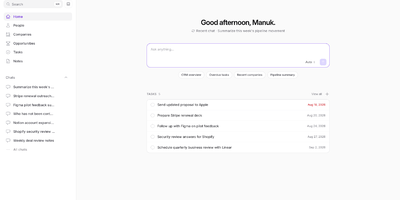
Relaticle delivers the first CRM built from the ground up for both human operators and AI agents — a self-hosted platform where Claude, GPT, Gemini, or any custom model connects through a production-grade MCP server exposing 30 tools for full CRUD operations across companies, people, opportunities, tasks, and notes without a single line of integration code. The 22 custom field types include text, email, phone, currency, date, select, multiselect, entity relationships, conditional visibility rules, and per-field encryption — all configurable through the UI without database migrations or code changes. Multi-team isolation enforces data boundaries through a 5-layer authorization system with team-scoped workspaces, API tokens, and granular permissions. The JSON:API REST surface provides Spatie QueryBuilder filtering, sorting, and pagination with schema discovery endpoints that let agents introspect your data model at runtime. A built-in AI chat connects directly to CRM data for natural language queries, while the external MCP server gives any compatible agent the same 30-tool access. Docker Compose deployment runs five containers — app (nginx + PHP-FPM), Horizon queue worker, scheduler, PostgreSQL 17, and Redis 7 — with automatic migrations on startup and demo data seeding for new teams. Running on a dedicated VPS on RepoCloud with guaranteed CPU, RAM, and SSD, full root SSH access, and a browser serial console. AGPL-3.0 licensed.
Trackarr
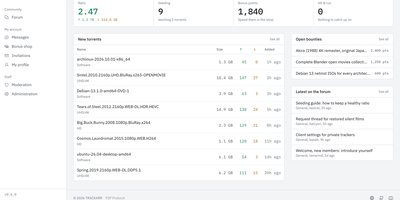
Trackarr gives a community everything it needs to run its own private BitTorrent tracker, from torrent uploads and member ratios to forums, messaging, and moderation. Members land on a home page showing their ratio, seeding count, bonus points, and hit-and-run status next to the newest torrents, open bounties, and forum threads. Browse torrents by category with search by name or hash, open a torrent for its swarm stats, description, and comments, and request missing titles by posting a bounty backed by a pot of points. Seeding earns bonus points to spend in the shop on upload credit, invites, and avatars, and admins can declare timed or open-ended freeleech. Private messages, invitations, reports, and a moderation queue keep the community orderly. Sonarr, Radarr, and Prowlarr connect through the Torznab API, and personal RSS feeds cover everything else. The admin area charts peers, seeders, and growth, and a panic button encrypts sensitive data on demand. Running on a dedicated VPS on RepoCloud with guaranteed CPU, RAM, and SSD, full root SSH access, and a browser serial console. MIT licensed.
Dockge
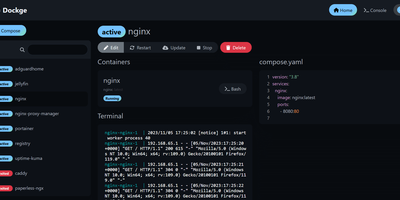
Created by the developer behind Uptime Kuma and carrying over 23,000 GitHub stars, Dockge brings the same clean, reactive design philosophy to Docker Compose stack management with a web interface that makes Portainer's compose handling feel like editing YAML in a terminal over SSH. The interactive editor provides syntax highlighting, inline validation, and a live preview of your compose.yaml files while keeping every stack stored as a standard file on disk in /opt/stacks by default, meaning you can seamlessly switch between the web UI and the docker compose CLI without lock-in or proprietary database formats. Real-time WebSocket updates stream pull progress, container start/stop transitions, and build output directly to the browser with no polling delays. The built-in web terminal opens a shell session inside any running container for quick debugging, while the docker-run-to-compose converter transforms single-container run commands into proper compose.yaml definitions with one click. Multi-agent support introduced in version 1.4.0 connects multiple Docker hosts to a single Dockge dashboard, enabling centralized management of stacks distributed across different servers. Image update detection shows which stacks have newer versions available, and one-click updates pull the latest images and recreate containers without manual intervention. The stack is a single Docker container running on Node.js with Socket.IO for reactivity and stores no external database. Running on a dedicated VPS on RepoCloud with guaranteed CPU, RAM, and SSD, full root SSH access, and a browser serial console. MIT licensed.
Statping-ng
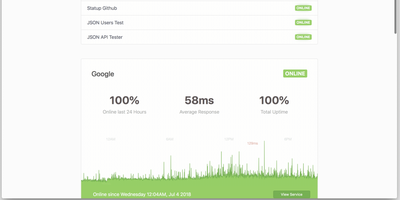
A status page and uptime monitor in one Go binary: Statping-ng - the actively maintained fork of Statping - replaces the UptimeRobot-plus-Statuspage combo with a ~20 MB Docker image using under 50 MB of RAM. It checks services over HTTP, TCP, UDP, ICMP ping, and gRPC health checks on configurable intervals, with per-service timeouts, expected status codes, POST requests with custom JSON bodies, SSL verification, and failure thresholds before alerting. The public status page is the differentiator against plain monitors: visitors see live status, uptime percentages, and latency charts grouped into service categories, with incident announcements and scheduled-maintenance messages you publish from the dashboard - and Sass-based custom styling matches the page to your brand rather than a vendor template. When something fails, notifiers fire immediately: Slack, Discord, Telegram, SMTP email, PagerDuty, Twilio SMS, Pushover, and custom webhooks, each testable before saving. Because notifiers are single Go files, the plugin system makes new channels straightforward. A RESTful API manages services and reads uptime data programmatically, and the free Statping mobile app connects to your server via QR code for on-the-go monitoring. Data persists to SQLite, MySQL, or PostgreSQL. Point it at internal services too - anything the container can reach is monitorable.
Mirobody
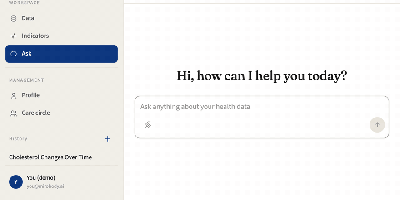
Three lab PDFs, a phone photo of a printed slip, and a spreadsheet become one cholesterol trend in Mirobody, a health data engine you host yourself, with the source file behind every number. Upload reports in 23 file types, import an Apple Health export, or connect Garmin, Oura, and Whoop, and every reading keeps a link to the page it was read from. Test names in English, Chinese, Japanese, and other languages resolve offline to LOINC codes and UCUM units, so HbA1c and Glycated Hemoglobin land on one series, and a name it cannot place stays unresolved instead of guessed. Ask questions in plain language and the agent shows each step as it works, charts the trend, and opens the reading and file behind every figure. A health journal turns one typed sentence into coded symptoms, blood pressure readings, and a medication entry, and a denied symptom like no fever is never logged. Genetic exports from 23andMe, AncestryDNA, and WeGene, or a VCF, can be queried by rsID, gene, or region. A care circle lets relatives share their own records on their own terms, and Claude Code, Codex, and Cursor can read your record through the built-in MCP endpoint. Choose OpenRouter, OpenAI, Gemini, Anthropic, or DeepSeek for answers, or keep every model on your own machine. Running on a dedicated VPS on RepoCloud with guaranteed CPU, RAM, and SSD, full root SSH access, and a browser serial console. Apache-2.0 licensed.