WoodPecker CI
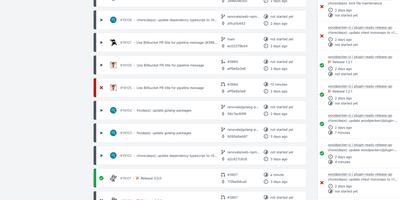
With 7,300+ GitHub stars and active releases through version 3.17, Woodpecker CI is the community-driven fork of Drone CI that kept the entire platform open source under Apache 2.0 — delivering a lightweight, container-native CI/CD engine that runs on minimal resources while providing enterprise-grade pipeline automation. Every pipeline step executes in an isolated Docker container, ensuring reproducible builds with zero host contamination and clean teardown after each run. Define workflows in simple YAML configuration files with step dependencies, conditional execution via when filters, service containers for databases and caches, and matrix builds that test across multiple language versions, platforms, or database engines simultaneously. Deep forge integration connects to GitHub, GitLab, Gitea, Forgejo, and Bitbucket via OAuth and webhooks, triggering pipelines on push, pull request, tag, deployment, and cron events. The plugin ecosystem inherits compatibility with the Drone plugin library — over 100 plugins for Docker builds, S3 uploads, SSH deployment, Slack and Telegram notifications, Helm deployments, and more. The server-agent architecture separates the web UI, API, and scheduler from pipeline execution, enabling horizontal scaling by adding agents across multiple machines or architectures including ARM. Secrets management supports global, organization, and repository-level scopes with approval workflows for forked repository pipelines. The admin web UI provides user management, agent monitoring, and queue control. Docker Compose deployment provisions the complete stack in under five minutes. Running on a dedicated VPS on RepoCloud with guaranteed CPU, RAM, and SSD, full root SSH access, and a browser serial console. Apache 2.0 licensed.
OctoPrint
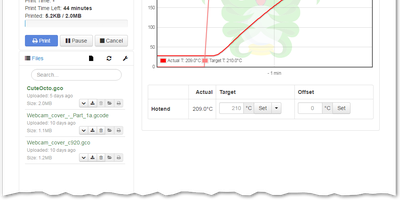
Over a million active instances make OctoPrint the standard web interface for consumer 3D printers - Gina Häußge's Python application, the center of the printing world since 2012. It talks to your printer over USB serial and turns every browser into a control panel: upload, organize, and start G-code prints; watch hotend and bed temperature graphs in real time; drive the print head manually; adjust feed rate, flow, and fan speed mid-print; and hit an emergency stop if things go wrong. The G-code visualizer renders the current layer in sync with the job, and a connected webcam adds a live feed plus automatic timelapse recording of every build. What keeps OctoPrint ahead is its plugin ecosystem - 300+ community plugins installable from the built-in manager. Highlights include Obico's AI spaghetti detection that pauses failed prints automatically, OctoEverywhere for tunnel-based remote access, Bed Level Visualizer's 3D mesh of your bed surface, PrintTimeGenius for accurate time estimates, Exclude Region to abandon one failed object mid-print while others continue, and Firmware Updater to flash Marlin or Klipper without SD-card shuffling. Event hooks fire notifications when prints finish or fail, and a full REST API supports slicer integration and custom automation. AGPL-licensed.

LobsterBoard
LobsterBoard lets you assemble custom monitoring dashboards from 50 pre-built widgets using a visual drag-and-drop editor, covering everything from CPU and memory gauges to AI subscription trackers, stock tickers, and camera feeds on your own server with zero cloud dependencies. The snap-grid editor handles layout composition with resize handles and a property panel, so you drag widgets onto a canvas, configure their data sources, and the dashboard is live. Real-time system statistics flow through Server-Sent Events, updating CPU load, memory pressure, disk usage, network throughput, and Docker container status without page refreshes. Five built-in themes range from a dark default to a retro CRT terminal aesthetic, a warm sepia paper look, and pastel options for different display environments. The template gallery lets you export complete dashboard layouts with auto-captured screenshot previews, share them with other users, and import configurations as a full replacement or selective merge. Custom pages extend beyond dashboards into notes, kanban boards, or any free-form layout you need. Built-in widgets connect to iCal feeds for calendar events, RSS sources for news aggregation, weather APIs for local conditions, and financial data providers for cryptocurrency and stock prices. The whole system runs from a single server.cjs file with zero cloud dependencies or external frameworks. Running on a dedicated VPS on RepoCloud with guaranteed CPU, RAM, and SSD, full root SSH access, and a browser serial console. BSL-1.1 licensed (free for non-commercial use; converts to MIT in 2030).
kkRepo
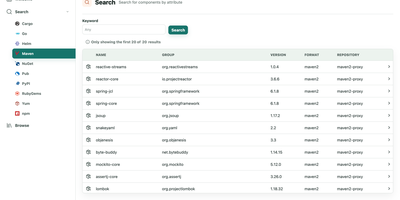
One trusted home for every package your build pipeline consumes: kkRepo hosts, proxies, and groups artifacts for Maven, npm, PyPI, Docker and OCI, Helm, Cargo, Go, NuGet, Composer, Terraform, Conda, APT, Conan, RubyGems, Yum, and more than twenty formats in total. Point your existing Nexus clients at it and nothing changes, because repository domains, the /repository/ URL layout, and the permission model carry over, and a one-click migration moves hosted data while clients keep building. Upstream proxies can be tuned per repository with their own outbound proxy and credentials, group repositories present many sources as one endpoint, and cleanup policies retire old artifacts before disks fill. Every stored artifact can be scanned against known vulnerabilities with SBOM generation and download enforcement, while Local, LDAP, and OIDC sign-in with fine-grained permissions decides who may publish or pull. Prometheus metrics and ready Grafana dashboards show throughput and storage, and multi-replica deployments share state through MySQL or PostgreSQL with blobs in S3-compatible storage. Running on a dedicated VPS on RepoCloud with guaranteed CPU, RAM, and SSD, full root SSH access, and a browser serial console. Apache 2.0 licensed.
Aurora
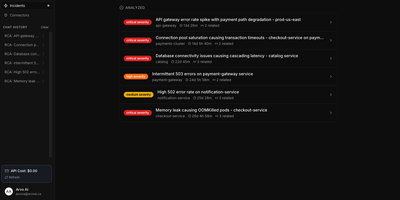
Aurora is an open-source AI SRE agent that investigates production incidents on its own, turning each incoming alert into a structured root cause analysis with evidence and a suggested fix. Alerts arrive from PagerDuty, Datadog, Grafana, New Relic, OpsGenie, incident.io, or CloudWatch, and every one triggers a background investigation without waiting for a human to pick it up. The agents choose from more than thirty tools, run cloud and cluster commands inside sandboxed pods, query logs, compare deployments, and search a knowledge base of past incidents for similar failures. An infrastructure dependency graph shows the blast radius across services and providers. When the root cause is found in code, Aurora can draft the remediation as a pull request instead of stopping at a diagnosis. Finished investigations become postmortems with a timeline, impact assessment, and remediation steps, exportable to Confluence, Notion, or SharePoint, and automated actions can open the fix, notify Slack, or update living documents as new evidence lands. Command policies and guardrails bound what the agents may run, and any major language model provider can power the reasoning, cloud-hosted or local. Running on a dedicated VPS on RepoCloud with guaranteed CPU, RAM, and SSD, full root SSH access, and a browser serial console. Apache-2.0 licensed.
Qpixel
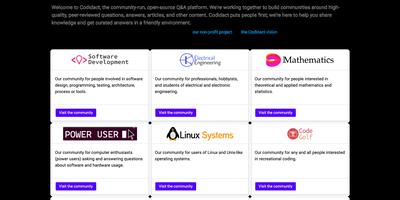
Instead of letting good answers vanish into chat scrollback, Qpixel gives questions a permanent home across searchable, votable communities. One installation hosts many independent communities, and each community divides itself into categories that can carry questions, long-form articles, or custom post types side by side. Answers rise and fall by a scoring formula that weighs controversy alongside raw votes, so a divisive answer does not masquerade as a settled one. Members earn abilities through useful activity: editing other posts, closing duplicates, curating tags, and working moderation queues unlock as the community learns to trust the work. Writing happens in Markdown with a live preview, MathJax for mathematics, image uploads, tables, and code formatting for technical communities. Every post carries a content license chosen by its author, and suggested edits let newcomers propose improvements to answers for reviewers to approve. Operators tune each community's name, branding, categories, and rules from admin settings, and run the whole network from one deployment. Running on a dedicated VPS on RepoCloud with guaranteed CPU, RAM, and SSD, full root SSH access, and a browser serial console. AGPL-3.0 licensed.
OpenReply
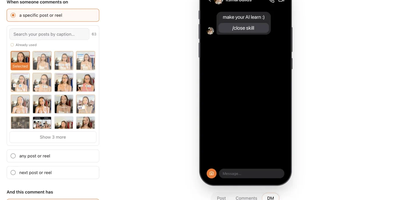
Someone comments LINK under your Instagram reel, and OpenReply, a free self-hosted ManyChat alternative, sends them a private DM with your link automatically. Each campaign ties one or many keywords, matched as whole words or partial, to a post or reel, and can add a public reply under the comment. The same keywords also fire on inbound DMs and text replies to Stories, so "Reply LINK to this Story" works with no post at all. Messages greet people by name with {username}, carry up to two link buttons, and route through tracked redirects that report clicks and click-through rate per campaign. An optional follow gate holds back the link until the person follows you, re-prompting until they do. The inbox lets you read Instagram conversations and reply from the dashboard within Meta's 24-hour window, and delivery logs record every send, skip, and failure with a reason. Sending stays under Meta's cap of 750 private replies per hour for each account, with overflow queued rather than dropped. Agencies can connect several Instagram accounts to one workspace, invite clients as owner, admin, or member, start from campaign templates, and read campaign settings and stats through a read-only API and MCP server. The dashboard speaks English, Traditional Chinese, Brazilian Portuguese, and Russian. Connect through Zernio's managed connection or your own Meta app, with no password sharing. Running on a dedicated VPS on RepoCloud with guaranteed CPU, RAM, and SSD, full root SSH access, and a browser serial console. MIT licensed.
DiceFrame
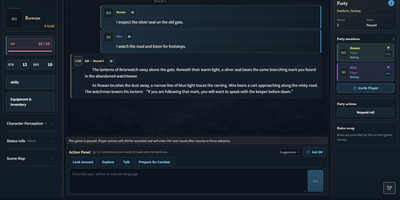
Game night keeps dying in the group chat because nobody can be in the same room, and the one willing game master is burned out by October. DiceFrame puts an AI game master on your own server instead: open the web UI, describe what your character does in plain language, and the engine adjudicates the action, rolls the dice check once, applies the result to your character sheet, and narrates what happens next. Run a solo campaign at midnight or invite friends through a link and play the same shared world from different cities, with waiting states, away players and live updates keeping the table in sync. Rules are layered rather than decorative; D&D 5e-inspired d20 play with advantage and disadvantage, CoC 7e-inspired d100 with bonus and penalty dice, custom d20 systems and freeform no-dice narrative all track hit points, gold, items, experience, death and revival properly. Build worlds, lorebooks and adventures in the content library, import scripts, PDFs and Foundry or Fantasy Grounds modules, or let AI assistance draft the world, rules and characters for you. Character cards are reusable across games, long campaigns are held together by session summaries and optional memory recall, and the story can be read aloud with text-to-speech through system voices or your own endpoints. Plugins and chat bots extend the table, all through your chosen OpenAI-compatible model endpoint. Running on a dedicated VPS on RepoCloud with guaranteed CPU, RAM, and SSD, full root SSH access, and a browser serial console. AGPL-3.0 licensed.
Tasks.md
Your task list should outlive the app that displays it: Tasks.md turns a folder of plain Markdown files into a kanban board, so the board is a view of your notes rather than a database holding them hostage. Every lane you create becomes a directory and every card a Markdown file inside it, which means the whole board stays readable in any text editor, greppable from a terminal, and friendly to the note tools you already use. You write card bodies in a proper Markdown editor, organize work with tags and due dates, and drag cards between lanes as priorities change. Sub-folders open as their own projects with separate lanes, so one installation quietly serves a work board, a home board, and a writing board side by side. Light and dark themes follow your operating system, three bundled color schemes (Adwaita, Nord, and Catppuccin) set the mood, and a custom stylesheet hook recolors everything else. The board installs as a PWA for an app-like window, speaks multiple languages detected from the browser, and slots under a subpath reverse proxy when it shares a domain. One Docker container on port 8080 serves the whole thing. Running on a dedicated VPS on RepoCloud with guaranteed CPU, RAM, and SSD, full root SSH access, and a browser serial console. MIT licensed.
DevDocs
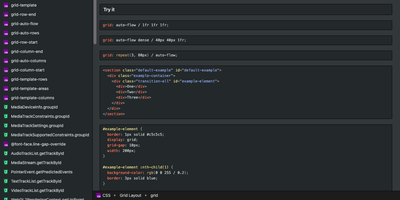
A half-remembered name like bgcp is enough for DevDocs to find background-clip in the reference documentation of hundreds of languages, frameworks, and tools. Search is fuzzy and instant. Type a project name or alias such as js or py, press Tab, and results narrow to that single reference. Share a link like #q=js date or add DevDocs to the browser address bar through OpenSearch. The catalog holds 247 documentations in 844 versions, including JavaScript, CSS, Python, PostgreSQL, Rust, Terraform, and Kubernetes. Enable only the versions your stack uses to keep the sidebar short and search results focused. The Offline page installs enabled documentation for use without a connection and lists every download's size. Export the whole set as a file and import it on another computer. Keyboard shortcuts move through the sidebar, open or copy the original page, and send a query to Google, Stack Overflow, or DuckDuckGo. Preferences offer automatic, light, and dark themes, custom fonts, fixed-width or justified layouts, and a custom CSS box. A mobile layout and installable web app keep references within reach on a phone. A shared instance gives a team or classroom one address for the same references, and the official build refreshes its documentation every month. Running on a dedicated VPS on RepoCloud with guaranteed CPU, RAM, and SSD, full root SSH access, and a browser serial console. MPL-2.0 licensed.
KoboldCpp
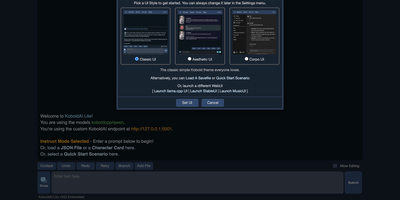
One file runs your own language model and serves it to any browser tab. KoboldCpp loads GGUF models on CPU or GPU. A web UI opens on port 5001. OpenAI, Ollama, Anthropic, and KoboldAI style endpoints answer every app that expects a cloud API. The bundled KoboldAI Lite interface covers chat, instruct, story, and adventure modes in Classic, Messenger, Aesthetic, and Corpo themes, with memory, world info, author's notes, character cards, scenarios, and saveable sessions. A llama.cpp style chat interface and interactive API documentation share the same port. Add a vision projector and the model reads images. Load Stable Diffusion, Flux, or video models for pictures and clips, Whisper for transcription, and Kokoro or Qwen3TTS for spoken replies. Tool calling, web search, retrieval over your own documents, an MCP bridge, and a built-in agent for editing code come included. Context size, GPU layers, batch size, and samplers including DRY and XTC are set from the launcher or the command line. A no-model option points it at a remote provider instead. An API key protects the endpoint before it faces a network. Running on a dedicated VPS on RepoCloud with guaranteed CPU, RAM, and SSD, full root SSH access, and a browser serial console. AGPL-3.0 licensed.
Omni
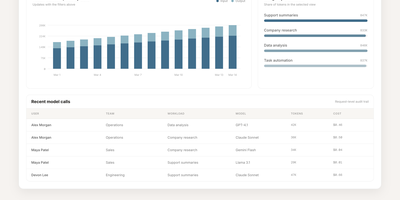
Omni is an open-source workplace AI agent and enterprise search platform that unites your company's scattered tools into a single context-aware workspace where team members can find answers and automate cross-application workflows. Employees can query connected knowledge sources including Google Drive, Gmail, Slack, Jira, GitHub, Confluence, and HubSpot to locate project specifications, customer records, and operational documents without jumping across tabs. The integrated AI assistant answers complex multi-step inquiries, summarizes lengthy email threads, and cites exact source passages so workers can verify factual accuracy before making business decisions. Granular permission inheritance mirrors existing access controls across every connected service, guaranteeing that sensitive personnel files, financial statements, and confidential repositories remain hidden from unauthorized staff. Engineers can construct bespoke data connectors and define automated agent skills through the extensible Python and TypeScript software development kits, triggering multi-service actions directly from interactive chat dialogues. Administrators can monitor background synchronization jobs, inspect audit trails, manage single sign-on access, and configure custom extraction pipelines using centralized operational dashboards. Running on a dedicated VPS on RepoCloud with guaranteed CPU, RAM, and SSD, full root SSH access, and a browser serial console. Apache 2.0 licensed.
pgrust
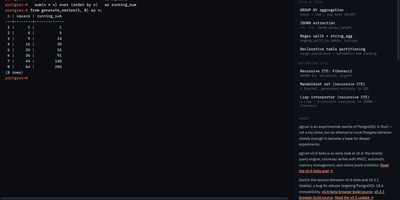
pgrust gives you one PostgreSQL-compatible server for both transactions and fast analytics, with psql sessions, drivers, and ORMs working unchanged. Row storage or columnar: pick per table. The pgrcolumnar format keeps compressed column data with zone maps and background compaction, and still supports transactional writes, rollbacks, and WAL logging for crash recovery. Columnar tables accept B-tree, hash, GiST, SP-GiST, and GIN indexes. Updates and deletes are recorded as markers instead of rewriting stored data. The Gravity query engine runs DML with ON CONFLICT and RETURNING, triggers, cursors, PL/pgSQL, and COPY with Postgres semantics, and compiles query plans to machine code. A built-in scheduler lowers the priority of long-running queries, so heavy reports interfere less with quick lookups. One memory budget, sized from the machine, covers the buffer pool, columnar caches, and running queries; near the limit, pgrust cancels the statement using the most memory instead of letting the operating system kill the server. Extensions come bundled: pgvector, pg_cron, pg_stat_statements, pg_trgm, hstore, pgcrypto, and postgres_fdw. The Docker image mirrors the official postgres image's environment variables, init script folder, and data volume. A browser demo at pgrust.com/try runs queries before you install anything. It is beta software, so keep regular Postgres as the source of truth for critical data. Running on a dedicated VPS on RepoCloud with guaranteed CPU, RAM, and SSD, full root SSH access, and a browser serial console. AGPL-3.0 licensed.
Lemonade
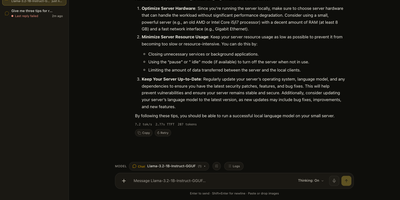
Squeeze a full AI stack out of one lightweight server and point every app you own at it. Lemonade serves chat, coding, speech, transcription, and image models over OpenAI, Anthropic, and Ollama style APIs, so existing editors, agents, and automation tools connect without code changes. Open port 13305 in a browser and the bundled web app takes over: a chat view with conversation history, a Model Manager that pulls GGUF and ONNX files from Hugging Face or ModelScope, and an Apps marketplace linking tools like Open WebUI, AnythingLLM, and Claude Code. Each modality has its own backend to install or remove from a Backends page, covering text, Whisper transcription, Kokoro speech, and Stable Diffusion images. A Monitor section charts tokens per second, parallel slots, memory, and recent inference runs. The command line pulls models, sets aliases for instant failover between model versions, and launches coding agents. Built-in tools and an MCP gateway let chats manage the server itself, and an experimental cloud offload routes selected requests to OpenAI compatible providers. Set an API key before opening the port to a network. Running on a dedicated VPS on RepoCloud with guaranteed CPU, RAM, and SSD, full root SSH access, and a browser serial console. Apache-2.0 licensed.
Google Webfonts Helper
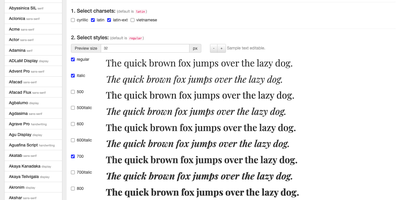
Self-hosting a Google font takes four steps in Google Webfonts Helper: pick a family, choose charsets and styles, copy the @font-face CSS, and download the files. The family list can be filtered by typing part of a name or category and ordered by family, category, popularity, last modified date, number of styles, or number of charsets. Each family page shows its styles and charsets beside an editable live preview with adjustable size, and ticking charsets and styles decides which files are generated. CSS comes in three modes: Modern Browsers with WOFF2 only, Legacy Support adding TrueType, and Historic Support adding EOT, WOFF, and SVG. A folder prefix field rewrites every url() to match where the files will live, and each rule sets font-display: swap. A zip download bundles the files in the selected mode's formats, named after the family, version, and charsets. A public JSON API lists families, returns font file URLs, and serves zips filtered by subsets, variants, and formats. Serving the files from your own domain keeps font requests off Google's servers, which helps sites with strict privacy requirements. To run the helper yourself, start one Docker container with a Google Fonts API key and publish port 8080; the image runs rootless. Running on a dedicated VPS on RepoCloud with guaranteed CPU, RAM, and SSD, full root SSH access, and a browser serial console. MIT licensed.
Gitness
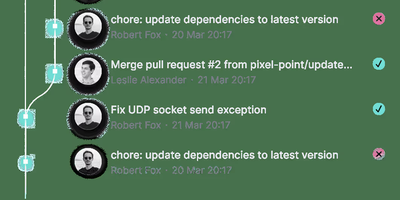
With 37,400+ GitHub stars and active daily development by the Harness engineering team, Gitness is the open-source developer platform that ships Git hosting, container-native CI/CD pipelines, a Docker-compatible artifact registry, and cloud developer environments in a single Go binary consuming approximately 100 MB of RAM — compared to GitLab's 4+ GB minimum footprint. Born as the next generation of Drone CI, Gitness inherits Drone's battle-tested pipeline engine while adding complete source code management with pull requests featuring threaded code review comments, suggested changes, required reviewer approvals, and merge strategies including squash and rebase. Branch protection rules enforce mandatory pull requests, minimum peer reviews, passing status checks, and force-push blocking. Pipelines use Drone-compatible YAML syntax with stages, steps, and service containers, triggered automatically on code changes with results displayed directly in pull request checks. The built-in container registry eliminates the need for separate Harbor or Docker Registry deployments, supporting Docker image push and pull plus Helm chart storage. Gitspaces provide on-demand remote development environments configured via industry-standard devcontainer.json files. Encrypted secrets management with Gitleaks-powered secret scanning blocks commits containing hardcoded credentials. One-click migration imports existing GitHub Organizations and GitLab Groups, automatically converting GitHub Actions and GitLab CI pipelines to Gitness YAML. The REST API with OpenAPI specification enables programmatic management of all resources. Running on a dedicated VPS on RepoCloud with guaranteed CPU, RAM, and SSD, full root SSH access, and a browser serial console. Apache 2.0 licensed.
D-Tale
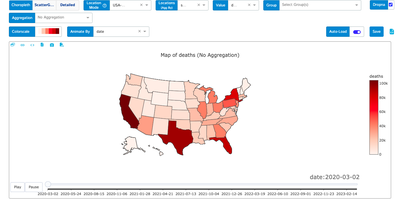
If your data lives in a pandas DataFrame, D-Tale gives it a spreadsheet-style grid, a column profiler, and a chart builder in the browser, started with one call from a notebook or script. In the grid you sort, filter, and edit cells inline, lock, hide, reorder, rename, or reformat columns from their menus, and open a Describe view with each column's distribution, summary statistics, outliers, and missing values, while highlight modes color dtypes, outliers, and numeric ranges across the whole table. Correlation matrices, a predictive power score, and duplicate reports sit beside dataframe functions that add numeric, binned, date, random, and type-converted columns, and Merge & Stack combines dataframes, including ones uploaded from Excel files. The chart builder draws line, bar, stacked, pie, wordcloud, heatmap, 3D scatter, surface, and map charts with grouping and aggregation, exports them as standalone HTML, and a network viewer graphs relationships between nodes. Whatever you build in the interface can be exported as reproducible Python code, and data can be saved as CSV or TSV. Launch it from Jupyter, Google Colab, Kaggle, a terminal, or the command line with a CSV path, protect it with optional authentication, and choose light or dark themes and English or Chinese. Running on a dedicated VPS on RepoCloud with guaranteed CPU, RAM, and SSD, full root SSH access, and a browser serial console. LGPL-2.1 licensed.
OpenMRS
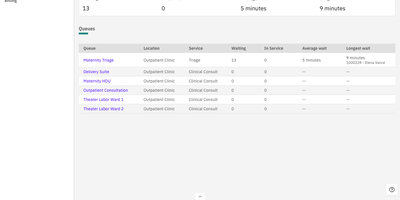
Clinics and hospitals can register patients, run visits, order tests and medications, and keep a complete chart for every person with OpenMRS, a free and configurable electronic medical record system built for places where budgets are tight and needs vary. After login, a home dashboard lists active visits and the day's appointments, while patient search, registration, service queues, and ward and bed management sit one click away. Each chart gathers vitals with trend charts, conditions, allergies, immunizations, visit notes, medications, test results, program enrollments, and attachments such as photos and PDFs. Clinicians place drug and test orders from an order basket, and a growth chart plots a child's weight against World Health Organization standards from birth to five years. Staff without programming skills design clinical forms in a visual Form Builder, then publish them to the chart. Optional apps add laboratory queues, medication dispensing, billing with invoices and payments, and stock management. A cohort builder finds patients by clinical and demographic criteria, privileges can be limited by location or data type, and audit logging shows who did what. The interface can show several languages at once, including right-to-left scripts. REST and FHIR APIs connect to lab systems, DHIS2, ERP tools, and national health exchanges, and add-on modules extend the platform further. Running on a dedicated VPS on RepoCloud with guaranteed CPU, RAM, and SSD, full root SSH access, and a browser serial console. MPL-2.0 with Healthcare Disclaimer licensed.