Flipt
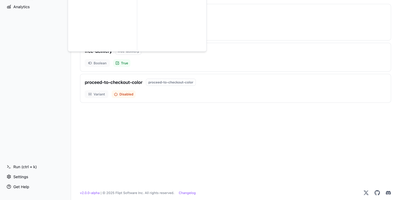
Backed by 4,800+ GitHub stars and trusted by teams replacing LaunchDarkly and Split with a self-hosted solution, Flipt v2 delivers the first truly Git-native feature management platform that treats feature flags as code stored in your own repositories. The architecture eliminates all database dependencies by building immutable in-memory snapshots from YAML flag definitions on every Git commit, delivering sub-millisecond evaluation latency with zero external runtime dependencies beyond the single Go binary. Multi-environment support maps directly to Git abstractions — separate repositories per environment, different directories within the same repository, or different branches — enabling teams to use their existing branching strategy, pull request workflows, and code review processes for flag changes. The evaluation engine supports boolean flags, multivariate string and numeric variants, segment-based targeting with constraint rules, percentage rollouts, and namespace isolation. Native SCM integration with GitHub, GitLab, BitBucket, Azure DevOps, and Gitea creates merge proposals directly from the UI with GPG-signed commits. Flipt implements the OpenFeature Remote Evaluation Protocol with official providers for Go, Node.js, Python, Java, C#, Ruby, and Web SDKs, enabling vendor-agnostic flag evaluation across all services. The gRPC API with REST HTTP gateway exposes flag management, evaluation, and analytics endpoints. Offline mode continues serving flags when the source repository is temporarily unavailable. Running on a dedicated VPS on RepoCloud with guaranteed CPU, RAM, and SSD, full root SSH access, and a browser serial console. Fair Core License (server) / MIT (client SDKs).
Unleash
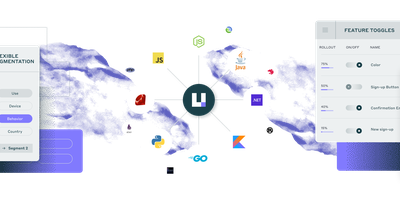
Deployment decoupled from release: Unleash, the most popular open-source feature management platform on GitHub, is a Node.js server backed by PostgreSQL. Ship code dark, then control who sees it through activation strategies: gradual percentage rollouts, targeting by user ID, IP, hostname, or application name, custom constraints against your own context fields, and scheduled or time-limited releases. Strategies stack - a flag activates if any strategy matches - and strategy variants layer A/B versions on top of the on/off decision. Each flag carries per-environment configurations, so a feature can run at 100% in staging while canarying at 5% in production. Backend SDKs (Node.js, Java, Go, Python, Ruby, .NET, PHP, Rust, and more) fetch configuration and evaluate flags locally, so a flag check adds zero network latency to request paths; frontend SDKs for React, Vue, Svelte, iOS, Android, and Flutter evaluate through a proxy layer. Flag hygiene is built in: flags are typed (release, experiment, operational, kill-switch, permission) with expected lifetimes, and Unleash marks overdue flags as potentially stale and surfaces unknown flags your SDKs request but that don't exist. Self-hosting via Docker keeps flag data, targeting rules, and evaluation infrastructure entirely on your side.
dyrector.io
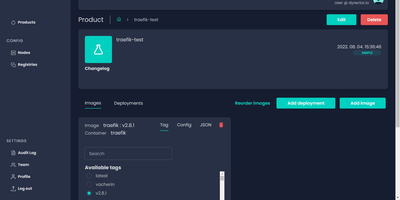
dyrector.io gives teams a visual web interface for deploying and managing containerized applications across Docker, Kubernetes, and Podman environments, replacing repetitive CLI commands and YAML editing with point-and-click configuration. Lightweight Go agents installed on target infrastructure communicate with the central TypeScript platform, enabling deployments to AWS, GCP, Azure, and on-premises servers without requiring infrastructure migration. Unified configuration screens eliminate redundant YAML editing across environments with support for all three container runtimes. Version management lets teams configure OCI-compatible container images once and deploy them as versioned releases with auto-generated changelogs and release notes. Multi-instance deployment enables simultaneous rollouts to multiple nodes with environment-specific configuration overrides, secret management, and instant test environment provisioning from any branch. The fine-grained RBAC system controls user access at project and environment levels, while audit logging tracks every deployment action. Registry integrations support Docker Hub, GitLab, GitHub, Google, and Azure container registries for image sourcing. ChatOps notifications integrate with Slack, Discord, and Microsoft Teams for deployment status alerts. Scheduled releases and workflow support enable automated deployment pipelines triggered by CI events via the REST API with JWT authentication. Running on a dedicated VPS on RepoCloud with guaranteed CPU, RAM, and SSD, full root SSH access, and a browser serial console. Apache 2.0 licensed.