Promptfoo
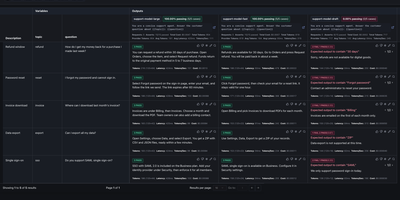
Promptfoo replaces vibes-based prompt tweaking with measurable tests, then attacks your AI app the way a hostile user would. An evaluation matrix lines up every prompt and model side by side, with pass or fail badges, assertion messages, latency, token counts, and cost in each cell. A red team wizard walks through the target, application details, plugins, and strategies, then probes for prompt injection, data exposure, broken access control, and harmful content. Preset bundles map plugins to the OWASP LLM Top 10, NIST AI RMF, MITRE ATLAS, GDPR, ISO 42001, and the EU AI Act. Meta Agent and Hydra Multi-Turn strategies adapt attacks across a whole conversation instead of firing one-shot prompts. Providers span OpenAI, Anthropic, Gemini, Bedrock, Azure, and local Ollama models, and any HTTP endpoint, Python script, or JavaScript function can be tested as a target. The history page lists every run with pass rates and raw scores, and prompt and dataset pages show which templates and test sets each run used. A provider allowlist file narrows the models offered in the web editor for cost control. Running on a dedicated VPS on RepoCloud with guaranteed CPU, RAM, and SSD, full root SSH access, and a browser serial console. MIT licensed.
LLMVault
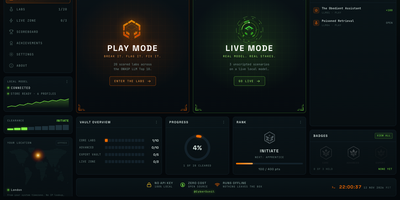
A hacking gym for AI apps: every lab is a chatbot or agent with a planted weakness, and your job is to exploit it and capture the flag. The dashboard tracks score, rank, badges, and a live activity feed across three tiers. Ten core labs map to the OWASP Top 10 for LLM Applications, ten advanced labs need multi-turn tactics like persona escalation, stored injection, and tool chaining, and an encrypted expert tier unlocks last. Each lab opens with a short reference panel on the weakness, offers hints, and ends with the defense that would have stopped you. Play mode uses scripted assistants so flags reproduce every time and the whole range runs offline without API keys. Live mode points attacks at a real local model through Ollama, mints a fresh secret per session, streams replies token by token, and checks the output instead of a flag box. Scenarios cover direct prompt injection, a hidden payload in an uploaded image, and unsafe rendering of model output. A RAG lab accepts text and markdown uploads, so poisoning a knowledge base is hands-on. Two themes, Neon and Phosphor green-CRT, change the look. Security teams run workshops with it, red teamers sharpen prompt injection skills, and developers see why their guardrails fail. Running on a dedicated VPS on RepoCloud with guaranteed CPU, RAM, and SSD, full root SSH access, and a browser serial console. MIT licensed.
DodoGuard
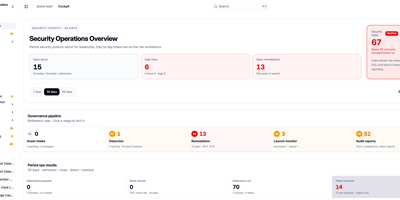
Before an AI agent meets real users, put it through a security checkup it cannot sweet-talk. DodoGuard is a web console and command line where teams register their agents, run evaluation and red-team tasks against them, and decide if each one is cleared for launch. The overview page shows a security index, open risks, remediation counts, and a pipeline that runs from asset intake through detection and remediation to launch monitoring and audit reports. An asset ledger lists every managed agent with its platform, environment, and risk level. A guided wizard creates assessment tasks that pick a test library for prompt injection, instruction leakage, tool misuse, and output risks, then runs black-box conversations against the agent. Evaluation configs cover prompts, providers, variable cases, and several assertion types, with OpenAI, Anthropic, Azure, Bedrock, Ollama, and any OpenAI-compatible endpoint supported. Findings land in a closed-loop board where owners confirm, fix, retest, and close each risk, and finished tasks export as reports for release evidence. Docker Compose with SQLite brings up the web UI on port 3000, and the same engine runs in continuous integration. Security teams use it for launch gates, platform owners use it for regression checks after prompt changes, and auditors use it for evidence. Running on a dedicated VPS on RepoCloud with guaranteed CPU, RAM, and SSD, full root SSH access, and a browser serial console. MIT licensed.