Bionic
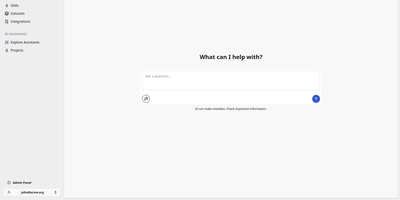
Bionic gives a company its own private AI workspace where models can read documents, use approved tools, run code, and hand back finished files. Staff open a chat, pick a model, and ask for work; the agent searches datasets, calls connected systems including Gmail, Google Drive, Salesforce, ServiceNow, and Jira, and saves spreadsheets, reports, and PDFs as artifacts. Skills package reusable instructions for jobs like release readiness, incident briefings, policy gap reviews, and RFP responses, so a good workflow gets written once and reused by everyone. Datasets collect security policies, product docs, handbooks, and support archives for grounded answers. Administrators manage API keys, watch token usage and request charts, set rate limits, configure providers, and divide people into teams with their own assistants. SSO, role-based access, and an audit trail keep the rollout governed. Developers can issue model and assistant keys and turn any OpenAPI specification into a new integration. Running on a dedicated VPS on RepoCloud with guaranteed CPU, RAM, and SSD, full root SSH access, and a browser serial console. Apache-2.0 licensed.
LocalGPT
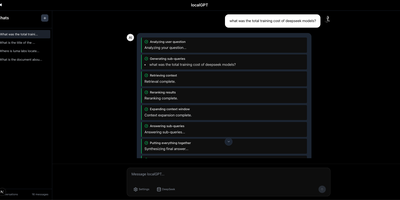
If a document is too sensitive for a hosted chatbot, LocalGPT lets you question it in plain English on your own server, with every answer citing the passages it used. Drop PDF, DOCX, HTML, Markdown, or plain-text files into a named index and scanned PDFs are read through OCR. Vector and full-text results are fused by rank, then a cross-encoder reranker keeps the best passages. A router decides per question between searching your documents and answering directly. Complex questions split into sub-questions that are searched separately, pooled, and answered in one pass. Progress cards stream the retrieval, reranking, and synthesis stages into the chat as they run. An optional verification pass appends a confidence percentage to the answer. A session-scoped semantic cache answers repeated questions faster. Per-chat settings toggle decomposition, pruning, verification, search type, model, and retrieval depth. Swap the answer model per session or per message, and choose the embedding model when you build an index. From a terminal, one command indexes a folder and another asks a question, and a REST API exposes every action the interface can take. A start script runs everything in Docker against Ollama on the host or in a container. Running on a dedicated VPS on RepoCloud with guaranteed CPU, RAM, and SSD, full root SSH access, and a browser serial console. MIT licensed.
deco Studio
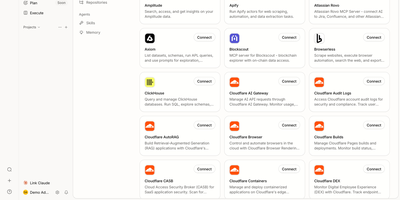
Roll out AI across a whole company without handing a single API key to anyone. deco Studio gives teams a shared chat workspace, and the admin keeps control of which models, tools, and data every agent can touch. Register MCP servers once from a catalog of ready-made connections, including Amplitude, Apify, Atlassian Rovo, ClickHouse, and a long list of Cloudflare services, then grant tool-level access by organization, role, or agent. Tokens stay in an encrypted vault, so teammates share capabilities and never credentials. Agents bundle instructions, skills, files, and approved tools, then publish as their own MCP endpoint that Cursor, Claude Desktop, or custom code can call. A built-in skills library ships with dozens of reusable playbooks, and Memory keeps facts the whole organization should remember. Model choice stays open through OpenRouter, Anthropic, OpenAI, Google Gemini, or any OpenAI-compatible server, and engineers can link a Claude Code or Codex session they already use. Projects group agents and connections around a goal, with Monitor dashboards for orders, visitors, logs, and deploys, and an Execute board for tasks and epics. Running on a dedicated VPS on RepoCloud with guaranteed CPU, RAM, and SSD, full root SSH access, and a browser serial console. MIT licensed.