OpenMetadata
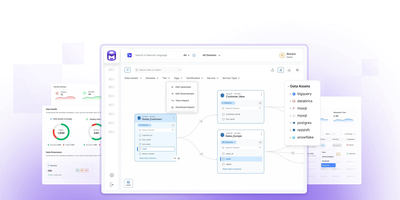
OpenMetadata builds a unified knowledge graph connecting schemas, tables, columns, dashboards, pipelines, ML models, and data products into one searchable catalog accessible at port 8585. The ingestion framework ships 130+ connectors covering Snowflake, BigQuery, Redshift, Databricks, PostgreSQL, MySQL, Kafka, Airflow, dbt, Tableau, Looker, Power BI, Metabase, and Superset, automatically extracting metadata on configurable schedules. Column-level lineage traces data flow across transformations, joins, and aggregations, while built-in data quality testing executes profiling and validation rules as data contracts with automated alerting on failures. Governance features include role-based access control, PII auto-detection, glossary term propagation, and domain-based ownership assignment. The native MCP server and AI SDK expose semantic search, lineage queries, and governance metadata as tools any LLM agent can call, enabling AI systems to discover and reason about enterprise data with full trust context. The architecture requires only PostgreSQL or MySQL plus Elasticsearch, no Kafka, no graph database, and deploys via a single Docker Compose file. Created by the founders of Apache Hadoop, Apache Atlas, and Uber's Databook, the platform has earned over 14,700 GitHub stars and adoption by 3,000+ organizations. Apache 2.0 licensed.
CKAN
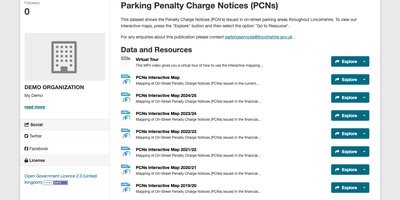
CKAN lets governments, research institutions, and companies publish data as a searchable catalog, where every dataset carries its description, license, tags, and downloadable files. Organizations own their datasets, and members, editors, and admins get different rights, so a dataset can stay private until someone with publishing rights releases it. Visitors narrow results with faceted filters on tags, formats, and organizations, or write fielded queries with wildcards and fuzzy matching. Resource pages preview spreadsheets in a grid and, when the data fits, as maps and charts, and they also display images, PDFs, and HTML. The DataStore keeps tabular resources as queryable tables, serving filtered rows with range conditions and nested AND/OR logic. Everything the web interface does is also available through the Action API. Groups gather related datasets, and custom metadata fields extend each record. Per-dataset activity streams document how data changes, and follow buttons feed a personal news feed. Files can be stored on local disk or, with extensions, in S3, Google Cloud Storage, or Azure Blob Storage. Extensions add geospatial search, harvesting for federated portals, multilingual metadata, and more chart types, and themes restyle the portal to match your brand. Running on a dedicated VPS on RepoCloud with guaranteed CPU, RAM, and SSD, full root SSH access, and a browser serial console. AGPL-3.0 licensed.
DSpace
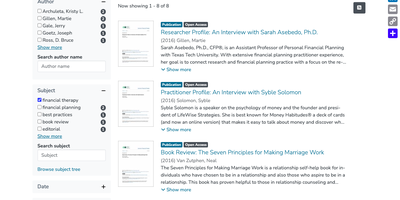
With DSpace, a library or research office can give every thesis, journal article, and dataset its own permanent web address, a searchable metadata record, and files visitors download from the archive. Content sits in a tree of communities and collections, and each collection decides who may deposit and how many review steps follow; reviewers accept a submission or reject it with a note that sends it back to the author. Embargoes hold files back until a set date, access policies limit other files to chosen groups, and sign-in works through LDAP, Shibboleth, SAML, OpenID Connect, or ORCID. Search covers metadata and the extracted full text of uploaded files, facets narrow the results, and browse pages sort by title, issue date, author, or subject. Editors can correct a published item through the submission form. Administrators inspect an audit trail and rewrite homepage news from an admin form. Entity types for people, organizations, projects, journals, and datasets link each publication to the work behind it, and DOIs can be registered through Crossref. Optional settings let authors keep an email address private on their researcher profile and download their own restricted files. Usage reports count visits, downloads, and top countries per item. REST, OAI-PMH, SWORD, and Google Scholar metadata connect the archive to harvesters, deposit tools, and search engines. Running on a dedicated VPS on RepoCloud with guaranteed CPU, RAM, and SSD, full root SSH access, and a browser serial console. BSD-3-Clause licensed.
DataHub
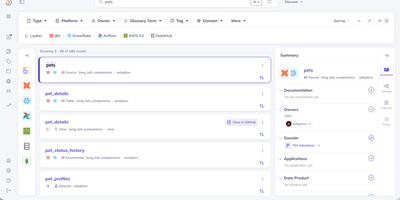
DataHub maps your entire data ecosystem into a searchable, governed catalog where every table, pipeline, dashboard, and metric is discoverable and traceable from source to consumer. Originally built at LinkedIn to manage metadata at hyperscale and proven to handle 10 million+ assets and billions of relationships in production, the platform is now trusted by 3,000+ organizations including Netflix, Visa, Slack, and Pinterest. The Spring Java backend (GMS) exposes both GraphQL and OpenAPI REST endpoints, while the React frontend delivers an intuitive interface for searching, browsing, and governing data assets. The Python-based ingestion framework provides 80+ production-grade connectors extracting deep metadata from Snowflake, BigQuery, Redshift, Databricks, dbt, Airflow, Spark, Kafka, Looker, Tableau, Power BI, Superset, PostgreSQL, MySQL, Hive, Glue, S3, Iceberg, and Unity Catalog through pull-based scheduled crawls and push-based emission via Python and Java SDKs. Automatic table-level and column-level lineage detection uses SQL parsing with 97-99% accuracy, tracing data flows from ingestion pipelines through warehouses to BI dashboards. Real-time metadata streaming via Kafka keeps the catalog continuously synchronized as schemas evolve and pipelines execute. The governance layer provides business glossary management, tag propagation along lineage graphs, domain-based organization, and fine-grained access control policies. DataHub Actions triggers automated responses to metadata changes, enabling notifications, quality checks, and downstream workflows. Elasticsearch powers full-text search with faceted filtering across entities. Running on a dedicated VPS on RepoCloud with guaranteed CPU, RAM, and SSD, full root SSH access, and a browser serial console. Apache 2.0 licensed.
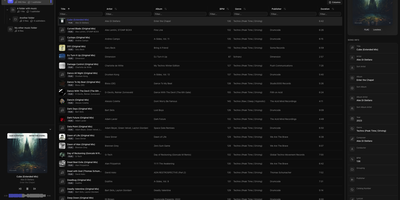
Tagr
When a music library is full of wrong tags, missing covers, and blank ratings, Tagr lets you fix the whole collection from any browser, on desktop or phone. Three roles divide the work on your own server. Admins mount a music folder, press scan, and get a searchable table of every track, with sortable and filterable columns, more than 40 editable fields, and room for custom tags. Taggers make the changes: edit fields inline, swap album art, and match one song or a whole selection against MusicBrainz, ticking which fields to overwrite. Mistakes are cheap, because every edit is stored in a persistent change history with a revert action, viewable per song or per folder. Rule-based smart playlists, such as every track with an empty comment, show what still needs attention. Listeners browse and play without edit rights, using the waveform player, a Recently played view, and optional ListenBrainz scrobbling that each person connects to their own account. Supported formats include MP3, FLAC, WAV, AAC, OGG, M4A, M4B, WMA, AIFF, and Opus, with changes written straight back into the files. Swipe-friendly panels, an installable PWA, and five interface languages make the phone a comfortable place to work. Running on a dedicated VPS on RepoCloud with guaranteed CPU, RAM, and SSD, full root SSH access, and a browser serial console. AGPL-3.0 licensed.