Kaeso
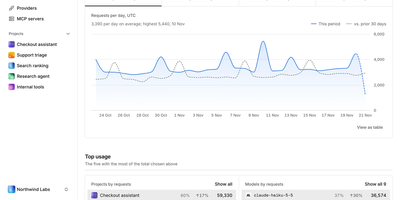
Point every app, SDK, and coding tool at one endpoint, and Kaeso routes each request to the provider or self-hosted model that should answer it, with budgets, logs, and access control built in. Apps keep speaking the OpenAI, Anthropic, Gemini, or ElevenLabs format, and Kaeso translates each request, reply, and stream for whichever provider sits behind the model name. Beyond chat it serves embeddings, reranking, decision models that answer typed questions with probabilities, images, video, speech, transcription, music, and batches. Alias routes add conditions, weighted splits, fallbacks, and retries, key pools spread a project over several keys of one provider, and retiring models send Deprecation and Sunset headers, show who still calls them, and offer a one-click move to the replacement. Hard or soft budgets and rate limits per project, member, service account, or key are checked before the provider is called, and guardrails mask or block secrets, email addresses, IBANs, and card numbers before the model sees them. Teams get single sign-on over OpenID Connect, SCIM 2.0, roles, and request logs that keep content only where the organization, project, or request allows. A playground compares models side by side, and a per-project MCP portal lets claude.ai, ChatGPT, or Cursor call your MCP servers. Claude Code and Codex can use Kaeso as their model provider, so every session is logged and budgeted. Running on a dedicated VPS on RepoCloud with guaranteed CPU, RAM, and SSD, full root SSH access, and a browser serial console. MIT licensed.
Chatty
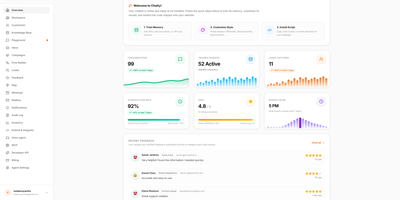
When a customer asks a question on your website, WhatsApp, Telegram, Messenger, Instagram, TikTok, SMS, or email, the Chatty AI agent answers from your own content and hands the chat to a person on request. Its knowledge base ingests PDF, DOCX, CSV, and text files plus crawled sites and sitemaps, and a WooCommerce connection looks up order status, live stock, and cart links. The agent captures leads into a CRM with CSV export and books meetings with Google Meet, Microsoft Teams, or Zoom links. A shared inbox streams conversations live, shows SLA breach warnings, and lets a human take over a thread with one click. A drag-and-drop flow builder adds rule-based paths with time-of-day conditions, webhooks, and an AI copilot that drafts the graph. Proactive campaigns fire on exit intent, time on page, or scroll depth, and a five-pillar scorecard grades conversion, deflection, accuracy, reliability, and satisfaction. An optional voice agent holds real-time spoken conversations with instant interruption and live transcripts, an 81-tool MCP server lets Claude, Cursor, or Codex run the dashboard, and each bot can use your own Gemini, OpenAI, Anthropic, Groq, or OpenRouter key. Running on a dedicated VPS on RepoCloud with guaranteed CPU, RAM, and SSD, full root SSH access, and a browser serial console. MIT licensed.
Token Bank
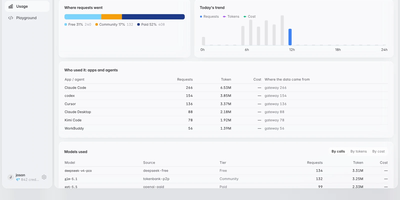
Run one local gateway and every AI coding agent you use shares the same address, key, and usage ledger. Token Bank onboards Claude Code, Codex CLI, Kimi Code, OpenCode, Claude Desktop, OpenClaw, and WorkBuddy in one click by injecting base-URL variables or patching configs, and Revert restores the official settings. Agents keep native model names while the gateway quietly reroutes requests to Ollama, Groq, Cerebras, or DeepSeek, converting between Anthropic Messages, OpenAI Chat, and Codex Responses. Route chains step from local models to free APIs, subscriptions, and pay-as-you-go keys with failover, scene and task presets, and optional lossless JSON compression. Every call is traced with route, model, tokens, latency, and cost, local session logs are imported, and signed-in devices merge into one dashboard. An assets library holds MCP servers, skills, prompts, and agent templates, projects them onto each installed runtime, and a rule-driven butler repairs broken projections. The unified agent API dispatches tasks to local apps, professional templates, external agents joined by pairing code, or agents hired per task, returning results synchronously, in the background, or as a stream. A credit-based market lets you rent out idle quota while keys stay on your machine. The container build serves the desktop interface in a browser on port 11431, with the gateway on 11430 and access control left to your firewall or proxy. Running on a dedicated VPS on RepoCloud with guaranteed CPU, RAM, and SSD, full root SSH access, and a browser serial console. Apache-2.0 licensed.
Workavera
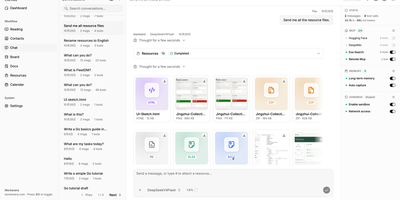
Workavera gives freelancers and small teams one self-hosted workspace for projects, docs, calendar, and files, with an AI assistant that actually does the work. Ask Chat to plan a project and it picks one of ten Kanban templates, creates tasks with states, priorities, and deadlines, and shows every reasoning step and tool call. Boards support custom workflow states, labels, members, and due dates, plus a read-only timeline you can share with clients by public link. Docs offers a rich-text editor with slash commands, version history, Markdown and HTML export, AI editing, and public pages. Calendar merges personal events with Board deadlines, including recurring events and reminders. Resources holds PDFs, Office files, code, images, archives, and SQLite databases that you attach to any chat with + or #, and an optional per-user Linux sandbox lets the assistant run Python or Node scripts to OCR a scanned PDF, clean a spreadsheet, or batch-rename files. Reading saves links with AI summaries, Discover follows sources such as GitHub Trending and Hacker News, and Contacts keeps a searchable team directory. Claude Code, Cursor, and other MCP clients connect with an API key, outside MCP servers plug into Chat, and models come from OpenAI, Anthropic, or Google endpoints or a local LM Studio, Ollama, vLLM, or llama.cpp server. Native Android and iOS apps put the workspace on your phone. Running on a dedicated VPS on RepoCloud with guaranteed CPU, RAM, and SSD, full root SSH access, and a browser serial console. Apache-2.0 licensed.
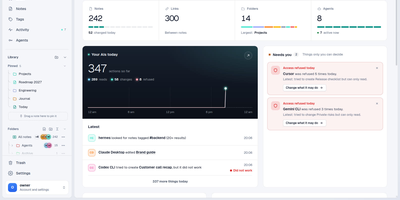
Memora
Memora is a self-hosted second brain where Claude Code, Cursor, ChatGPT, and your other AI agents share one memory made of plain Markdown notes that never leave your server. Agents read and write those notes through 77 tools on a Model Context Protocol endpoint, authenticating with a scoped API key per agent or with OAuth approved in the browser. Every change is committed to git, so any revision can be listed, diffed, and restored, and wikilinks and backlinks turn the vault into a navigable graph. The web UI shows a 3D brain with a region per folder, force, radial, and cluster graph layouts, and a canvas with a frame per folder, beside a reader and editor with reading settings. A live activity timeline records every read, write, search, and sign-in, with filters and JSON or CSV export. Mnemo, a built-in notes agent, finds, writes, tags, links, and tidies notes with your own OpenAI, Anthropic, or OpenAI-compatible key, shows every step, and hands tasks to sub-agents. Privacy rules hide folders from chosen agents, scopes and tool lists limit each key, and access rules allow or block by IP, CIDR, or domain. Images pasted into a note stay in its folder, and the interface installs as a PWA. Install with npm, Docker, or a systemd installer, then claim the instance with a one-time setup code. Running on a dedicated VPS on RepoCloud with guaranteed CPU, RAM, and SSD, full root SSH access, and a browser serial console. AGPL-3.0 licensed.