EvoScientist
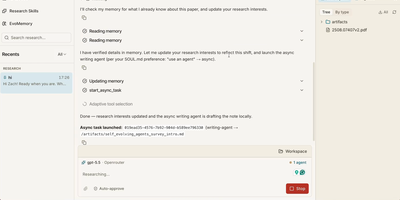
EvoScientist gives a research project a team of cooperating AI agents that plan experiments, read papers, write and debug code, and draft reports, then remember what they learned so the next project starts further ahead. A researcher can schedule a weekday arXiv digest as a cron-style task, optionally graded against a rubric checklist, while a lab lead reviews the reusable skills that AutoSkills proposes from recurring patterns. The EvoSkills catalog adds ready-made skills such as academic slides, paper figures, and experiment pipelines. Six sub-agents cover planning, research, coding, debugging, data analysis, and writing, following a workflow of intake, plan, execute, evaluate, write, and verify. Each turn is distilled into a memory that links itself into a knowledge graph you can browse in the EvoMemory view, next to profile pages for you, your research taste, and the agent's SOUL. Work from a terminal UI, a browser workspace with a file tree and agent panel, or messaging channels including Telegram, Slack, and Feishu that share one session. Rubric and goal commands grade each turn against acceptance criteria you approve. MCP servers plug in extra tools with one command, shell commands ask for approval by default, and the Docker image confines file edits to the folders you mount. Choose Anthropic, OpenAI, Google, MiniMax, NVIDIA, or any OpenAI-compatible endpoint such as vLLM. Running on a dedicated VPS on RepoCloud with guaranteed CPU, RAM, and SSD, full root SSH access, and a browser serial console. Apache-2.0 licensed.
Datakeel
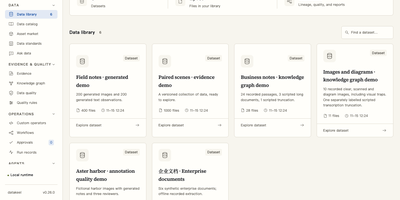
Datakeel is a workbench where teams proofread AI training data, trace every business number back to its definition, and approve risky changes before anything is deleted. Evidence review marks each claim as present, absent, or unknown, so missing annotations never pass as clean, and accepted decisions are stored apart from the extracted evidence. Ask data answers a question like last quarter's retail revenue from registered metrics, shows the bound SQL, source tables, and time range, and refuses or asks for clarification when a question is ambiguous. A data catalog maps sources, tables, fields, owners, lineage, and glossary terms, and an asset market handles access requests with purpose and expiry. A knowledge graph review queue turns document extractions into entities and relations that stay candidates until a person checks the source sentence. Dataset versions freeze file manifests with SHA-256 hashes, quality scores rank samples, and workflows run health checks, cleanups, and metric changes that pause at an approval sheet bound to a digest of the plan. Built-in agents and an MCP server can propose actions but never apply them alone, every receipt is kept in an append-only history, and the interface ships in English and Chinese with three themes. Running on a dedicated VPS on RepoCloud with guaranteed CPU, RAM, and SSD, full root SSH access, and a browser serial console. Apache-2.0 licensed.
Row-Bot
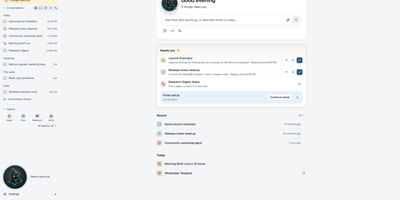
Conversations, goals, memory, and scheduled workflows live together in one private AI assistant that runs on your own server and opens in any browser, on a laptop or a phone. Chat with local models through Ollama, provider API keys, ChatGPT, Claude, or Grok subscriptions, or any OpenAI-compatible endpoint, and every tool call shows up in the transcript. Risky actions pause for Approve or Deny in the chat, on the Home screen, or on a connected channel. Memory grows into a personal knowledge graph with recall, review, and an Obsidian-compatible wiki vault. Ask for a deck, a mockup, or an app and a design or code panel opens beside the chat, with Present, export to PDF, HTML, PNG, or PPTX, a changes view, Git, pull requests, checks, and an interactive terminal. Goals keep going until done, delegated agents get their own conversations, and workflows run on a schedule, a webhook, or a chain, with run history and delivery to channels. Telegram, WhatsApp, Discord, Slack, and SMS channels, voice dictation, and an app catalog for GitHub, Notion, Linear, and Stripe extend it, and health checks propose one fix per problem. Pairing a phone takes a QR code and a one-time invitation, and the server serves a single owner across many devices. Running on a dedicated VPS on RepoCloud with guaranteed CPU, RAM, and SSD, full root SSH access, and a browser serial console. Apache-2.0 licensed.
NornicDB
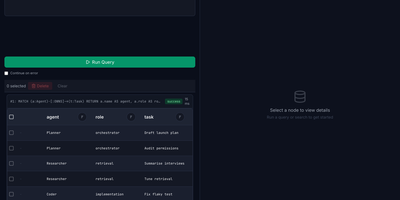
Agents forget things, and a graph database that learns is a fine place to keep what they should remember. NornicDB stores connected data as nodes and relationships, then answers Cypher queries from the browser console or from any Bolt driver you already use. Results appear in a sortable table, and selecting a row opens node details with labels, properties, and a Find Similar action. Switch to the Graph Explorer to see a node's neighborhood drawn as a graph, with a depth setting and filters for labels, edge types, and properties. Vector and full-text search run beside traversal, so one database can answer both who is connected and what is similar. Historical reads keep earlier states available through MVCC, and a lifecycle page shows pressure, prune runs, and schedules. Knowledge policies define decay and promotion rules for agent memory, and API tokens secure MCP and other integrations. Running on a dedicated VPS on RepoCloud with guaranteed CPU, RAM, and SSD, full root SSH access, and a browser serial console. MIT licensed.
Kompl
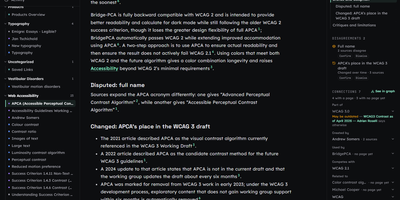
Save a link, a PDF, a YouTube video, or a bookmark export to Kompl and it reads the material on arrival, then writes it into cross-linked wiki pages instead of leaving it in a folder you never reopen. Save more on the same subject and the existing pages are rewritten, so source number fifty improves the pages it touches. Every claim carries a numbered citation back to the original text, and when two sources disagree the page records both sides with a confirm or dismiss button. A knowledge graph shows how topics connect, each link backed by the sentence that states it. An onboarding wizard stages pasted text, URLs, uploaded files, browser bookmarks, Twitter exports, Apple Notes, and Upnote exports for review before anything is compiled. Settings pick the compile model from DeepSeek or Gemini, cap daily spend, and show wiki health. Eight MCP tools let Claude Code, Cursor, Codex, and other agents search, read, and cite pages. Full backups export as one zip that restores without further model calls. Running on a dedicated VPS on RepoCloud with guaranteed CPU, RAM, and SSD, full root SSH access, and a browser serial console. Apache-2.0 licensed.
Engraphis
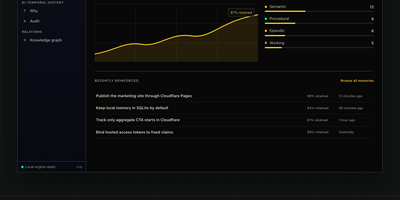
Engraphis is a durable memory layer for coding agents that answers questions like what did we decide about the auth layer three weeks ago, and why, with inspectable project memory that survives across sessions and repositories instead of evaporating when a chat ends. Store a decision once and recall it later in a new session, scoped by workspace, repository, and session so one project's facts never leak into another's context. Recall blends vector, lexical, graph, and code-aware retrieval, then packs the strongest evidence into a hard context budget your agent can actually use. Every returned fact keeps its provenance attached, and the engine cites its support or abstains when the evidence is too weak to trust. Facts are never silently overwritten: bi-temporal history preserves earlier versions, and a timeline view surfaces superseded knowledge when you need to know what used to be true. Index a repository into a code-symbol graph and ask what calls a function before you change it. Conflicting or quarantined memories wait in a review queue for a human decision. Running on a dedicated VPS on RepoCloud with guaranteed CPU, RAM, and SSD, full root SSH access, and a browser serial console. Apache 2.0 licensed.
Evonic
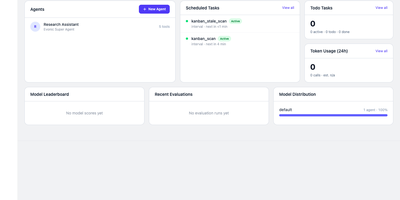
AI agents that delegate to each other, remember past conversations, and stay inside your safety rules all live in one self-hosted platform called Evonic. Every agent in Evonic has its own identity, model, tools, knowledge base, channels, and skills, and a guided first-run wizard creates the first one in minutes against OpenRouter, Together AI, Ollama, DeepSeek, llama.cpp, or any custom OpenAI-compatible endpoint. Agents message and delegate to each other, run commands in a Docker, Podman, or bubblewrap sandbox, and execute on a local folder, an SSH server, or a tunnel device that needs no public IP. A built-in Kanban board hands tasks to agents, a scheduler fires cron jobs and reminders, and Telegram, WhatsApp, and Discord channels put agents where users already chat. Markdown knowledge bases with wiki-links form an interactive graph, a memory engine recalls facts across sessions, and an organizer sub-agent extracts entities and merges duplicates. Safety layers inspect actions for mass deletion or remote code execution and escalate to a human, and an injection guard blocks prompt manipulation. Evaluation dashboards score models across domains, a token monitor tracks usage per agent and model, and bundled skills, 12 plugins, backup and restore, and themed light and dark modes round it out. Running on a dedicated VPS on RepoCloud with guaranteed CPU, RAM, and SSD, full root SSH access, and a browser serial console. AGPL-3.0 licensed.