Pretix
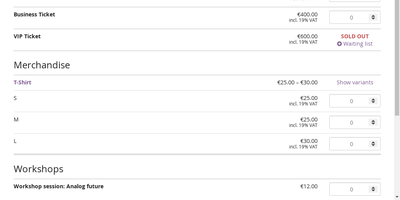
Pretix powers thousands of events and millions of ticket sales through a fully brandable ticket shop with interactive seating plans, 30+ payment providers, and a mobile check-in app for venue entry management. With over 2,400 GitHub stars, it delivers what organizations need when they demand full control over attendee data and revenue rather than surrendering margins to Eventbrite or Ticket Tailor. Built with Python and Django on PostgreSQL with Redis and Celery, the ticket shop adapts to your colors, logo, and domain with responsive design. The graphical seating plan editor handles everything from small cinemas to large stadiums, letting buyers choose seats mapped to pricing categories. Payment providers connect through plugins including Stripe, PayPal, Mollie for iDEAL and Bancontact, SEPA direct debit, and bank transfer with automatic CSV import for payment matching. The voucher engine generates bulk discount codes with usage limits, quota reservations, and automated email distribution. Waiting lists automatically offer released tickets to the next registrant with expiration deadlines. A built-in mini-CMS hosts event descriptions, terms of service, and static pages directly in the ticket shop. Customer accounts enable repeat buyers to check out faster across events. The pretixSCAN mobile app performs QR code check-in on Android and iOS with offline capability. Embeddable JavaScript widgets integrate the shop into any website. Plugin architecture extends functionality with output formats, analytics, and Apple Wallet passes. Deploy via Docker with the pretix/standalone image alongside PostgreSQL and Redis. Running on a dedicated VPS on RepoCloud with guaranteed CPU, RAM, and SSD, full root SSH access, and a browser serial console. AGPL-3.0 licensed.
Ontime
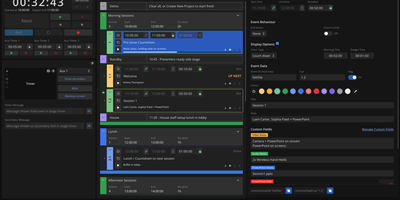
Before doors open, the rundown lives in Ontime's editor, and once the show starts every operator screen, stage timer, and cuesheet follows it live. It is built from timed events, groups for acts and panels, and milestones for operator notes, with durations typed as 10m15s. Excel and Google Sheets imports bring in an existing plan. During the show, play events by hand or switch on roll mode to follow the system clock. Added time and delays flow into downstream events, and expected start and finish times show how far the show has drifted. Custom fields hold light, sound, and camera notes, and a shared cuesheet link gives each department or client only the access it needs. Operator, cuesheet, stage timer, backstage, countdown, studio clock, and timeline views each get a URL, and presets turn long view settings into short shareable links. Remote client redirects steer wall displays nobody can touch. OSC, HTTP, and WebSocket APIs, a Bitfocus Companion module, and event-triggered automations tie the rundown to vMix, QLab, and OBS. An MCP server gives AI agents the tools to build, group, and audit a rundown from a pasted agenda, but never to start, stop, or advance a timer. Conference organizers, touring shows, broadcasters, theatres, and houses of worship use it to keep crews on one clock. Running on a dedicated VPS on RepoCloud with guaranteed CPU, RAM, and SSD, full root SSH access, and a browser serial console. GPL-3.0-or-later licensed.
Indico
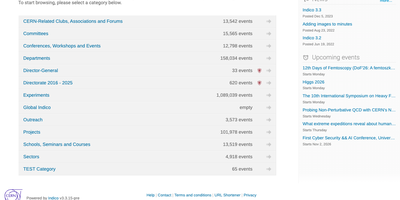
From the call for abstracts to the badge handed over at the registration desk, Indico handles every step of running a conference, plus the weekly meetings and one-off lectures that fill the calendar around it. Events live in a nested tree of categories, and access rules can be set per category, event, session, or single contribution, with custom roles inside each event. Speakers submit abstracts, track reviewers score them against questions the organizers define, judges accept or reject them, and accepted talks become contributions that sit in a drag-and-drop timetable of color-coded sessions. Registration forms are assembled field by field, carry fees, and take payment through PayPal, Stripe, or SIX Payment plugins; attendees get QR-coded tickets, and a badge editor prints name tags for the whole room. A paper reviewing workflow collects full papers. Meeting pages keep minutes and slide decks attached to the talk they belong to. The room booking module adds approvals, recurring reservations, and audiovisual equipment, and the Zoom plugin creates online sessions straight from an event page. Calendar views span a month, week, or day, filter by category, and export to iCal for subscriptions. Scripts pull event data from the HTTP export API as JSON or XML with personal API tokens. Running on a dedicated VPS on RepoCloud with guaranteed CPU, RAM, and SSD, full root SSH access, and a browser serial console. MIT licensed.
ChurchCRM
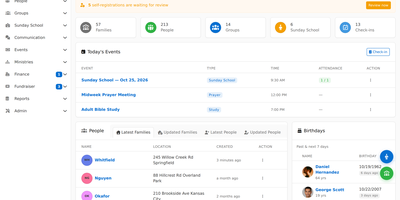
Church offices juggle member directories, giving records, event rosters, and volunteer schedules, and ChurchCRM, a free church management system, brings all of it into one browser-based workspace. Administrators keep a record for every person and family, with contact details, roles, notes, custom properties, and a timeline, while visitors submit a self-registration form that staff approve before it reaches the printed directory. Treasurers log donations against family pledge accounts, follow numbered giving envelopes and multi-year pledges, and batch gifts into deposit slips with printable bank forms. Ministry leaders organize teams, committees, Bible studies, and Sunday School rosters, then schedule volunteers into positions with substitutions and reminder email. Events can be one-time or recurring, appear on month, week, day, and list calendars beside birthdays and anniversaries, and collect attendance through kiosk tablets that alert parents by email or SMS. Members sign in to a portal to update their details, confirm their household, and check the church calendar and their volunteer schedule. A family map shows where households live and which ones are close by. Reports produce directories, mailing labels, birthday lists, financial statements, and custom queries, while CSV import, an Export Hub, and one-click database restore handle moving data. Role-based permissions and two-factor sign-in protect sensitive records, and plugins add MailChimp and Vonage SMS. Running on a dedicated VPS on RepoCloud with guaranteed CPU, RAM, and SSD, full root SSH access, and a browser serial console. MIT licensed.
DOMjudge
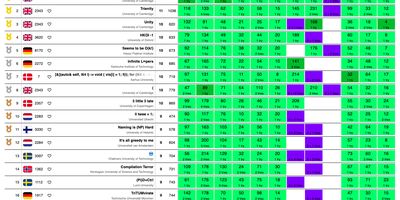
Built for ICPC-style programming contests, DOMjudge takes team submissions, judges them in a restricted sandbox, and posts a live scoreboard. Each team gets its own page. There they read the problem set, submit source code from the browser or a command line client, follow verdicts, and send clarification requests. Judges see every submission, judging run, and output diff. They verify results and rejudge a single submission or everything for a language, problem, team, or judgehost. Administrators schedule activation, start, freeze, end, and unfreeze times, import teams, categories, affiliations, and problems in bulk, and watch a traffic-light status for every team. The public scoreboard freezes for the final stretch and exports as a static HTML page. Judgehosts compile and run each solution with time and memory limits in languages such as C, C++, Java, Python, Kotlin, Go, and Haskell, with custom validators and interactive problems when a task calls for them. Balloon runners get a delivery queue. Clarifications sort into categories. Open contests accept self-registration. The Contest API and event feed connect external scoreboards, and a shadow mode compares results against another system. Running on a dedicated VPS on RepoCloud with guaranteed CPU, RAM, and SSD, full root SSH access, and a browser serial console. GPL-2.0 licensed.
Alf.io
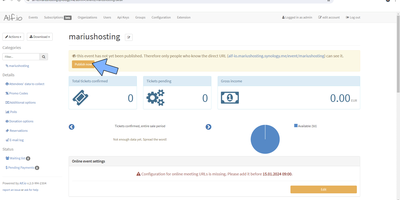
Alf.io handles the complete conference and event lifecycle from ticket distribution through check-in to financial reporting, built for organizers who refuse to surrender attendee data to third-party ticketing platforms like Eventbrite or Tito. Built on Java 17 with Spring Boot and PostgreSQL with row-level security policies, the project has earned over 1,500 GitHub stars from privacy-conscious event organizers across Europe and beyond. Payment processing supports Stripe for credit cards, Mollie for iDEAL, Bancontact, KBC/CBC, and Przelewy24, plus Revolut, PayPal, bank transfers, on-site collection, and configurable custom offline payment methods with localized instructions. Multi-tier ticket categories enable early bird, VIP, standard, and free registrations with promotional codes, group discounts, and waiting lists that automatically notify next-in-queue when cancellations occur. Customizable registration forms collect attendee data beyond standard fields, while EU VAT management validates tax IDs through the VIES web service and supports Italian e-invoicing with automatic PDF invoice generation attached to confirmation emails. The Alf.io Scan mobile app for iOS and Android performs QR code check-in at venue entrances, and the Alf.io-PI project provides Raspberry Pi-powered offline-capable check-in stations that form encrypted clusters for high-throughput badge printing at large events. Apple Wallet integration delivers digital passes via PassKit. The extensions system integrates with CRMs, accounting platforms, Slack, Telegram, and Mailjet. Multi-language support covers nine languages. Deploy via Docker with PostgreSQL. Running on a dedicated VPS on RepoCloud with guaranteed CPU, RAM, and SSD, full root SSH access, and a browser serial console. GPLv3 licensed.
Revel
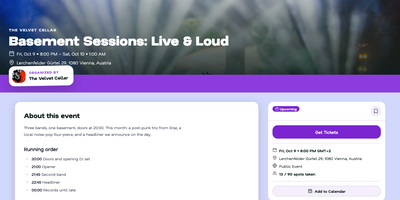
Yoga studios, comedy clubs, choirs, and bands use Revel to sell tickets, memberships, and season passes from their own server with no platform fee. Studios and clubs sell monthly or yearly memberships through Stripe and offer series passes that cover a class pack, a course, or a season, with wallet cards that a door scan verifies. Venues design seat maps with sectors, individual seats, and accessible seats, and buyers pick seats on an interactive map while the seats are held at checkout. Bands and DJs sell their own shows with no promoter in between, set pay-what-you-can tiers, open presales to invitation-link holders, and export every buyer's name and email. Communities that vet who comes screen requests with questionnaires reviewed automatically, manually, or both, and keep private guest lists, invitation-only events, and a fuzzy-matched blacklist. Buyers check out a multi-tier cart without an account, using discount codes and fixed-price, free, or pay-at-the-door tiers. Tickets arrive as QR PDFs or Apple Wallet and Google Wallet passes, and door staff check guests in by scanning. Organizers run waitlists with time-limited offers, announcements, reminders, and a Telegram bot for RSVPs and invitations. Revenue and VAT reports export as XLSX or PDF, and VIES checks buyer VAT IDs. The web app speaks English, German, Italian, French, Spanish, and Portuguese. Running on a dedicated VPS on RepoCloud with guaranteed CPU, RAM, and SSD, full root SSH access, and a browser serial console. MIT licensed.
Admidio
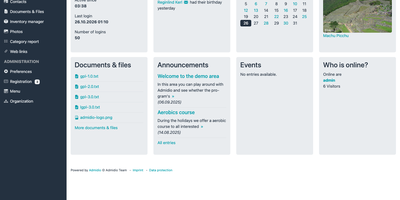
Admidio is membership management software for clubs, associations, and groups, built so that every permission follows from the roles a person holds. Organizers define roles such as board, youth team, or trainers, decide who may email or see each one, and grant module rights like managing events, editing contacts, or uploading photos with simple switches. Contact records use customizable profile fields, record relationships such as parent and child, and can be imported in bulk or exported as vCards. New members register online and administrators review each request. Events carry dates, venues, calendars, and participant lists with sign-up, and the schedule downloads as iCal. Messages go as HTML email to individuals, roles, or groups, and members also find announcements, a categorized forum, document folders with role-based access, and photo albums with e-cards. The inventory manager tracks equipment, who holds it, and its borrowing history. Optional two-factor login protects accounts, a change history can be switched on for every module, and single sign-on lets other applications authenticate against the member database. Twenty-five languages are included, the interface installs as a progressive web app, and sub-organizations can be managed from the same installation. Running on a dedicated VPS on RepoCloud with guaranteed CPU, RAM, and SSD, full root SSH access, and a browser serial console. GPL-2.0 licensed.
UniTime
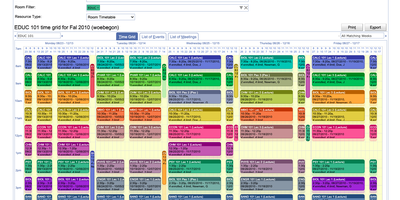
Building a conflict-free class and exam schedule for an entire campus is the problem UniTime solves, covering rooms, meeting times, and the placement of each student in sections. Course timetabling balances student conflicts against instructor preferences, room preferences, and links between classes, and managers can test scenarios with fewer classrooms. A published timetable can still change: an interactive solver proposes new times and rooms for a class that must move and shows each option's student conflicts. Midterms and finals receive periods and rooms through examination timetabling, which minimizes direct conflicts and back-to-back exams and respects rules like Same Period or Precedence. One events calendar holds every class meeting and exam, and staff and students request guest talks and club meetings in free rooms. Students enter prioritized course requests with wait-list and substitute choices, and online scheduling assigns open sections and holds seats that later students need. The scheduling dashboard tracks availability, projected demand, enrollments, reservations, and consent requests for every course. Instructor scheduling assigns teaching assistants to classes after the timetable is set, honoring each person's maximum load and teaching preferences. Timetables display by room, instructor, department, curriculum, subject area, or student group, with CSV, XLS, and PDF exports. UniTime runs alone for a school's classes and exams or connects to an existing student information system through documented import and export interfaces. Running on a dedicated VPS on RepoCloud with guaranteed CPU, RAM, and SSD, full root SSH access, and a browser serial console. Apache-2.0 licensed.
Event Schedule
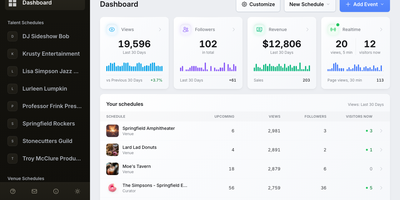
One self-hosted site can publish your event calendar, sell tickets, take bookings, and send the newsletter. Event Schedule gives venues, performers, and curators their own schedule types, and a curator page gathers events from the venues and performers it follows. Recurring patterns cover daily, weekly, monthly-by-weekday, and yearly dates with per-date exceptions, and calendars import from ICS feeds, Google Calendar, or Eventbrite. Tickets come in several types with promo codes, waitlists, gift cards, and a drag-and-drop seating plan, and payments go through Stripe, PayPal, Payfast, Razorpay, or cash straight to your own accounts. Door staff scan QR tickets in a browser and a live dashboard counts arrivals. Appointment pages sync both ways with Google Calendar, Outlook, and CalDAV. The newsletter editor sends segmented, A/B tested campaigns through your own SMTP server, and optional AI features turn pasted text or flyer images into draft events. Analytics, an audit log, TOTP two-factor login, signed webhooks, a REST API, and twelve interface languages cover the admin side. Running on a dedicated VPS on RepoCloud with guaranteed CPU, RAM, and SSD, full root SSH access, and a browser serial console. AAL licensed.
Bracket
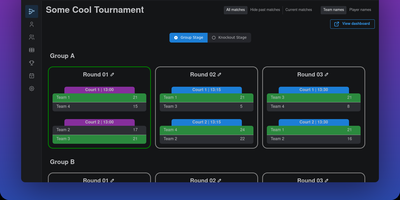
Organizers running sports leagues, gaming tournaments, and community athletics can deploy Bracket as an open-source competition control hub that coordinates multi-stage events without recurring SaaS subscription fees. Competition directors can configure multi-tier tournament topologies combining single elimination, double elimination, round-robin pools, and dynamic Swiss format brackets within a unified event schedule. An interactive calendar grid enables operators to drag and drop fixtures between designated courts, assign start times, and balance player recovery intervals across multiple playing areas. Public dashboard displays generate real-time match outcomes, court assignments, and standings boards that spectators can monitor on mobile devices or overhead venue monitors with customized team logos. Club administrators can manage multiple regional athletic organizations, register rosters through bulk CSV spreadsheet imports, and coordinate simultaneous divisions spanning amateur and championship flights. Integrated OpenAPI REST endpoints allow external scoring overlays, live stream graphic generators, and automated result bots to query match statuses or submit verified referee scorecards programmatically. Running on a dedicated VPS on RepoCloud with guaranteed CPU, RAM, and SSD, full root SSH access, and a browser serial console. AGPL-3.0 licensed.
CiviCRM
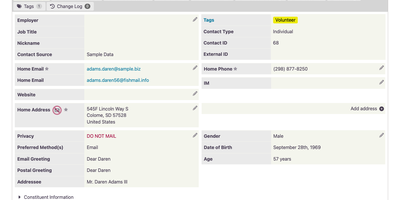
For nonprofits, advocacy groups, and NGOs that want donors, members, volunteers, and event guests in one database, CiviCRM is a constituent relationship management system you can host yourself. Contacts come first: people and organizations link through relationships, groups, tags, smart groups, and custom fields, and dedupe rules merge duplicates automatically or after review. CiviContribute takes one-time, recurring, and in-kind gifts on online pages, plus pledges and personal fundraising pages. Transaction batches export to accounting software. Events get online registration, fees, waitlists, and on-site check-in through CiviEvent. CiviMember handles membership types, online sign-up, auto-renewal where the payment processor supports it, and reminder emails. Mass mailings go out through CiviMail with optional open and click tracking, A/B testing, delivery reports, and unsubscribe records. CiviCase turns casework into a sequence of follow-up activities. CiviCampaign tracks events, mailings, and gifts against goals, and runs surveys and petitions. CiviGrant processes grant applications. SearchKit builds saved searches and result displays in the browser; FormBuilder designs custom data-entry forms for a directory or volunteer portal. Reports are built into every component. A stable API and community extensions add payment processors and integrations. Standalone mode needs no separate CMS, and the same code also installs into Drupal, WordPress, Joomla, or Backdrop. Running on a dedicated VPS on RepoCloud with guaranteed CPU, RAM, and SSD, full root SSH access, and a browser serial console. AGPL-3.0 licensed.
Fab-manager
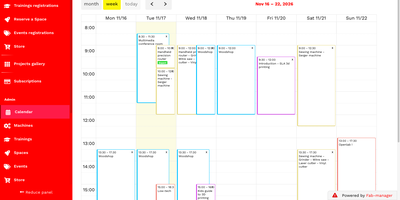
Fab-manager runs the booking desk, cash register, and bookkeeping of a FabLab or makerspace from a single web application. Pick a machine. Pick a slot. Book it. Time slots are opened, moved, or closed by administrators, and cancellation settings decide when a booking may still change. Validating attendance at a training opens its associated machines. Pay by card through Stripe or PayZen. Or on a payment schedule. Or on site by cheque or cash. Pricing bends to the lab: subscription plans per user group, prepaid hour packs, discounts, promo codes, and an electronic wallet. A numbered PDF invoice follows every sale. Refunds become credit notes. Accounting periods can be closed. Exports feed an external ERP. An online store sells consumables, with categories, stock alerts, and separate internal and public inventory. A personal space holds each member's bookings and invoices, projects with steps and collaborators appear in a public gallery, and children can be registered for kids' sessions. Members can be imported from CSV, tagged, grouped, and asked for supporting documents. Statistics track bookings and revenue. Sign-in works through OAuth2, OpenID Connect, or SAML. A token-based OpenAPI exposes bookings, events, and invoices to other tools. Plugins, CSS themes, and translations adapt the platform to each lab. Running on a dedicated VPS on RepoCloud with guaranteed CPU, RAM, and SSD, full root SSH access, and a browser serial console. AGPL-3.0 licensed.
Hitobito
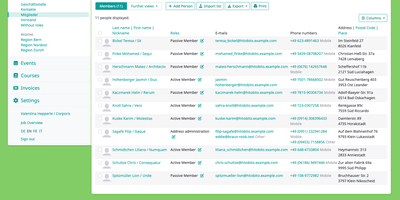
For clubs, associations, and federations, Hitobito replaces the member spreadsheets, sign-up forms, and mailing tools with one web application that mirrors how the organization is actually built. Chapters, regions, committees, and boards sit in a single group tree, and each person holds one or more roles that decide what they can see and change. People tables filter, import, and export to CSV, Excel, vCard, and PDF. Each record carries households, tags, notes, qualifications, and history, and a duplicates view helps clean up double entries. Events and courses accept online registrations, send overflow to a waiting list, and award qualifications that expire or renew by rule. Messages reach mailing lists as bulk e-mail, PDF letters, or SMS, and bounces are collected. The invoicing module issues single invoices and invoice runs, follows each through draft, issued, partially paid, paid, and reminded states, and can import bank payments over EBICS. Administrators edit texts, labels, tags, and course categories without writing code. Other systems sign in through an OAuth 2.0 and OpenID Connect provider and read data through a JSON:API with personal tokens or service accounts. The interface switches between German, English, French, and Italian. Running on a dedicated VPS on RepoCloud with guaranteed CPU, RAM, and SSD, full root SSH access, and a browser serial console. AGPL-3.0 licensed.
Meetable
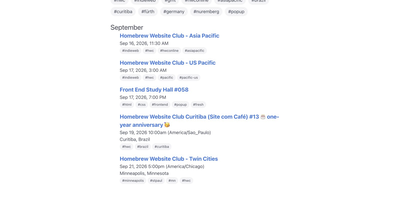
From the first announcement to the photos shared afterwards, every meetup, conference, and online session gets its own page on a Meetable events site that you host yourself. The home page lists upcoming events, an archive holds past ones, and a year page draws each month as a calendar with event days highlighted. Each event page carries a cover photo, location, website and ticket links, a Markdown description, and a timezone converter, and events can be marked tentative, postponed, or cancelled. Recurring events are templates that create future dates weekly, biweekly, or monthly, including second-Tuesday patterns. Tags give every topic its own page, iCal feeds cover the whole site, each tag, and each event, and Add to Calendar exports an .ics file or opens Google Calendar. Signed-in visitors RSVP yes, no, maybe, or remote, and proposed events let them vote on candidate dates. Attendees add photos with alt text. Webmention lets them post photos, blog posts, and notes from their own sites into a moderation queue. Zoom meetings can be scheduled automatically, online events get reminders, and a Discord bot posts notifications and syncs the server's event list. AI assistants find events through the built-in MCP server, and other tools add events through the API. Passkeys, GitHub, OpenID Connect, Vouch Proxy, or Discord handle sign-in for one organizer or many. Running on a dedicated VPS on RepoCloud with guaranteed CPU, RAM, and SSD, full root SSH access, and a browser serial console. MIT licensed.