
Countly
Mixpanel, OneSignal, and Crashlytics in one self-hosted stack - Countly is an all-in-one product analytics and engagement platform where every byte of first-party data stays on your server. A Node.js application over MongoDB, it collects through ten battle-tested SDKs spanning iOS, Android, web JavaScript, React Native, Flutter, Unity, and desktop (plus a data write API for anything else), and has powered tens of thousands of mobile, web, and desktop apps since 2012. The analytics core covers sessions, custom events, views, user profiles, and real-time dashboards, with exploration tools built for product managers as much as analysts. What separates Countly from pure analytics tools is acting on the data without third parties: built-in push notifications send automated, transactional, and personalized messages to iOS (APNs), Android (Firebase), and Huawei devices, with the SDK handling token retrieval and permission flows automatically; crash reporting captures symbolicated native crashes on iOS and Android plus JavaScript errors, correlated with the same user and session data. Email reports keep stakeholders updated, and the plugin-based architecture means features load as modules. For GDPR-sensitive products, engagement without piping user data to advertising companies is the entire point. AGPL-licensed server, installable in minutes.
ToolHive
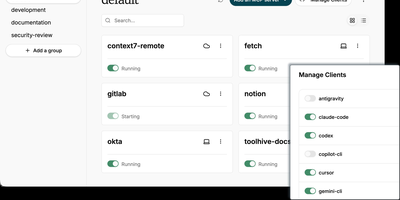
ToolHive is an open-source MCP server management platform that lets you run, secure, and orchestrate Model Context Protocol servers in isolated containers, giving AI agents structured access to tools like GitHub, databases, and cloud services without exposing host credentials or network. Every server launches inside its own sandboxed container with a minimal permission file, network access filtering, and encrypted secrets management, preventing misbehaving connectors from reaching beyond their defined scope. The built-in registry provides a catalog of vetted servers you can install with one command, while custom images and package-manager references let you onboard proprietary connectors without writing Dockerfiles. Platform teams deploy the Kubernetes operator to declare MCP servers as cluster resources using Custom Resource Definitions, with automated lifecycle management and multi-namespace isolation. The Virtual MCP Server gateway aggregates multiple backends behind a single endpoint, centralizing OIDC authentication, tool filtering, and composite cross-server workflows so clients connect once instead of juggling separate URLs. An MCP Optimizer analyzes tool schemas via semantic search and surfaces only relevant tools per request, cutting token consumption by up to 85%. OpenTelemetry traces and Prometheus metrics deliver full visibility into tool execution, latency, and request audit trails across every managed server. Running on a dedicated VPS on RepoCloud with guaranteed CPU, RAM, and SSD, full root SSH access, and a browser serial console. Apache 2.0 licensed.
PostHog
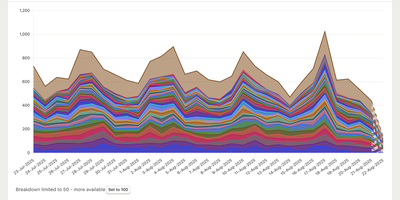
With over 37,000 GitHub stars and used by teams at Y Combinator, Airbus, and Phantom, PostHog replaces an entire stack of paid analytics tools — Mixpanel, Amplitude, Heap, LaunchDarkly, Hotjar, and Google Analytics — with a single open-source platform where every tool shares a common event layer and user context. Product analytics captures events automatically or via manual instrumentation with HogQL (SQL) access for custom queries, while web analytics provides GA-like dashboards for traffic, conversions, and Core Web Vitals. Session replay records user interactions with DOM snapshots and network waterfall analysis, linking directly to errors and feature flag exposures. Feature flags safely roll out changes to specific cohorts with multivariate support and instant rollback, while experiments run A/B tests with automatic Bayesian significance calculations and revenue attribution. Error tracking captures stack traces linked to session replays and user properties for immediate reproduction context. AI observability monitors LLM generations, traces, token usage, latency, and costs across model versions. The managed data warehouse syncs 120+ external sources including Stripe, Postgres, Salesforce, and HubSpot alongside product events, queryable through a unified SQL editor. An MCP server enables AI agents in Cursor, Claude Code, or VS Code to query analytics and execute SQL directly. Running on a dedicated VPS on RepoCloud with guaranteed CPU, RAM, and SSD, full root SSH access, and a browser serial console. MIT licensed.
Artifact Keeper
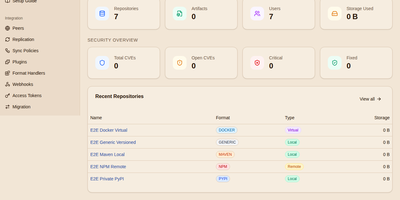
Artifact Keeper serves as a self-hosted universal software artifact repository that consolidates container images, application libraries, and infrastructure bundles under a unified management control plane. Software development teams can publish and resolve dependencies using their existing build tools, including Docker, Helm, npm, PyPI, Maven, Cargo, NuGet, and Terraform without installing proprietary client plugins. Remote repositories act as transparent pull-through caching proxies for public upstreams like Docker Hub and PyPI, accelerating internal CI/CD build speeds while insulating production pipelines from external registry outages. Virtual repositories combine multiple local, remote, and third-party endpoints into single URLs, resolving packages across prioritized internal teams and public registries automatically. Automated security scanners evaluate incoming packages for Common Vulnerabilities and Exposures using Trivy and Grype engines, assigning letter grades and enforcing quarantine policies to block vulnerable binaries before production release. Administrators can sign package metadata with cryptographic GPG keys, configure peer mesh replication across geographic regions, and manage team permissions using OpenID Connect, SAML, and granular access tokens. Running on a dedicated VPS on RepoCloud with guaranteed CPU, RAM, and SSD, full root SSH access, and a browser serial console. MIT licensed.
Coder
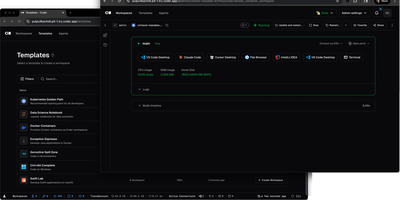
With over 14,000 GitHub stars and enterprise adoption by security-conscious organizations, Coder transforms how development teams provision, manage, and secure their coding environments. Every workspace is defined as a Terraform template, meaning infrastructure engineers can standardize development environments across EC2 instances, Kubernetes pods, Docker containers, or any combination, while developers get self-service provisioning that launches in seconds rather than days of manual setup. The WireGuard-based networking layer establishes encrypted tunnels between developer machines and remote workspaces, providing low-latency access without exposing ports or configuring VPN concentrators. Automatic idle detection shuts down unused workspaces after configurable periods, directly reducing cloud compute costs for organizations running hundreds of developer environments. The Coder Agents feature introduces native AI coding capabilities where the agent loop executes entirely within the control plane on self-hosted infrastructure, keeping LLM API credentials out of individual workspaces and eliminating credential exfiltration risks. Centralized model governance allows platform teams to approve specific AI providers and models, set per-user spend limits, and maintain complete audit logs of all prompts, tool calls, and agent activity. IDE integration supports VS Code through a dedicated extension, JetBrains IDEs via Gateway and Toolbox plugins, and browser-based code-server for web access. The template registry provides pre-built configurations for common development stacks. DevContainer support builds environments from standard devcontainer.json specifications. Deploy on a dedicated VPS on RepoCloud with guaranteed CPU, RAM, and SSD, full root SSH access, and a browser serial console. AGPL-3.0 licensed.
MindsDB
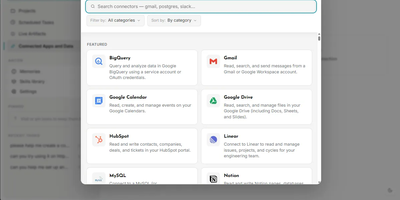
Backed by 39,500+ GitHub stars and over 339 releases, MindsDB delivers the open-source federated query engine that gives AI agents a single SQL interface to read, join, and aggregate across 200+ live data sources without any ETL pipelines or data movement. The Connect-Unify-Respond architecture wires up Postgres, MySQL, MongoDB, Snowflake, BigQuery, ClickHouse, Redshift, Databricks, Salesforce, Shopify, Slack, S3, GCS, Azure Blob, and dozens more through self-contained Python handler packages merged in the open from the community. Knowledge Bases fuse structured tables with vectorized unstructured data from PDFs, emails, support tickets, and documents using hybrid search combining vector similarity with keyword matching for retrieval-augmented generation. Jobs execute queries on configurable schedules refreshing Knowledge Bases nightly or syncing derived tables hourly, while Triggers fire on data changes to automatically vectorize new rows into the appropriate store. The SQL-compatible query language extends standard SQL with constructs for creating models, defining agents, managing workflows, and searching unstructured data. The built-in web editor at port 47334 provides interactive SQL authoring, while the MySQL-compatible API at port 47335 and PostgreSQL API at port 47336 connect any database client directly. An MCP Server integration exposes MindsDB to AI assistants, and the Python SDK enables programmatic access from application code. Docker deployment runs with a single command exposing all APIs immediately. Running on a dedicated VPS on RepoCloud with guaranteed CPU, RAM, and SSD, full root SSH access, and a browser serial console. MIT licensed.
GitNexus
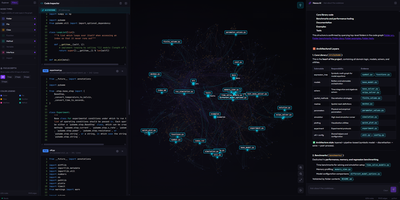
GitNexus turns any codebase into an interactive knowledge graph that maps every dependency, call chain, functional cluster, and execution flow, giving AI coding assistants the deep structural awareness they need to stop breaking things. Drop a repository URL or ZIP file into the browser-based explorer and watch Tree-sitter parsers decompose your code into a navigable property graph you can zoom, click, and query. The MCP server integrates directly with Cursor, Claude Code, Codex, Antigravity, and other editors through 16 specialized tools covering architectural queries, impact analysis, safe multi-file renames, change detection, and cross-repo contract matching. Need to know the blast radius before touching a shared utility? The impact analyzer traces every caller, implementer, and downstream consumer in milliseconds. Teams reviewing pull requests get automated blast-radius annotations powered by the same graph. The registry architecture lets a single MCP server manage multiple indexed repositories simultaneously, so switching between projects requires zero re-indexing. For visual exploration, the web interface renders interactive community-clustered graphs where you can trace execution paths, browse file trees, and chat with an AI agent grounded in the graph's structural data rather than raw file snippets. Everything runs locally; your source code never leaves the machine. Running on a dedicated VPS on RepoCloud with guaranteed CPU, RAM, and SSD, full root SSH access, and a browser serial console. PolyForm Noncommercial 1.0.0 licensed.
CubeJS
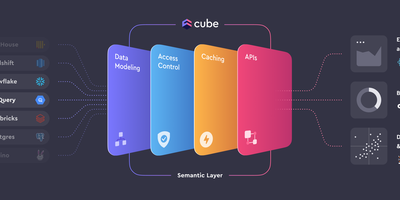
Between your databases and everything that consumes data - BI tools, embedded analytics, AI agents - sits Cube (formerly Cube.js), an open-source semantic layer. Metrics, dimensions, joins, and access rules are defined once as code in YAML, JavaScript, or Python, forming a governed data model that every downstream consumer shares, so "revenue" means the same thing in every dashboard. Caching is two-level: an in-memory cache absorbs bursts of identical queries, and declared pre-aggregations - rollup tables built in the warehouse or in Cube Store, Cube's distributed columnar engine, and refreshed in the background - deliver sub-second latency while cutting warehouse compute costs. The query planner routes each request to cache, rollup, or source automatically. Consumers connect through a Postgres-compatible SQL API (any tool that speaks Postgres works), plus REST, GraphQL, and a Meta API for model introspection. Row-level security and multi-tenancy are enforced in the layer itself, upstream of every client. Sources include Snowflake, BigQuery, Databricks, Postgres, MySQL, Presto, and Athena. Headless by design - bring your own UI.
Kutt
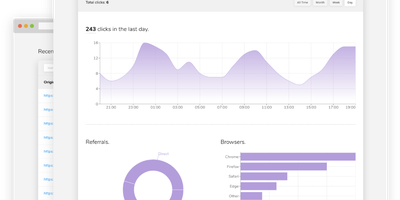
Built for self-hosting from the ground up, Kutt is a modern, MIT-licensed URL shortener: zero-configuration setup, no build step, and SQLite, PostgreSQL, or MySQL with optional Redis caching. Links carry real management features - custom slugs from a configurable alphabet (confusable characters like 0/O and l/1 omitted by default), password protection, descriptions, expiration times, and the ability to edit a destination URL without changing the short link already in circulation. Custom domains make branded short links first-class: add as many as you like and serve each under your own name instead of a third-party's. Private, per-link statistics track clicks, browsers, operating systems, and countries without logging visitor IPs or sensitive data. An admin page manages users and links instance-wide, and two environment flags (DISALLOW_REGISTRATION, DISALLOW_ANONYMOUS_LINKS) lock the instance down for private use; OpenID Connect login integrates with an existing identity provider. Automation runs through a documented REST API - create, list, delete, and pull stats - plus Chrome and Firefox extensions and ShareX compatibility for shortening from anywhere. Built with Node.js and React, deployed in one Docker container, it replaces Bitly with something you own: your domain, your analytics, and links that never die with a vendor.
Centrifugo
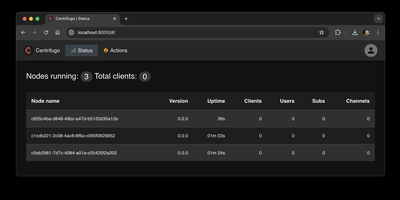
Benchmarked at one million concurrent WebSocket connections and 30 million delivered messages per minute on a single server, Centrifugo is a self-hosted real-time messaging server that integrates with any backend language — Node.js, Python, Go, Ruby, PHP, Java — without requiring architectural changes to your existing application. It handles persistent connections over WebSocket, HTTP-streaming, Server-Sent Events, gRPC, and experimental WebTransport, routing messages through a channel-based PUB/SUB model with automatic reconnection recovery that replays missed messages from hot channel history. Built-in horizontal scaling operates through Redis (including Redis Cluster, AWS ElastiCache, Valkey, KeyDB, and DragonflyDB), NATS, or PostgreSQL brokers, allowing multi-node deployments without external message queues. The server provides JWT-based authentication using HMAC or RSA keys, granular channel permissions, online presence tracking showing who is currently subscribed to a channel, and an RPC proxy that forwards client calls to your backend over HTTP or gRPC. The embedded ReactJS admin web interface displays real-time connection statistics, node information, and provides an interactive API console for publishing messages, managing subscriptions, and inspecting channel history. Official client SDKs are available for JavaScript, Dart, Go, Swift, and Java, with unidirectional transports requiring no SDK at all. Centrifugo also supports delta updates to minimize bandwidth, connection event proxying, and Prometheus-compatible metrics for Grafana monitoring. Running on a dedicated VPS on RepoCloud with guaranteed CPU, RAM, and SSD, full root SSH access, and a browser serial console. Apache 2.0 licensed.
Infisical
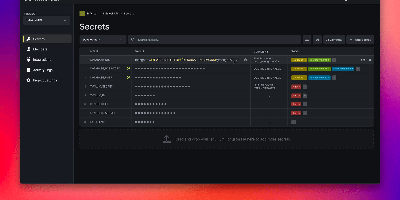
API keys hardcoded in repos, database passwords pasted into CI variables, .env files emailed between developers - Infisical, the open-source platform for secrets, certificates, and privileged access management, is the answer to all three. Secrets live in versioned stores scoped by project, environment, and path, with fine-grained identity-aware access control and full audit logging on every read and change. Delivery covers every consumption pattern: CLI injection into local dev, SDKs for Go, Node.js, and Python, an HTTP API, agents, a Kubernetes Operator, and secret syncs that push to GitHub, GitLab, AWS Secrets Manager, and Vercel. Automatic rotation replaces credentials for PostgreSQL, MySQL, MSSQL, LDAP, AWS IAM, and Azure on a rolling schedule - new credentials issue while old ones stay temporarily valid, so nothing breaks mid-rotation. Dynamic secrets go further, generating ephemeral, time-bound database credentials on demand, and SSH access replaces static keys with short-lived CA-signed certificates that expire automatically. Secrets scanning catches hardcoded credentials in code and pipelines, certificate management automates X.509 issuance and renewal, and a built-in KMS handles encrypt/decrypt with central key control. Self-hosting keeps the keys to everything else on your own infrastructure.
New API
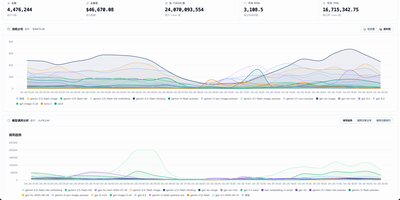
New API is a Go-powered LLM gateway that funnels over 40 AI providers, from OpenAI and Anthropic to Google Gemini, Azure, AWS Bedrock, DeepSeek, and Mistral, through a single OpenAI-compatible endpoint with intelligent routing and enterprise cost controls. Bidirectional format conversion translates between OpenAI Chat Completions, Claude Messages, and Gemini GenerateContent APIs transparently, so clients call any provider using their preferred format while the gateway handles the rest. Routing logic supports weighted random channel selection, priority-based failover, and automatic retry on provider errors to maximize uptime. The React admin dashboard shows usage charts, token consumption tracking, per-model cost breakdowns, and real-time request monitoring. Multi-tenant architecture includes three role levels, token-based authentication, per-user quota management, and a three-phase billing system with tiered pricing via a custom expression language. Multimodal support covers text completion, vision, embeddings, text-to-speech, speech-to-text, image generation, and creative task providers like Midjourney-Proxy and Suno-API. The interface ships in five languages including English, Chinese, Japanese, and French. Docker deployment runs with SQLite or MySQL for persistence. 45,000+ GitHub stars. AGPL-3.0 licensed.
dbx
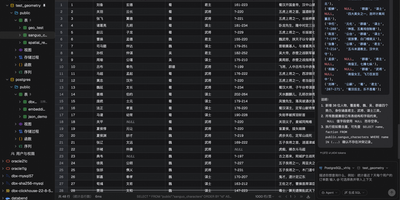
Universal database administration across modern enterprise infrastructure is simplified through dbx, a lightweight web client and SQL studio supporting over ninety database engines. Database administrators connect to MySQL, PostgreSQL, SQLite, Redis, MongoDB, ClickHouse, DuckDB, Oracle, and Microsoft SQL Server through authenticated network connections and encrypted SSH tunnels. The interactive query editor provides real-time multi-schema autocomplete, syntax linting, execution plan analysis, and natural language SQL query synthesis powered by configurable large language model backends. Teams visualize complex relational database architectures using interactive entity-relationship diagrams that map table foreign key constraints, primary indexes, and table partition layouts automatically. Operators inspect live Redis memory usage breakdowns, monitor real-time server command throughput, and manage key expirations without opening raw terminal sessions. The editable data grid supports multi-row modifications, foreign key reference lookups, CSV and JSON exports, and binary blob data inspection directly inside the browser viewport. Software developers expose connected databases directly to external AI coding assistants through native Model Context Protocol server endpoints. Running on a dedicated VPS on RepoCloud with guaranteed CPU, RAM, and SSD, full root SSH access, and a browser serial console. Apache-2.0 licensed.
Doccano
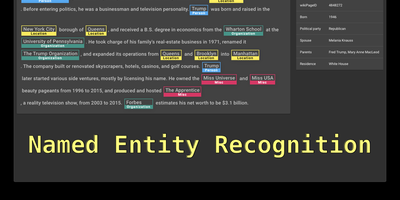
Doccano is a text annotation platforms for building machine learning training datasets. The web-based interface supports text classification for sentiment analysis and document categorization, sequence labeling for named entity recognition with overlapping entity support and relation extraction between labeled spans, and sequence-to-sequence annotation for text summarization and machine translation pairs. Collaborative annotation enables multiple annotators to work on the same project simultaneously with per-user progress tracking, annotation guidelines, example assignment to specific members, and filtering by assignee. Auto-labeling integrates with external machine learning model APIs through configurable request and response mapping templates, allowing pre-annotation that annotators can review and correct. Data import accepts plain text, JSONL, CoNLL, and Excel formats, while export produces JSONL and CoNLL datasets compatible with spaCy, Hugging Face Transformers, PaddleNLP, and other training frameworks through the doccano-transformer library. The Django backend with Django REST Framework exposes a complete RESTful API for programmatic project creation, dataset management, and annotation retrieval via the official doccano-client Python library. Celery handles background tasks including dataset import and export processing with Flower providing task monitoring. One-click deployment supports AWS CloudFormation and Heroku alongside Docker Compose for self-hosted environments. Running on a dedicated VPS on RepoCloud with guaranteed CPU, RAM, and SSD, full root SSH access, and a browser serial console. MIT licensed.
NoteDiscovery
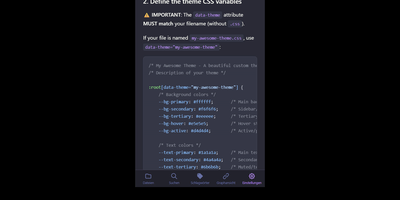
Transforming fragmented research notes, daily technical logs, and project documentation into an interconnected knowledge base is what NoteDiscovery delivers for privacy-conscious teams and researchers. Writers compose rich documents using a dual-pane editor that renders MathJax equations, interactive task lists, and dynamic Mermaid sequence diagrams side by side with raw text. The interactive knowledge graph maps semantic relationships across notebooks, allowing researchers to explore backlinks, uncover hidden topical connections, and navigate complex idea webs visually. Team members sketch architecture diagrams and wireframes directly inside note canvases using the integrated drawing tool, saving revisions as embedded image layers without external editors. The platform organizes thoughts through flexible tag hierarchies, nested folder trees, and reusable document templates equipped with automatic date and variable substitutions. Autonomous coding assistants and language models query documentation, create structured meeting summaries, and update project indexes directly through the native Model Context Protocol server. Built-in export tools convert notebook collections into standalone HTML packages, printable documents, or portable Markdown archives for offline archiving. Running on a dedicated VPS on RepoCloud with guaranteed CPU, RAM, and SSD, full root SSH access, and a browser serial console. MIT licensed.
Novu
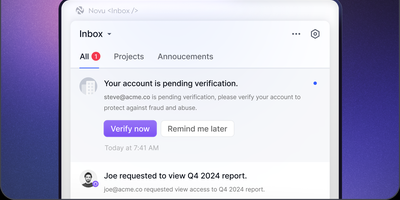
Powering notification delivery for thousands of organizations with over 39,000 GitHub stars, Novu is the open-source communication infrastructure that eliminates the need to build separate integrations for every messaging channel. The TypeScript-based platform provides a single API endpoint that routes notifications across In-App Inbox, Email via SendGrid, Mailgun, AWS SES, and Postmark, SMS through Twilio, Vonage, and Plivo, Push via Firebase Cloud Messaging, Expo, and APNS, and Chat through Slack, Discord, Microsoft Teams, and WhatsApp. The embeddable React Inbox component delivers real-time WebSocket-powered notifications with read/unread states, action buttons, and user-controlled preferences directly inside your application. The workflow engine orchestrates complex multi-channel delivery with conditional branching, time delays, digest batching to reduce notification fatigue, throttle controls, and per-step channel fallbacks. Novu Connect introduces Agent Communication Infrastructure enabling AI agents built with LangChain, Claude, or custom frameworks to hold threaded two-way conversations with humans across any supported channel through a single conversation model with identity resolution and credential management. The backend runs on Node.js with NestJS, MongoDB for notification storage, Redis with BullMQ for job queuing, and Socket.io for real-time delivery. Self-hosting deploys via Docker Compose with the dashboard accessible at port 4200. Running on a dedicated VPS on RepoCloud with guaranteed CPU, RAM, and SSD, full root SSH access, and a browser serial console. MIT licensed.
EDDI
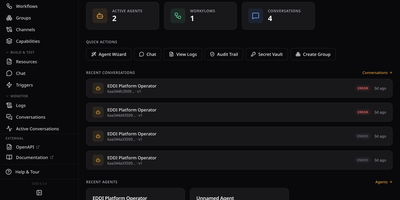
Deploy autonomous conversational AI agents and coordinate complex multi-agent workflows through EDDI, an open-source orchestration middleware that turns declarative configuration files into secure, production-grade enterprise assistants. Engineering teams connect AI models from twelve different commercial and local providers, using bilateral Model Context Protocol tools to let external desktop clients and coding assistants interact directly with running conversational services. Autonomous agents collaborate through structured group interaction patterns including round table discussions, peer reviews, Delphi consensus rounds, and devil's advocate debates to refine generated solutions before delivery. Declarative workflow extensions automate external REST API calls with dynamic request templating, extracting structured properties into persistent conversation memory and chaining multi-step service interactions without custom script glue. Built-in secret vaults safely manage sensitive API credentials, while the centralized web dashboard provides live conversation inspection, token quota enforcement, and comprehensive audit logging for regulatory compliance. Running on a dedicated VPS on RepoCloud with guaranteed CPU, RAM, and SSD, full root SSH access, and a browser serial console. Apache 2.0 licensed.
Open Code Review
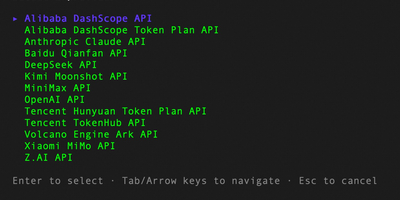
Originated as Alibaba Group's official internal AI code review assistant serving tens of thousands of developers and identifying millions of code defects over two years before open-sourcing in May 2026 — now at 21,000+ GitHub stars — Open Code Review is the production-hardened platform that proves enterprise-grade code review can be fully open-source under Apache 2.0. The hybrid architecture separates deterministic engineering pipelines (file selection, diff parsing, rule matching for NPE, thread-safety, XSS, and SQL injection across 10+ languages) from LLM-powered agent reasoning with tool-use capabilities including FileRead, CodeSearch, and cross-file context inspection, consuming approximately one-ninth the tokens of general-purpose coding agents while delivering line-level precise comments with severity and confidence scoring. The bundled web dashboard (port 4173) provides review management, findings triage, result browsing, and direct GitHub posting without external dependencies, while the session viewer (port 5483) renders full LLM request/response traces for debugging and auditing. Integration spans GitHub Actions, GitLab CI, GitFlic CI, and Gerrit with delegation mode enabling Claude Code, Cursor, and other AI agents to leverage OCR's engineering logic alongside their own LLM reasoning. Supports OpenAI, Anthropic, Google Gemini, DeepSeek via built-in providers plus Ollama and vLLM for air-gapped deployments. Running on a dedicated VPS on RepoCloud with guaranteed CPU, RAM, and SSD, full root SSH access, and a browser serial console. Apache 2.0 licensed.