Hatchet
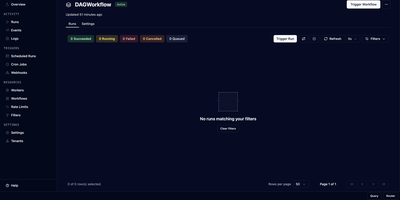
Processing over one billion tasks per month on Hatchet Cloud and holding 7,600+ GitHub stars, Hatchet is the open-source orchestration engine that replaces fragile legacy queues with durable, fault-tolerant task execution built entirely on PostgreSQL — no Redis, RabbitMQ, or Kafka required. Born from the creators' experience scaling Uber's Cadence-inspired patterns, the v1 engine achieves 10,000 tasks per second sustained throughput with 20ms average queue latency through dynamic buffer flushing and batch insert optimization. Define tasks, durable workflows, and DAG pipelines as code using native SDKs for Python, TypeScript, Go, and Ruby — every function gets automatic retries with configurable backoff, concurrency control with group round robin or cancellation policies, priority queuing, and dynamic rate limiting for third-party API protection. Durable execution persists the complete history of every task and state transition, enabling replay from failure, debugging via full event timelines, and complex pause/resume conditions using durable sleep and event waits. The real-time web dashboard provides workflow run visualization with DAG timeline rendering, worker health monitoring with slot utilization, queue depth metrics, task throughput charts, and error rate tracking — all filterable by status, workflow, or time window. OpenTelemetry integration and Prometheus metrics export enable advanced observability. Multi-tenant by default with users, roles, and namespace isolation. Self-host via Docker Compose with PostgreSQL and optional RabbitMQ, or use the single-container Hatchet Lite image for development. Running on a dedicated VPS on RepoCloud with guaranteed CPU, RAM, and SSD, full root SSH access, and a browser serial console. MIT licensed.
DAC
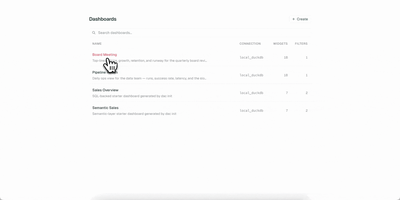
Your dashboards deserve version control, code review, and reproducible builds, just like the rest of your stack. DAC lets you define interactive data dashboards in YAML or TSX, validate them in CI, and serve them from a single Go binary that embeds a full React frontend. Choose from 21 chart types including line, bar, area, pie, scatter, bubble, funnel, sankey, heatmap, calendar, sparkline, waterfall, gauge, treemap, radar, and candlestick, plus metric cards, data tables, text blocks, and image widgets. The built-in semantic layer lets you define metrics and dimensions once in reusable model files, then reference them from any widget while DAC generates the SQL automatically. Connect to Postgres, MySQL, Snowflake, BigQuery, Redshift, Databricks, and DuckDB through standard Bruin connection configs. Interactive filters with date pickers, dropdowns, multiselects, and search inputs inject values via Jinja templating and re-execute only affected widgets. Live reload via Server-Sent Events refreshes connected browsers instantly when you save a file. Export dashboards as self-contained static HTML with baked-in query results for S3, GitHub Pages, or offline sharing, and render slide decks via the Google Slides export command. On RepoCloud, deploy DAC on a dedicated VPS with root SSH access and persistent storage for your dashboard definitions and database connections under the AGPL-3.0 license.
Veritas Kanban
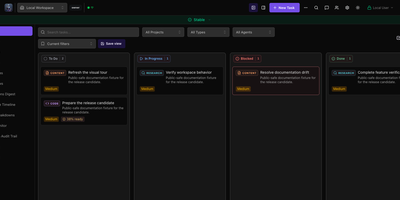
A drag-and-drop task board that works fine on its own and can also hand cards to AI coding agents, Veritas Kanban shows what each agent is doing, what it changed, and what is waiting for your approval. Start with no agents at all. Cards move through To Do, In Progress, Blocked, and Done, and each one carries subtasks, dependencies, time tracking, comments, and an activity log. When you are ready, connect Codex, Claude Code, Copilot CLI, Hermes, or OpenClaw, give every agent an Intern, Specialist, or Lead permission level, and follow each agent's status and model on a live dashboard. Let a task run in its own Git worktree, read the diff, leave inline comments, approve or request changes, and open a GitHub pull request from the task panel. Squad Chat gives agents one shared channel that posts spawned, completed, and failed events. Workflows chain steps with parallel branches, loops, and human approval gates. Policy rules allow, deny, or hold agent actions for review. Assistants reach the board through an MCP server, a command-line client, or a REST API. Running on a dedicated VPS on RepoCloud with guaranteed CPU, RAM, and SSD, full root SSH access, and a browser serial console. MIT licensed.
Local Deep Research
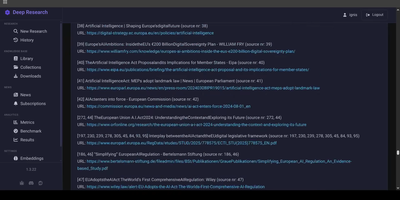
Execute comprehensive multi-angle investigations across scientific journals and web repositories using Local Deep Research, an autonomous intelligence engine designed for researchers, analysts, and knowledge workers. Users can submit complex analytical questions through a self-hosted web console to initiate agentic research cycles powered by LangGraph workflows. The application dynamically queries search providers including SearXNG, arXiv, PubMed, Wikipedia, and Google, iteratively evaluating discovered content to formulate targeted follow-up queries. Discovered academic papers and web sources can be indexed into an encrypted personal library to combine internal documentation with external search intelligence. Reports are synthesized with structured outlines, section headings, and verifiable academic citations that link directly to source references. Individual research sessions, system logs, and user credentials remain isolated in per-user SQLCipher databases protected by AES-256 encryption. Automated subscriptions deliver scheduled news digests and topic monitoring summaries directly to connected notification channels. Running on a dedicated VPS on RepoCloud with guaranteed CPU, RAM, and SSD, full root SSH access, and a browser serial console. MIT licensed.
Scira
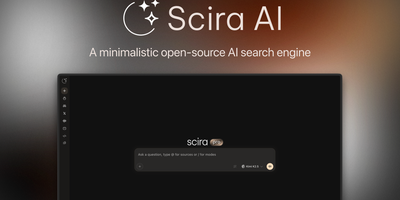
Scira is an AI search engine that breaks complex research questions into sub-tasks, retrieves grounded answers from live sources, and cites every claim with clickable links to the original evidence. Formerly known as MiniPerplx and now backed by nearly 12,000 GitHub stars, the platform implements agentic research planning where language models decompose queries, select appropriate tools, retrieve information in parallel, and synthesize responses with inline citations. Seventeen distinct search modes cover Web, Academic, Extreme, X (Twitter), Reddit, GitHub, Stocks, Crypto, YouTube, and Prediction markets, each activating a curated subset of the 28 built-in tools. The Extreme mode deploys a deep research agent with multi-step planning, parallel source retrieval, code execution in sandboxed Daytona environments, and R2 artifact storage for generated charts. Model routing spans 50+ AI providers through a unified configuration layer supporting OpenAI, Anthropic, Google, xAI Grok, and custom models, with per-mode model assignment based on task requirements. The web search tool supports Exa, Tavily, and Firecrawl as interchangeable providers via a Strategy pattern. Lookouts schedule recurring research agents on cron schedules that monitor topics, track changes, and email summaries using Upstash QStash for reliable execution. PostgreSQL stores chat history, user preferences, and custom instructions while Redis handles caching and rate limiting. Running on a dedicated VPS on RepoCloud with guaranteed CPU, RAM, and SSD, full root SSH access, and a browser serial console. AGPL-3.0 licensed.
Directus
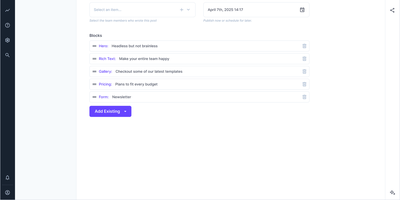
With 37,000 GitHub stars and over 45 million downloads powering 500,000+ deployed projects, Directus is the most widely adopted open-source backend platform that connects to your existing SQL database without requiring schema migrations or data duplication. Point it at PostgreSQL, MySQL, MariaDB, MS SQL, SQLite, OracleDB, or CockroachDB and it instantly generates production-ready REST and GraphQL APIs complete with filtering, sorting, pagination, field selection, and relational queries — all derived from your actual schema with zero configuration. The visual Studio provides a full no-code management interface where non-technical teammates create content, manage assets, build dashboards, and configure access policies without engineering involvement. Field-level granular permissions govern every API request and Studio action through composable policies applied to roles, users, and AI agents identically. A built-in AI Assistant writes copy, translates content across languages, creates records, and routes items for review directly within the Studio interface. The native Model Context Protocol server connects Claude Desktop, Cursor, ChatGPT, or any MCP-compatible tool to your live data governed by the same access policies. Real-time WebSocket subscriptions push collection changes instantly for collaborative editing and live dashboards. Extensibility covers custom endpoints, hooks, interfaces, displays, layouts, modules, and operations. Deploy via Docker with environment-variable configuration or use Directus Cloud for managed hosting. Running on a dedicated VPS on RepoCloud with guaranteed CPU, RAM, and SSD, full root SSH access, and a browser serial console. BSL-1.1 licensed with free self-hosting.
Zitadel
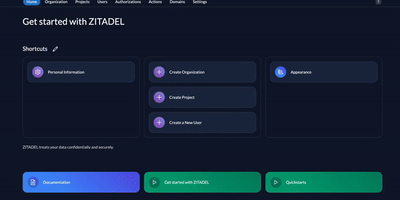
Securing a SaaS product, running B2B onboarding, or replacing Auth0 and Keycloak with a stack they own - teams needing more than basic auth reach for ZITADEL, an open-source identity and access management platform built in Go. Its multi-tenancy model is the differentiator: a strict Instance, Organization, Project hierarchy isolates data and scopes policy at each level, with identity brokering (pre-built templates for Google, GitHub, Microsoft, Apple, plus generic OIDC, OAuth, SAML, and LDAP), domain discovery that routes users to the right organization by email domain, and delegated management so customers administer their own users and roles. Authentication covers OpenID Connect (certified, including device authorization and token exchange), SAML 2.0 as both IdP and SP, SCIM, FIDO2 passkeys for phishing-resistant passwordless login, and MFA via OTP, email, SMS, and U2F; machine-to-machine flows support JWT profile, PATs, and client credentials. The architecture is event-sourced - every mutation is an immutable event, yielding a complete audit trail - with relational projections for queries and no external session store, so it scales horizontally. API-first with gRPC and REST, extensible via Actions webhooks, and the same codebase self-hosted (Docker Compose or Helm on PostgreSQL) as in the cloud.
Unkey
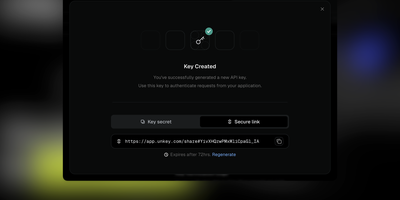
Unkey is the open-source platform that unifies API key management, rate limiting, deployment, and observability into a single control plane. The Go API service validates keys with sub-millisecond latency using regional Redis caches and MySQL 8.0 persistent storage, while ClickHouse captures every verification event for per-key and per-keyspace analytics with filterable time-series charts, request counters, and active key tracking. Keyspaces organize API keys by product, environment, or tier, each configurable with custom prefixes, byte lengths, IP whitelists, encrypted key recovery, and delete protection. Per-key settings include expiration dates, rate limit quotas with configurable windows, RBAC roles and permissions, owner identities linking multiple keys to a single user or organization, and key rotation with grace periods from immediate revocation through 24-hour overlap. The deployment pipeline connects GitHub repositories for automatic Docker container builds, generates preview environments per commit, promotes tested versions to production, and validates releases with OpenAPI diff detection flagging breaking changes before production. The edge gateway authenticates and rate-limits requests at the closest region before routing to the nearest API instance. Immutable audit logs track every key creation, verification, deletion, and configuration change with actor, timestamp, and event metadata. The CLI provides terminal access to key management, analytics queries, and deployment operations. On RepoCloud, deploy Unkey on a dedicated VPS with Docker, root SSH access, and complete control over your API infrastructure, all under the AGPL license.
libSQL
libSQL bridges the gap between SQLite's legendary simplicity and the server-accessible database model developers expect from PostgreSQL and MySQL, adding network access, replication, and vector search while maintaining full file format and API compatibility. The sqld (SQL daemon) component transforms SQLite into a network-accessible database server accepting queries via HTTP with JSON payloads, WebSocket connections, and a Hrana protocol optimized for low-latency edge access. Client libraries for TypeScript, JavaScript, Rust, Go, and Python connect to sqld identically to any traditional client-server database, while the LD_PRELOAD compatibility layer enables switching existing SQLite applications from local to remote mode without code changes. Embedded replicas synchronize a local SQLite copy inside your application process with the primary server, delivering sub-millisecond read latency while maintaining consistency through streaming replication. Bottomless replication continuously backs up database state to S3-compatible object storage with generation-based snapshots and WAL page shipping, providing point-in-time recovery without manual backup scheduling. Native vector search enables semantic similarity queries directly within SQL using cosine distance functions, eliminating the need for external vector database infrastructure. Read replica support distributes query load across multiple sqld instances, and integration with mvSQLite adds multi-version concurrency for high-availability deployments. Created by Turso with 17,100+ stars and active production deployment. Running on a dedicated VPS on RepoCloud with guaranteed CPU, RAM, and SSD, full root SSH access, and a browser serial console. MIT licensed.
PocketBase
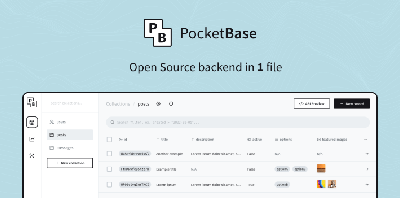
An entire backend in a single Go executable: PocketBase embeds SQLite with realtime subscriptions, authentication and user management, file storage, and an admin dashboard, all behind a REST-ish API. SQLite runs in WAL mode, which outperforms client-server databases for the read-heavy workloads typical of small and mid-sized apps. Authentication supports email/password, one-time passwords, and 15+ OAuth2 providers including Google, Apple, and GitHub, with stateless tokens. Clients subscribe to record changes over server-sent events, and official JavaScript and Dart SDKs cover web, mobile, and Flutter frontends. Collections, rules, and API access permissions are managed visually in the admin UI. When you need custom logic, extend it with JavaScript hooks running in the embedded JS VM of the prebuilt binary, or import PocketBase as a Go library and compile custom business logic into your own single-file backend. File storage attaches uploads to records with thumbnail generation for images and optional S3-compatible external storage. All state lives in one pb_data directory, so backup is a directory copy and upgrade is replacing a binary - one of the lowest-maintenance backends you can run. The contrast with Firebase is the point: where usage-based pricing scales with reads, writes, and bandwidth, PocketBase runs the entire backend at flat hosting cost, and the data is a plain SQLite file you can copy anywhere. MIT-licensed.
Manticore Search
With nearly 12,000 GitHub stars and a lineage tracing back to Sphinx Search, Manticore Search is the C++ search database that delivers the full-text, vector, and hybrid search capabilities of Elasticsearch at a fraction of the resource cost — starting in under a second and consuming just 40MB RAM for an empty instance. The SQL-first interface speaks the MySQL wire protocol, meaning mysql client, MySQL Workbench, and any MySQL-compatible driver connects natively without adapters, while the HTTP JSON API provides RESTful access for modern applications. Over 20 full-text operators handle proximity search, quorum matching, field-start and field-end constraints, MAYBE operators, and regex patterns, backed by stemming, lemmatization, stopwords, synonyms, wordforms, and advanced morphology in 70+ languages. Vector search with HNSW indexing enables semantic similarity queries, and hybrid mode combines keyword relevance with vector distance in a single ranked result set using a cost-based query optimizer. Real-time indexing delivers sub-second document availability after insert, sharded tables distribute data across nodes, and Galera-based synchronous replication ensures high availability. Conversational search via CREATE CHAT MODEL and CALL CHAT integrates LLM-backed responses with KNN retrieval and conversation history directly inside the database. Client libraries ship for PHP, Python, JavaScript, TypeScript, Java, Go, Rust, and Elixir. Columnar storage via the Manticore Columnar Library handles analytical workloads on large datasets. Running on a dedicated VPS on RepoCloud with guaranteed CPU, RAM, and SSD, full root SSH access, and a browser serial console. GPLv3 licensed.
Wiki.js
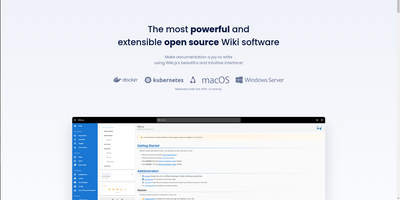
Team and product documentation on a fast Vue frontend with PostgreSQL storage: Wiki.js is a Node.js wiki engine. Its distinguishing trait is per-page editor choice: authors pick Markdown with live preview, a WYSIWYG visual builder for non-technical writers, or raw HTML, page by page. Native Git synchronization commits every page change to GitHub, GitLab, Bitbucket, Azure DevOps, or any Git remote - bi-directionally, so edits made in the repository flow back into the wiki - giving documentation version-controlled backup for free. Authentication coverage is among the broadest of any self-hosted wiki: local accounts with self-registration, social login via Google, GitHub, Discord, and Slack, and enterprise SSO through LDAP/Active Directory, SAML, CAS, Auth0, Okta, Azure AD, Keycloak, and generic OAuth2/OIDC, with optional MFA. Built-in full-text search runs on PostgreSQL with zero setup, and external engines like Algolia or Solr can substitute. Page history with visual version comparison, granular group-based permissions per path, nested navigation menus, 50+ integration modules, and full localization round it out. AGPLv3-licensed with a 28k-star community.
Unleash
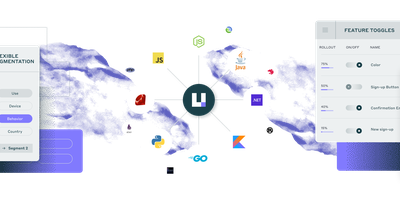
Deployment decoupled from release: Unleash, the most popular open-source feature management platform on GitHub, is a Node.js server backed by PostgreSQL. Ship code dark, then control who sees it through activation strategies: gradual percentage rollouts, targeting by user ID, IP, hostname, or application name, custom constraints against your own context fields, and scheduled or time-limited releases. Strategies stack - a flag activates if any strategy matches - and strategy variants layer A/B versions on top of the on/off decision. Each flag carries per-environment configurations, so a feature can run at 100% in staging while canarying at 5% in production. Backend SDKs (Node.js, Java, Go, Python, Ruby, .NET, PHP, Rust, and more) fetch configuration and evaluate flags locally, so a flag check adds zero network latency to request paths; frontend SDKs for React, Vue, Svelte, iOS, Android, and Flutter evaluate through a proxy layer. Flag hygiene is built in: flags are typed (release, experiment, operational, kill-switch, permission) with expected lifetimes, and Unleash marks overdue flags as potentially stale and surfaces unknown flags your SDKs request but that don't exist. Self-hosting via Docker keeps flag data, targeting rules, and evaluation infrastructure entirely on your side.
Node-RED
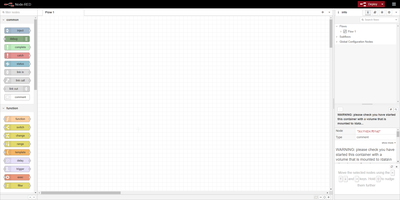
Wire nodes together in a browser, deploy in one click, and real-time data flows from sources through transformations to outputs: Node-RED is the OpenJS Foundation's flow-based programming tool for event-driven applications. Born at IBM as a proof-of-concept for manipulating MQTT topic mappings, it has become the lingua franca of IoT and automation glue - home automation, industrial control, edge data collection - with a community library of over 5,000 contributed nodes and flows covering protocols, devices, and services. Where visual wiring runs out, JavaScript function nodes written in a rich in-editor code editor take over, and every flow serializes to importable, exportable JSON that shares cleanly and version-controls sensibly. Version 5.0 (2026) delivered the largest editor overhaul in the project's history: a rethought layout with Explorer and Information panels in a split sidebar, a native dark theme with theme variants, improved accessibility, and refreshed node appearance. The runtime is lightweight Node.js, exploiting the event-driven non-blocking model so the same flows run on a Raspberry Pi at the network edge or a cloud VM. Apache-2.0 licensed with 240+ contributors, it pairs naturally with dashboard nodes for live charts and controls.
OpenPencil
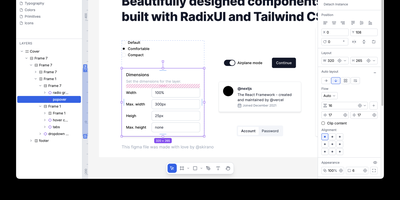
OpenPencil is the open-source design editor that reads and writes native Figma .fig files using the same Kiwi binary format — enabling bidirectional copy-paste between Figma and OpenPencil without data loss. The built-in AI assistant provides 90+ design tools through a chat interface, creating and modifying shapes, fills, strokes, auto-layout, components, variables, and boolean operations from natural language prompts, with BYOK support for Anthropic, OpenAI, Google AI, OpenRouter, Z.ai, MiniMax, and compatible endpoints. A Skia CanvasKit WASM renderer paired with Yoga WASM layout engine delivers Figma-parity rendering with flex and CSS Grid support including gap, padding, and alignment. The headless CLI inspects node trees via XPath queries, lints naming and accessibility, converts between document formats, analyzes color and typography patterns, extracts design tokens, and exports to PNG, SVG, JSX/Tailwind, and HTML. An MCP server exposes all design operations over stdio and HTTP, connecting Claude Code, Cursor, Windsurf, and Gemini CLI for AI-assisted design automation. Real-time P2P collaboration via WebRTC with Yjs CRDT synchronization requires no server and no account. The Vue SDK provides headless components for embedding the editor into custom applications. Ships as a 7 MB Tauri v2 desktop app for macOS, Windows, and Linux, or runs in any browser as a PWA. Running on a dedicated VPS on RepoCloud with guaranteed CPU, RAM, and SSD, full root SSH access, and a browser serial console. MIT licensed.
LibreTranslate
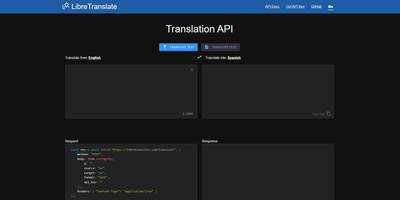
Machine translation with no Google, no Azure, no per-character billing, and no text leaving your infrastructure: LibreTranslate is a free, open-source translation API that runs entirely on your own server. The engine underneath is Argos Translate, which runs OpenNMT neural models with SentencePiece tokenization and Stanza sentence-boundary detection, all offline. Models install as portable .argosmodel packages covering dozens of languages - English, Spanish, French, German, Chinese, Japanese, Russian, Arabic, Hindi, Portuguese, and many more - and Argos handles automatic pivoting: with es-to-en and en-to-fr installed, it chains them to translate es-to-fr without a direct model. The API is a straightforward HTTP POST to /translate with source and target language codes, returning JSON - simple enough that the ecosystem has clients in every major language and integrations across tools like Weblate and Mastodon. Beyond plain text it translates HTML while preserving markup and handles whole file uploads (documents in, translated documents out), plus automatic language detection when the source is unknown. A clean bundled web UI serves interactive translation for end users, and optional API keys with rate limits control access. AGPL-licensed and trainable with custom models, it is the standard answer when translation must be private, unmetered, and self-contained - GDPR-sensitive text never touches a third party.
pgAdmin
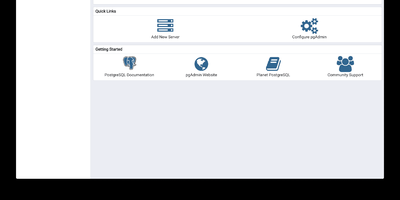
pgAdmin 4 is the reference administration GUI for PostgreSQL, bundled by virtually every Linux distribution and supporting versions 14 through 18 including EDB Advanced Server — browse schemas in a hierarchical tree, write and optimize queries with AI assistance, design entity-relationship diagrams visually, monitor live sessions, and run backup/restore operations entirely from the browser. Built on Python Flask with a ReactJS frontend, version 9.17 delivers a comprehensive web-based platform accessible from any device. The Query Tool provides syntax highlighting, auto-completion, query history, an EXPLAIN plan visualizer with graphical node representation, AI-powered SQL generation from natural language prompts, and AI Insights for execution plan analysis that identifies performance bottlenecks. The Graph Visualiser renders query results as line charts, bar charts, stacked charts, and pie charts directly in the interface. The ERD Tool auto-generates entity-relationship diagrams from existing schemas for visual database design. The Schema Browser presents databases, schemas, tables, views, functions, sequences, roles, and extensions in a navigable hierarchy. Server monitoring dashboards display real-time active sessions, locks, transaction throughput, and vacuum status. GUI-driven backup and restore wraps pg_dump and pg_restore with format and compression options. Authentication supports internal, LDAP, Kerberos, OAuth2/OIDC, and webserver modes. The Helm chart includes an HTTPRoute template for Kubernetes Gateway API deployments. Bundled pg_dump, pg_restore, and psql utilities version 18.4. Deploy via Docker with the official dpage/pgadmin4 image. Running on a dedicated VPS on RepoCloud with guaranteed CPU, RAM, and SSD, full root SSH access, and a browser serial console. PostgreSQL License.
Flipt
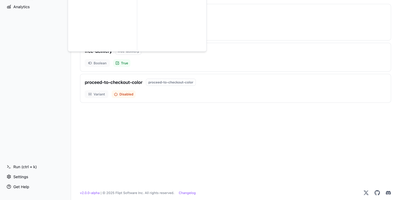
Backed by 4,800+ GitHub stars and trusted by teams replacing LaunchDarkly and Split with a self-hosted solution, Flipt v2 delivers the first truly Git-native feature management platform that treats feature flags as code stored in your own repositories. The architecture eliminates all database dependencies by building immutable in-memory snapshots from YAML flag definitions on every Git commit, delivering sub-millisecond evaluation latency with zero external runtime dependencies beyond the single Go binary. Multi-environment support maps directly to Git abstractions — separate repositories per environment, different directories within the same repository, or different branches — enabling teams to use their existing branching strategy, pull request workflows, and code review processes for flag changes. The evaluation engine supports boolean flags, multivariate string and numeric variants, segment-based targeting with constraint rules, percentage rollouts, and namespace isolation. Native SCM integration with GitHub, GitLab, BitBucket, Azure DevOps, and Gitea creates merge proposals directly from the UI with GPG-signed commits. Flipt implements the OpenFeature Remote Evaluation Protocol with official providers for Go, Node.js, Python, Java, C#, Ruby, and Web SDKs, enabling vendor-agnostic flag evaluation across all services. The gRPC API with REST HTTP gateway exposes flag management, evaluation, and analytics endpoints. Offline mode continues serving flags when the source repository is temporarily unavailable. Running on a dedicated VPS on RepoCloud with guaranteed CPU, RAM, and SSD, full root SSH access, and a browser serial console. Fair Core License (server) / MIT (client SDKs).