Memoh
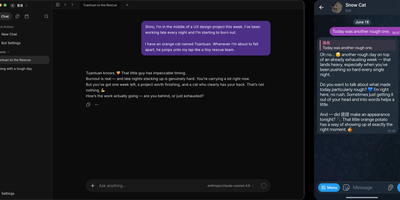
Memoh delivers an open-source multi-agent platform where every AI agent gets its own computer — not a chat window but a fully isolated container with dedicated filesystem, desktop environment, browser, network stack, and persistent long-term memory that survives across sessions, days, and platforms. The containerd-based runtime ensures each bot operates in complete isolation with snapshot and data import/export capabilities. The memory engine uses LLM-driven fact extraction with hybrid retrieval combining dense embeddings via Qdrant, sparse vectors, and BM25, plus 24-hour context loading and automatic compaction — with Mem0 and OpenViking as drop-in alternatives. Ten communication channels connect agents to users through Telegram, Discord, Lark, QQ, Matrix, WeCom, WeChat, Email, Web UI, and group chats with cross-platform identity binding. MCP tool calling enables agents to interact with external services, while browser automation drives GUI workflows for web research and data extraction. Agent hosting supports running external coding agents like Codex and Claude Code inside Memoh workspaces via ACP with per-bot configuration. Scheduled tasks run without human triggers, and agents proactively reach out when needed. The web dashboard built with Vue 3 and Tailwind CSS provides streaming chat, tool call visualization, file management, model and provider configuration, and bot lifecycle management. Deploy via Docker Compose with PostgreSQL, Qdrant, sparse service, and the Go backend server. Running on a dedicated VPS on RepoCloud with guaranteed CPU, RAM, and SSD, full root SSH access, and a browser serial console. AGPL-3.0 licensed.
Dagger
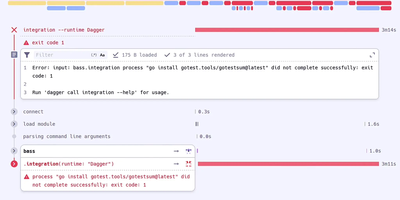
With 16,100 GitHub stars and created by Solomon Hykes (co-founder of Docker), Dagger eliminates proprietary YAML DSLs from CI/CD by letting developers write pipelines as real programs in their preferred language — then executing them identically on a laptop, in GitHub Actions, in GitLab CI, or on any machine with a container runtime. The BuildKit-based Dagger Engine runs every pipeline operation inside OCI containers, constructing a directed acyclic graph where each node is cached by default, parallelized automatically, and produces bit-for-bit reproducible outputs regardless of execution environment. Native SDKs generated from the GraphQL API schema provide Go, Python, TypeScript, PHP, Java, .NET, Elixir, and Rust developers with full type safety, IDE autocomplete, and the ability to unit-test CI pipelines using the same testing frameworks as application code. The module ecosystem enables cross-language composition where a Python team can invoke a Go team's build functions without learning Go, while filesystems, secrets, git repositories, and network tunnels are passed between functions as strongly-typed objects. Pipeline operations cache at container-layer granularity with content-addressed deduplication, and the interactive REPL enables step-by-step pipeline debugging with live container inspection. Host dependencies are explicit and strictly typed, eliminating implicit environment coupling that causes "works on my machine" failures. Running on a dedicated VPS on RepoCloud with guaranteed CPU, RAM, and SSD, full root SSH access, and a browser serial console. Apache 2.0 licensed.
Concourse
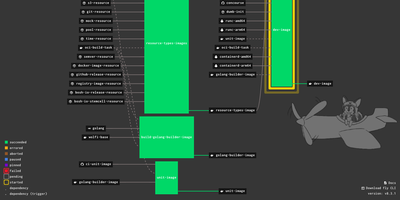
When a commit lands, a timer fires, or a pull request opens, Concourse runs the matching jobs in fresh containers and draws the entire CI/CD pipeline as a live graph you can read at a glance. Pipelines are plain YAML files that tie resources such as git repositories, registries, and buckets to jobs made of get, put, and task steps, so the same file behaves the same on every installation. Resources are checked continuously for new versions, webhooks can request an immediate check, and a version can be pinned when something needs to stay put. The dashboard lists every pipeline by team with status colors, a filter box, favorites, and a high-density view, while build pages stream colored logs and let you rerun a build with the exact same inputs. The fly command line sets pipelines, runs one-off tasks against local files from your laptop, and opens a shell inside the container of a failed step. A set_pipeline step lets pipelines configure other pipelines, and instance vars create a family of related pipelines, such as one per pull request. Teams keep projects separate and can be tied to a GitHub organization, credentials arrive at run time from Vault, CredHub, AWS, or Kubernetes, and policy rules can block disallowed images. Running on a dedicated VPS on RepoCloud with guaranteed CPU, RAM, and SSD, full root SSH access, and a browser serial console. Apache-2.0 licensed.