Routr
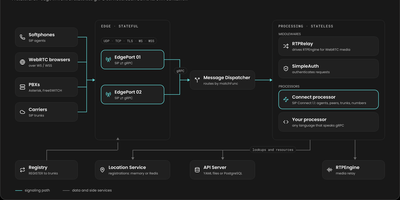
Routr is a programmable SIP server that proxies, registers, and routes calls for carriers and communication platforms, replacing racks of inherited PBX plumbing with one cloud-ready process. Phones and trunks connect over UDP, TCP, TLS, WebSocket, or secure WebSocket, register against the built-in registrar, and find each other through the location service backed by memory, Redis, or Postgres. Routing is configurable per domain with intra-domain, ingress, egress, and peer-egress strategies, and multi-tenant domains carry their own access control lists. Load balancing with session affinity spreads calls across Asterisk and FreeSWITCH media servers, and RTPEngine middleware anchors media and adds SDES-SRTP toward TLS trunks. Web phones authenticate with JWT endpoint credentials, and every call message can be recorded and replayed for debugging. Operators manage the whole system through a gRPC API, the Node.js SDK, or the rctl command-line tool, and custom Processors and Middleware written in JavaScript reshape SIP messages as they pass. OpenTelemetry traces, metrics, and logs expose the server's behaviour in production, and the same deployment runs from a single Docker container to a Kubernetes cluster through the published Helm charts. There is no single point of failure in the design, so a registrar outage never takes the dial tone with it. Running on a dedicated VPS on RepoCloud with guaranteed CPU, RAM, and SSD, full root SSH access, and a browser serial console. MIT licensed.
AiPBX
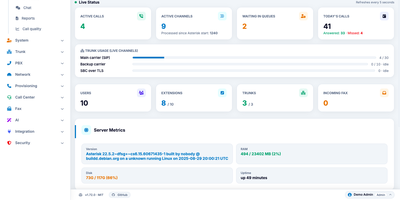
One server replaces the phone system, the meeting link, and the fax line: AiPBX turns a Linux machine into a business phone system with extensions, video meetings, chat, and call queues. Every employee gets one extension that rings a desk phone, the browser softphone, and the mobile app, while ring groups, multi-level IVRs, and time conditions route callers without anyone editing dialplan files. Queues staff your support line with dynamic agent sign-in, hold music, and position announcements, and a live wallboard lets supervisors watch waiting callers and agent states, then listen, whisper, or barge into a call. Meetings run in the browser: schedule conferences with PINs, send guests a magic link into a WebRTC room with screen sharing, and let streams forward without transcoding. Chat lives in the same portal: photos, files, presence, read receipts, and fax is composed in a rich-text editor or uploaded as PDF and delivered over T.38. Desk phones provision themselves: a discovery daemon spots new Yealink, Fanvil, Grandstream, Snom, and Cisco handsets and writes their configuration files. An AI assistant plans dialplan changes in plain language with dry-run preview and one-click undo, cloud voices from Google, Polly, Azure, ElevenLabs, or OpenAI read announcements aloud, and GDPR, KVKK, HIPAA, and PCI-DSS presets govern recording consent and retention purges. A 100-plus-endpoint REST API with scoped keys and HMAC-signed webhooks makes everything scriptable. Running on a dedicated VPS on RepoCloud with guaranteed CPU, RAM, and SSD, full root SSH access, and a browser serial console. MIT licensed.