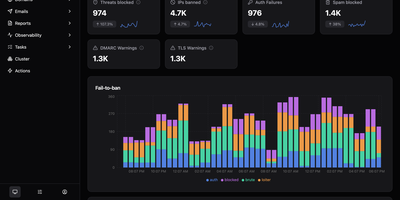
Stalwart Mail
Stalwart replaces the traditional Postfix + Dovecot + SpamAssassin + calendar-server stack with one Rust binary that speaks every standard mail and collaboration protocol natively. JMAP, IMAP4rev2, POP3, SMTP, CalDAV, CardDAV, and WebDAV all run inside the same process — no glue scripts, no sidecar daemons, no version conflicts between components. The pluggable storage architecture lets operators choose RocksDB for single-node deployments, FoundationDB for distributed clusters, PostgreSQL, MySQL/MariaDB, or SQLite for the data store, S3/MinIO/Azure Blob for message blobs, and Elasticsearch or Meilisearch for full-text search, with Redis or the internal engine backing rate limiters and session state. Security features include S/MIME and OpenPGP encryption at rest, automated DKIM key generation with DNS publication, DANE and MTA-STS transport security, automatic ACME TLS provisioning, granular ACLs, rate limiting, and IP banning. The browser-based admin console manages accounts, domains, groups, mailing lists, SMTP queues, DMARC/TLS-RPT/ARF reports, and every configuration object without touching a config file, while the self-service portal at /account gives end users password reset and encryption key management. Multi-tenant support with per-tenant quotas enables hosting-platform deployments, and coordinator-less clustering via Zenoh or NATS scales horizontally by adding nodes. Deploy via Docker or the standalone binary. Running on a dedicated VPS on RepoCloud with guaranteed CPU, RAM, and SSD, full root SSH access, and a browser serial console. AGPL v3 licensed.
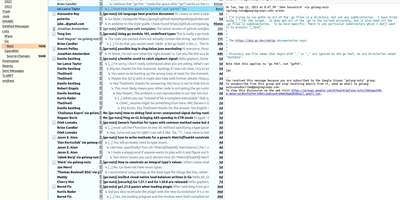
Mox
Mox offers a complete mail server stack in a single Go binary requiring no external dependencies. The quickstart command configures a working mail server with SMTP, IMAP4, webmail, and full DNS authentication in under ten minutes. SMTP handling includes a delivery server on port 25, a submission server for authenticated clients, and a queue with automatic retries and DKIM signing. IMAP4rev2 implementation provides full mailbox synchronization with CONDSTORE and QRESYNC for efficient offline clients, NOTIFY for multi-mailbox monitoring, MULTISEARCH across mailboxes, and TLS client certificate authentication via the EXTERNAL SASL mechanism. The built-in webmail provides browser-based reading and composing with message threading, attachments, and HTML rendering without requiring a separate web client. Email authentication implements SPF validation, DKIM signing and verification with automatic key rotation, DMARC policy enforcement with aggregate and failure reporting, DANE with DNSSEC-protected TLSA records, and MTA-STS for certificate verification. Junk filtering combines reputation-based sender scoring with Bayesian content analysis trained per account. The web administration interface manages domains, accounts, DNS records, TLS certificates, delivery queue, and real-time log viewing. Internationalized email addresses with EAI and IDNA support handle non-ASCII domains and mailboxes. Account autoconfiguration publishes settings for Thunderbird autoconfig and Outlook autodiscover. Running on a dedicated VPS on RepoCloud with guaranteed CPU, RAM, and SSD, full root SSH access, and a browser serial console. MIT licensed.
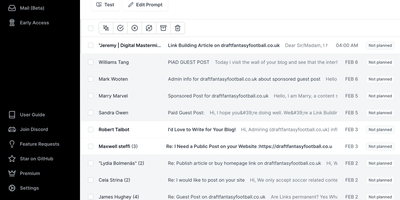
Inbox Zero
Your Gmail, Google Workspace, or Outlook inbox, worked by an AI assistant: Inbox Zero sits on top of the account you already have. Its core idea is rules written in plain English - tell the assistant "label invoices and file the PDF to Drive" or "archive cold outreach unless they mention my company" - and it executes against every incoming message. Emails that need a response arrive with a pre-drafted reply written in your tone, learned from your email history and calendar context. Reply Zero tracks what you owe responses to and what you're waiting on; the Bulk Unsubscriber surfaces newsletters you never read (with read-rate analytics) for one-click unsubscribe-and-archive; the Cold Email Blocker auto-archives unsolicited pitches based on your own definition of "cold." Smart Filing routes attachments - receipts, contracts, PDFs - into the right Google Drive or OneDrive folder, and Slack/Telegram integration lets you read, draft, and triage without opening a mail client. Email analytics show top senders and volume trends. It is not a new email client: everything happens in your real mailbox using native filters. Self-hosting means your mail content and the LLM calls that process it run on infrastructure you control.
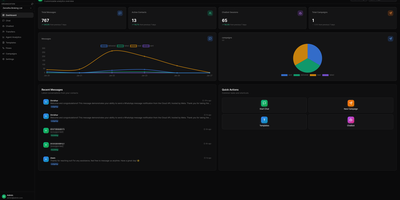
Whatomate
A complete WhatsApp Business Platform covering messaging, chatbot automation, and voice calling with IVR — a combination most self-hosted projects never attempt. The Fastglue/fasthttp backend processes WhatsApp Cloud API webhooks through PostgreSQL and Redis into a real-time WebSocket layer powering instant chat updates across a Vue 3 frontend built with shadcn-vue and TailwindCSS. Chatbot automation supports keyword triggers, multi-step conversation flows with branching logic, AI-powered responses from OpenAI, Anthropic, or Google models, knowledge base integration via vector stores, and seamless handoff to human agents when the bot gets stuck. The visual IVR builder uses a drag-and-drop node canvas where you wire greeting prompts, DTMF menu capture, HTTP callbacks to external APIs mid-call, business-hours routing by IANA timezone, agent team transfers with hold music, and reusable sub-flows. Every call recording streams encrypted to your S3-compatible bucket with retention you control. Multi-tenant architecture isolates organizations with separate data, roles, and API keys while a unified inbox presents both chat and call conversations to agents in a single dashboard. Meta-approved template management, bulk campaign messaging, analytics tracking, and a full REST API round out the platform. Deploy via Docker Compose with Postgres and Redis included. Running on a dedicated VPS on RepoCloud with guaranteed CPU, RAM, and SSD, full root SSH access, and a browser serial console. AGPL v3 licensed.

Nodyx
Nodyx puts forum threads, real-time chat channels, peer-to-peer voice calls, collaborative whiteboards, and a drag-and-drop homepage builder behind one installation script on hardware you control. Create categories and threaded discussions that search engines index, then switch to Socket.IO-powered chat rooms where replies, pins, link previews, and @mentions update instantly. Voice channels connect participants through WebRTC mesh networking, keeping audio between peers without routing through third-party servers; a Rust-based STUN/TURN relay handles restrictive NATs so home-server deployments work without port forwarding. The NodyxCanvas layer adds CRDT-synchronized collaborative drawing with 11 tools, voice-aware cursors, and board-scoped chat, all persisted to PostgreSQL snapshots. Build your community's landing page with a visual editor that places widgets across 11 layout zones, then extend functionality by dropping third-party widget archives into the admin panel or authoring your own with the plain-JavaScript Widget SDK. Private conversations stay end-to-end encrypted with ECDH P-256 key exchange and AES-256-GCM ciphers where the private key never leaves the browser, and the OctoGuard module automates moderation with five matcher types plus configurable actions from muting to banning. For streamers, a native Streamer Hub bridges Twitch chat bidirectionally, provides a drag-and-drop soundboard, generates OBS browser-source overlays, and offers a mobile Stream Deck. Instances discover each other through a gossip protocol, forming a decentralized network without central coordination. Running on a dedicated VPS on RepoCloud with guaranteed CPU, RAM, and SSD, full root SSH access, and a browser serial console. AGPL-3.0 licensed.
LiveKit
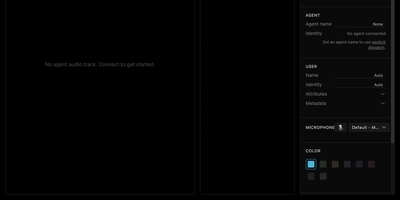
With over 20,000 GitHub stars and adoption by companies building everything from telehealth platforms to AI voice agents, LiveKit is the most widely deployed open-source real-time communication server available. The Go-based Selective Forwarding Unit handles hundreds of concurrent participants per node with adaptive bitrate streaming, simulcast layers, SVC codec support for VP9 and AV1, and end-to-end encryption. Client SDKs span JavaScript, Swift, Kotlin, Flutter, React Native, Rust, Python, Unity, and ESP32 embedded devices, while server-side APIs cover Node.js, Go, Ruby, Java, Python, Rust, PHP, and .NET. The Agents framework enables building AI-powered voice and video applications — real-time speech-to-text, LLM-driven conversations, and computer vision pipelines — running as server-side participants in any room. Egress records sessions to S3-compatible storage or streams to RTMP endpoints, while Ingress pulls external feeds from OBS via RTMP, WHIP, or SRT into LiveKit rooms. The SIP bridge connects traditional telephony to WebRTC rooms for hybrid conferencing. JWT-based authentication, webhook notifications, room-level moderation APIs, and selective subscription give operators granular control. Deploy as a single binary for development, Docker Compose for production single-node, or Kubernetes with the official Helm chart for distributed multi-region clusters using Redis for state coordination. Running on a dedicated VPS on RepoCloud with guaranteed CPU, RAM, and SSD, full root SSH access, and a browser serial console. Apache 2.0 licensed.
Posta
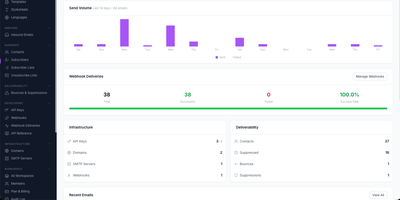
Built as a developer-first alternative to SendGrid, Mailgun, and Postmark, Posta delivers a complete self-hosted email infrastructure platform handling both outbound delivery and inbound reception through a single HTTP API with official SDKs for Go, PHP, and Java. The Go backend processes email through Redis and Asynq with automatic retries, priority queues, and async delivery while PostgreSQL stores templates, contacts, campaigns, and delivery analytics. Outbound features include versioned multi-language templates with variable substitution and stylesheet inlining, bulk campaigns with subscriber targeting and A/B testing per-variant metrics, scheduled timezone-aware delivery with draft/paused/cancelled lifecycle states, email address verification checking syntax, MX records, disposable domains, and role accounts, plus web view links with signed expiring URLs and one-click unsubscribe headers. The built-in SMTP receiver with TLS handles inbound email at your domains, parses messages and attachments, scores spam, and forwards structured payloads to your application via HMAC-verified webhooks with real-time SSE notification streams. The Vue-based dashboard manages templates, SMTP server pools, domains, contacts, API keys, campaigns, and email logs with dark and light mode support while admin-level platform metrics expose delivery rate trends, bounce rate graphs, and latency percentiles alongside Prometheus integration and daily health reports. Deploy via Docker with PostgreSQL and Redis. Running on a dedicated VPS on RepoCloud with guaranteed CPU, RAM, and SSD, full root SSH access, and a browser serial console. Apache 2.0 licensed.
Zulip
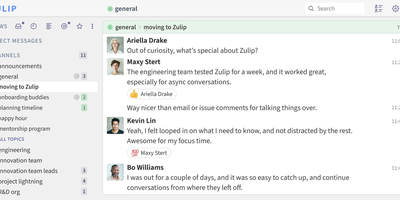
Used by the Rust language community, NASA, Dropbox, and thousands of organizations worldwide with over 25,600 GitHub stars and 1,500+ contributors, Zulip is the only modern team chat app designed from the ground up for both real-time and asynchronous communication through its unique topic-based threading model where every message belongs to a named topic within a channel. This eliminates the context collapse of linear chat by letting teams follow specific conversations without scrolling through unrelated messages, resume threads days later without losing context, and catch up on missed discussions at per-topic granularity. Server 12.0 introduced end-to-end encryption for mobile push notifications, AI-powered search ranking, channel folders for workspace organization, and expanded video conferencing with Jitsi, BigBlueButton, and Zoom integration. Over 100 native integrations connect GitHub, GitLab, Jira, Sentry, PagerDuty, Travis CI, Redmine, dbt, Nextcloud, and n8n with bidirectional notifications, while LLM-driven agents access web-public channels via a standard llms.txt interface. Full-text search covers unlimited message history across all plans, code blocks render with syntax highlighting for 250+ languages, and LaTeX math expressions display inline. The REST API with typed Python and JavaScript SDKs enables custom bots, webhook integrations, and programmatic administration. Import tools migrate entire workspaces from Slack, Microsoft Teams, Mattermost, and Rocket.Chat. Running on a dedicated VPS on RepoCloud with guaranteed CPU, RAM, and SSD, full root SSH access, and a browser serial console. Apache 2.0 licensed.
Misskey
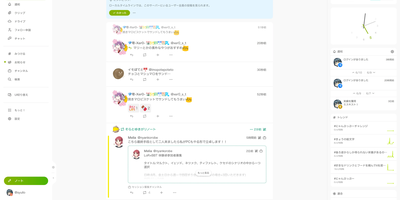
With 11,000+ GitHub stars and over 1,291 releases since 2016, Misskey is the most feature-rich open-source microblogging platform in the Fediverse — federation-first social networking with capabilities that go far beyond simple status updates. The TypeScript and Vue 3 frontend delivers a highly customizable interface with drag-and-drop widget layouts, switchable themes, per-user custom CSS, and AiScript-powered plugins that transform every instance into a unique social experience. ActivityPub federation enables seamless interaction with Mastodon, Pixelfed, PeerTube, and any ActivityPub-compatible platform across the decentralized network. Emoji reactions let users respond with custom instance emojis instead of simple likes, while Misskey Flavored Markdown adds animated text effects, sparkle decorations, and rich formatting to posts. The built-in Drive provides personal cloud file management with folder organization for images, videos, and audio — eliminating the need for external storage services. Antennas create custom filtered timelines based on keywords, users, or criteria for monitoring specific topics. Channels offer topic-specific feeds separate from the main timeline. Pages enable users to build personal websites directly within their instance. Clips save and organize posts into curated collections. The Node.js backend scales with PostgreSQL for persistence, Redis for caching, and optional S3-compatible storage for media. Docker Compose deployment provisions the complete stack including the database and cache in under 15 minutes. Running on a dedicated VPS on RepoCloud with guaranteed CPU, RAM, and SSD, full root SSH access, and a browser serial console. AGPL-3.0 licensed.
Papercups
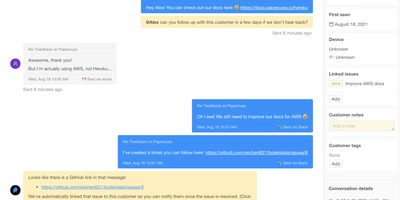
Companies with privacy and security concerns about piping customer conversations through Intercom or Zendesk run Papercups - open-source live customer chat. The stack is a deliberate strength: an Elixir/Phoenix API over PostgreSQL, with real-time messaging powered by Phoenix Channels and Presence - the same BEAM foundation trusted by Discord and PagerDuty for fault-tolerant, low-latency messaging. Customers see a customizable chat widget that embeds in any site as an HTML snippet, a React component, or even inside React Native apps, with configurable colors, greetings, and away messages. Your team sees a dashboard for managing conversations - close, assign, and prioritize - with Markdown and emoji in replies. The killer workflow is the reply-channel integration: connect Slack or Mattermost and every customer conversation becomes a synced thread your team answers without leaving the tool they already live in, with two-way message syncing handled by webhooks. Email and SMS channels extend intake beyond the widget, an analytics dashboard tracks communication patterns, and the Storytime feature adds real-time screen sharing to watch users navigate while you help them. A documented API supports fully custom chat UIs in Svelte, Flutter, or Vue. MIT-licensed and GDPR-conscious - customer data stays in your PostgreSQL.
Frappe CRM
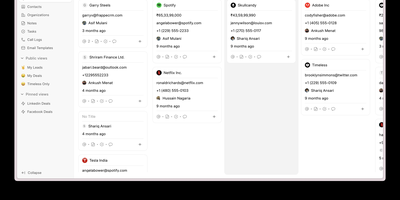
With 3,300+ GitHub stars, 200+ releases, and v1.77 shipping in July 2026, Frappe CRM delivers enterprise CRM capabilities without per-seat licensing costs that plague Salesforce and HubSpot deployments. The Python backend running on Frappe Framework v15/v16 with MariaDB and Redis pairs with a Vue 3 frontend using Pinia state management, Vue Router, and the Frappe UI component library styled with Tailwind CSS v3. All-in-one lead and deal pages consolidate activities, comments, notes, tasks, call logs, and email history into a single scrollable view while the drag-and-drop Kanban board provides visual pipeline tracking across configurable stages. Built-in Twilio integration enables click-to-call with recording directly from deal pages, Exotel routes calls through agent mobile phones, and WhatsApp messaging connects via the Frappe WhatsApp module for conversational sales. A visual field layout editor lets non-technical users customize CRM forms, sidepanels, and grid views with real-time drag-and-drop without writing code. The Service Level Agreement engine tracks first-response and rolling-response times against configurable policies with automatic escalation. Meta integration captures leads from Facebook and Instagram ad campaigns directly into the pipeline. ERPNext connectivity extends CRM into invoicing, accounting, inventory, and purchasing with native data flow. Docker Compose deployment with a single command provisions a production-ready instance. Running on a dedicated VPS on RepoCloud with guaranteed CPU, RAM, and SSD, full root SSH access, and a browser serial console. AGPL-3.0 licensed.
Centrifugo
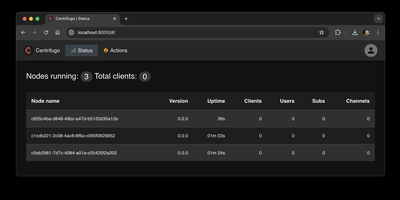
Benchmarked at one million concurrent WebSocket connections and 30 million delivered messages per minute on a single server, Centrifugo is a self-hosted real-time messaging server that integrates with any backend language — Node.js, Python, Go, Ruby, PHP, Java — without requiring architectural changes to your existing application. It handles persistent connections over WebSocket, HTTP-streaming, Server-Sent Events, gRPC, and experimental WebTransport, routing messages through a channel-based PUB/SUB model with automatic reconnection recovery that replays missed messages from hot channel history. Built-in horizontal scaling operates through Redis (including Redis Cluster, AWS ElastiCache, Valkey, KeyDB, and DragonflyDB), NATS, or PostgreSQL brokers, allowing multi-node deployments without external message queues. The server provides JWT-based authentication using HMAC or RSA keys, granular channel permissions, online presence tracking showing who is currently subscribed to a channel, and an RPC proxy that forwards client calls to your backend over HTTP or gRPC. The embedded ReactJS admin web interface displays real-time connection statistics, node information, and provides an interactive API console for publishing messages, managing subscriptions, and inspecting channel history. Official client SDKs are available for JavaScript, Dart, Go, Swift, and Java, with unidirectional transports requiring no SDK at all. Centrifugo also supports delta updates to minimize bandwidth, connection event proxying, and Prometheus-compatible metrics for Grafana monitoring. Running on a dedicated VPS on RepoCloud with guaranteed CPU, RAM, and SSD, full root SSH access, and a browser serial console. Apache 2.0 licensed.
Mailu
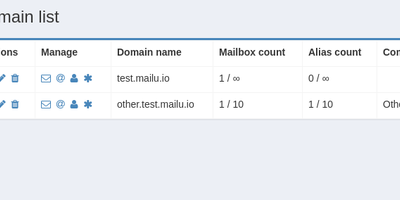
With over 7,100 GitHub stars and 200 contributors since 2016, Mailu has become one of the most popular self-hosted email solutions, delivering a complete production-ready mail server stack as pre-configured Docker containers that eliminate weeks of manual setup. The platform bundles Postfix for SMTP and Submission with auto-configuration profiles for Thunderbird, Outlook, and mobile clients, Dovecot for IMAP and POP3 with full-text search across email attachments, Rspamd for intelligent spam filtering with auto-learn Bayesian classification, greylisting, SPF and DMARC validation, and ClamAV for antivirus scanning of attachments with configurable malicious file blocking. The web administration interface provides global admin controls, per-domain delegation, user quota management, domain aliases, custom routing rules, and announcement capabilities. Users access self-service features including aliases, auto-reply, auto-forward, fetched accounts from external mailboxes via fetchmail, and Sieve filter management through ManageSieve. Security features include enforced TLS on all connections, automatic Let's Encrypt certificate provisioning, outgoing DKIM signing, DANE and MTA-STS support for transport security, and Snuffleupagus PHP hardening for the web interface. The setup wizard at setup.mailu.io generates complete Docker Compose configurations tailored to specific deployment requirements. All components are free and open-source software with zero proprietary dependencies and no tracking. Running on a dedicated VPS on RepoCloud with guaranteed CPU, RAM, and SSD, full root SSH access, and a browser serial console. MIT licensed.
Keila
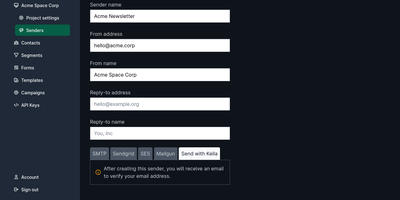
Among open-source Mailchimp alternatives, Keila has the most modern UI - built in Germany on Elixir and Phoenix (the PETAL stack), with GDPR-conscious defaults including an optional no-tracking mode, and 100% open source with no proprietary premium tier. Campaign authoring is flexible three ways: a visual block editor with multi-column layouts, Markdown with or without WYSIWYG for hybrid HTML-plus-plain- text sends, and raw MJML for hand-coded designs. The personalization system is unusually clean - every contact carries custom data as a single JSON object (populated from sign-up form fields or pushed from your CMS/CRM), and Shopify's Liquid template language renders it into fully dynamic emails. Targeting uses a visual segment editor backed by a powerful segment language for complex logic over tags, language preferences, and any custom field. Sign-up forms with custom fields grow your lists; open and click tracking measures campaigns; scheduled sending handles timing. Delivery pipes through your own SMTP or first-class integrations with AWS SES (including automated bounce handling), SendGrid, Mailgun, and Postmark. A full REST API manages contacts, campaigns, and segments, with Erlang/OTP reliability underneath. Comfortable at 100K+ subscribers. AGPL-licensed, EU-hosted project, actively developed.
HumHub
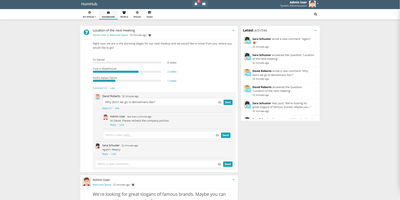
Workplace and Yammer's pattern on your own server, with GDPR compliance by construction rather than contract: HumHub is an open-source enterprise social network from Germany. Built in PHP on Yii2, it organizes everything around four concepts. Users get rich profiles with follows and interactions. Spaces are the structural unit - rooms for departments, projects, events, or clubs, with per-Space permissions, notification settings, and email summaries, and operators can auto-map users into the right Spaces. Content covers posts, wiki pages, photos and video, events, and tasks, with multi-level comments, versioning, archiving, moderation reporting, and filterable full-text search across everything. Modules make it a platform: roughly 80 install-and-activate extensions including Calendar, Wiki, Polls, Tasks, Gallery, News, direct-message Mail, OnlyOffice document editing, Advanced LDAP, SAML and JWT SSO, a RESTful API, mass user import, Translation Manager, and a Theme Builder with custom pages - every one optional and toggleable at runtime. That module economy is why HumHub serves such varied deployments: corporate intranets, city governments, universities, political parties, and nonprofits all configure the same core differently. Requirements are a plain LAMP stack - PHP 8.1+ and MySQL/MariaDB - making it one of the easiest community platforms to operate long-term.
Revolt
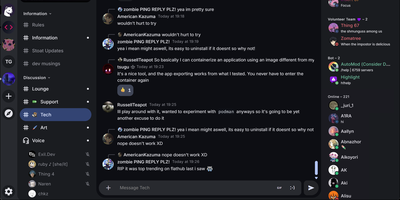
Revolt gives communities the full Discord experience without ads, behavioral tracking, or subscription fees: servers with text and voice channels, direct messages, group conversations, roles, bots, and custom emoji at zero cost per user. The Rust microservices backend splits responsibilities across Delta for REST API and authentication, Bonfire for persistent WebSocket real-time event delivery, Autumn for file upload routing to MinIO S3-compatible object storage, and January for link preview proxy and embed generation. Voice chat operates through LiveKit with WebRTC audio streaming supporting multiple concurrent participants per channel. Server administrators configure hierarchical role-based permissions at the server, channel, and per-role level, controlling who can send messages, manage channels, kick members, and access moderation tools. Text channels support Markdown formatting, custom emoji, file attachments up to 20 MB, GIF search via Tenor integration, and message reactions. The bot API enables automated moderation, entertainment, and custom workflow integration with community-maintained libraries available in JavaScript, Python, and Rust. The TypeScript and Solid.js web frontend provides a responsive interface with theme customization. Docker Compose deployment spins up the complete stack including MongoDB for message and user storage, Redis for caching, and MinIO for attachments, providing complete data sovereignty over all conversations and files. Running on a dedicated VPS on RepoCloud with guaranteed CPU, RAM, and SSD, full root SSH access, and a browser serial console. AGPL-3.0 licensed.
GoToSocial
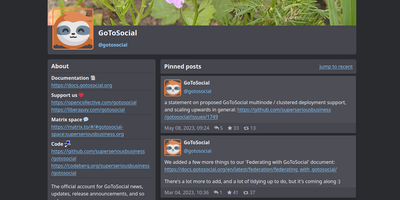
Mastodon serves single-user and small-community instances poorly; GoToSocial, an ActivityPub server written in Go, was built precisely for them. Where Mastodon demands Ruby, PostgreSQL, Redis, and Sidekiq, GoToSocial is one binary using roughly 250-350 MiB of RAM with SQLite as the default database (PostgreSQL optional) - it runs comfortably on a $5 VPS or a repurposed laptop. The deliberate design choice is having no built-in web client: the server exposes profile pages, a settings panel, and a faithful implementation of the Mastodon API, and you post through the client app you already like - Tusky on Android, Feditext on iOS, Pinafore or Phanpy in the browser. Federation is the point: your instance follows, boosts, and replies across Mastodon, Misskey, Pixelfed, and the rest of the Fediverse, with your identity anchored to your own domain. Safety is a stated focus, with granular per-post visibility and interaction controls, content warnings, custom emoji, hashtag following, domain allow/blocklists, and OIDC login support. Built-in Let's Encrypt provisioning simplifies the mandatory TLS. AGPL-3.0 licensed and in active beta, federating cleanly with the ecosystem's major servers.
DispatchMail
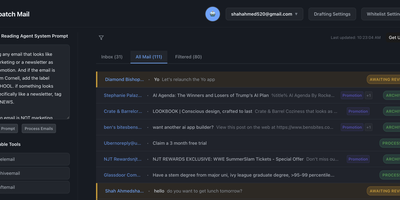
DispatchMail is an SuperHuman alternative and delivers a self-hosted AI email assistant that processes your Gmail inbox through configurable OpenAI prompts without sending data to third-party cloud services beyond the LLM API itself. The Flask backend connects to Gmail via IMAP, retrieves new messages according to your schedule, and routes them through customizable whitelist rules based on sender address, subject keywords, or natural language descriptions before AI processing begins. Two distinct prompt configurations control behavior — the Reading Prompt instructs how the AI should analyze and classify incoming messages, while the Draft Prompt defines how responses should be composed, letting you maintain consistent tone and policy across all automated replies. Whitelist filtering ensures the AI only processes messages you explicitly authorize, preventing unnecessary API costs and keeping sensitive emails out of the LLM pipeline entirely. The React web interface provides inbox management with message previews, AI-generated summaries, draft editing with human-in-the-loop approval before sending, and configuration panels for prompts and rules. Automatic labeling and archival organize processed messages into categories without manual intervention. The sender research feature uses LLM-powered deep analysis to build background profiles of email contacts. All email content, credentials, and processing results persist in a local SQLite database with zero cloud storage dependencies. Running on a dedicated VPS on RepoCloud with guaranteed CPU, RAM, and SSD, full root SSH access, and a browser serial console. Apache-2.0 licensed.