Baserow
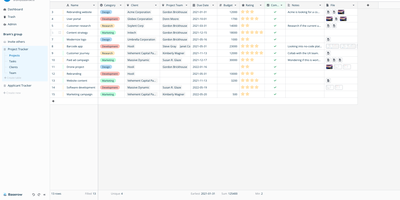
Airtable's spreadsheet-database model, self-hostable and open-source: that is Baserow. It presents data in a spreadsheet-style grid, but underneath each table is a real relational structure with typed fields, links between tables, filters, sorts, and multiple views (grid, gallery, form, kanban, calendar). Beyond the database core, it includes an application builder for composing pages and portals on your data, workflow automations, and dashboards. Everything is API-first: each table exposes a REST endpoint with token auth and webhooks, so it plugs directly into n8n, Zapier, or custom scripts. The stack is Django (Python) on the backend, Vue.js on the frontend, PostgreSQL for storage, with Redis for async tasks. Core features are MIT-licensed; premium features are a paid add-on. The self-hosted version has no row, storage, or API request limits - Airtable's per-base record caps and monthly API quotas simply don't exist here, and capacity is bounded only by your PostgreSQL database and disk. Existing Airtable bases, CSVs, and Excel files import directly with structure preserved, so migration doesn't start from a blank slate, and both the backend and frontend support plugins for custom field types and integrations without forking the core. For non-technical teammates the interface behaves like a spreadsheet; for engineers, the data model is the API.
Scrumboy
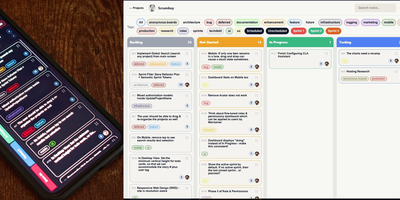
Scrumboy is a Kanban and sprint management tool that ships as a single Go binary backed by SQLite, deploys in under ten seconds via Docker, and uniquely integrates with AI coding agents through a standards-compliant MCP JSON-RPC endpoint. The dual-mode architecture supports Full mode with bootstrapped authentication, TOTP two-factor auth, OIDC/SSO integration through Keycloak, Authentik, Auth0, or Entra ID, role-based access control across Owner, Admin, User system tiers plus per-project Maintainer, Contributor, and Viewer roles, and Anonymous mode that generates instant shareable boards accessible via unique URLs with zero signup requirement. Custom workflows allow user-defined lane configurations per project including designated "Done" lanes, while sprints with configurable one or two-week cycles include board-level sprint filtering and the ability to disable and re-enable sprint tracking without losing history. Real-time Server-Sent Events power instant multi-user board updates, and outbound webhooks deliver JSON payloads to registered URLs when domain events fire with HMAC signature verification. The MCP endpoint at /mcp/rpc enables native integration with Cursor, Claude Code, and other AI agents through OAuth 2.1 with PKCE authorization, while API access tokens support CLI automation and CI/CD pipelines. Additional capabilities include VoiceFlow voice commands, per-project sticky-note walls, Markdown and Mermaid diagram support in task notes, append-only audit trails, VAPID Web Push notifications, SMTP password reset, Trello import, JSON backup with merge/replace/copy strategies, and 22-language internationalization. Running on a dedicated VPS on RepoCloud with guaranteed CPU, RAM, and SSD, full root SSH access, and a browser serial console. AGPL v3.0 licensed.
Owncloud
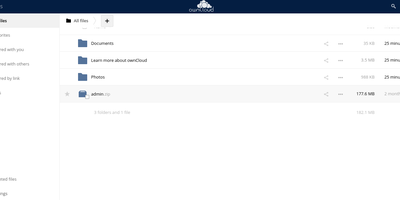
The project that proved organizations could have Dropbox-style convenience with complete data ownership: ownCloud is the original open-source file sync and share platform - the codebase Nextcloud later forked from. This deployment runs the classic ownCloud Server (PHP over PostgreSQL or MariaDB, with Redis caching), the battle-tested edition trusted across enterprises, universities, and public institutions worldwide. The core loop: store files on your server, sync them via desktop clients for Windows, macOS, and Linux plus iOS and Android apps, and access everything through the web interface or standard WebDAV. Sharing is granular - internal users and groups, external recipients via public links with passwords and expiration dates, and federated sharing that connects separate ownCloud instances into one network. Security controls include file firewall rules, multi-factor authentication, encryption, and detailed audit-friendly lifecycle management with versioning and trash-bin recovery. An app marketplace extends the platform, and Web Office integrations bring collaborative document editing through Collabora Online, OnlyOffice, or Microsoft Office Online directly into your files. LDAP and Active Directory integration slots it into existing identity infrastructure. For teams that need a proven, self-hosted alternative to Dropbox or Google Drive - where compliance demands knowing exactly which disk your data sits on - ownCloud remains a foundational choice.
ExcaliDash
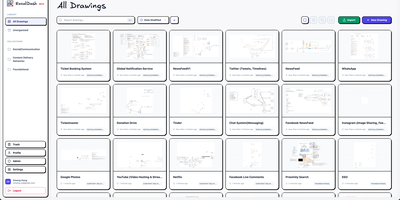
ExcaliDash adds persistent storage, access control, version history, and real-time collaboration to Excalidraw, transforming ephemeral whiteboarding sessions into a managed drawing library your team can rely on. The Node.js/Express backend with React/TypeScript frontend deploys via Docker Compose on port 6767, using Prisma ORM on SQLite for all drawings, users, and metadata. WebSocket-powered collaboration lets multiple users edit the same canvas simultaneously with live cursor presence. Drawing snapshots preserve every revision with visual preview and one-click restore to any previous state. Three authentication modes handle different deployment needs: local email/password for personal use, hybrid mode mixing native credentials with OIDC for gradual enterprise adoption, and enforced OIDC-only for organizations requiring SSO through providers like Authentik or Keycloak. Scoped sharing controls determine whether drawings stay private, shared internally with team members, or accessible via external links without authentication. Collections organize drawings through drag-and-drop grouping, full-text search locates any diagram instantly, and exports use the non-proprietary .excalidraw format ensuring complete data portability. 1,350+ stars since November 2025. Running on a dedicated VPS on RepoCloud with guaranteed CPU, RAM, and SSD, full root SSH access, and a browser serial console. AGPL-3.0 licensed.
Vaultwarden
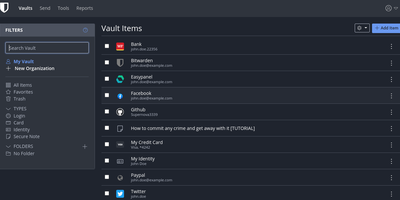
The Bitwarden server, reimplemented in Rust: Vaultwarden (formerly bitwarden_rs) is the unofficial lightweight edition. It speaks the same wire protocol as the official server, so every official Bitwarden client - browser extensions, iOS, Android, desktop, and the bw CLI - connects without modification, while the server itself runs as a single container against SQLite (or MySQL/MariaDB/PostgreSQL) instead of the official multi-container stack that wants gigabytes of RAM. Features Bitwarden gates behind paid tiers ship free: organizations with collections, groups, member roles, and policies; TOTP code storage; file attachments; Bitwarden Send; Emergency Access; event logs; and admin password reset. Two-factor options cover authenticator apps, email, FIDO2 WebAuthn, YubiKey, and Duo, and OIDC-based SSO landed natively in v1.35.0. Zero-knowledge encryption is unchanged - vault data is encrypted client-side and the master password never reaches the server. Attachments and Sends store on local disk or S3-compatible backends, an admin panel manages users and server settings, and backup is copying one data directory. Suited to individuals and teams up to roughly 50 users.
TREK
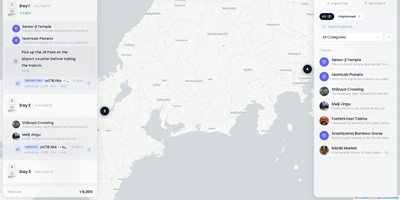
TREK coordinates group expeditions and vacations through a collaborative travel planning workspace that unifies daily itineraries, interactive route maps, shared expense budgets, and packing lists. Travel groups can build day-by-day timelines by dragging activities between dates, attaching transit bookings with flight numbers, and estimating driving intervals directly on OpenStreetMap and Mapbox canvases. Instant WebSocket synchronization mirrors itinerary edits, group chat messages, and decision poll votes across all traveling companions simultaneously without page refreshes. The integrated multi-currency expense manager tracks shared expenditures across lodging, dining, and transit categories, automatically calculating per-person debts and generating simplified debt settlement summaries. An interactive world atlas highlights visited nations and tracks lifetime travel statistics, enabling globe-trotters to manage personal bucket lists and review past journeys. Travelers can organize shared packing checklists from reusable equipment templates, monitor real-time weather forecasts powered by Open-Meteo, and export comprehensive travel schedules to printable PDF guides and calendar feeds. Role-based permission controls safeguard sensitive travel documents and boarding pass uploads while allowing guests to contribute notes and vote on activities. Running on a dedicated VPS on RepoCloud with guaranteed CPU, RAM, and SSD, full root SSH access, and a browser serial console. AGPL-3.0 licensed.
Livebook
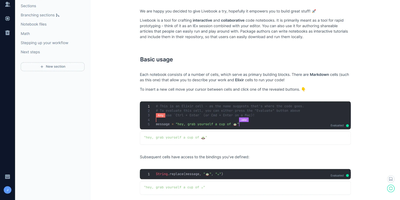
Livebook is an interactive notebook for Elixir where you write code alongside rich Markdown prose, execute it cell by cell with reactive dependency tracking, and deploy finished notebooks as standalone web applications with a single click. Nearly 6,000 GitHub stars reflect the Elixir core team's investment in a platform where code cells run on demand alongside Mermaid diagrams and KaTeX mathematical formulas. The Kino visualization library renders Vega-Lite charts, interactive data tables with sorting and pagination, Leaflet maps, and Mermaid diagrams directly within notebook output cells, while custom Kino components enable building interactive controls with sliders, text inputs, and buttons that feed values back into running code. Smart cells abstract high-level tasks into configurable UI widgets: query PostgreSQL, MySQL, SQLite, and BigQuery databases, train machine learning models with Axon, plot charts, and build map visualizations without writing boilerplate code. Real-time collaboration lets multiple users edit the same notebook simultaneously with cursor presence indicators and synchronized cell evaluation. Notebooks are stored as .livemd files, a Markdown-compatible format that renders cleanly on GitHub and integrates with standard version control workflows. Custom runtimes connect Livebook to existing Elixir applications for live introspection and documentation of running systems. The Docker image at ghcr.io/livebook-dev/livebook exposes ports 8080 and 8081 with password or token authentication. Running on a dedicated VPS on RepoCloud with guaranteed CPU, RAM, and SSD, full root SSH access, and a browser serial console. Apache 2.0 licensed.
Zulip
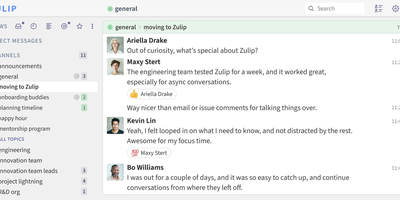
Used by the Rust language community, NASA, Dropbox, and thousands of organizations worldwide with over 25,600 GitHub stars and 1,500+ contributors, Zulip is the only modern team chat app designed from the ground up for both real-time and asynchronous communication through its unique topic-based threading model where every message belongs to a named topic within a channel. This eliminates the context collapse of linear chat by letting teams follow specific conversations without scrolling through unrelated messages, resume threads days later without losing context, and catch up on missed discussions at per-topic granularity. Server 12.0 introduced end-to-end encryption for mobile push notifications, AI-powered search ranking, channel folders for workspace organization, and expanded video conferencing with Jitsi, BigBlueButton, and Zoom integration. Over 100 native integrations connect GitHub, GitLab, Jira, Sentry, PagerDuty, Travis CI, Redmine, dbt, Nextcloud, and n8n with bidirectional notifications, while LLM-driven agents access web-public channels via a standard llms.txt interface. Full-text search covers unlimited message history across all plans, code blocks render with syntax highlighting for 250+ languages, and LaTeX math expressions display inline. The REST API with typed Python and JavaScript SDKs enables custom bots, webhook integrations, and programmatic administration. Import tools migrate entire workspaces from Slack, Microsoft Teams, Mattermost, and Rocket.Chat. Running on a dedicated VPS on RepoCloud with guaranteed CPU, RAM, and SSD, full root SSH access, and a browser serial console. Apache 2.0 licensed.
Multica
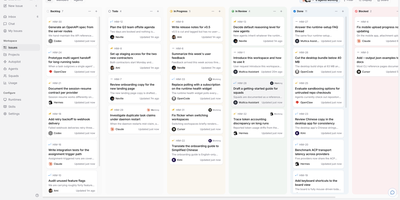
Reaching 45,000 GitHub stars within seven months of launch, Multica is the fastest-growing open-source platform for managing AI coding agents as first-class teammates — assign an issue to Claude Code, Codex, Cursor, Copilot, Kimi, or any of 21 supported agent CLIs and it picks up the work, comments progress in real time via WebSocket, raises blockers, and hands the result back for human review before anything merges. The Go backend (Chi router, sqlc-generated type-safe queries, gorilla/websocket) connects to PostgreSQL 17 with pgvector for semantic search across workspace history, while the Next.js 16 App Router frontend delivers workspace dashboards showing per-agent token spend, execution time, daily cost charts, and runtime status across unlimited connected machines. Agent Skills provide reusable methods, reference material, and supporting files that compound across runs — a persistent knowledge layer that makes each subsequent task faster and more accurate. Squads let a leader agent select the right specialist for subtasks, creating multi-agent workflows without manual orchestration. Review gates ensure no AI-generated code ships to main without explicit human approval. Self-host via Docker Compose or Kubernetes with full Git integration across GitHub, GitLab, Gitea, and Forgejo including self-hosted instances. The CLI and REST API make every surface scriptable, and Autopilot automations trigger agent runs from events. Running on a dedicated VPS on RepoCloud with guaranteed CPU, RAM, and SSD, full root SSH access, and a browser serial console. Apache 2.0 licensed with additional conditions.
HumHub
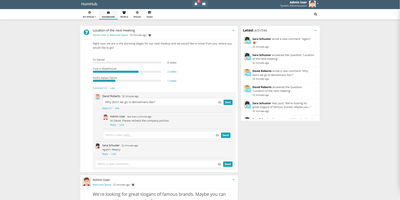
Workplace and Yammer's pattern on your own server, with GDPR compliance by construction rather than contract: HumHub is an open-source enterprise social network from Germany. Built in PHP on Yii2, it organizes everything around four concepts. Users get rich profiles with follows and interactions. Spaces are the structural unit - rooms for departments, projects, events, or clubs, with per-Space permissions, notification settings, and email summaries, and operators can auto-map users into the right Spaces. Content covers posts, wiki pages, photos and video, events, and tasks, with multi-level comments, versioning, archiving, moderation reporting, and filterable full-text search across everything. Modules make it a platform: roughly 80 install-and-activate extensions including Calendar, Wiki, Polls, Tasks, Gallery, News, direct-message Mail, OnlyOffice document editing, Advanced LDAP, SAML and JWT SSO, a RESTful API, mass user import, Translation Manager, and a Theme Builder with custom pages - every one optional and toggleable at runtime. That module economy is why HumHub serves such varied deployments: corporate intranets, city governments, universities, political parties, and nonprofits all configure the same core differently. Requirements are a plain LAMP stack - PHP 8.1+ and MySQL/MariaDB - making it one of the easiest community platforms to operate long-term.
XWiki
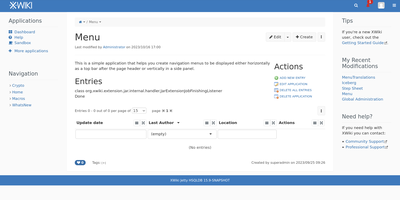
With over 140,000 code commits, 1,200+ GitHub stars, and continuous development since 2004 spanning more than two decades of active maintenance through version 18.6.0 released in July 2026, XWiki operates as a second-generation wiki platform that goes beyond static pages by enabling teams to build custom collaborative applications directly inside wiki pages using structured data forms and in-page scripting. The Java backend runs on Apache Tomcat with PostgreSQL, MySQL, or Oracle database storage, serving a responsive web interface with a WYSIWYG editor featuring real-time collaborative editing, link and macro editors, user mentions, inline comments, annotations, and complete version history with diff comparison. The App Within Minutes extension lets non-developers create custom data-driven applications using drag-and-drop form builders that generate filterable live tables for structured data browsing without writing code. Over 900 extensions from the built-in Extension Manager add functionality including blogs, task trackers, forums, diagram editors, and Confluence migration tools. Enterprise integration features include LDAP and Active Directory authentication, SAML and OIDC single sign-on, fine-grained per-page and per-space permissions with nested page hierarchies, and multi-wiki support for hosting multiple independent wikis from a single installation. The RESTful API provides programmatic access to pages, spaces, objects, attachments, and properties with XML and JSON representations. Office document import converts Word and Excel files directly into wiki pages while PDF export generates formatted documents from wiki content. Running on a dedicated VPS on RepoCloud with guaranteed CPU, RAM, and SSD, full root SSH access, and a browser serial console. LGPL-2.1 licensed.
Rallly
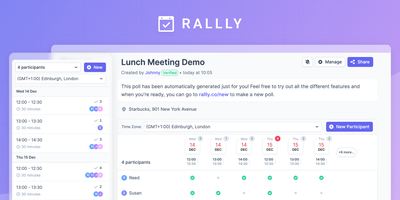
What Doodle did before ads and paywalls took over: Rallly (three L's) lets you propose a few dates, share a link, and watch an availability grid fill in - no email threads, no forced accounts, no "$6.95/month to remove ads." The availability grid makes the winning slot obvious at a glance, comments on each poll keep the "I can do Tuesday if we start late" discussion attached to the decision instead of buried in chat, and email notifications fire as votes and comments arrive. When consensus lands, finalize the winning option and everyone gets notified. The stack is modern TypeScript - Next.js, tRPC, Prisma over PostgreSQL, Tailwind - with a clean, genuinely mobile-friendly UI, dark mode, and community translations in 10+ languages. Self-hosting means unlimited polls and unlimited participants with meeting data on your server rather than a scheduling SaaS. It pairs naturally with Cal.com: Rallly answers "which time works for everyone?", Cal.com handles "book a slot on my calendar." AGPL-licensed.
Stalwart Mail
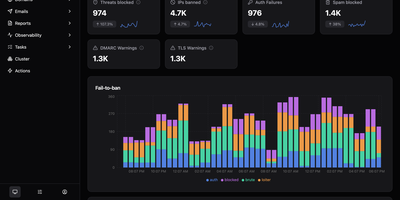
Stalwart replaces the traditional Postfix + Dovecot + SpamAssassin + calendar-server stack with one Rust binary that speaks every standard mail and collaboration protocol natively. JMAP, IMAP4rev2, POP3, SMTP, CalDAV, CardDAV, and WebDAV all run inside the same process — no glue scripts, no sidecar daemons, no version conflicts between components. The pluggable storage architecture lets operators choose RocksDB for single-node deployments, FoundationDB for distributed clusters, PostgreSQL, MySQL/MariaDB, or SQLite for the data store, S3/MinIO/Azure Blob for message blobs, and Elasticsearch or Meilisearch for full-text search, with Redis or the internal engine backing rate limiters and session state. Security features include S/MIME and OpenPGP encryption at rest, automated DKIM key generation with DNS publication, DANE and MTA-STS transport security, automatic ACME TLS provisioning, granular ACLs, rate limiting, and IP banning. The browser-based admin console manages accounts, domains, groups, mailing lists, SMTP queues, DMARC/TLS-RPT/ARF reports, and every configuration object without touching a config file, while the self-service portal at /account gives end users password reset and encryption key management. Multi-tenant support with per-tenant quotas enables hosting-platform deployments, and coordinator-less clustering via Zenoh or NATS scales horizontally by adding nodes. Deploy via Docker or the standalone binary. Running on a dedicated VPS on RepoCloud with guaranteed CPU, RAM, and SSD, full root SSH access, and a browser serial console. AGPL v3 licensed.
APITable
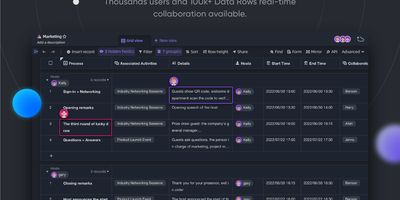
With over 15,000 GitHub stars and positioning itself as the most feature-complete open-source alternative to Airtable, APITable combines a buttery-smooth spreadsheet interface with a full database engine and automatic API generation that turns every datasheet into a queryable REST endpoint without writing a single line of backend code. Real-time collaborative editing powered by Operational Transformation algorithms supports 100,000+ rows with multiple simultaneous users, while seven built-in view types — Grid, Kanban, Gallery, Gantt chart, Calendar, Mindmap, and Form — let teams visualize the same data in whatever format suits their workflow. The one-click API panel exposes every table as a documented REST API with filtering, sorting, and pagination, effectively functioning as a backend-as-a-service for frontend developers and automation builders. Robot automation triggers workflows on record changes with integrations into n8n, Zapier, Appsmith, and Slack, while the extensible widget system provides 20+ open-source widgets for custom charts, dashboards, and data visualizations embedded directly into datasheets. Enterprise features include SAML single sign-on, field-level and row-level permissions via Mirrors, organizational team management, audit logging, database auto-backup, and data export. Bi-directional table linking with infinite cross-links creates relational data models across workspaces, and built-in templates cover CRM, project management, inventory, and content planning. Running on a dedicated VPS on RepoCloud with guaranteed CPU, RAM, and SSD, full root SSH access, and a browser serial console. AGPL-3.0 licensed.
OpenPencil
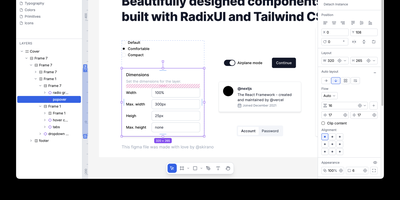
OpenPencil is the open-source design editor that reads and writes native Figma .fig files using the same Kiwi binary format — enabling bidirectional copy-paste between Figma and OpenPencil without data loss. The built-in AI assistant provides 90+ design tools through a chat interface, creating and modifying shapes, fills, strokes, auto-layout, components, variables, and boolean operations from natural language prompts, with BYOK support for Anthropic, OpenAI, Google AI, OpenRouter, Z.ai, MiniMax, and compatible endpoints. A Skia CanvasKit WASM renderer paired with Yoga WASM layout engine delivers Figma-parity rendering with flex and CSS Grid support including gap, padding, and alignment. The headless CLI inspects node trees via XPath queries, lints naming and accessibility, converts between document formats, analyzes color and typography patterns, extracts design tokens, and exports to PNG, SVG, JSX/Tailwind, and HTML. An MCP server exposes all design operations over stdio and HTTP, connecting Claude Code, Cursor, Windsurf, and Gemini CLI for AI-assisted design automation. Real-time P2P collaboration via WebRTC with Yjs CRDT synchronization requires no server and no account. The Vue SDK provides headless components for embedding the editor into custom applications. Ships as a 7 MB Tauri v2 desktop app for macOS, Windows, and Linux, or runs in any browser as a PWA. Running on a dedicated VPS on RepoCloud with guaranteed CPU, RAM, and SSD, full root SSH access, and a browser serial console. MIT licensed.
Jitsi Meet
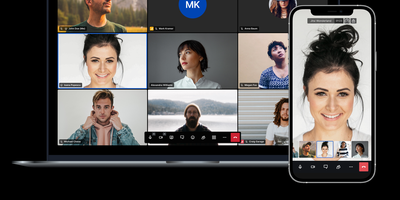
Backed by nearly 30,000 GitHub stars and powering millions of meetings through meet.jit.si, Jitsi Meet is the open-source video conferencing platform that runs entirely in the browser with no plugins or downloads required. The WebRTC-based architecture delivers HD audio and video through the Jitsi Videobridge selective forwarding unit, while Prosody handles XMPP signaling and Jicofo manages conference focus and orechestration. End-to-end encryption uses AES-GCM 128-bit keys exchanged via the Olm protocol, protecting audio, video, and screen sharing through the Insertable Streams API in Chromium-based browsers. Moderators can split participants into breakout rooms with individual password protection, enable lobby waiting rooms for admission control, set meeting passwords, and track speaker statistics with per-participant talk time metrics. Virtual backgrounds leverage TensorFlow.js body segmentation with WebGPU and WebGL acceleration, automatically adapting quality through device tier detection. Server-side recording and YouTube live streaming run through Jibri, while Jigasi provides a SIP gateway for PSTN dial-in and speech-to-text transcription. The platform includes in-meeting chat with private conversations, polls, raise-hand functionality, emoji reactions, and tile and speaker view layouts. Mobile applications for iOS and Android complement the web client, and both web and native SDKs enable embedding video conferences into custom applications. Running on a dedicated VPS on RepoCloud with guaranteed CPU, RAM, and SSD, full root SSH access, and a browser serial console. Apache-2.0 licensed.
MateClaw
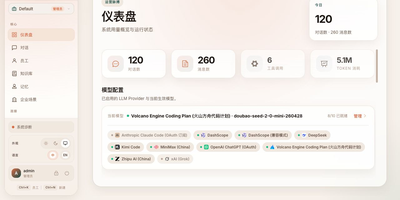
MateClaw delivers a multi-agent AI platform where digital employees run as persistent team members with roles, goals, and accumulated skills rather than stateless chat completions. The Spring Boot backend on Spring AI Alibaba provides ReAct iterative reasoning and Plan-and-Execute decomposition on a StateGraph runtime, with parallel delegation between employees and dynamic context pruning for multi-step tasks. Five career templates ship ready (Product Researcher, Customer Support, Knowledge Curator, Data Analyst, Executive Assistant) while custom employees inherit configurable backstories, pixel-art avatars, and dedicated tool bindings. The MCP integration supports stdio, SSE, and Streamable HTTP transports with per-employee tool isolation preventing capability bleed between agents. ACP bridges bring Claude Code, Codex, and other coding agents in as first-class employees. Workflow orchestration composes multiple employees and system actions into publishable linear DSL processes with seven step modes: sequential, fan_out, collect, conditional, await_approval, dispatch_channel, and write_memory. The trigger system wires cron schedules, webhooks, channel messages, employee lifecycle events, content matches, and workflow completions to automated flows. The Admin Runtime Console provides real-time visibility into running employees with token usage tracking and one-click force-recycle. Spring Boot Actuator monitoring, full audit trail, and per-channel error isolation deliver production-grade reliability. Running on a dedicated VPS on RepoCloud with guaranteed CPU, RAM, and SSD, full root SSH access, and a browser serial console. Apache-2.0 licensed.
Papermark
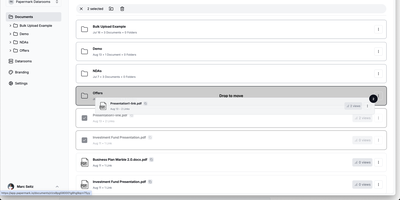
With nearly 9,000 GitHub stars and adoption by over 60,000 companies across 100 countries, Papermark is the open-source DocSend alternative that turns document sharing into a data-rich conversation between you and your viewers. Every shared document generates page-by-page analytics showing exactly which pages capture attention, how long viewers spend on each section, where they drop off, and whether they return for a second look, with real-time notifications the moment a document is opened. Virtual data rooms support unlimited folders with drag-and-drop organization, bulk uploads, granular per-viewer permissions, dynamic watermarking that stamps each page with the viewer's identity, and NDA gating that requires agreement before access. Custom branding applies your logo, colors, and custom domain to every shared link and download page, while email verification and password protection add authentication layers. The AI Data Room Copilot lets viewers chat with uploaded documents, ask questions, and receive contextual summaries directly within the data room interface. The developer platform exposes 43 REST API operations covering data rooms, documents, folders, links, visitors, and analytics, with an MCP server for AI agent integration and a CLI for automation. Built on Next.js with TypeScript, Prisma ORM, PostgreSQL, NextAuth.js authentication, and shadcn/ui components. Running on a dedicated VPS on RepoCloud with guaranteed CPU, RAM, and SSD, full root SSH access, and a browser serial console. AGPLv3 licensed.