Headlamp
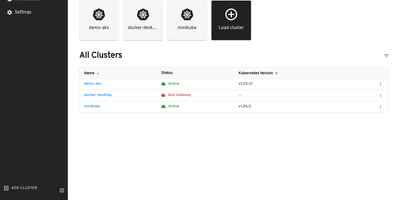
The Kubernetes project's own answer to cluster management UIs: maintained under SIG UI governance, Headlamp's roadmap tracks Kubernetes releases and its design philosophy reflects community needs rather than a vendor's product strategy. The React interface provides full read-write capabilities adapted to each user's RBAC permissions — delete, scale, edit, and restart buttons appear only when the authenticated user holds the corresponding cluster role, preventing accidental unauthorized actions. Multi-cluster support surfaces workloads across development, staging, and production from a single view without context switching. The plugin architecture drives extensibility through a curated catalog: an AI Assistant plugin answers natural-language cluster queries and performs operations via configurable LLM keys, Flux handles GitOps, Karpenter manages nodes. Integrated terminals provide browser-based exec access to running pods, live log streaming follows container output with filtering, and the YAML editor displays inline Kubernetes API documentation alongside resource definitions. Deployment creation forms let you configure containers, environment variables, volumes, and replicas without writing manifests. Side-by-side cluster comparison views surface differences in workload distribution. Works with any distribution: EKS, GKE, AKS, Minikube, Docker Desktop. Helm chart installation via the Headlamp repository with images on GitHub Container Registry. Running on a dedicated VPS on RepoCloud with guaranteed CPU, RAM, and SSD, full root SSH access, and a browser serial console. Apache-2.0 licensed.
OpenFGA
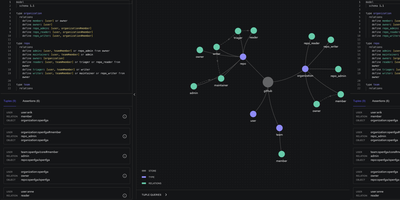
OpenFGA answers the question 'can this user perform this action on this resource?' in single-digit milliseconds, implementing Google's Zanzibar paper as a production-ready authorization engine adopted by Auth0, Grafana Labs, Canonical, Docker, Agicap, and Read.AI. The server exposes both gRPC and HTTP APIs for authorization queries including Check, ListObjects, ListUsers, Expand, and the high-throughput BatchCheck endpoint that deduplicates and processes multiple authorization decisions in a single request. Authorization models combine relationship-based access control with role-based and attribute-based patterns through a purpose-built DSL that supports contextual tuples, conditional relationship tuples with CEL expressions, and time-based filtering via the ReadChanges API. Storage backends include PostgreSQL 14+, MySQL 8, and SQLite in beta, with an in-memory adapter for development and testing. Official SDKs for Java, .NET, Node.js, Go, and Python provide type-safe client integration, while a Terraform provider enables infrastructure-as-code management of authorization stores and models. The built-in browser playground at port 3000 lets developers visually model authorization schemas, write relationship tuples, and test access control queries interactively before deployment. OpenTelemetry instrumentation integrates with existing monitoring infrastructure, and Helm charts simplify Kubernetes deployment. A VS Code extension provides syntax highlighting and validation for FGA model files, and GitHub Actions automate model testing in CI/CD pipelines. A CNCF incubating project with transparent governance. Running on a dedicated VPS on RepoCloud with guaranteed CPU, RAM, and SSD, full root SSH access, and a browser serial console. Apache 2.0 licensed.